
- Trending:
- Forgiveness
- |
- Marriage
- |
- Afterlife
- |
- Trump
- |
- Pentecost
- |
- Deconstruction
RELIGION LIBRARY
Papua New Guinea
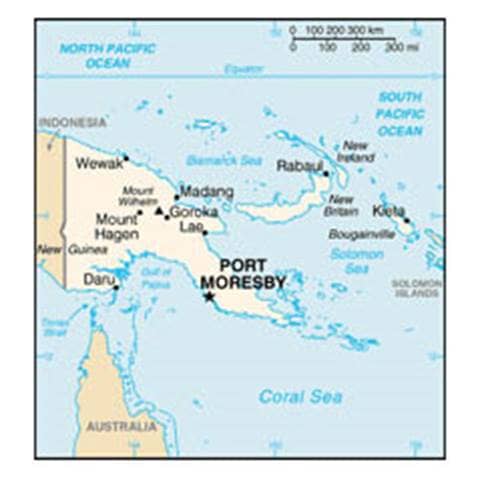
The country is an island nation with an area of 287,608 square miles and a population of 6.3 million. According to the 2000 census, 96 percent of citizens identify themselves as Christian. Churches with the most members are Roman Catholic, 30 percent; Evangelical Lutheran, 20 percent; United Church, 11.5 percent; Seventh-day Adventist, 10 percent; Pentecostal, 8.6 percent; Evangelical Alliance, 5.2 percent; Anglican, 3.2 percent; Baptist, 2.5 percent; and the Salvation Army, 0.2 percent. Other Christian groups, including The Church of Jesus Christ of Latter-day Saints (Mormons) and the Jehovah's Witnesses, constitute 8 percent. There are approximately 15,000 Baha'is and 2,000 Muslims. Many citizens integrate Christian faith with some indigenous beliefs and practices.
Western missionaries introduced Christianity to the country in the 19th century. Colonial governments initially assigned different missions to different geographic regions. Since territory in the country is aligned strongly with language group and ethnicity, this colonial policy led to the identification of certain churches with certain ethnic groups. However, churches of many denominations are now found throughout the country. The Muslim community has a mosque in the capital of Port Moresby and seven Islamic centers across the country.
Nontraditional Christian and non-Christian religious groups have become increasingly active in recent years. Muslim and Confucian missionaries have a growing presence. Pentecostal and charismatic Christian groups have found converts within the congregations of the more established churches.
Missionaries of many traditions operate freely. The Summer Institute of Linguistics (SIL) partnered with the Department of Education and local communities in linguistic research, literacy, Bible translation, Scripture use, and training. The Department of Education relies on SIL to produce translations of the Bible for government-sponsored religious instruction in schools. As of December 2008, SIL had translated the New Testament into 170 of the country's indigenous languages.
| Population | Population (2009 est.) 6,057,263 |
| Religious Demographics | Roman Catholic 27%, Evangelical Lutheran 19.5%, United Church 11.5%, Seventh-Day Adventist 10%, Pentacostal 8.6%, Evangelical Alliance 5.2%, Anglican 3.2%, Baptist 2.5%, other Protestant 8.9%, Baha'i 0.3%, indigenous beliefs and other 3.3% (2000 census) |
| Ethnic Groups | Ethnic Groups Melanesian, Papuan, Negrito, Micronesian, Polynesian |
| Languages | Languages Tok Pisin, English, and Hiri Motu are official languages; some 860 indigenous languages spoken (over one-tenth of the world's total) |
| Country Flag | 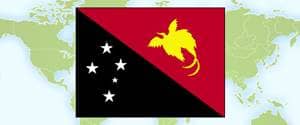 |








 Ad-Free & Subscriber Log-In