
- Trending:
- Forgiveness
- |
- Marriage
- |
- Afterlife
- |
- Trump
- |
- Pentecost
- |
- Deconstruction
RELIGION LIBRARY
Hinduism
Leadership
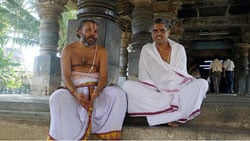 Brahmins are the highest ranking of the four social classes articulated in the Vedic Purusha Shukta, which describes the creation of the world through the sacrifice of the primal being, Purusha. The Brahmins are created out of the being's mouth. They were designated as the exclusive priests in the Hindu world, assigned the duty of learning and preserving the sacred texts—orally passing them on from one generation to the next—and performing the sacred rituals.
| VEDIC TEXTS |
|
In the Vedas, sacrifice is the central religious action; it was thought to maintain and sustain the universe. The Brahmins had the exclusive knowledge of the Vedas and thus were the sole sacrificial priests; 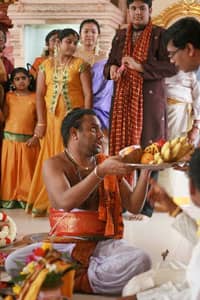 they chanted the sacred hymns and performed the many sacred acts that made up the Vedic sacrifices.
There are, in fact, dozens of different sorts of religious leaders, some of whom might be compared to priests or clergy in the western religious context: these include gurus, yogins, swamis, pandits, acharyas, sadhus, rishis, and many others.
The term guru is a Sanskrit word that is typically translated simply as "teacher." A guru is a particularly learned person, typically although not exclusively a Brahmin, who passes his (or, in some cases her) knowledge to his or her students. 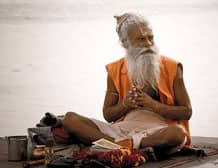 The role of the guru is extremely important in numerous contexts in Hinduism. The guru not only teaches, but also guides; thus a guru not only knows the sacred texts and the rituals, but also knows the abilities, capabilities, and needs of his or her students.
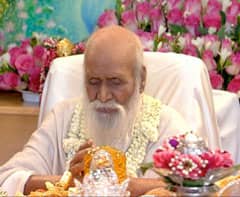 Gurus are often revered and worshipped by their students, regarded as actual embodiments of the knowledge they impart. Indeed, gurus in India are sometimes treated as gods; they are seen as a living incarnation of a god on earth. Such famous gurus as Maharishi Mahesh Yogi or Satya Sai Baba
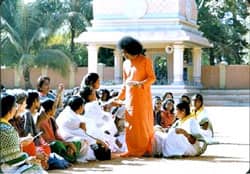 —to name two gurus well known in the West—as well as numerous lesser known gurus are understood by their followers to be living gods, and are treated as such. Their followers come to them for darshan, a highly significant mutual "seeing" of the divine, in which the god also sees the worshipper, and they perform puja rituals to them.
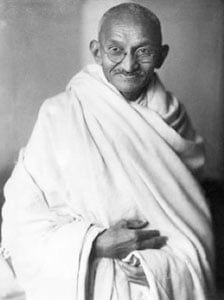 Religious leadership and authority in India derive from a number of important factors. Certainly there is the issue of birth; most religious leaders in Hinduism are Brahmins. Gurus, who are usually Brahmins, attain their status through their knowledge of sacred texts and rituals, which they pass on to their students. Religious authority can also come from the actions one performs in one's life. Mahatma Gandhi, for instance, was certainly a learned man, but his religious leadership came not from his knowledge of the sacred texts, but from his actions. It was his moral example that led people to follow him.
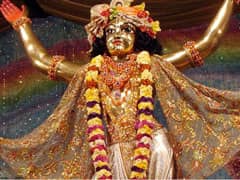 Some figures who are regarded by their followers as living gods attain that status through particularly auspicious, even miraculous acts. Chaitanya, the 15th-century Krishna devotee, has been elevated to the status of sainthood through his intense devotion to Krishna. He has for centuries been held up as the model of bhakti, loving devotion to the god.
 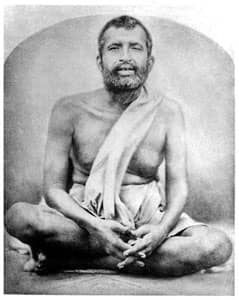 Likewise, Ramakrishna, the 19th-century Bengali saint, is regarded by his followers as a saint because of his intense devotion and exemplary meditation, as well as the actual content of his spiritual message.
Such figures, and countless others, become holy in part through the devotion of their followers. They become divine because they are regarded as divine. There are temples throughout India dedicated to such figures, some of them quite famous and known throughout India and abroad, others only known in a particular town or village. Mata Amritanandamay Devi (b. 1953), known to her followers as "Amma," mother, and famous outside of India as the "hugging saint"—she is the subject of the 2005 documentary film Darshan: The Embrace—is a contemporary example of a person who becomes a religious leader, a saint in the eyes of her millions of devotees, through a combination of her acts on earth and the love and devotion shown by her followers. She offers daily darshan to her followers and hugs each one in a warm embrace. Some reports say she has hugged over 25 million people in the course of the last thirty-five years. Furthermore, she has sponsored a number of prominent social causes, thus further elevating her divine status in the eyes of her followers.
Study Questions:
1. Who are the Brahmins?
2. How do gurus differ from Brahmins?
3. How could a Hindu become a saint?












 Ad-Free & Subscriber Log-In