
- Trending:
- Forgiveness
- |
- Marriage
- |
- Afterlife
- |
- Trump
- |
- Pentecost
- |
- Deconstruction
RELIGION LIBRARY
Hinduism
Founders
Hinduism has neither a specific moment of origin nor a specific founder. Rather, the tradition understands itself to be timeless, having always existed. Indeed, its collection of sacred texts is known, as a whole, as Sanatana Dharma, "The Eternal Teaching." At the beginning of each new cosmic age, or yuga, the core of these teachings is (re)revealed to human beings by the gods.
Some texts posit that the first human to receive the sacred texts is Manu, and so in some sense he is understood to be the founder of the tradition, although it is important to note that he is not the author of the texts, only their recipient.  The great epic the Mahabharata says that Manu, as the first human, is thus the progenitor of all future Hindus.
Many of the numerous sub-sects and sub-schools that conglomerate to form the religion we know as Hinduism do, however, have individual founders. The Advaita Vedanta school of philosophy, for instance, which for many modern Hindus articulates the core philosophical principles of Hinduism, is often said to have been founded by 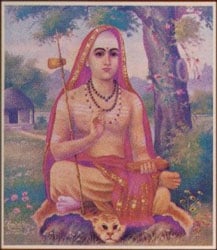 Shankara Acharya in the late 8th century C.E. Shankara is credited with authoring some of the most important commentaries on key sacred texts, particularly the Upanishads commentaries that later became the basis for many of the devotional (bhakti) and meditational (yoga) principles and practices of later Hinduism. The core of his teachings is that there is no essential difference between the divine principle of the cosmos (Brahman) and the material and human realm. Shankara argued that what we think of as "the world" is merely an illusion, and that through knowledge (jnana) we are able to cut through this illusion and realize union with Brahman (called moksha).
| Six branches of Hindu philosophy |
Likewise, Ramanuja (1017-1137), another great theological commentator, is often seen as a "founder" in that he articulated a complex theological and devotional system known as Vishishtadvaita Vedanta (qualified non-dualism), which, like Shankara's Advaita Vedanta, had a tremendous influence on later Hindu thought and practice. Ramanuja argued, in contrast to Shankara, that there is an essential difference between the world and the divine, although individuals contain a fragment or portion of the divine. For the followers of Ramanuja, knowledge is not as essential as devotion (bhakti).
| Founder: Shankara Acharya | Founder: Ramanuja |
| School: Advaita Vedanta | School: Vishishtadvaita Vedanta |
| Belief: the material realm and the divine cosmos are essentially the same | Belief: the material world and the divine are different |
Again, Hinduism is not a single institution, but a vast, complex collection of schools, subschools, sects, subsects, etc., that together make up what is known as "Hinduism." As such, there can be no single founder, but rather a diverse group of men and women who have contributed, over the course of two millennia, essential philosophical and ritual and devotional principles that, together, can be understood to make up the whole of the religion.
Study Questions:
1. Who was Manu?
2. What was Shankara Acharya's contribution to Hinduism?
3. Who was Ramanuja, and how did his teachings conflict with those before him?
4. Why is it incorrect to classify Hinduism as a single institution?











 Ad-Free & Subscriber Log-In