
- Trending:
- Forgiveness
- |
- Marriage
- |
- Afterlife
- |
- Trump
- |
- Pentecost
- |
- Deconstruction
RELIGION LIBRARY
Hinduism
Sacred Time
 Time is cyclical in the Hindu view. The cosmos is created, maintained for a certain period, then destroyed, only to be recreated. This cycle has no beginning and no end. Each world cycle (sometimes called a Great Cycle) is the equivalent of a single day in the life of the god Brahma, who is often understood to be the "creator" of the universe. Each Brahma-day lasts 4,320,000,000 years. Each Brahma-day is divided into four yugas: the Satya Yuga is said to last about 1.7 million years; the Treta Yuga about 1.3 million years; the Dvapara Yuga about 860 thousand years; and the Kali Yuga, about 430 million years. The world as we know it is currently in the last of the four yugas, the Kali Yuga, the most chaotic and degenerated period, when dharma—order—has broken down almost completely.
| Yugas (epochs) |
|
In this sense, since all time is measured relative to the divine, all time is thus sacred. Until fairly recently, there were dozens of different calendars in use in the Hindu world, each of which reflected certain regional and sectarian variations. In contemporary India, there are two main calendars used alongside the Gregorian calendar of the West: the Vikram Samvant and the Saka.  The Saka was developed by a 1st-century Indian king, Shalivahana, in the year 78 C.E., while the Vikram is thought to have begun at about the same time with the coronation of the king Vikramaditya. Both of these are lunisolar calendars, thus measuring the year according to twelve lunar months. All major religious festivals and auspicious times and days for performing particular rituals are determined by these calendars.
Hinduism has traditionally held that there are certain times and days that are better to hold or to begin important events, such as marriage, particular religious rituals, even business ventures. The times and days for all major religious events are determined by careful consultation of the calendars by priests. On a more mundane level, many Hindus will consult a priest or other religious figure to determine the proper day for a marriage, or a journey, or any number of other activities.  For each person, there are more and less auspicious times, based on the day and time of their birth, the movements of the planets and stars, and a number of other factors. Many Hindus have their own astrological charts made—sometimes by parents shortly after the birth of a child—that they will consult and have interpreted by priests throughout their lives.
 Another sense of sacred time in the Hindu world is the time of the distant past, a kind of mythical time when certain gods were active in the human realm. The Mahabharata and the Ramayana record these times, as do the many Puranas, which often narrate divine acts in the human world. As much as these mythic times are understood to be in the past, there is an important sense in which this past continues to be relevant. These stories are retold over and over again, and often presented in dramatic form (including on television), thus making them in a sense contemporary.
Such a sense of sacred time is not always beneficent, however. For instance, in the contemporary political realm some Hindus, particularly those on the right side of the political spectrum, have called for a return to or restoration of this ancient, mythic idealized sacred past, a past when god-kings such as Rama ruled India according to the laws of dharma.  Such conceptions of the past, and such calls for a return to a more sacred Hindu time, have all too often had disastrous effects, leading to some extremists to demand that all non-Hindus leave India. The late 1980s and early 1990s saw one such movement with the rise of the BJP political party, which called precisely for a return to the sacred past, and the eventual destruction of the Babri Masjid in Ayodha in 1992 and subsequent riots that left thousands of Hindus and Muslims dead.
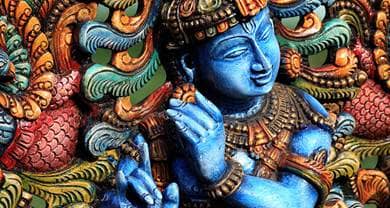
 Another sense of sacred time is seen in the many stories about the Krishna and his human "consort" Radha. Radha and Krishna's relationship takes place in the forest of Vrindavana (Vrindavan or Brindavana or Brindavan). Although Vrindavana is a physical place—it is in the Mathura district of the modern state of Uttar Pradesh—it is usually conceived as a mythical paradise, a kind of utopia (literally a "no place") that exists "out of time," in a kind of eternal divine present.
 Pilgrims visit Vrindavana, seeking the places where Krishna and Radha lived and engaged in their divine play and divine love, as described in any number of devotional texts, such as the beloved Gitagovinda, written by the poet Jayadeva in the 12th century. Although the gods are not physically present (although they can be, in the form of murtis, images), being in this sacred land in a sense transports the worshippers out of human time, into divine time. In an important sense, any Hindu temple, or any sacred place, presents this same sense of temporal transcendence, of sacred, eternal time.
Study Questions:
1. How does the Hindu understanding of time differ from the western construction of time?
2. Why are many Hindus interested in the concept of auspicious days?
3. How has sacred time become politicized within Hinduism?









 Ad-Free & Subscriber Log-In