
Editor's Note: In 2010, Amina Wadud, a noted author and scholar on Islam and gender, traveled to Makkah and Madinah to perform her first Hajj and celebrate Eid ul-Adha. Wadud kept an extraordinary blog about Hajj experiences. Patheos is combining her blog posts into four essays covering her preparation, her actual Hajj, and coming home. Click here for part one. Click here for part two. Click here for part three. In part four, Wadud talks about the ramy Jamarat, or stoning the devil, how she returned to Makkah, and the rainbow at the end of it all.
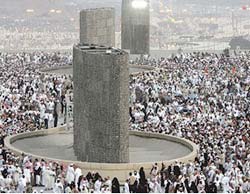 Ramy Jamarat: Stoning the Devil Out of Our Lives
December 2010
To understand my lowest point, we have to step back to the other ritual requirements after wuquf Arafat. I've already described my Muzdhalifah experience in part three. [After Muzdhalifah] we return to the tent city at Mina for three days. Once, on each of these days, we go to the ramy Jamarat. This is pretty literally "throw (stones) at the pillars." There are three pillars—big, medium, and small—that represent the places where Satan tempted Abraham (or his son) against the divine command to sacrifice. He threw seven stones at each of these places.
Today, the pilgrims commemorate this ritually. First we must collect our stones. Like most people I collected mine at Muzdhalifah (there has to be some use for the place, I guess). However, they can be collected at Mina, Arafat, and even Makkah. Someone said these pebbles should be the size of a bean. At first I was collecting rocks way too little. It is suggested to collect seven for the first day and twenty-one for each of the next three days; a total of seventy, plus a few, in case you lose or drop any on the days of the ramy. That first day, fresh off of Arafat and after having survived Muzdhalifah, we proceed to ramy while still in ihram. Afterward, we can shave and shower and change clothes. Well, (most of) the men shaved. Having cut six inches off my hair the first time I came out of ihram, I decided to only do a token cut this time.
Anyway, that first day I walked to the Jamarat with our leader, Mr. Mansour, and a few other people. It was exciting and seeing so many Muslims coming out was also exciting. It was also exhausting to walk there and once the adrenaline had worn off it was a killer to walk back. The first time for ramy Jamarat, you are supposed to think of your seven biggest sins, fears, losses, or temptations and throw for each of these—like expiation. We only throw stones at the biggest of the pillars (at this time, there is no difference in the actual size of the pillars, but the biggest one is the last one as the people walk goes. So we must pass the first two, which had guards and prohibiting).
This ramy Jamarat is pretty serious. For one thing, technically it should be done some time between noon and sunset only. Yes, that's right, the hottest part of the day with the sun at its zenith. Only women and the disabled are allowed to throw after the sun sets. Next is the location of the pillars in this new pavilion. The pavilion is also at Mina, but remember, there are millions of pilgrims in this tent city. So, it spreads out quite a distance. As it stands, those whose tents are the closest to the pavilion are those in the VIP tents. Yes, their conditions are a grade up from our conditions, but then, our conditions are a grade up from others, and there are still many pilgrims without tents or camped outside. There are class differences, despite the notion that we are all made equal by these rites and rituals.
Our tent was about a kilometer before the two kilometer "people walk" to the Jamarat. This is where tradition meets technology, in my estimation, to the best extent. If you look at the history of the Jamarat, from the days of a simple pillar with a ditch to collect the stones, to the building of a three-story structure, to what they have now—a pavilion with five stories, escalators and this elaborate "people walk"—I think you can appreciate the simple fact that religion and religious practice must meet modernity at least in some ways. This is also the place that has suffered the greatest collective tragedies at the hajj in past years.
For example, there are two tunnels along the people walk. One year, the people flowed into the tunnel faster than they moved out on the other end. As a consequence, the people in the middle lost sufficient air, and a large number suffocated. This was so easy to imagine as we went to complete this rite for the third and final time. The throngs of people were easily 15-20 abreast, jammed so close together there was nothing visible except the persons immediately in front or beside you. I still had the advantage of being taller than most Muslims and could see over their heads.





 Ad-Free & Subscriber Log-In