Yes, but what do we NEED from our Pagan leaders?

The discussion around the post, What do we want from our Pagan leaders? was enlightening for me. Admittedly, I have a close, personal connection to the subject, as I’m seeking to discover what it might mean that I am, as a friend told me, “called to lead” in some way.

This comment really stood out to me:

I think that’s one of the basic yardsticks of spiritual maturity: can what you offer to others be about what’s needed rather than all about self-promotion? Or self-effacement, or self-absorption, or deprivation, or justification, or any of the other funky little trips we can run that get between what we have to offer and actually offering it, freely and lovingly, as we’re called to do?

- Cat C-B

Ah…the need. I started out with the want, but the real answer may lie in the need.

Religious leadership can be complicated, I think, especially within a community that isn’t in agreement about our collective identity, our purpose in the greater society, or even if we should classify what we do as religion. By and large, the comments reflected that what we want is a co-creative, egalitarian model of group interaction rather than one which relies on a single leader. We want all of our strengths to be put to good use, we want our fellow coven or grove members to support us as we support them, and we want to experience our community without the sense that we are being governed.

This is what we want. But, is this what we need?

Another commentor, John Beckett, started off with a slightly more active tone:

Any leader has to begin with a vision. Who are you going to lead? Where are you going to lead them? Who and what do you serve?

A leader has to articulate his vision. If you keep it to yourself, you aren’t leading anyone.

A leader has to implement her vision. Talk is cheap – how are we going to do the work necessary to make the vision a reality?

I find this connection between vision and leadership to be interesting, especially in contrast to the idea that leadership functions best when it serves the needs of the community. I wonder if this idea of “beginning with a vision” would be better phrased as “beginning with vision”.

Should the vision of a leader be thought of as more of a quality of seeing; a refinement of one’s faculties of observation? Perhaps we need our leaders to see what is happening in our communities and in the lives of individual with greater clarity. In this way, their “vision” isn’t a noun. It isn’t a platform on which they can run for election. Instead, it is a tool which they use in order to better understand their brothers and sisters.

But then the question is, what do we do when, through our clear vision we recognize a specific need? Is that the moment where leadership begins?

I like the idea that leaders should be teachers, or possessors of knowledge. They shouldn’t be so bookish as to be unapproachable, but I like to think they’ve put in some time learning about the nuts and bolts of their practice or tradition. I also feel that pastoral care should be a primary focus of religious leadership. If we’re going to work in service to the community, we should understand how to serve the real, human needs. I’m talking about skills of compassion and empathy.

To be clear, in all of this musing I’m not feeling conflicted about the subject of Pagan leadership. I just find the discussion to be fascinating. I think there’s value in stepping back and thinking about the difference between what we want and what we need in all aspects of our life, but particularly when we’re thinking about the leaders of our covens, our groves, or our larger Pagan institutions.

Do you see a difference between what Pagans want from our leaders and what we need from them? If you have led a group, have you found it challenging to discern the needs of the group, or did you have clear vision from the start?

This blog is a safe space to unpack your ideas and experiences, and I encourage you to do so in the Comment section.

What do we want from our Pagan leaders?

In this last week of post-Pantheacon decompression, I’ve discovered a few things about myself.

First, as much as I am invested in my online work, either through blogging or social networking, nothing compares to real-life, skin and sweat, handshakes and hugs interaction. You can imagine all you want about how great it would feel to dance, but that isn’t the same as dancing.

And, I love to dance.

Pantheacon, my first large Pagan gathering, provided me with the opportunity to embody my spiritual practice, and to present myself as a spiritual and religious person. I wore my little “Druid” nameplate, a keepsake of Uncle Isaac, I introduced myself proudly to everyone I met, and I became at different moments a student, an inquisitor, a historian and a kid in a candy store. I had permission to engage in dialogue about complicated, esoteric ideas with a number of great thinkers, not because that permission was explicitly given to me by someone else, but because I gave it to myself. It was kind of self-liberation. I highly recommend it.

Second, I’ve learned that I have an easier time investing in my religious practice if I’m given — or, again, if I give myself — a more active role. If I’m left to watch from the sidelines I may be more inclined to criticize, analyze, and generally keep a distance between me and what’s actually going on. Skills of observation are useful to a writer, but observation doesn’t always trump experience. Sometimes it’s better to get your hands dirty.

And, I love dirt.

As I wrote about in my last post, I’ve been consistent in approaching my altar each morning for the better part of the last month. No matter how groggy I feel, I perform a short ceremony to honor Those who I honor, and then I start my day. I do what’s worked for me before, and open myself to whatever happens. Sometimes I improvise, and other times I follow my simple liturgy. Regardless of what transpires, the regularity of the ritual is proving to be very nourishing.

With my daily ritual firmly in place, I’ve decided to return to the Dedicant Path, an ADF study program which seeks to develop one’s own personal religion (Neopagan Druidism), while deepening one’s knowledge about the Indo-European cultures of antiquity. I feel that ADF has something very valuable to offer me, and this was confirmed by my experience in ritual and in fellowship with the ADF members I met at Pantheacon.

I’ve also decided to return to University and seek a degree in religious studies. This decision requires much more planning and preparation, and it probably won’t come to pass for another 12 or 18 months. But, I feel that if I’m going to take myself seriously as a writer on religious matters, not to mention if I’m going to ask anyone else to do the same, I have to put in the work.

When I commented on my Facebook page about looking into applying to Marylhurst University for further study, an ADF Druid who I met in San Jose replied,

“Do it, brother. You were called to lead.”

If he’s right, then I have a lot of work to do. And, if he’s right, I have a lot thinking to do about what it means to be a leader.

There have been great discussions on blogs and in podcasts about Pagan leadership, and I’d like to continue that dialogue here at Bishop in the Grove. My readership is so diverse, and so willing to engage in deep thinking about practice, tradition, philosophy, and belief, that it would be foolish of me not to ask you what you think about leadership.

What does effective religious leadership look like to you? Do you expect leaders to be well-educated? Charismatic? Inspirational? Instructive?

When you think about leadership in the Pagan community, where do you think we’ve gotten it right, and where do we have room for improvement?

Please, lend me your insights into what leadership means. And then, if you know someone who might have a valuable perspective on this subject, pass along this post.

The Action of Worship

My religion is experienced in the doing.

This became clear to me as I entered the sacred space of our ADF ritual at Pantheacon, lifted my voice to invoke the spirit of Inspiration, and, for a moment, left my mind behind.

When I stepped in front of the altar and began to sing, I was performing a religious and magickal act. It was spontaneous and improvisational, and it originated from within my heart. It was the purest offering I could make.

In that moment, I was not thinking about what it meant to be a Druid. I was not weighing the strengths and weaknesses of the various Druid traditions, or squabbling over the definition of a word or title. No – I was invoking. I was calling down, stirring up, igniting the fire of inspiration in my own heart and in the hearts of all those present.

There was nothing intellectual about it.

“Worship requires action – it is not an intellectual task.”

These words came from Jean “Drum” Pagano, a man I met during my weekend in San Jose. Drum has been involved with ADF since the earliest days, and he serves in various leadership positions within the organization. Drum’s voice, in the few conversations we had in person and through his written word, resonates deeply with me.

Have you ever met someone and felt instantly as though you understood something about them, as though something inside them was very similar to something inside you?

That’s how it felt when I met Drum.

Drum says that worship requires action, and I heard that very message echoed by other Pagan leaders during the conference. So much of what we do in our day-to-day lives is mind work. We blog about our ideas, we argue about our differences, we share memes on Facebook ad nauseam (which, in my opinion, is very low mind work), and we allow this to consume great portions of our day.

What happens, then, when we spend our lives in our mind, on our screens, and even in the pages of our books, but we do not practice the action of worship?

It is no surprise that during November and December of last year, a time when I felt most conflicted about my religious path, that my altar was a wasteland; vacant, and unused. I did not approach it because I was uncertain if I believed in the words that I was saying each morning. I thought about it, and thought about it, and when I couldn’t decide how to think about it, I did nothing.

(If you were reading my blog during that time, you might remember a change in my tone. If you weren’t, you’ll find evidence of the change in the Archives.)

The result of my lack of doing was a period of spiritual stasis. In the absence of regular worship I became a bit more cynical, a little jaded even, and there was no sign of the fire in my heart which I speak of so often. I sing from this fire. I write from this fire. I make love from this fire. Worship keeps the fire burning, even as worship is an extension of this fire.

But then, after I became tired of the cold, dim reality of a life without reverence, I began my daily practice again. When I did, something changed.

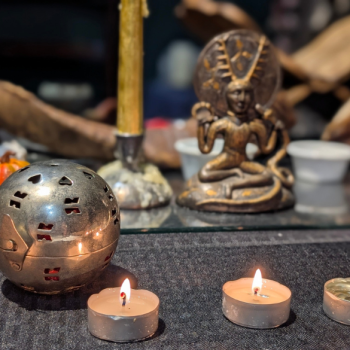
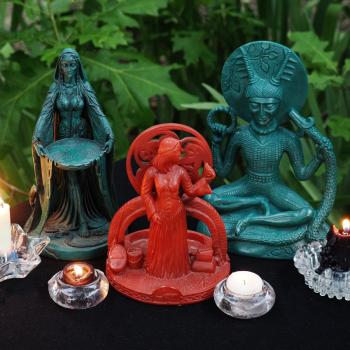
I lit a candle, prepared a chalice of water, and laid out a wand made of wood. I gave thanks to the Mother. I called upon the God who had aided me before in the creation of sacred space, and was happy to discover that I could feel His presence again. I made offerings to the Gods and Goddesses, known and unknown, to the Ancestors, and to the Spirits of the Land. I lit a fire for Brighid, and gave thanks to Her. I did all of these things, stumbling from time to time, but reverent as I could muster, and my consciousness began to shift back toward the fire.

Worship requires action. You cannot think yourself into a state of transpersonal awareness. You must do something.

I wonder (more of an imaginative act than an intellection one) if you’ve experienced something similar. Have you been through periods when you thought more than you felt? And, if so, did that throw you off? Perhaps you have a different relationship to the intellect altogether. Perhaps it is a starting point for your experience of worship.

I always love to know what my readers think, but this time I’m going ask:

What do you do?