Where Does Compassion Belong Among Pagans and Polytheists?

I’m having a hard time with compassion.

So far, I’ve developed a daily ritual at my altar, I’ve reconciled (for the time being) my differences with my Christianity, I’m working to hold the tension between my Druid Revival leanings and my ADF approach, and all of that feels good. I feel like I’m developing a balanced, sincere, honorable religious practice.

And yet, I’m uncertain about compassion.

By saying that I’m uncertain about compassion I don’t mean to imply that I don’t feel compassion, or that I’m uncertain of how to show compassion. It’s more that I’m not sure how I incorporate compassion into my practice. This subject hasn’t come up much in my Pagan studies, and I’m not really sure why.

We Pagans and Polytheists concern ourselves a great deal with orthopraxy, or right action. We discussion belief from time to time, but mainly as it relates to what we do. In light of this, I think we are actually well suited to explore the subject of compassion.

Compassion, as I see it, is all about the doing. It is about right action in relationship to another person or living thing. Compassion speaks to a quality of interaction, and as I understand it, arises from a place of empathy. We act with compassion by seeking to understand, relate to, and care for another person, exactly where they are in that moment. In this way, compassion can be seen as a practice similar to a daily ritual at one’s altar, except that the opportunity to show compassion is present every time we connect with another person.

Compassion is not a solitary act; it is an act of communing.

Just before bed last night, I read a post by my colleague, Star Foster, in which she announced that she would be taking a brief hiatus from blogging. I also read a rather heated and uncomfortable debate between Star and her readership, followed by a flurry of posts about the exchange on Facebook. Everyone was worked up, and many were downright angry.

I’m not taking sides on the matter, because I don’t think that would be helpful. What I will say is that what is evident in the argument that unfolded around her original post, and the situation that Star describes in her Sabbatical post are indications that we are in dire need to have a discussion about compassion and what it means in our interactions with one another.

The internet, by and large, has not proven to be a haven for compassion. We all know this. We engage in social networks from a place of relative isolation, and in the process we practice a kind of inauthentic, calculated transparency. Our profile pics are not our genuine faces, and our text-voice is not our voice-voice. When we communicate online, we are interacting with something that only resembles a part of a complete person. I wonder if in recognizing this fact we give ourselves permission to be meaner than we would if a person was sitting across from us. Perhaps compassion feels multidimensional, whereas the internet presents us all as two-dimensional characters. I don’t know.

But I do know that I was upset by the intensity and insensitivity of the language that followed Star’s posts. I like Star, with all of her feistiness. I also know and like many of the people who responded to her, and I trust that they are equally as capable of compassion as she is.

In thinking about this, I had to acknowledge my own inability to convey and express compassion. My first draft of this post was quite righteous, and I’m afraid was devoid of any compassion whatsoever. Ironic, no? In my own quest to call out others for their lack of compassion, I experienced a lack of compassion. Why would that be so?

I have many questions. I would like to know if compassion could be a guiding principle in our interaction with one another, and if we might allow it to come more to the forefront of our minds. When we find ourselves being caddy with one another, or hateful, or when we use our language to shut one another down in conversation, I wonder if we might take a moment to ask ourselves if there is a more compassionate way of acting.

I could be the most pious, most devout, most respected person in the world (or at least, in my corner of the blogosphere), but if I don’t practice compassion with the people I come into contact with what is my piety worth? Perhaps it’s worth something to the Gods I worship, but I’m not living in a world populated exclusively by my Gods. Everybody else is here too, and you are all deserving of my compassion.

I would like to see compassion become a point of discussion in our community. I would like to see us discuss with a calm, self-reflective, gentle voice how we can be more compassionate with one another. I could imagine us searching through our histories, both mythological and ordinary, for examples of compassion-in-action, and holding up those mythological and historical figures who exemplify compassion as being worthy of special recognition.

And, I’d like us to think of compassion as an act of magick, as though our clear, concise choice to use our faculties and will to respond to our fellow human being with care and kindness is mystical in nature.

Could we conceive of compassion as a magickal practice?

If we are a people concerned with religious orthopraxy – right action in relation to the Gods – what would happen if we began to think of compassion for one another as a king of social orthopraxy – right action in relationship to one another? How might that change things?

What are your thoughts on compassion?

Do Not Speak, and You Will Be Heard

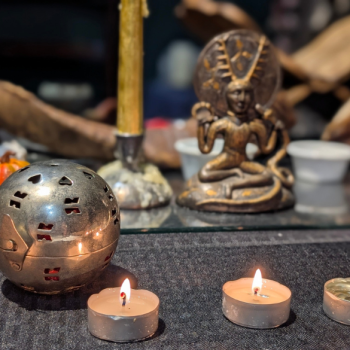
Today I approached my altar in silence. Speaking the words out loud, my standard approach to a daily ritual, felt unnecessary. In my mind, in my heart, the words rang out with perfect clarity, and I trusted that whomever needed to hear them would.

The effort I put into my daily practice waxes and wanes, and it is influenced a great deal by my emotional state. Some days I don’t feel I have it in me to make offerings of gratitude and thanks to the Kindred. There are financial concerns, piles of paperwork on the desk, and sticky-notes of errands that have been neglected. When I wake up with a busy brain I have a very difficult time making space for piety.

But today in my ritual, rather than using my voice to will the space into stillness, I went inward. I turned my gaze into the depths and found that there was already plenty of space for reverence. Caverns of it, really. And the stillness came.

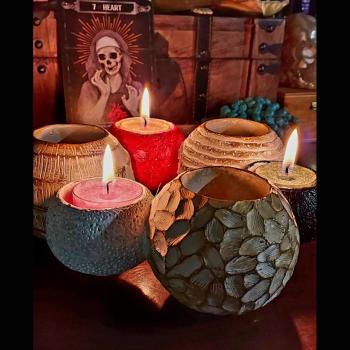
To my delight, I found that the richness of my meditative, magickal work increased in this state of silent dialogue. My small candle flame transformed into the great, Sacred Fire with a force that it hadn’t before. The chalice became the Well, and reached deep into the center of the earth, effortlessly. In between the two stood the Great Tree, broad and majestic, and full of life.

All of this happened in a silent room, and it was only possible – I think – because I’ve been faithful to my daily practice to the point where the words I speak out loud could finally be internalized. The Kindred listen in ways that are beyond my imagination. The spirits of the land and of our ancestors are sentient, I believe, but I’m not sure how. I think that I was persistent in speaking out loud because I thought there was a connection between the sound of my voice and their ability to hear. This may have even been a lesson I was taught.

But I don’t believe it’s true. I don’t believe we need to approach the Kindred — the Gods of our heart — with the idea that their limitations are easily conceivable. They may not, as many Pagans have presumed, be omni-anything, but the exact shape of their being remains a mystery.

Sometimes I think the Pagan Humanists have it right in their approach to their practice. They see the Gods as archetypes, but they also see the archetypes as our entry into deeper engagement with the greatness, the expansiveness, the mystery of the Gods. In a way, I’d rather suspend my need to affirm some definite conception of the Gods if it allowed me to approach Them with greater reverence and wonder.

Does that make sense?

Before today, I spoke out loud in my room because I thought I needed to do so in order to be heard, in order for my ritual to be successful. But I’ve discovered that I can have the experience of being heard without speaking at all. It feels like there are greater ramifications to this discovery that I can’t yet see.

Does this inspire something in you?

Listen to my interview on The Pagan Knitter Podcast!

I’m excited to announce that my interview on The Pagan Knitter Podcast is live!! I had such a wonderful time talking with Ursa about my experience of Druidry, my love of knitting, and my passion for writing and blogging.

You can listen to the podcast on the Pagan Knitter website, or download it directly through iTunes.

I hope you enjoy!