Hating the Invisible Man

We finally made it to the Oregon Coast yesterday. I took some pictures in the redwood forest that I’ll share soon, but this post isn’t about that.

We got in before dinner and were happy to learn that we had a hotel room with an ocean view. Not only that, but it actually is right on the beach. So of course, we decided to sleep with the windows open.

It’s one thing to fall asleep to the nature sounds on my iPad; it’s entirely another to drift into an alpha state to the real thing.

And then came the noise. It was this periodic buzzing/honking/humming that started sometime in the middle of the night. It sounded like someone snoring through the wall in the next room. Seriously? I drive two thousand miles to sleep next to the ocean and you’re going to keep me awake snoring?

I started imagining this person sawing logs in the next room. Nothing I imagined about them was attractive. I began to fantasize about sneaking in and stuffing wine corks up his nostrils or slapping one of my Breathe Right strips across the bridge of his nose. At one point in a near-sleep state, I actually had a vision of covering his snoring face with a pillow.

I know, a horrible thing. But sleep – and the lack of it – can bring out some strange demons.

He actually even worked his way into my dream. We were strolling through a park and there was this disheveled man following us and harassing us. Finally the police arrived, and they were less than kind to this guy in my dream. They shackled his wrists behind his back in handcuffs and shoved his face to the ground when he talked back to them.

That’s what you get, my dream-self thought, watching the man in blue press the vagrant’s face into the gravel.

Who is this me that’s coming out because of this guy next door to me, completely unaware of the power he has over me? But I know who it is. It’s just the part of me I’d rather not admit is there, but who can be summoned under the proper circumstances.

It’s the part that wishes suffering on a snoring man I’ve never met.

Or punishment for a homeless man bothering me in the park.

Or who can’t wait to cast the first stone at the woman in the middle of the circle.

Or who joins in the swelling chorus to crucify an innocent man.

I reached my breaking point when someone built a campfire on the beach at 5 in the morning, sending smoke directly into our room. I stumbled out of bed and slid the glass closed.

Lo an behold, the snoring stopped.

Open glass – more snoring. Close it – no snoring.

It turns out there’s a persistent warning signal for ships in the harbor where we’re staying that let’s them know if they’re too close to land. The man next door, if there ever was one, had nothing to do with it.

It didn’t matter; I tried and executed him in my head anyway.

Sorry, Invisible Man.

What is Church 2.0? (Video)

Here is a condensed version of a workshop I offer on the concept of “Church 2.0.” I talk in it about the popularity of things like the “Why I Hate Religion But Love Jesus” video and Mark Driscoll’s Acts 29 Network of churches. But while we can learn something from what these kinds of voices are saying and doing, we can also do this while still offering the world a more liberating theology and a radically inclusive community.

At the end of the video, I talk about an article I wrote called “Can Alcoholics Anonymous Save the Church?” Click the previous link to read it.

Finally, though this may appear that I’m proposing something new for the church, this is really much more reflective of the original Christian movement/church/network than it is anything groundbreakingly original. Just placed in a contemporary context.

YouTube Preview Image

Evangelical 2.0: The Deception of Mark Driscoll’s Acts 29 Network

I’ve written quite a bit about churches like Mark Driscoll’s Mars Hill and the concerns I have about a lack of accountability, given that they’re not part of a denomination or other larger body of oversight. Churches led my ministers like Driscoll and John Piper seem to be independent, yet pressing a surprisingly consistent agenda in many ways, when you consider they’re not connected.

Well, maybe a little bit connected, it turns out.

I have to give evangelicals due credit in one way at least; they’re highly inventive and adaptive when it comes to how they reach people. In the publishing world, it’s inevitably an evangelical house or group that has the coolest new media, the hippest looking new graphic novel or web-based ministry. We mainliners and progressive independents always seem several steps behind when it comes to branding.

But of course, underneath the veneer of something new lies the same old evangelical doctrine. And this is what bothers me more than my personal objections to most evangelicals’ theology. It seems opportunistic to me, if not disingenuous simply to change the packaging on an old message, just to grab people’s attention. It’s a little bit like looking at my grandfather decked out in Abercrobmie & Fitch swag, while still checking behind my ears for dirt.

The missional church movement, however, seemed to be a different animal. Emerging from the imaginations of a a handful of mainliners and independents (and yes, even a few evangelicals), the emergent church seemed something refreshingly new. It didn’t just look different; it spoke and acted differently. It seemed to put relationship ahead of doctrine and human beings ahead of church agendas. It acknowledged the deep senses many of us already had that the Body of Christ was not so much bricks and mortar, but rather flesh, bone, heart, mind and spirit, particularly when two or more of these converged.

Servant evangelism was valued over saving souls. Compassion meant more than conformity. Relationship was more important, it seemed, than religion.

It’s not surprising that evangelicals took notice when this movement began to take hold.

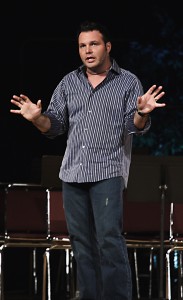
Enter the Acts 29 Network, established and run by – you guessed it – Mark Driscoll himself.

Now, before you go running for your Bible, let me save you the trouble. There are only 28 chapters in the book of acts, much of which is dedicated to the establishment of early Christian churches. The idea behind the name is that this is the “next chapter” in the life of the church.

On the surface, Acts 29 sounds much like the emergent church movement, in that it claims to be a network rather than a denomination, and their website claims that their values are not meant to supersede those of any particular church’s doctrine. They state that their purpose is to create relationship and to share resources, much like the emergent networks tend to do, which makes a lot of sense to me.

But there’s plenty that’s bothersome about it at the same time.

First of all, a glance over the Leadership roster makes one thing clear: middle aged white guys are in charge here. Of the 25 people shown on the team, 22 of them are white males. All positions of top Board and administrative leadership are white guys, and of the executive staff, there is only on African-American.

Yes, there is one woman in the mix; she’s the secretary. And they do have an Asian on staff handling communications.

Then there’s the value statement, most of which is consistent with a typical evangelical church vision. However, this one point stands out, in which Acts 29 commits itself to “…get behind the men (emphasis added) who are planting churches by…networking with men in different denominations and networks for the kingdom good of the city.”

Translated: no penis, no dice.

They are clear in several places that they align themselves with the National Evangelical Association, taking a page straight from the evangelical playbook. They even have an entire web page dedicated to outlining their group’s doctrine, which seems a little strange to me since on the home page they say they’re not interested in challenging the individual doctrines of member churches. But if you want to be a member, you’d better be ready to align yourself with the 1,356-word doctrinal statement.

Maybe I missed a memo, but in my experience, the words “emergent” and “doctrine’ don’t exactly sit well together. Nonetheless, many evangelical publications regularly tout Acts 29 as an “Emergent Church network.”

Finally, I have to take issue with their definition of “missional church.” If this were baseball, I’d say they’re batting .333 in this area. Here’s how they describe themselves as missional on their site:

  • We believe that our local churches must be faithful to the content of unchanging Biblical doctrine (Jude 3).
  • We believe that our local churches must be faithful to the continually changing context of the culture(s) in which they minister (1 Corinthians 9:19-23).
  • We believe that our mission is to bring people into church so that they can be trained to go out into their culture as effective missionaries.

The second point definitely aligns with the intent of missional church. However, as I mentioned, evangelicals tend to do this only on the surface, while holding true to the same old doctrine and theology. So really, it ends up only being a superficial adaptation. This is evident in the first and third points which, again, could have been plucked straight from the docket of an agenda from the Southern Baptist Convention or the National Evangelical Association.

I’m all for congregational and denominational change. But when it’s the same old white guys preaching largely the same old agenda, it smacks more of a desperate power grab than a genuine longing to better know and connect with the world around us.

What is an Evangelical?

The “E Word” in Christianity is a funny thing. In one respect, Evangelicals are self-identified, and therefore, self-defined. On the other, popular culture (particularly media) lays its own meaning on what it means to be Evangelical. In the latter context, the word inevitably translates to “Conservative Christian.”

But I think this definition isn’t fair. What’s more, it’s not accurate.

I’m a self-proclaimed “word nerd,” so I tend to turn to etymology for help. The root meaning of “evangelical,” at least as a paraphrase, means “to tell the good news.”

Sufficiently vague, right? depends on who you ask.

The tendency is to assume that the good news we’re called to share is that Jesus died for our sins. The concept is clear, concise, and has taken hold as the standard identifier for evangelicalism.

But some Christians simply don’t agree with this concept, while others believe it’s the linchpin that determines whether or not you’re even a Christian. So I suppose by some people’s definition, all Christians would be evangelical. I suppose that, in so much as every Christian should have some type of good news that they feel compelled to share, I would agree.

But what is your good news? And how do you share it?

For those who embrace liberation theology, the salvific message of Christ is one of radical justice for the oppressed, freedom from bondage and hope that serves as sustenance for present suffering.

For others, the good news is that, one day, God’s love will be made complete, fully realized, not off in the distance but here on earth.

The good news can take the form of recovery from addiction, or a crack in the darkness of depression that lets in just enough light to change everything.

It can be a persistent message of unconditional, compassionate love that says, over and again, “you belong, you are loved,” regardless of who you love.

It can be the willing hand of service that touches your life in a moment of greatest need.

It can be a listening ear and an open heart, willing to bear part of the burden of your own pain.

It can be expressed in a spirit that refuses to be broken, despite the greatest efforts of violent oppressors.

For some, the shedding of divine blood is good news. For others, it is the indomitable love and forgiveness amid the bloodshed that sings to the heart of humanity’s brokenness.

On the one hand, evangelical good news may focus on individual salvation; on the other, there is no salvation until the collective suffering of all of God’s people is relieved.

It is the thing, the message inscribed by God’s spirit on our heart, that forever changes both us and how we see the world and others. It is embedded in the first word on our lips when we wake up, and nestled within the drowsy prayers of thanksgiving offered up before a night’s rest.

Whatever it is, it cannot be contained. It is bigger than we are. And at it’s heart, it is good. It is the goodness from which humanity emerged, which God proclaimed was our essence after being divinely inspired.

In that sense, we are the good news. And in sharing our lives, we share that good news.

So what was the question?