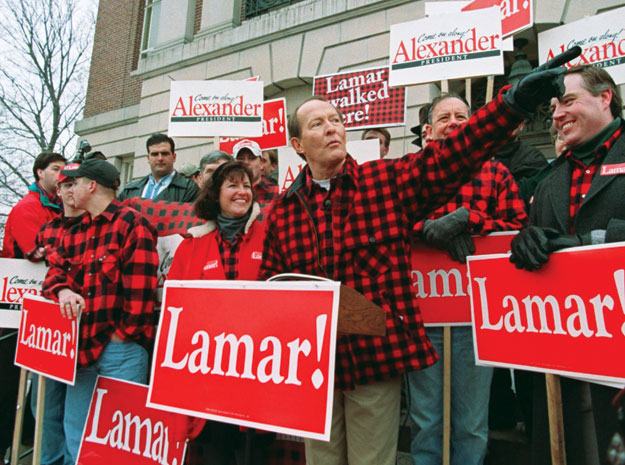
Explaining the Santorum mystery to America

So former Sen. Rick Santorum has dropped out of the GOP side of the horse race for the White House, which is a pretty big deal here in DC Beltway land. After all, nothing in life matters as much as the fine details of political horse races. That’s what average Americans wake up in the morning wondering about. Right?

Santorum’s campaign was, from the beginning to end, a total mystery to the political establishment — GOP or Democratic — here in Washington, D.C. Thus, it was a total mystery to the journalists who depend on establishment voices to help them explain the world to the world.

As always, the withdrawal of a big horse from the ultimate national horse race requires a package of Washington Post stories that is supposed to tell readers what this event means. In this case, one of the stories needed to make sense of (a) why Santorum had so much success in certain zip codes and (b) what that success means to the now-all-but-unopposed GOP nominee, Mitt Romney.

Note, in the following passage, the lack of attributions for almost all of the key statements of fact. No, this story did not have an “analysis” label.

Santorum came this far not only by waging an unusually emotional campaign but by carrying out a clever strategy that began more than a year ago in Iowa.

He spent a year campaigning in the state, shifting his family of nine there and trundling from county to county in a vehicle he dubbed “the Chuck Truck,” after an aide. He made up for his lack of official endorsements with a bus full of reality-TV backers: Jim Bob and Michelle Duggar and their 19 children, who often showed up at his campaign rallies. …

Santorum, who prided himself on a shoestring campaign that lacked a professional pollster, struggled against Romney’s better-organized and better-funded operation. He made gaffes and often failed to stay on message. And he was never able to convince voters that he could appeal to independents — a necessity in the general election.

A few oh-so familiar voices of the GOP establishment show up from time to time, yet they mainly reflect on the big picture — not offer information that helps establish or prove the details in the picture.

Finally, there is this final trip inside the mind of the mysterious candidate and his mysterious supporters:

Santorum’s unusual, emotionally driven run will probably have reverberations for the rest of the race. By connecting with evangelical Christians and other deeply conservative Republicans, he exposed Romney’s chronic difficulties in winning over those voters. And by invoking his blue-collar roots, he put a face on the struggles of people who work in the manufacturing sector.

Despite the country’s economic focus, Santorum, a staunch Catholic, rose on a message that centered on a conservative vision of family. He argued passionately that the nation could not shed its economic troubles without shoring up heterosexual marriage, ending abortion, and returning God and religion to the center of public life.

Now, here is my main question: How does one establish the central message of a candidate without using any of his own words, his images, his rhetoric? Where is the voice of Santorum offering a few sentences of proof that this Post summary of his views is accurate?

For example, did the candidate voice the direct cause-and-effect sequence that is attributed to him in that final sweeping statement? This one: “He argued passionately that the nation could not shed its economic troubles without shoring up heterosexual marriage, ending abortion, and returning God and religion to the center of public life.”

I’ll be the first to admit that I didn’t follow the GOP primaries very closely. I don’t think I ever listened to Santorum’s whole stump speech, for example. I did hear him talk a lot about the forces — moral, social and financial — that he believes is fracturing many marriages and families and even preventing some of them from forming in the first place. I am familiar, I think, with his views on the individual issues alluded to in this particular Post credo.

Did he ever make this claim about the economy, or did he say that the economic crisis is hurting families? Did he, perhaps, say that attempting to promote intact homes and marriages — cue up the quotes from the great Democrat Sen. Pat Moynihan — is one of the only surefire ways to prevent poverty and the development of a downtrodden underclass that hurts women and children?

Perhaps the equation contained in this paraphrased credo attributed to Santorum by the Post is accurate. If this equation was at the heart of his campaign, then it should have been easy to have found that killer quote to back up that point. Has anyone seen one?

WARNING: Before clicking “comment,” ask if you are ready to argue for or against Santorum the candidate. The goal here is to discuss the journalism issues linked to the Post article’s summary of his views on the economy.

Print Friendly

About TMatt

Terry Mattingly directs the Washington Journalism Center at the Council for Christian Colleges and Universities. He writes a weekly column for the Scripps Howard News Service.

  • John Pack Lambert

    Even if the Post had a quote, how much it was either central or in context would be debatable. However without any quote at all, they are just degreeing what we must believe. This is not journalism, it is advocacy.

  • Ben

    From Santorum’s Iowa caucus speech, transcript here on the wapo site:

    “….Those are the same people that President Obama talked about who cling to their guns and their Bibles.

    (APPLAUSE)

    Thank God they do.

    (APPLAUSE)

    They share our values about faith and family. They understand that when the family breaks down, the economy struggles.”

  • Ben

    Speech to the Detroit economic club (transcript here):
    “How about a candidate who cares about 100%? Who cares about everybody and gives them the opportunity to be able to rise in society. Not just to do that with energy and manufacturing jobs but also to understand that unless we have strong families and strong communities, we’re not gonna be an economically successful country. We certainly won’t be able to have limited government, lower taxes, if the family continues to disintegrate.”

  • Ben

    An analysis by the Catholic News Agency suggests that linkage was a key innovation of Santorum’s bid.

    Dr. David Campbell, a political scientist at the University of Notre Dame, told CNA on April 11 that the “intriguing link” that Santorum drew between morality and economics has the potential to “change our national discussion.”

    ….

    Tony Perkins, president of Family Research Council, said that voters were attracted to Santorum “because he passionately articulated the connection between America’s financial greatness and its moral and cultural wholeness.”

  • Ben

    From an Arizona debate (transcript here):

    “What we’re seeing is a problem in our culture with respect to children being raised by children, children being raised out of wedlock, and the impact on society economically, the impact on society with respect to drug use and all — a host of other things when children have children.”
    ….
    “Over 40 percent of children born in America are born out of wedlock. How can a country survive if children are being raised in homes where it’s so much harder to succeed economically? It’s five times the rate of poverty in single-parent households than it is in two-parent homes. We can have limited government, lower tax — we hear this all the time, cut spending, limit the government, everything will be fine. No, everything’s not going to be fine.”

  • Ben

    And from his final speech in Gettysburg (transcript here)

    “Folks like the Duggars, the Duggar family, who travelled around with us in their bus and gave their time and energy because again they believed in the basic importance of having strong families as part of a strong country; that we can’t have a strong economy as you’ve heard me say over and over again, without strong families and a strong moral fiber that makes us the moral enterprise that is America.

    All right, I’ll stop. But basically, this was a well-founded assertion by the wapo.

  • http://www.tmatt.net tmatt

    BEN:

    Thank you so much for doing a great job of making my main point.

    Read the WPost statement again. Look at it’s various parts.

    Then read the quotes you have provided. What you’ll see is the basic Moynihan approach over and over. You break the family, you cause poverty in a high percentage of cases. You could also quote another great Democrat on that point, the late Gov. Robert Casey of Pa.

    Now the “moral fiber” language you quoted hints at what the Post chose to insert into its own equation. They combined a bunch of issues in a way that I never heard Santorum combine them.

    So you are right. It was a ASSERTION by the Post, not an actual quotation or paraphrase of the candidate. If the Post had simply used any of the quotes you provided, the story would have been solid.

    Thank you for your work on that. Why do you think they created that assertion rather than simply use one of the candidate’s own quotes?

  • Ben

    Tmatt,

    I have no idea what you mean. You asked in your post:

    For example, did the candidate voice the direct cause-and-effect sequence that is attributed to him in that final sweeping statement? This one: “He argued passionately that the nation could not shed its economic troubles without shoring up heterosexual marriage, ending abortion, and returning God and religion to the center of public life.”

    And I found a quote where the candidate says:

    “we can’t have a strong economy as you’ve heard me say over and over again, without strong families and a strong moral fiber…”

    That seems like the exact cause-and-effect you are questioning. The candidate himself said he’s made that very point over and over again – and said it in his final speech that was the focus of the wapo piece. Are you questioning whether when he says “strong families and a strong moral fiber” whether that can truly be mapped to “shoring up heterosexual marriage, ending abotion, and returning God and religion to the center of public life.” If so, we can go through some more speeches where those are main issues under the strong family heading.

  • John Pack Lambert

    The point is that these quotes do not say “heterosexual marriage”. Yes, Santorum means man/woman marriage, but meaning it, and saying it are two different things. Anyway, he normally says “families breaking down” not just marriages. It is at much parents not parenting their children as parents divorcing that is the problem.

    The nuances of what Santorum said and what the Washington Post claimed he said are different. They are nuances and the differences are easy to overlook, especially if you want to brush him off. However the Washington Post could not have phrased their claims the way they did if they had actually quoted statements of Santorum. Dr. Campbell’s position does not equal what the Washington Post says.

    Anyway, for what it is worth Dr. Campbell is neither Catholic nor American. He is a Candian Mormon. This is mainly relevant because presenting him as a University of Notre Dame CNA correspondant gives the apparance that he is Catholic. He will be the first to announce his non-Catholicness and avoid giving false impressions.

  • http://collectingmythoughts.blogspot.com Norma

    Do you always place warnings in your blog entries, or just for Rick Santorum pieces? My first visit.

  • http://www.tmatt.net tmatt

    NORMA:

    No, warnings are sadly common. Lots of folks like to yell about politicians, doctrines, etc., instead of writing about the actual subject of this blog — which is mainstream media coverage of religion news.

  • http://www.dominos.com Andrew A. Sailer

    This is getting a bit more subjective, but I much prefer the Zune Marketplace. The interface is colorful, has more flair, and some cool features like ‘Mixview’ that let you quickly see related albums, songs, or other users related to what you’re listening to. Clicking on one of those will center on that item, and another set of “neighbors” will come into view, allowing you to navigate around exploring by similar artists, songs, or users. Speaking of users, the Zune “Social” is also great fun, letting you find others with shared tastes and becoming friends with them. You then can listen to a playlist created based on an amalgamation of what all your friends are listening to, which is also enjoyable. Those concerned with privacy will be relieved to know you can prevent the public from seeing your personal listening habits if you so choose.