On blogging, religious liberty and ‘bell-ringing homilies’

Every semester, there is a class at the Washington Journalism Center in which the students and I wrestle with one of the most important issues in the age of digital journalism: What exactly is a weblog?

Since I did some of my graduate work at the University of Illinois in Urbana-Champaign, I am one of those people who strive to follow the doctrine that “technology shapes content.” For me, the term “weblog” refers, first and foremost, to an empty box that has been created by a particular form of software.

Thus, not all blogs are alike. It depends on what bloggers choose to put into that box.

In fact, the same box/blog can contain radically different kinds of information. It’s easy to use this software to deliver hard-news content hour after hour, day after day. It’s possible to use this same box — because of its unlimited depth, or “news hole” — to contain ridiculously large amounts of detailed information (such as hyperlinks to annotated versions of all of the legal briefs ever written by a nominee to serve as chief justice). And, yes, blogs can also serve as platforms for analysis or pure opinion writing in which writers (such as your GetReligionistas) are free to express their views on a variety of issues.

When most people hear the word “blog,” they probably think of this kind of first-person, opinion-driven work.

But just because something runs in a blog doesn’t mean that it can’t be valid news. There is news, and there is opinion (oceans of it), at the “On Faith” site run by The Washington Post. And, there is a mixture of news and opinion in the “Faith & Reason” site operated by veteran religion-beat scribe Cathy Lynn Grossman at USA Today.

This is natural, since Grossman generates way too much news and information for the dead-tree-pulp pages of that national newspaper. Much of her work runs in her blog, where it becomes the only, or the primary, USA Today news content on many important events and trends. Rest assured that if I was on the beat full-time, these days, I’d be doing the same thing.

However, this format — news and opinion, running in the same blog — does lead to confusion from time to time for readers, especially when major news events end up being covered with analysis work in the blog, without corresponding hard-news coverage in the news pages.

Take, for example, that Fortnight For Freedom Mass on the 4th of July at the Basilica of the National Shrine of the Immaculate Conception in Washington, D.C. — which drew nearly 5,000 people into one of the world’s largest Christian sanctuaries, which seats 3,500. Now, this particular event has drawn relatively little mainstream news coverage, especially when contrasted with the wave of coverage of the comparatively small crowds of people who gathered to hear the doctrinal and political thoughts of a small number of liberal nuns, touring on a bus.

Thus, there is much to praise in Grossman’s blog post about this service — such as her hard-news content about the scope of this D.C. event, and similar events held across the nation. The piece is also packed with hyperlinks to key documents and sources of other information — left, right and center — linked to the Fortnight For Freedom effort. That’s one of the best parts of the technological box known as a weblog, of course. Grossman’s blog post also includes large chunks of the keynote sermon delivered by Philadelphia Archbishop Charles Chaput.

So what is the problem here?

Take a look at the top of this USA Today blog post:

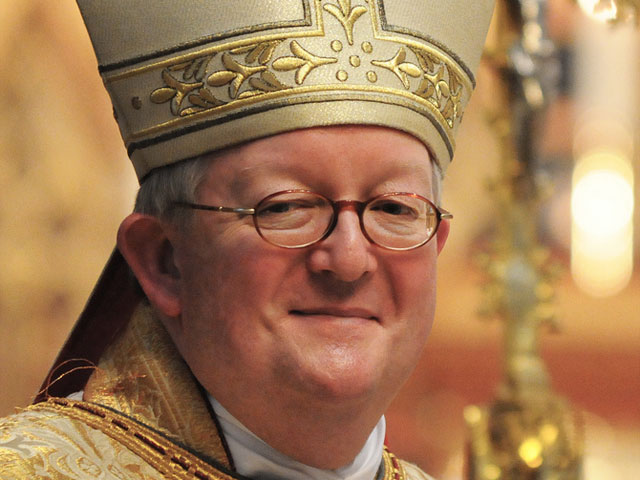
Independence Day abounds in political patriotic displays. But today Archbishop of Philadelphia Charles Chaput brought theological fireworks in a bell-ringing homily on the Affordable Care Act as an enemy of freedom under God.

For two weeks now, the U.S. Conference of Catholic Bishops has pounded the drums for religious freedom from every available platform.

The trigger: The ACA’s requirement for employers to provide free contraception insurance coverage, coverage bishops say will force the faithful to violate church doctrine on abortion.

The U.S Conference of Catholic Bishops launched a national push to assert that government (i.e. the Obama administration) should not decide who is religious enough to be exempt from government mandates.

The problem — if this is a news report — is that Chaput’s speech (text here) never mentions, directly or indirectly, the Affordable Care Act. Meanwhile, Grossman states, as fact, that this homily was “on the Affordable Care Act as an enemy of freedom under God.” In fact, Chaput’s sermon never addresses the seven (church-bulletin insert here as .pdf) religious-liberty concerns that led the U.S. bishops to create their special committee on religious liberty and, later, to launch the Fortnight For Freedom project.

In fact, it’s pretty clear to anyone who scans the text or views the video (above) that Chaput set out to deliver a sermon that affirms America’s religious liberty, yet stresses over and over that, for Christian believers, there are issues linked to freedom, salvation and human dignity that are even more important. Instead of being a political sermon, it’s about the belief that politics — even when affirming the good — are not the ultimate reality.

With her use of the word “trigger” a few lines later, Grossman appears to be following the mainstream media’s template stating that the whole religious-liberty emphasis truly began with the HHS birth-control mandate and, thus, as a movement in opposition to the administration of President Barack Obama.

It doesn’t really matter that Chaput has been writing and speaking on religious liberty topics ever since he was named to the U.S. Commission on International Religious Freedom way back in 2003.

It doesn’t matter that most of the seven religious-liberty concerns listed by the bishops predate the Obama administration.

It doesn’t matter that key members of the U.S. hierarchy have been growing more and more concerned about religious-liberty trends in the United States ever since 2006, when Catholic Charities of Boston stopped doing adoptions, facing the impact of new gay-rights laws, rather than violate centuries of Christian doctrines on marriage and family.

Still, let me stress that Grossman has every right to her interpretation that the Fortnight For Freedom campaign was “triggered” by the HHS regulations and — she accurately notes — their decree that the government should have the power to draw the legal lines between freedom of worship (stuff in churches) and free exercise of religious convictions in public life (ministry that touches the public). There are plenty of people who agree with her and, when it comes to expressing that point of view, I think the word “trigger” is an excellent term to use, in this case.

But, to wrap things up, the problem is that this USA Today blog post does not say this is her opinion. It also doesn’t quote anyone else — say George Soros — voicing this particular interpretation of the on-the-record facts. It simply states that the HHS regulations sparked this effort and that’s that. There are, of course, other possible interpretations of the known facts. Consider, for example, this very interesting “Advisory Memo To Journalists” from Sister Mary Ann Walsh, on behalf of the U.S. bishops.

If this is an opinion piece in her weblog, Grossman has every right to make that case on her own.

But what if this is seen as the only news piece published by USA Today on this important event? What then? Should an analysis piece of this kind be labeled, or is that simply understood to be the case since this ran in a weblog? The problem is, as I said earlier, that Grossman does a fine job of using her blog as a forum for valid news. How to readers know the difference?

Also, what about the factual error in the blog post’s lede? Whether this is a news piece or a work of analysis, it is simply inaccurate to state that Chaput delivered a “bell-ringing homily” on the Affordable Care Act, when he never mentioned it.

Well, I am pleased to note Grossman has decided to add the following note — at the top, no less — of her previously published online piece:

Archbishop of Philadelphia Charles Chaput takes issue with my post putting a political context to the homily he gave in Washington on Sunday at the concluding event of the Bishops’ Fortnight for Freedom.

Francis Maier of the archbishop’s staff sends these concerns via email:

We’ve heard from dozens of people — some delighted, some enraged — commenting on the archbishop’s giving a “political” or “partisan” homily, based on your article. That is precisely and deliberately what the archbishop didn’t do. …

Read it all. Read Maier’s remarks and read Grossman’s whole piece. As I stated, it contains tons of interesting and perfectly valid material.

Editor’s note: It goes without saying that comments should focus on the journalism issues in this post, not on opinions about Chaput’s sermon or to the related doctrines and social issues.

Print Friendly

About TMatt

Terry Mattingly directs the Washington Journalism Center at the Council for Christian Colleges and Universities. He writes a weekly column for the Scripps Howard News Service.

  • Thomas A. Szyszkiewicz

    While Cathy’s piece contains valid information, she should have changed the first part of her post to reflect the reality that Fran Maier pointed out to her. (BTW, Fran is a regular reader of these pages, the former editor of the National Catholic Register and former chancellor to Archbishop Chaput in Denver.) Why she couldn’t see that reality in the first place and write her comments accordingly is something which I cannot comprehend. But when she’s directly told by the archbishop’s closest adviser, “This was not a political sermon,” and yet leaves her blog post up that says it was, seems to be a bit of chutzpa.

    Yet I wonder if there are other questions being raised here. Is the journalism of old still valid? I think it’s necessary, but will we get it? Or will we descend to the power of the demos — i.e., your opinion is just as good as mine no matter how ill-informed it is?

    As to that NPR piece, once again we see how the secular press consider all things — merely as politics. But look in whose eyes it’s political (besides Hagerty’s) — our friend and George Soros’ friend — John Gehring of Faith in Public Life. And, of course, Tom Reese had to be brought into the discussion. I mean, what secular report about the Catholic Church is complete without the pope of the American press? (Sorry, but it’s so frustrating to keep seeing his name pop up. Is there no one else? Besides the fallacy of his logical shows that he’s basically throwing a temper tantrum.) Why is it that the left resorts to political constructs while the bishops are just trying to do their jobs (finally)?

    That Hagerty went after Bruskewitz was a surprise, though I have to wonder why she chose him, of all the bishops. Why not someone like Hubbard or Cupich or Vigneron or…? Was it just to set up the largest contrast she could?

    Unfortunately, it’s still the fact that the press just doesn’t get religion.

  • Maureen

    Adding marked corrections and updates to a blog entry = good.

    Changing the words of a blog entry = not seen as good. (Actually, kinda seen as cowardly or lying, because if somebody links with criticism, it makes the linker look like they were lying.)

  • Thomas A. Szyszkiewicz

    You’re right, Maureen. However, it seems to me she should have made some sort of comment expressing agreement (or not) with what he wrote, and why.

  • http://www.tmatt.net tmatt

    I’m with Maureen.

    I think Grossman did the right thing, going to far as to put the new material at the top of the story.

    It is strange, however, that she has the Chaput spokesman cite the factual error, rather than USA Today acknowledging the error. Thus, in DC terms, this becomes one of those non-apology apologies, a “we beg to differ” statement.

    Like I said, if this is a blog piece — not a news piece — she has all kinds of room to offer analysis (even if that is rather confusing at times). I defend her on that.

    But the lede? The sermon is not about the ACA and, simply stated, he never mentions it.

  • Trob

    “The sermon is not about the ACA and, simply stated, he never mentions it.”

    Really? Not to be sarcastic, but after months of skimming through articles written by Catholic bishops and supporters of the like, my take is that they believe that the ACA is EXACTLY what is eroding “religious freedom”. Your link failed to open, but I have read articles stating that because of the ACA, conservative Catholics (in their minds, “real” Catholics) will be forced to affirm and perform religious ceremonies such as gay weddings, gay adoptions, and gay baptisms. These are just a few issues that I’m willing to bet are listed in the provided link. I don’t think it’s a stretch to read between the lines of Chaput’s sermon to infer that, in his view, the ACA is accelerating the erosion of Catholic doctrine in the face of government coercion. But that is definitely my opinion. …

  • Darrell Turner

    Trob raises some good points in a respectful way. Mollie in particular often expresses her personal views on issues and can be sarcastic at times. Having said that, I am also impressed at the level of scholarship and background information that Mollie and the other Get Religionistas often bring to their postings.

    I see no harm done in the Get Religionistas acknowledging that they take traditional, conservative, libertarian (take your pick) positions on many of the issues on which they blog. Their opinions are often accompanied by solid facts and scholarship. Why not acknowledge up front that Get Religion is not a non-partisan, objective blog?

  • http://www.getreligion.org Mollie

    Trob writes:

    “The sermon is not about the ACA and, simply stated, he never mentions it.” Really? Not to be sarcastic, but after months of skimming through articles written by Catholic bishops and supporters of the like, my take is that they believe that the ACA is EXACTLY what is eroding “religious freedom”.

    The original story said the homily was “on the Affordable Care Act as an enemy of freedom under God.”

    If it was, that would have been eminently easy to substantiate. You could substantiate it, too. The homily is here. It’s short, an easy read and easy to understand. Perhaps a bit more difficult to digest than what you might read in the New York Times or USA Today or what not, but not in a way that anyone should struggle with.

    Nowhere is the Affordable Care Act, the HHS mandate, the White House or anything about Obama mentioned. Not even close. Not even like a hint of closeness.

    Your other claims — that conservative Catholics think that the ACA has something to do with same-sex wedding ceremonies, gay couples adopting people or gay baptisms — are very hard to examine since you provide no links. I’ve been reading a great deal on the matter and I certainly haven’t come across anything suggesting that any opponents of the HHS mandate think it relates to these issues.

    But your allegation does point to something very important — that there are all sorts of religious liberty issues in play that have absolutely nothing to do with ACA, much less the HHS mandate. Which bolsters tmatt’s points above.

    But when you write:

    These are just a few issues that I’m willing to bet are listed in the provided link. I don’t think it’s a stretch to read between the lines of Chaput’s sermon to infer that, in his view, the ACA is accelerating the erosion of Catholic doctrine in the face of government coercion. But that is definitely my opinion.

    Well, you would be betting unwisely, since it neither mentions the ACA nor ties it to, um, “gay baptisms.” As for whether it’s fair to say that a homily said something it didn’t, I’ll stay in the camp of “unfair.”

    You also say that tmatt’s use of the term “mainstream media” is code for “liberal-bias generators.” No, this is wrong. Basically we stick to a pretty narrow focus. There are all sorts of conservative media sites. There are all sorts of liberal media sites. And we say “more power to them. Go on with your bad selves.” We don’t critique them because they’re not in any way part of our focus. But we are big fans of traditional media in the mainstream, American model. Media outlets that strive not to advance a particular agenda — be it conservative or liberal or religious or something else — but ones that strive just to report the news without engaging in advocacy. That’s all tmatt (or the rest of us mean) by the term “mainstream media.” The fact is that we get requests to critique all sorts of opinion pieces all the time. ALL THE TIME. But we don’t mind if people are writing opiniony stuff when it’s billed as opinion-y stuff.

    Still, your criticisms here are always welcome and I, if not my much more genial and professional colleagues here, can always stand to hear them!

    Best,

    MZH

  • http://www.tmatt.net tmatt

    Link on the Fortnight For Freedom bulletin insert is fixed. It, of course, mentions the seven issues — pre- and post-Obama — including ACA.

    The issue I was discussing, of course, was whether ACA was mentioned — as described in USA Today — in Chaput’s SERMON text.

  • Francis X. Maier

    One of the constant demands from main stream media is for the Church to apologize for past sins and errors. OK, fair enough. But just try to get even an egregious factual error like this one acknowledged and repented for by the MSM, and good luck — it’s like extracting impacted molars. The press simply will not acknowledge its own fallibility on matters it deems part of its sacred calling.

    There is no excuse for the Grossman lede. None. “Reading between the lines” on Chaput is a nonsensical justification by Trob. Please: The correct answer here for the reporter is — “I screwed up.” Period.

  • Jay

    Thanks for posting Sister Walsh’s memo: it is a real eye opener, and contains many specific points that are exactly contrary to the Soros-funded attack on the RCC and support of the HHS mandate.