This was written by Sakina and originally published at Ruined by Reading.
I recently finished Lipstick Jihad by Azadeh Moaveni, which is a memoir of an Iranian girl who grew up in California and has moved to Tehran as a BBC correspondent in an effort to find a place where she belongs. She spent her entire adolescence feeling out of place, believing that if she were to just reconnect with her “Iranianness”, she would find a home and she would be complete. Unfortunately, once she gets to Tehran, she realizes that she feels like an outsider and a foreigner there as well. While she tries to find her place, she learns about modern day Iranian society and gives the reader an insight into Iran that is about more than harems and suicide bombers.
One thing that is constantly discussed is gender relations, and the way women are treated and expected to act and dress. Amidst all the claims that hijab is meant to protect women from men, and is meant to keep sexual desires out of the public sphere, Moaveni contradicts this by asserting that it does the opposite. At least in modern day Iran it does. And it makes sense. This is also an idea touched upon by Louise Brown in The Dancing Girls of Lahore – if you keep something from the public eye, then it will become more desired by society, more scandalous when it is actually seen, and on the minds of the public even more. In this case, that something is a woman’s body. According to Moaveni, many men are perverts who take simple things, such as smiling or even smoking in public, as an invitation to invite a woman to bed. Even the clerics ask women for their numbers, which is experienced by Moaveni herself in a particularly shocking and comical detailing of the time a cleric asked if he could get her number and visit her, alone, when he visited Cairo. Sex is on the minds of men and women alike, and the same women who walk the streets in a chador spend their nights engaging in erotic conversations in internet chatrooms. Even though the state forces women to cover to an extent, in an effort to control society, the opposite is achieved and the product is a society that craves sex and desires to talk about it and experience it.
Maoveni treats hijab and modest dress flippantly. But I can’t really blame her. Her only real experiences with Islam are in an unreligious community in California, and in a country where Islam is corrupted and forced down the throats of every citizen. The way Islam is described in Lipstick Jihad seems as though it would only serve to make the reader, uneducated on Islam, think that it really is inherently oppressive to women. But I can’t really hold that against the author, since this is her memoir and the purpose is not to educate Western readers on Islam – something which seems to be almost as foreign to herself as it is to many of those who will read this book. It isn’t her fault that her experiences with it have been mostly negative when it comes to the treatment of women.
I will say though that, although I agree with the idea that hijab can serve to do the opposite of it’s intended purpose, it is not inherently bad or corrupted. If the state had not enforced it, and society had raised and socialized men to believe that they can control their desires and are not wild animals, and that society’s virtue and honor does not rest solely upon a woman’s chastity, the Iran that Moaveni stepped into would have probably be vastly different. If only those ideas were applied to the entirety of the Muslim community.
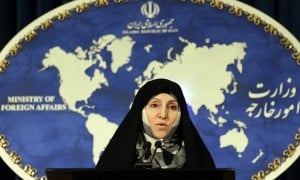
Moaveni (pictured left) is an intriguing author and I enjoyed her memoir. Iranian politics and history are, to me, complicated and I have pretty much no knowledge of them except for my undying love for Ahmadinejad (you think I’m joking, but I’m almost serious). I realize that her memoir is hardly representative to the experiences of Iranians as a whole. She only really represents the privileged class, which is usually a class that is often exempted from the rules of society and can get away with a lot more. I would really love to read a memoir from someone who was from the poorer, working class. Someone from southern Tehran. I would love to read a woman’s story of her time serving in the Morality Police, though I doubt anything of that sort will be hitting the bookstore shelves anytime soon.

Tweet
Tags: Azadeh Moaveni, Iran

[...] Jump to Comments My review of Lipstick Jihad was posted on Muslimah Media Watch. You can see it here if you’re interested. Or…you could just read it here, but the ladies at MMW added new [...]
I like this review. But I love this part most:
“if you keep something from the public eye, then it will become more desired by society, more scandalous when it is actually seen, and on the minds of the public even more”.
So true.
I have always had a huge interest in the nation that is Iran. What I cringe at is that every book even remotely related to Islam, has to stick the word “Jihad” in their title, in what I think is an effort to sell more books.
“I have pretty much no knowledge of them except for my undying love for Ahmadinejad.”
I know this makes no sense but I think his cute, I mean… his not handsome, but his very striking, minus the height and certain political policies. His very Charming…
I like Moaveni’s honesty, it doesn’t feel like she’s intentionally pushes these prejudices. And that line, “Unfortunately, once she gets to Tehran, she realizes that she feels like an outsider and a foreigner there as well.”, don’t we all want a place to belong? At least she tried it out.
Laila – I know, he’s so adorable lol
Moaveni, to many of us Iranians (and you can check the blogsphere for this) is the kiss of death. She has absolutely ZERO understanding of her surroundings and portrays a teeny, EXTREMELY small population of Tehran, – not even Iran – as the entire country.
Having books of this kind on the bookshelf is worse than not having anything on Iran because it provides such an distorted, skewed image.
In fact, I believe it is direct proof of the extreme ill intentions of The Times (the publication for which she was reporting) when they assign her as their Tehran correspondent.
Pedestrian,
“Having books of this kind on the bookshelf is worse than not having anything on Iran because it provides such an distorted, skewed image.”
I sincerely hope that your statement does not mean that you condone the banning of books, because that is the kind of justification used by paternalistic moral and intellectual guardians of the state to suppress critical thought and debate. There is more harm done in book banning because it insults the maturity and intelligence of many discerning readers. Not to make a mountain out of a molehill here folks, I haven’t read this book but I don’t think it’s insulting or blasphemous; it is merely the writer’s own experiences in Iran and the accuracy of her accounts is open to debate.
I read this book, and even though I was interested in Moaveni’s experiences, I walked away with a bad feeling. Because, like Sakina says, this really only reflects a small class of people in Iran.
I think the problem with this book is that it is taken to represent all of Iran and all Iranians. As an Iranian who grew up in the U.S., I have a lot of sympathy for her feeling out of place in Iran, which is why I read the book in the first place. But her experiences shouldn’t be taken at face value, nor should she be a mouthpiece for Iranians.
This is the main problem with books like these: though it’s a memoir, many refuse to see/market it that way and take it as a comprehensive report on Iranian life, which it isn’t. It’s a MEMOIR, meant to share a personal experience ONLY.
Banning books? Huh?
That’s not at all what I meant at all. “Having books of this kind is better than not having them at all” is an answer to those people who say having anything on Iran is better than nothing.
I disagree. There are things that are worse than nothing.
OF which this is one.
And I agree with Fatemeh, this is a personal memoir. Just like “Persepolis” was a personal memoir.
The trouble is that there is so little unbiased reporting out there on Iran … That memoirs become the fact of life. Do you know how many people took that film, or that book as “the” condition in Iran today? I’ve spoken to dozens of them and that’s what irks me all the more.
The problem is that her words are taken at face value and do become a mouthpiece for Iranians.
And I don’t think that’s all coincidental. Just like I don’t believe such horrendous portrayal of Muslims in general is just coincidental. There’s a GARGANTUAN media/political/economic machine that feeds off of this raped image. And the likes of Moaveni – knowingly or unknowingly – play straight into their hands.
Well, as a non-Muslim Westerner, I took Moaveni’s memoir–and Persepolis–as being just that. Personal memoirs. I found them both interesting and I’m glad they were published. I believe the experiences of the authors are valid. But I didn’t assume they represented all of Iran (Moaveni’s in particular–she was quite upfront about her outsider perspective).
This reminds me of the reactions of other Chinese Americans to Maxine Hong Kingston’s fictionalized memoir The Woman Warrior–but I think it is selling outside readers short to assume that we cannot take a memoir as a personal experience rather than representative of an entire culture. And I think it’s problematic that members of a non-dominant cultural group are not socially permitted the freedom to write a memoir–whether or not it’s “representative”–that white men, and to a lesser extent white women, have to share personal experiences without being assumed or expected to be “representative” (which I rather doubt anything can be).
I completely agree with Mel.
Why do all books about Iran have to ‘represent’ the Iranian people? Lipstick Jihad was a personal account of one individual, not the entire Iranian nation.
As an Iranian myself, I get so supremely annoyed by the defensive reaction of Iranians to any book or film having to do with this country. Whether it’s Persepolis, or Reading Lolita in Tehran, or Funny in Farsi, Iranians just get so darn defensive! You can’t represent a complex country like Iran in one book or magazine article, so Iranians should stop expecting a perfect reflection of their country. It’s impossible.
If the author was intentionally saying “This book represents all Iranian people”, I would be offended myself. But “Lipstick Jihad” wasn’t saying that, it’s just a personal account.
When Americans read this book, they know they’re getting one individuals’ account of an Iranian experience. And considering the other stuff that comes out about Iran by the neo-cons and Islamaphobes, aren’t you relieved reading a more nuanced personal memoir?
lol
I loved Funny in Farsi.
@Mel and Rochelle:
Although I can see what you’re saying, I don’t agree that the reader is that savvy. Sorry. This may seem offensive but too often when it comes to non North American cultures we in North America do tend to generalize. I mean hell, American’s don’t even know the diversity of Canadian culture let alone non-North American ones. I can’t tell you how many times Americans have seriously asked Canadians whether we all live in igloos, or whether they should bring their skis here in the summer (and keep in mind these are rich enough people be able to vacation in Canada, hence probably relatively educated)
Sorry, but if we Canadians get that kind of ignorance directed at our way of life then I honestly don’t have that much faith in what readers think of Iran and other non-North American cultures.
[...] New Zealand catwalk, look at Na’ima B. Roberts’ personal journal for the Times Online, review Azadeh Moaveni’s Lipstick Jihad, and crown ourselves queens of the Friday link list. [...]
I agree with (most of) you guys that this book should be taken as what it is: a personal memoir. Personally, I enjoyed it because I didn’t try and give it any special consideration or read it with the mentality: “this is going to represent all Iranians.”
That’s actually one of my pet peeves with many people who automatically assume that when we write, we’re trying to represent a “Muslim” viewpoint, when, in reality, we could just be talking about ourselves and our own experiences.
I’m an Iranian Woman whi lives in Iran . I know what azadeh said in her book . she is completely right . I realy enjoy her book because she described every thing good . I’m sorry for the ones who thinks Ahmadinejad is a right man just sorry for them …