Guest Post: It is time for Pagans to stop being Pagan

Find other posts related to this topic on the link round-up post!

I’ve been involved in MANY discussions trying to define what Pagans share.
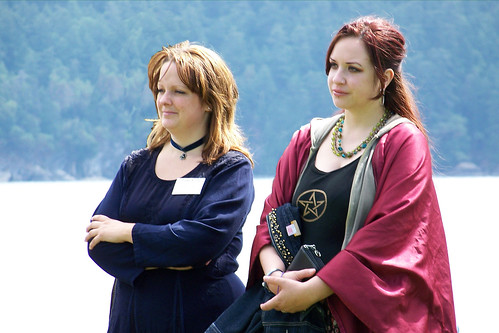
Nanaimo Pagan Pride Day 2009. By Kam's World via FlickrCC

Are we all:

  • Earth Centered?  Nope
  • Polytheists?  Nope
  • Sex Positive?  Nope
  • Goddess Based?  Nope
  • Peaceful?  Definitely Not

After LOTS of discussion, the end result is clear.  The ONE defining universal trait among Pagans is that WE ARE NOT CHRISTIANS. Even the Dictionary agrees!

pa·gan

n.

  • An adherent of a polytheistic religion in antiquity, especially when viewed in contrast to an adherent of a monotheistic religion.
  • A Neopagan.
  • Offensive

o    One who has no religion.

o    An adherent of a religion other than Judaism, Christianity, or Islam.

  • A hedonist.

If you think about it, the major reason that “Pagans” hang together is because it’s so nice to interact with people who don’t assume that we should act a certain way to be the right flavor of Jewish, Christian or Islamic.

But think carefully; how civil would Fundamentalist Asatru Culture be with Fundamentalist Ifa culture if they weren’t standing together against the 800lb Gorilla of Christianity?

Fundamentalism is a strict adherence to principles above other things.  It means that your principles are more important than even life itself. And, if you would die for your principles, nothing really stops you from being willing to kill or harm for them too.

Fundamentalism = Dangerous vs Bigger “Enemy”
Here is where the modern Pagan movement finds itself. We all know that in a Pagan-Christian war, the Pagans would die.   Even the dumbest of us know to be VERY careful to avoid flavors of Fundamentalism that would pit the Pagan Movement against the Christians.  If some Pagan starts making loud anti-Christian noise we disown them, and help shut them up.

This has ensured that most Pagans adopt and advocate a VERY good principle: Tolerance. We focus on being tolerant to everyone and their beliefs… well… except the Christians.

The very term Pagan functionally means “not Christian.”  Our situation has resulted in us displaying so many wonderful values, but our very title pushes us toward fear and separation.  Christians verses Pagans.  Us verses Them.

Adopting Universal Values
It is time to change this.  It is time to intentionally adopt values that are universal, re-title ourselves and grow past identifying ourselves as Pagan.

Of course then we would have to agree on Values and most of us can’t even agree on whether to walk the circle clockwise or counterclockwise… or even if there should BE a circle.  Thus…

Tolerance
I advocate that the most beautiful thing that the race, Pagan and GLBT movements have pushed into the public light be what we intentionally adopt and define as our shared guiding value.

Now I’m not pushing for universalism. I don’t want my prayers to start with “To whom it may concern” (joking).  However, rather than trying to figure out what we all share, I advocate that in tolerance, we agree to celebrate NOT SHARING. Let’s make the conscious decision to defend everyone’s right to practice our own weird faith… this time including the Christians.

So what name would we choose for this movement?  Tolerants?  Nah, too many syllables (we’ll say it a lot, it should have two or less syllables).

Aw heck… let’s make up a word.

1. Tolerance means Pagans and non-Pagans together.

2. Pagans AND Non-Pagans could become “Pagan and”

3. Remove another syllable and mash them together and you get “Pagand”

So that’s my thought.  Let’s keep it simple.   Let’s have pagans grow from being merely Pagan and start being PagAND.  It would be easy for to remember, easy to explain and we’re all used to saying pagan anyway.

Sure it seems silly, but it’s a little exciting that one letter could be the difference between focusing on excluding others and declaring that we are a part of a group with an intentional focus on living the wonderful principle of tolerance…

Of course, maybe not; I’m tolerant that way.

Scott Reimers
Power Before Wisdom

Comments

  1. Glenn says:

    I think Pagans stick together because in numbers there is power. Someday there will be enough of us to be a political force. Then “some people” will listen to us !

    • Glenn says:

      P.S. I don’t particularly like the term Pagan. I consider myself to be first and foremost Asatru. Pagan is more their term for us than my term for all non – Christian polytheist religions.

      • Glenn,

        The sticking point! Yes, you are Asatru. Yes, Pagan is their term for “not us.”

        The whole point of this article is to ask what we should consciously use to define “US” and what US should mean. I proposed a slightly silly word and that “US” should mean people who hold tolerance as a prime shared value.

        Do you propose something else?

        • Glenn says:

          Scott,

          I am Asatru, others are Wiccans, or Druids, etc…. Why do I need a second term to describe me ? Asatru means faith in the Aesir, that is all the description I need ! There is no us ! We are held together only by being the others, the outcasts if you will. I have no other bond with other Pagan religions other than that. Sorry !

          • huh. I hadn’t expected to hear that, but it makes sense.

            I wonder how common that is.

            Thanks and blessings on your path. :-)

          • Glenn says:

            May your way be clear of obstacles as well my friend !

          • Justin says:

            Scott,

            It is actually quite common in Heathenry. Heathens (Asatru/Forn Sed/Odinist/etc) are just that, Heathens. As was said, we fall into the umbrella term of Paganism by default. We see more closely eye to eye with other religions that fall under the umbrella, simply because there is more of a similarity. But that does not mean that we are the same. Everyone has their own path to follow, regardless of what they determine that it should be.

            I have heard before (and repeated often) if you get a group of 25 pagans in a room and ask a question, you’ll get 30 answers. Its like herding cats – can’t be done. While the goal of unifying the pagan community is admirable, Ill have to agree with Glenn – its only through being the “other.”

            Disclaimer: This is my opinion, I don’t speak for all of Heathenry. This is based off my interactions with the general Heathen community. Blah blah blah.

            -Justin

          • I feel like my personal path (an initiatory mystery witchcraft religion) also only falls under the pagan umbrella by default. It’s not something I personally identify as.

          • Anonymous says:

            It’s a pretty common idea amongst pretty much all religious reconstructionists I’ve known, myself (a Hellenist) included. My only real interest in the greater “Pagan (& Polytheist) Community” is the basic principle of strength in numbers. That’s not to say that there’s no other common ground between what I do and what, say, an ADF Druid does –indeed, this is more likely than having some sort of common religious ground with your average Christian, and even then, there may be some common ethics– but that I generally have little use for that greater community outside of ssome shared news of interest, and the occasional attendance at a large “Inter-Pagan” event.

          • Erin says:

            Scott, it is the primary reason that so many people prefer the term Reconstructionist Polytheist as an umbrella term over Pagan (which should really be Neopagan, to distinguish this particular community from others in the world who are merely pagan by Judeo-Christian definition, but do not affiliate with the Neopagan community at all, such as Hindus and those in ethnic tribal groups practicing their ancestral religious traditions).  There is only an ‘us’ when ‘we’ relate, but when we don’t there isn’t. 

          • Ian Phanes says:

            Do any the individuals you worship with participate in any other pagan practices than Asatru?

            If so, there is something linking you to the us.

          • Glenn says:

            I am somewhat of an outcast even as an Asatruar. That is why I started writing the blog An Independent Asatru. To answer your question, no. We believe the Eddas are sacred and follow the teachings of Sveinbjorn Beinteinsson, the first Allsherjargodi, of Iceland’s Asatru. Why would we stray from the Gods and Goddesses of our ancestors and who we love and honor so very much ?

          • Ian Phanes says:

            That’s not what I’ve seen here in East Central Illinois. There are Asatruar who are active in the local ADF protogrove. And there are others in the protogrove that are active in other pagan practices, creating cross-cutting ties with the larger pagan community. And there’s a young man who attends Pagans Night Out (a monthly social) who was raised in Asatru by his dad, and also works with chakras and such. From what I’ve seen in scholarship about heathens in general, such overlap is more common than not. (Which is not to say that the majority of heathens have multiple practices. All it takes to create cross-cutting ties is one or two folk in a given group that have multiple practices.)

            As for the question “Why would we stray…?”, what would you suggest to someone who is called both by one or more of the Aesir and is called by some Holy Powers from outside the Germanic cultural milieu? Do you think we have the right to tell the gods who they may or may not call?

            And to address another issue that you almost touch on… You write: “the Gods and Goddesses of our ancestors”. I am of mixed heritage: Irish, German, Welsh, Scottish, French, and English (that I know of). Who, then, are the gods of *my* ancestors? Should I tell Dionysos to leave me alone because I don’t have any ancestors from the Hellenistic world (unless you count the incursions of the Roman Empire into northwest Europe)?

            Please note, those really are questions for you to explore, not a veiled attack. You don’t need to answer them to me. But I think you owe it to yourself to answer them in your own head. (Or at least think about them. Some of them I don’t think have final answers.)

          • Anonymous says:

            I am a Heathen.  I am also a former Pagan Pride organizer, and put on events there and at the Gathering For Life on Earth and other pan-pagan events.  My personal pracitce is Heathen (Asatru), and my kindred (Heathen Freehold) is purely Asatru.  There is enough commonality of practice for ADF Druids to be common guests at my rites, and I at theirs.  I also frequently participate in open rituals with Wiccans and others following the basic laws of hospitality laid down by Odin in the Hamaval.  Follow your duties as guest or host, and you may write an Asatru ritual that is Asatru but welcoming to those of other faiths, or participate in an open ritual that springs from another tradition.

            I hold to my own gods, but know there are others.  My faith has much to teach me, but there are men and women of much wisdom on many paths, and it is good we learn from and inspire each other.  Heathenism teaches the building of communities, indeed heathen common law is still the basis for community law in the English speaking world.  We understand how to work together in harmony with those different from us.  We can learn from each other without watering down our practice.

    • Anonymous says:

      And when there are enough of ‘us’ to be a political force, we’ll manage to tear ourselves apart due to inherent differences of belief. That was the key to the success of Xtianity in the first place… syncretization. I’m still wondering why there is such insistence by pagans on being ‘officially’ recognized by the culture at large. I think it’s kind of silly to look for validation to a culture that only seeks to destroy everything we collectively preach.

      • Star Foster says:

        “I’m still wondering why there is such insistence by pagans on being ‘officially’ recognized by the culture at large.”

        Ask someone who is Shawnee the same question, and how it relates to their right to their culture and beliefs.

        • Glenn says:

          Thank You Star !

        • Anonymous says:

          You’re comparing apples and oranges. Pagans are largely low to middle class and white, with all its associated privileges. Comparing them to a conquered and now oppressed minority does little to support your argument.

          • Star Foster says:

            Thanks, because Pagans are a supported majority? I just watched a documentary on Massasoit and Tecumseh and felt it spoke well to the issues we face as a movement.

          • Kenneth says:

            Yes, and the whole point of our Constitution is that equal treatment by our own government is not something that has to be “earned” by being “black enough” or poor enough or oppressed enough. That’s a game that extremists on both the left and right like to play with us. The conservatives like to claim that anyone (besides white Christians) agitating for a place at the table is seeking “special rights.” The leftist believe that anyone who is white and middle class or better has no “right” to hold any grievance of any kind.

          • Anonymous says:

            The leftist believe that anyone who is white and middle class or better has no “right” to hold any grievance of any kind.

            As a far-left Socialist and some-one who’s been pulled over on account of DWP[Driving While Poor] in a rich neighbourhood, I find these people an embarrassment to the cause.

            All being “white” in the U$ means is that next to nobody assumes that your skin colour is the reason for all your problems or your neighbours problems. At the same time, though, there is intersectionality at play, and if you obviously have a low income, are perceived to be of the wrong social class, aren’t heterosexual and/or cisgender, aren’t Christian, wrong weight, wrong height, and on and on…, suddenly you realise that being “white” is not synonimous with “free from problems”. Any discussion of social -isms that doesn’t consider intersectionality is essentially useless, as it grossly oversimplifies how oppressions from the overculture actually work.

          • Anonymous says:

            You were pulled over in a rich neighborhood because you were poor??

          • Well, more accurately because it was assumed that nobody who had any reason to be there would be driving a ’93 Neon with no front bumper (and we really couldn’t afford to get it fixed) — even though I was hired as a wedding photographer.  Cops followed me and my boyfriend at the time (cos I don’t drive) all the way to the church after it was finally sorted out, and parked outside the whole time, too, just to follow us out of town.  And that’s just the most recent example — don’t get me started on all the times I went with my father in his “rag n’ bones” truck to pick up broken fridges and like from hoity-toidy sub-divisions.  So yeah, I’m sick of middle class sociology students getting in my face cos I’m pale and thus somehow “don’t know what real oppression is, not like what ‘POC’s face”.

            Seriously, if those kids wanted to *really* get the vaguest idea what it might be like to be the only black or Mexican kid at an all-white neighbourhood or school, they’d dye their hair blue and drive around rich neighbourhoods in a hoopty car — but that’s too much trouble for them, so they take ivy-league (or aspiring) soc- classes, preferably headed by a “token minority” prof so they can put on good-guy badges and feel like they’re levelling playing-fields.

          • Kauko says:

            Speaking on behalf of my Finno-Ugric ancestors and all modern Finno-Ugric people I have to point out that the world is not so easily divided into privileged ‘white’ people and everyone else as you would make it. I bring up my Finno-Ugric heritage because Finno-Ugric peoples have long been minorities in a sea of Indo-Europeans and subject to their power. Today, only 3 Finno-Ugric peoples have their own nations, the Finns (who only gained indpendence as their own nation in the 20th century after being passed between Sweden and Russia for 800 years), Estonians and Hungarians, all the rest are minorities in other countries, mostly Russia and Scandinavia. As minorities they have had to struggle to preserve their distinct cultures, languages etc from governments that have tried for centuries to assimilate them into the dominant and privileged majorities. The Sami, especially, have had a struggle much like that of Native Americans, as well as having a traditional culture very much like that of other indigenous arctic peoples (the Sami are also the only European people classified by the UN as an indigenous people). Starting around the 17th century Christian missionaries began to forcibly convert the Sami people, almost all Sami shaman drums were confiscated during this time (with a few surviving, mostly in museums currently). During the 19th through the 20th centuries the governments in countries like Norway and Sweden prohibited the Sami from speaking their own languages, Sami children were sent to schools where they were only taught the dominant language and culture (Norwegian or Swedish) and prohibited from speaking the Sami languages at all. Anyone knowledgeable about the history of native Americans knows that the American government did they exact same thing here to native peoples. The Sami have made great progress in getting their rights and saving this languages and culture from extinction, but many other Uralic language groups (the language family to which the Finno-Ugric peoples belong, which stretches from northern Europe to Siberia) in Russia are still fighting for those rights and to preserve their heritage. My point being that these people are also Europeans, i.e. white, and they don’t exist in the bubble of absolute privilege you would ascribe to all ‘white’ people.

          • Anonymous says:

            Actually, looking at the history of early Christianity’s rise, the comparison is quite easy to make. The meme that “early conversion of Europe to Christianity was peaceful” is a fallacy –nothing more than later Christian propaganda and white-washing– and needs to die.

            Yes, you have a point that there’s a big difference between said and modern Pagans & Polytheists, but oppression is oppression, no matter what slice you get, and “Oppression Olympics” is always designed to have no winners.

        • This is the best point made so far I have read. Until we stand up for our rights, gather together, become more organized…and take advantage of that Labeling of the Government that gives us rights…we have none.

          All of this dissection, delineation, and arguing over I am this and not that…makes no difference in the end….At a Pagan festival, let me learn from you, but to the public you have to be united…Pagan is fine with me, and so is Wiccan if you want to let me exercise my US rights to worship under it…but technically I am Kemetic.

          • I agree to use the term pagan for political expediency and cultural shorthand. But it no more defines me than “middle class” does. I think we can organize politically without using a term that is supposed to define us all but doesn’t. Coalitions can embrace multiple identities and do the same thing.

        • This is the best point made so far I have read. Until we stand up for our rights, gather together, become more organized…and take advantage of that Labeling of the Government that gives us rights…we have none.

          All of this dissection, delineation, and arguing over I am this and not that…makes no difference in the end….At a Pagan festival, let me learn from you, but to the public you have to be united…Pagan is fine with me, and so is Wiccan if you want to let me exercise my US rights to worship under it…but technically I am Kemetic.

  2. Glenn says:

    I think Pagans stick together because in numbers there is power. Someday there will be enough of us to be a political force. Then “some people” will listen to us !

    • Glenn says:

      P.S. I don’t particularly like the term Pagan. I consider myself to be first and foremost Asatru. Pagan is more their term for us than my term for all non – Christian polytheist religions.

      • Glenn,

        The sticking point! Yes, you are Asatru. Yes, Pagan is their term for “not us.”

        The whole point of this article is to ask what we should consciously use to define “US” and what US should mean. I proposed a slightly silly word and that “US” should mean people who hold tolerance as a prime shared value.

        Do you propose something else?

        • Glenn says:

          Scott,

          I am Asatru, others are Wiccans, or Druids, etc…. Why do I need a second term to describe me ? Asatru means faith in the Aesir, that is all the description I need ! There is no us ! We are held together only by being the others, the outcasts if you will. I have no other bond with other Pagan religions other than that. Sorry !

          • huh. I hadn’t expected to hear that, but it makes sense.

            I wonder how common that is.

            Thanks and blessings on your path. :-)

          • Glenn says:

            May your way be clear of obstacles as well my friend !

          • Justin says:

            Scott,

            It is actually quite common in Heathenry. Heathens (Asatru/Forn Sed/Odinist/etc) are just that, Heathens. As was said, we fall into the umbrella term of Paganism by default. We see more closely eye to eye with other religions that fall under the umbrella, simply because there is more of a similarity. But that does not mean that we are the same. Everyone has their own path to follow, regardless of what they determine that it should be.

            I have heard before (and repeated often) if you get a group of 25 pagans in a room and ask a question, you’ll get 30 answers. Its like herding cats – can’t be done. While the goal of unifying the pagan community is admirable, Ill have to agree with Glenn – its only through being the “other.”

            Disclaimer: This is my opinion, I don’t speak for all of Heathenry. This is based off my interactions with the general Heathen community. Blah blah blah.

            -Justin

          • I feel like my personal path (an initiatory mystery witchcraft religion) also only falls under the pagan umbrella by default. It’s not something I personally identify as.

          • It’s a pretty common idea amongst pretty much all religious reconstructionists I’ve known, myself (a Hellenist) included. My only real interest in the greater “Pagan (& Polytheist) Community” is the basic principle of strength in numbers. That’s not to say that there’s no other common ground between what I do and what, say, an ADF Druid does –indeed, this is more likely than having some sort of common religious ground with your average Christian, and even then, there may be some common ethics– but that I generally have little use for that greater community outside of ssome shared news of interest, and the occasional attendance at a large “Inter-Pagan” event.

          • Erin says:

            Scott, it is the primary reason that so many people prefer the term Reconstructionist Polytheist as an umbrella term over Pagan (which should really be Neopagan, to distinguish this particular community from others in the world who are merely pagan by Judeo-Christian definition, but do not affiliate with the Neopagan community at all, such as Hindus and those in ethnic tribal groups practicing their ancestral religious traditions).  There is only an ‘us’ when ‘we’ relate, but when we don’t there isn’t. 

          • Ian Phanes says:

            Do any the individuals you worship with participate in any other pagan practices than Asatru?

            If so, there is something linking you to the us.

          • Glenn says:

            I am somewhat of an outcast even as an Asatruar. That is why I started writing the blog An Independent Asatru. To answer your question, no. We believe the Eddas are sacred and follow the teachings of Sveinbjorn Beinteinsson, the first Allsherjargodi, of Iceland’s Asatru. Why would we stray from the Gods and Goddesses of our ancestors and who we love and honor so very much ?

          • Ian Phanes says:

            That’s not what I’ve seen here in East Central Illinois. There are Asatruar who are active in the local ADF protogrove. And there are others in the protogrove that are active in other pagan practices, creating cross-cutting ties with the larger pagan community. And there’s a young man who attends Pagans Night Out (a monthly social) who was raised in Asatru by his dad, and also works with chakras and such. From what I’ve seen in scholarship about heathens in general, such overlap is more common than not. (Which is not to say that the majority of heathens have multiple practices. All it takes to create cross-cutting ties is one or two folk in a given group that have multiple practices.)

            As for the question “Why would we stray…?”, what would you suggest to someone who is called both by one or more of the Aesir and is called by some Holy Powers from outside the Germanic cultural milieu? Do you think we have the right to tell the gods who they may or may not call?

            And to address another issue that you almost touch on… You write: “the Gods and Goddesses of our ancestors”. I am of mixed heritage: Irish, German, Welsh, Scottish, French, and English (that I know of). Who, then, are the gods of *my* ancestors? Should I tell Dionysos to leave me alone because I don’t have any ancestors from the Hellenistic world (unless you count the incursions of the Roman Empire into northwest Europe)?

            Please note, those really are questions for you to explore, not a veiled attack. You don’t need to answer them to me. But I think you owe it to yourself to answer them in your own head. (Or at least think about them. Some of them I don’t think have final answers.)

          • Anonymous says:

            I am a Heathen.  I am also a former Pagan Pride organizer, and put on events there and at the Gathering For Life on Earth and other pan-pagan events.  My personal pracitce is Heathen (Asatru), and my kindred (Heathen Freehold) is purely Asatru.  There is enough commonality of practice for ADF Druids to be common guests at my rites, and I at theirs.  I also frequently participate in open rituals with Wiccans and others following the basic laws of hospitality laid down by Odin in the Hamaval.  Follow your duties as guest or host, and you may write an Asatru ritual that is Asatru but welcoming to those of other faiths, or participate in an open ritual that springs from another tradition.

            I hold to my own gods, but know there are others.  My faith has much to teach me, but there are men and women of much wisdom on many paths, and it is good we learn from and inspire each other.  Heathenism teaches the building of communities, indeed heathen common law is still the basis for community law in the English speaking world.  We understand how to work together in harmony with those different from us.  We can learn from each other without watering down our practice.

    • Anonymous says:

      And when there are enough of ‘us’ to be a political force, we’ll manage to tear ourselves apart due to inherent differences of belief. That was the key to the success of Xtianity in the first place… syncretization. I’m still wondering why there is such insistence by pagans on being ‘officially’ recognized by the culture at large. I think it’s kind of silly to look for validation to a culture that only seeks to destroy everything we collectively preach.

      • Star Foster says:

        “I’m still wondering why there is such insistence by pagans on being ‘officially’ recognized by the culture at large.”

        Ask someone who is Shawnee the same question, and how it relates to their right to their culture and beliefs.

        • Glenn says:

          Thank You Star !

        • Anonymous says:

          You’re comparing apples and oranges. Pagans are largely low to middle class and white, with all its associated privileges. Comparing them to a conquered and now oppressed minority does little to support your argument.

          • Star Foster says:

            Thanks, because Pagans are a supported majority? I just watched a documentary on Massasoit and Tecumseh and felt it spoke well to the issues we face as a movement.

          • Kenneth says:

            Yes, and the whole point of our Constitution is that equal treatment by our own government is not something that has to be “earned” by being “black enough” or poor enough or oppressed enough. That’s a game that extremists on both the left and right like to play with us. The conservatives like to claim that anyone (besides white Christians) agitating for a place at the table is seeking “special rights.” The leftist believe that anyone who is white and middle class or better has no “right” to hold any grievance of any kind.

          • The leftist believe that anyone who is white and middle class or better has no “right” to hold any grievance of any kind.

            As a far-left Socialist and some-one who’s been pulled over on account of DWP[Driving While Poor] in a rich neighbourhood, I find these people an embarrassment to the cause.

            All being “white” in the U$ means is that next to nobody assumes that your skin colour is the reason for all your problems or your neighbours problems. At the same time, though, there is intersectionality at play, and if you obviously have a low income, are perceived to be of the wrong social class, aren’t heterosexual and/or cisgender, aren’t Christian, wrong weight, wrong height, and on and on…, suddenly you realise that being “white” is not synonimous with “free from problems”. Any discussion of social -isms that doesn’t consider intersectionality is essentially useless, as it grossly oversimplifies how oppressions from the overculture actually work.

          • Anonymous says:

            You were pulled over in a rich neighborhood because you were poor??

            I agree with the rest of what you said.

          • Well, more accurately because it was assumed that nobody who had any reason to be there would be driving a ’93 Neon with no front bumper (and we really couldn’t afford to get it fixed) — even though I was hired as a wedding photographer.  Cops followed me and my boyfriend at the time (cos I don’t drive) all the way to the church after it was finally sorted out, and parked outside the whole time, too, just to follow us out of town.  And that’s just the most recent example — don’t get me started on all the times I went with my father in his “rag n’ bones” truck to pick up broken fridges and like from hoity-toidy sub-divisions.  So yeah, I’m sick of middle class sociology students getting in my face cos I’m pale and thus somehow “don’t know what real oppression is, not like what ‘POC’s face”.

            Seriously, if those kids wanted to *really* get the vaguest idea what it might be like to be the only black or Mexican kid at an all-white neighbourhood or school, they’d dye their hair blue and drive around rich neighbourhoods in a hoopty car — but that’s too much trouble for them, so they take ivy-league (or aspiring) soc- classes, preferably headed by a “token minority” prof so they can put on good-guy badges and feel like they’re levelling playing-fields.

          • Kauko says:

            Speaking on behalf of my Finno-Ugric ancestors and all modern Finno-Ugric people I have to point out that the world is not so easily divided into privileged ‘white’ people and everyone else as you would make it. I bring up my Finno-Ugric heritage because Finno-Ugric peoples have long been minorities in a sea of Indo-Europeans and subject to their power. Today, only 3 Finno-Ugric peoples have their own nations, the Finns (who only gained indpendence as their own nation in the 20th century after being passed between Sweden and Russia for 800 years), Estonians and Hungarians, all the rest are minorities in other countries, mostly Russia and Scandinavia. As minorities they have had to struggle to preserve their distinct cultures, languages etc from governments that have tried for centuries to assimilate them into the dominant and privileged majorities. The Sami, especially, have had a struggle much like that of Native Americans, as well as having a traditional culture very much like that of other indigenous arctic peoples (the Sami are also the only European people classified by the UN as an indigenous people). Starting around the 17th century Christian missionaries began to forcibly convert the Sami people, almost all Sami shaman drums were confiscated during this time (with a few surviving, mostly in museums currently). During the 19th through the 20th centuries the governments in countries like Norway and Sweden prohibited the Sami from speaking their own languages, Sami children were sent to schools where they were only taught the dominant language and culture (Norwegian or Swedish) and prohibited from speaking the Sami languages at all. Anyone knowledgeable about the history of native Americans knows that the American government did they exact same thing here to native peoples. The Sami have made great progress in getting their rights and saving this languages and culture from extinction, but many other Uralic language groups (the language family to which the Finno-Ugric peoples belong, which stretches from northern Europe to Siberia) in Russia are still fighting for those rights and to preserve their heritage. My point being that these people are also Europeans, i.e. white, and they don’t exist in the bubble of absolute privilege you would ascribe to all ‘white’ people.

          • Actually, looking at the history of early Christianity’s rise, the comparison is quite easy to make. The meme that “early conversion of Europe to Christianity was peaceful” is a fallacy –nothing more than later Christian propaganda and white-washing– and needs to die.

            Yes, you have a point that there’s a big difference between said and modern Pagans & Polytheists, but oppression is oppression, no matter what slice you get, and “Oppression Olympics” is always designed to have no winners.

        • This is the best point made so far I have read. Until we stand up for our rights, gather together, become more organized…and take advantage of that Labeling of the Government that gives us rights…we have none.

          All of this dissection, delineation, and arguing over I am this and not that…makes no difference in the end….At a Pagan festival, let me learn from you, but to the public you have to be united…Pagan is fine with me, and so is Wiccan if you want to let me exercise my US rights to worship under it…but technically I am Kemetic.

          • I agree to use the term pagan for political expediency and cultural shorthand. But it no more defines me than “middle class” does. I think we can organize politically without using a term that is supposed to define us all but doesn’t. Coalitions can embrace multiple identities and do the same thing.

  3. As the outliers of the majorty christian/islam world in the west Pagans tend to fall together under an umbrella term. We tend to fill our circles both ritual and social with not so much people who are on the same faith path as we are. But people who are not of the majorty, The common thread that binds most Pagans seems to be is the shared experance of people finding a path with a blend of self exploration and exploration of a path.

    Does it truely matter if the person i seek councle with is a follower of a native practice,asatru or Kemetic? if they are otherkin,wiccan,druid or even hindu? Yes and no. Everyone uses there path as a honeing stone of wisdom, As a guide in there daily life and as a begining of a framework for there relaton with the nature, community and daity. If you seeked councle with anyone each will give you somewhat diffrent advice, But each of there advices is as much a reflection of them and there path, As well as the wisdom that is in it. But each is also a refined advice, and by and large all should prove to be fruitful

    what i still admire about many people who follow pagan paths…is they know and understand on many levels that they are not practiceing and liveing the only way. But they are on the path they need to be, for as long as they need to be on it. When ever i find someone i disagree with…i know wisdom is to be found for all if we choose.

    what i hope to see is a future were people can be as comfortable seeking out any person who is on a path when they need advice, as per the nature of the advice sought. and in so many ways….it is also my hope that pagans lead by example. athough in many ways it is taboo, but many of our paths deal in energy work, communion with the divine or nature, ritual for an end or ritual to honor, as the case may be. we should not forget the subtle ways of influanceing the world that we share. the words spoken today may have an echo that lasts a thousand years.

  4. As the outliers of the majorty christian/islam world in the west Pagans tend to fall together under an umbrella term. We tend to fill our circles both ritual and social with not so much people who are on the same faith path as we are. But people who are not of the majorty, The common thread that binds most Pagans seems to be is the shared experance of people finding a path with a blend of self exploration and exploration of a path.

    Does it truely matter if the person i seek councle with is a follower of a native practice,asatru or Kemetic? if they are otherkin,wiccan,druid or even hindu? Yes and no. Everyone uses there path as a honeing stone of wisdom, As a guide in there daily life and as a begining of a framework for there relaton with the nature, community and daity. If you seeked councle with anyone each will give you somewhat diffrent advice, But each of there advices is as much a reflection of them and there path, As well as the wisdom that is in it. But each is also a refined advice, and by and large all should prove to be fruitful

    what i still admire about many people who follow pagan paths…is they know and understand on many levels that they are not practiceing and liveing the only way. But they are on the path they need to be, for as long as they need to be on it. When ever i find someone i disagree with…i know wisdom is to be found for all if we choose.

    what i hope to see is a future were people can be as comfortable seeking out any person who is on a path when they need advice, as per the nature of the advice sought. and in so many ways….it is also my hope that pagans lead by example. athough in many ways it is taboo, but many of our paths deal in energy work, communion with the divine or nature, ritual for an end or ritual to honor, as the case may be. we should not forget the subtle ways of influanceing the world that we share. the words spoken today may have an echo that lasts a thousand years.

  5. I think most Christo-pagans would disagree with your first bold point.

    • lol. Behold! The power of a living language!

      I could spend a lot of time arguing that my statement is legitimate and your could spend a lot arguing that yours is as well.

      I came from a background of Fundamentalist Christianity. For a while I tried to walk both paths. After years I finally decided that I could not walk both as I understood them and chose to walk away from the zombie (walking dead) faith I held as a child (not saying all Christianity is a zombie faith, but that the flavor I practiced was).

      Ironically after years of walking I’ve come to a VERY non-biblical understanding of Christ which aligns strongly with my path. In this light I MIGHT understand the hyphenated term Christo-pagan. How have you experienced Christo-pagans?

      • Illiezeulette says:

        Interesting, about the zombie faith bit. Do you react similarly to Osiris and the God of the Wicca faith, who both have very heavy death-rebirth tones, yet are non-Christian?

        • rofl. My statement about Zombie faith had nothing to do with the death and resurrection of Christ. The statement of Zombie faith was specifically regarding how I practiced a faith of rules and law that was no longer living. My faith was active and dead… thus… zombie.

          • Illiezeulette says:

            OH. Ha. I get it now (:
            It’s also Easter today, and “zombie Jesus” is on my mind. :P

    • Anonymous says:

      Most christo-pagans are confused about their paths anyway. You don’t get to fully embrace a tradition of witchcraft (just as an example) by sitting on the fence about christianity. There’s a word for christo-pagans already established. It’s ‘protestant’.

      • Illiezeulette says:

        Hi, I am a Christo-Pagan, I am definitely not confused about my path, and I strongly disagree that Christo-Pagans are confused, carry baggage from their only-Christian days, or “sit on the fence.” My interpretations of Christos, Sophia, Yeshua, Miryam, and others of the wider Christian pantheon are explicitly modern Gnostic and blend extremely well with other elements of my practice. There isn’t a “Christian side” and a “Neo-Pagan side” of my practice… the whole thing is cohesive. I can speak about this at length via e-mail if you’d like. In short, Yeshua/Christ is “just another god” to me.

        Also, I would argue that Protestantism is much, MUCH further from Paganism than Catholicism (Eastern or Roman) is, excepting perhaps some Episcopalians and Lutherans.

        • Anonymous says:

          “In short, Yeshua/Christ is “just another god” to me. ”

          And that’s precisely the part that identifies you as NOT a christian… at least according to all of the versions of christianity I’ve encountered. It’s a boolean religion… you either believe Jesus is THE way, THE Truth and THE light or you don’t. It’s not a religion that shares you’re view on Christ Jesus. You can’t have it both ways, by their reckoning.

          • Illiezeulette says:

            Gnostic Christianity. Look it up, both ancient and modern versions. Also check out the history of the creation of Christian canon and the relationship between Gnostic and proto-Orthodox Christianities in the 50s-300s CE. (Short version is that the creation of canon and persecution of Gnostics wiped out most forms of Gnosticism. Some survived all the way into modernity, like the Mandeans.)

            Also, your definition of Christianity potentially excludes forms of progressive and liberal Christianity. Heck, most Christians I know at my university don’t fit the exclusivist definition you gave. Even the RCC thinks that people like Gandhi likely made it into Heaven.

            Furthermore, I never identified as a Christian. I identify as Christo-Pagan. Totally different. (:

          • KoraKaos says:

            Also, once one has spent time studying, contemplating, and finally just realizing/knowing (gnowing!) the nature of Light, one realizes that there is no issue knowing Christ as the Way/Truth/Life/Light and following a polytheistic path as well. Monotheists and polytheists have often told me they think these “ideas” to be mutually exclusive, but physics (nature/truth) tells me this is not so. I go both ways =D

      • Ian Phanes says:

        Through the later 1980′s and 90s, I used to joke: “I gave up Christianity for Lent. But since I wasn’t Christian anymore, Easter never came.”

        During those years, I didn’t just “embrace a tradition of witchcraft,” I founded one. (Well, a lineage. We don’t tend to describe ContraryWise Craft as a tradition.) Then, in 1998, I did also “embrace a tradition of witchcraft”, receiving initiation into a lineage descending from NECTW.

        And then…Easter came. Throughout the years that I was distinctly not Christian, I would usually attend Midnight Mass, and often some or all of the Triduum, because I was moved by the beauty of their mysteries. (I would also usually go to church around Samhain, to honor my ancestors in their context.) In 2000, something different happened. Jesus reached out to me. I’ve had enough gods establish relationships with me over the years that recognized the experience, though I certainly wasn’t expecting it.

        I’m not confused about my path. I’m a monistic-polytheist whose personal relationships happen to include Jesus and his Father. (I am not a Trinitarian; I see Jesus as a deified demi-god, like Dionysos.)

        As for “sitting on the fence,” multiple religious practices is the hallmark of all paganisms, traditional and modern. By that, I mean that individuals in pagan cultures (including ours) frequently practice more than one cult but not all of the cults in the culture. Those cross-cutting ties between the various cults are what weave together a pagan culture.

        I am not an orthodox Christian, and I don’t claim to be. (Then again, I’ve never been orthodox as a pagan, either.) When I told the rector of the church I started attending after my connection with Jesus that I was pagan, he said it was fine for me to join that church, so I did. A decade later, I rejoice in an additional faith community, though it can make my spiritual calendar a bit full at times.

        One last thing: I am not a Christo-pagan, in any syncretic sense. I am a Christian, and a ContraryWise Witch, and a member of the Hermetic Order of the Celtic Cross, and a Wiccan Witch; but I don’t “cross the streams”.

  6. I think most Christo-pagans would disagree with your first bold point.

    • lol. Behold! The power of a living language!

      I could spend a lot of time arguing that my statement is legitimate and you could spend a lot arguing that yours is as well.

      I came from a background of Fundamentalist Christianity. For a while I tried to walk my christianity and this new undefined path. After years, I finally decided that I could not walk both as I understood them and chose to walk away from the zombie (walking dead) faith I held as a child (not saying all Christianity is a zombie faith, but that the flavor I practiced was).

      Ironically after years of walking I’ve come to a VERY non-biblical understanding of Christ which aligns strongly with my path. In this light I MIGHT understand the hyphenated term Christo-pagan.

      How have you experienced Christo-pagans?

      • Illiezeulette says:

        Interesting, about the zombie faith bit. Do you react similarly to Osiris and the God of the Wicca faith, who both have very heavy death-rebirth tones, yet are non-Christian?

        • rofl. My statement about Zombie faith had nothing to do with the death and resurrection of Christ. The statement of Zombie faith was specifically regarding how I practiced a faith of rules and law that was no longer living. My faith was active and dead… thus… zombie.

          • Illiezeulette says:

            OH. Ha. I get it now (:
            It’s also Easter today, and “zombie Jesus” is on my mind. :P

    • Anonymous says:

      Most christo-pagans are confused about their paths anyway. You don’t get to fully embrace a tradition of witchcraft (just as an example) by sitting on the fence about christianity. There’s a word for christo-pagans already established. It’s ‘protestant’.

      • Illiezeulette says:

        Hi, I am a Christo-Pagan, I am definitely not confused about my path, and I strongly disagree that Christo-Pagans are confused, carry baggage from their only-Christian days, or “sit on the fence.” My interpretations of Christos, Sophia, Yeshua, Miryam, and others of the wider Christian pantheon are explicitly modern Gnostic and blend extremely well with other elements of my practice. There isn’t a “Christian side” and a “Neo-Pagan side” of my practice… the whole thing is cohesive. I can speak about this at length via e-mail if you’d like. In short, Yeshua/Christ is “just another god” to me.

        Also, I would argue that Protestantism is much, MUCH further from Paganism than Catholicism (Eastern or Roman) is, excepting perhaps some Episcopalians and Lutherans.

        • Anonymous says:

          “In short, Yeshua/Christ is “just another god” to me. ”

          And that’s precisely the part that identifies you as NOT a christian… at least according to all of the versions of christianity I’ve encountered. It’s a boolean religion… you either believe Jesus is THE way, THE Truth and THE light or you don’t. It’s not a religion that shares you’re view on Christ Jesus. You can’t have it both ways, by their reckoning.

          • Illiezeulette says:

            Gnostic Christianity. Look it up, both ancient and modern versions. Also check out the history of the creation of Christian canon and the relationship between Gnostic and proto-Orthodox Christianities in the 50s-300s CE. (Short version is that the creation of canon and persecution of Gnostics wiped out most forms of Gnosticism. Some survived all the way into modernity, like the Mandeans.)

            Also, your definition of Christianity potentially excludes forms of progressive and liberal Christianity. Heck, most Christians I know at my university don’t fit the exclusivist definition you gave. Even the RCC thinks that people like Gandhi likely made it into Heaven.

            Furthermore, I never identified as a Christian. I identify as Christo-Pagan. Totally different. (:

          • KoraKaos says:

            Also, once one has spent time studying, contemplating, and finally just realizing/knowing (gnowing!) the nature of Light, one realizes that there is no issue knowing Christ as the Way/Truth/Life/Light and following a polytheistic path as well. Monotheists and polytheists have often told me they think these “ideas” to be mutually exclusive, but physics (nature/truth) tells me this is not so. I go both ways =D

      • Ian Phanes says:

        Through the later 1980′s and 90s, I used to joke: “I gave up Christianity for Lent. But since I wasn’t Christian anymore, Easter never came.”

        During those years, I didn’t just “embrace a tradition of witchcraft,” I founded one. (Well, a lineage. We don’t tend to describe ContraryWise Craft as a tradition.) Then, in 1998, I did also “embrace a tradition of witchcraft”, receiving initiation into a lineage descending from NECTW.

        And then…Easter came. Throughout the years that I was distinctly not Christian, I would usually attend Midnight Mass, and often some or all of the Triduum, because I was moved by the beauty of their mysteries. (I would also usually go to church around Samhain, to honor my ancestors in their context.) In 2000, something different happened. Jesus reached out to me. I’ve had enough gods establish relationships with me over the years that recognized the experience, though I certainly wasn’t expecting it.

        I’m not confused about my path. I’m a monistic-polytheist whose personal relationships happen to include Jesus and his Father. (I am not a Trinitarian; I see Jesus as a deified demi-god, like Dionysos.)

        As for “sitting on the fence,” multiple religious practices is the hallmark of all paganisms, traditional and modern. By that, I mean that individuals in pagan cultures (including ours) frequently practice more than one cult but not all of the cults in the culture. Those cross-cutting ties between the various cults are what weave together a pagan culture.

        I am not an orthodox Christian, and I don’t claim to be. (Then again, I’ve never been orthodox as a pagan, either.) When I told the rector of the church I started attending after my connection with Jesus that I was pagan, he said it was fine for me to join that church, so I did. A decade later, I rejoice in an additional faith community, though it can make my spiritual calendar a bit full at times.

        One last thing: I am not a Christo-pagan, in any syncretic sense. I am a Christian, and a ContraryWise Witch, and a member of the Hermetic Order of the Celtic Cross, and a Wiccan Witch; but I don’t “cross the streams”.

  7. KoraKaos says:

    I’m both =/ I am Catholic and an adherant to many non-Abrahamic traditions as well. The traditions of Christ, Dionysos, Shiva, Mars- oh, I cannot count the names.

  8. KoraKaos says:

    I’m both =/ I am Catholic and an adherant to many non-Abrahamic traditions as well. The traditions of Christ, Dionysos, Shiva, Mars- oh, I cannot count the names.

  9. Lizzclements says:

    It seems to me that the best way to move forward is to establish groups that are less theology based and more interest driven. As an example, a Hellenistic cooperative instead of a Hellenistic church. The benefits of such groups would include creating a unified front, networking, moving toward community goals, and more. But I think a lot of smaller groups that affiliate with one another would be better than a large council or association because our interests are so diverse.

    • Hellenistic cooperative?? I don’t like the sound of that. It’s like calling them “spring spheres” in order to be more politically correct. If you’re going to have a Hellenistic Temple, then it should be just that–a Hellenistic Temple. It shouldn’t have anything to do with the rest of it. It should be a place where you can find religious texts, or at least good books on the subject, speak to others of the faith to gain understanding or talk about a problem, be a haven for those of the religion, and be a general place of learning specifically for Hellenion, etc.
      Making it a “cooperative” I think would turn away more Hellenists (continuing the example) than it would draw in. It would focus more on the society and how we should all be unified, while really downplaying the key points in the religion in the hopes that someone who practices it differently whether by a lot or a little won’t get upset, offended, or feel left out.

  10. Lizzclements says:

    It seems to me that the best way to move forward is to establish groups that are less theology based and more interest driven. As an example, a Hellenistic cooperative instead of a Hellenistic church. The benefits of such groups would include creating a unified front, networking, moving toward community goals, and more. But I think a lot of smaller groups that affiliate with one another would be better than a large council or association because our interests are so diverse.

    • Hellenistic cooperative?? I don’t like the sound of that. It’s like calling them “spring spheres” in order to be more politically correct. If you’re going to have a Hellenistic Temple, then it should be just that–a Hellenistic Temple. It shouldn’t have anything to do with the rest of it. It should be a place where you can find religious texts, or at least good books on the subject, speak to others of the faith to gain understanding or talk about a problem, be a haven for those of the religion, and be a general place of learning specifically for Hellenion, etc.
      Making it a “cooperative” I think would turn away more Hellenists (continuing the example) than it would draw in. It would focus more on the society and how we should all be unified, while really downplaying the key points in the religion in the hopes that someone who practices it differently whether by a lot or a little won’t get upset, offended, or feel left out.

  11. Scott, I think that you are right that descriptions of Paganism seem froth with subjectivity. There is another problem with the word “pagan.” It has long been use in a derogatory form. Even in the light of religious tolerance; Pagan still lacks many of the positive connotations afforded other religions. In order to address these twin plights of bringing precision and positive meaning to Pagan, I suggest that the ancient Greek word Єύσέβεia may be used as a central theme of Pagan religion, the idea of piety as Pagan religion. I suggest that at the heart of Paganism is piety; be it reverence for the gods, earth, or other humans. Piety is the right action towards a relationship.

    • Interesting. However peity as a group name would be… challenging. Could you repost the phoenitics of the original greek term in symbols most of us would understand?

      • P. Sufenas Virius Lupus says:

        You might recognize the term, Scott: it’s literally “eusebeia”; the Christian church father/historian Eusebius of Caesarea has a name based on that noun/concept…

        Though I like the suggestion, I don’t know if I agree with it as a good moniker, personally, or even as a uniting factor amongst modern pagans of various stripes. There’s an awful lot of non-recons, for example, who do not want to see the gods as beings that they “worship,” or that are in any way superior to them…the idea of “not bowing your head” and so forth is pretty ingrained in many people. And while one’s feelings of piety do not need to include such gestures or concepts, that does tend to be the first thing people jump to when thinking in that particular vocabulary.

      • Thanks Reimers (P. Sufenas Virius Lupus) for giving the phoenitics “esuebeia” a Greek word. For my basic definition of Єύσέβεia (Esuebeia) I used Laszlo Versény’s understanding and terms from his “Holiness and Justice: An Interpretation of Plato’s Euthyphro.” Where eu is ‘rightly,’ ‘properly,’ ‘well;’ and sebein is ‘to fear,’ ‘revere,’ ‘be in awe of.’ I find it interesting that in the Ionic dialect εΰσεβίa (esuebia) is sometimes translated as ‘poet.’

        However, I think a modern Pagan context this can be seen as right reverence (a term that I think T. Thorn Coyle uses) more so than “worship” which Reimers rightly points outs may not be in line with all modern Pagan thought. I do think that it should spring to mind actions not just beliefs when seems more in line with modern Pagans. Yet, this is not just the right movements during a ritual but the right actions towards all our relationship.

  12. Anonymous says:

    Scott, I think that you are right that descriptions of Paganism seem froth with subjectivity. There is another problem with the word “pagan.” It has long been use in a derogatory form. Even in the light of religious tolerance; Pagan still lacks many of the positive connotations afforded other religions. In order to address these twin plights of bringing precision and positive meaning to Pagan, I suggest that the ancient Greek word Єύσέβεia may be used as a central theme of Pagan religion, the idea of piety as Pagan religion. I suggest that at the heart of Paganism is piety; be it reverence for the gods, earth, or other humans. Piety is the right action towards a relationship.

    • Interesting. However peity as a group name would be… challenging. Could you repost the phoenitics of the original greek term in symbols most of us would understand?

      • P. Sufenas Virius Lupus says:

        You might recognize the term, Scott: it’s literally “eusebeia”; the Christian church father/historian Eusebius of Caesarea has a name based on that noun/concept…

        Though I like the suggestion, I don’t know if I agree with it as a good moniker, personally, or even as a uniting factor amongst modern pagans of various stripes. There’s an awful lot of non-recons, for example, who do not want to see the gods as beings that they “worship,” or that are in any way superior to them…the idea of “not bowing your head” and so forth is pretty ingrained in many people. And while one’s feelings of piety do not need to include such gestures or concepts, that does tend to be the first thing people jump to when thinking in that particular vocabulary.

      • Anonymous says:

        Thanks Scott for the reminder about the Greek and to P. Sufenas Virius Lupus for giving the phoenitics “esuebeia.” For my basic definition of Єύσέβεia (Esuebeia) I used Laszlo Versény’s understanding and terms from his “Holiness and Justice: An Interpretation of Plato’s Euthyphro.” Where eu is ‘rightly,’ ‘properly,’ ‘well;’ and sebein is ‘to fear,’ ‘revere,’ ‘be in awe of.’ I find it interesting that in the Ionic dialect εΰσεβίa (esuebia) is sometimes translated as ‘poet.’

        However, I think a modern Pagan context this can be seen as right reverence (a term that I think T. Thorn Coyle uses) more so than “worship” which P. Sufenas Virius Lupus rightly points outs may not be in line with all modern Pagan thought. I do think that it should spring to mind actions not just beliefs when seems more in line with modern Pagans. Yet, this is not just the right movements during a ritual but the right actions towards all our relationship.

  13. John says:

    Too much tolerance in the face of intolerant monotheism (which appears to be NATURALLY intolerant) is dangerous, even suicidal. In my not-so-humble opinion the author needs to pull his head out of a dark orifice and get a clue.

    • There is a huge difference between tolerance and being a doormat. Clearly, your definition of “tolerance” could use some adjusting.

    • John, I understand and have studied your position more than you probably assume. Your point CAN be discussed, but your personal attack interferes with a debate where we might both benefit.

      There are some powerful tools to weaken the position of persons attacking you out of intolerance.

      If you’d like to share how you have personally experienced the intolerance, then we could discuss a tool-set you can use in the future. :-)

      Scott Reimers

      • Kenneth says:

        I can see yours and John’s points. Personally I’m quite happy identifying myself as pagan even though I consider it a very partial descriptor. I agree that it’s not productive to define ourselves primarily as “not Christian” or “ex-Christian.” On the other hand, it would be very naive to pretend that we don’t have a very problematic and complicated relationship with large segments, and probably the majority of Christian communities in this country today. I’ve had enough time to develop my identity as a pagan that I’m very secure in it and no longer have any visceral feelings about Christianity anymore than I would Sikhism or the Bahai faith. I’m on my path because that’s where I am called to be, not because I’m some kid cheesed off at the church his parents made him attend. I have very good relations with a number of friends and family who are Christian of one sort or another and we’ve found ways to mutual respect.

        That said, a decided majority of Christians, and essentially all of evangelical and Catholic officialdom have an obvious and deep seated contempt for me and others like me. They are not my friends, and no amount of touchy feely “tolerance” on my part is going to change that. These folks have a stated and demonstrated agenda to marginalize us and make us second class citizens before the law. The Catholic bishops and the core of their conservative faithful (ie many of the hardcore weekly churchgoers in Catholicism), would bring back the Inquisition and they would do so by the close of business tomorrow if they had the power to do so.

        This is not my paranoia. This is their words. I’ve spent plenty of time in their forums trying to offer a reasonable and friendly face of paganism. It was utterly fruitless. Nor can we write them off as a tiny minority of wingnuts like Westboro Baptist. They are a minority of Christians, yes, but a very very substantial minority. Much of the Tea Party and the Republican Party these days is run on a platform that is very openly and proudly Christian Dominionist. Some of Mike Huckabee’s core allies argue that non-Christians have no inherent rights under the Constitution and are to be tolerated, or not, at the whim of the Christian majority who “owns” the legacy of this country. These people are in the mainstream of American politics these days, or nearly so, and they mean business.

        I take a guarded but polite stance toward Christians I don’t know these days: I hope for the best and prepare for the worst. Like the travelers of old, I stand ready to offer a handshake to a stranger or to reciprocate one, but at the same time that hand never drifts too far from the sword belt….

    • Illiezeulette says:

      I prefer to separate a religion’s doctrine somewhat from the people who practice it. The Christians I know are by far extremely tolerant, spiritually inquisitive, sincerely interested in my religious perspectives, and genuinely loving, caring people. Most Catholics I know disagree with the Church on more than one teaching. I disagree with the RCC on MANY of their teachings and practices, but I find that reducing a religion to its doctrines can potentially dehumanize the practitioners.

      Of course, there are bigots, jerks, and irrationally intolerant people in Christianity, but there are people like that of every spiritual persuasion. I choose not to create discourse with people who are intolerant, for there is nothing that I can say that can persuade them out of their hate and ignorance.

      I think that Scott is trying to heal the rift between Christianity and Pagans as an “Us v. Them” dichotomy and instead work together toward interfaith cooperation.

  14. John says:

    Too much tolerance in the face of intolerant monotheism (which appears to be NATURALLY intolerant) is dangerous, even suicidal. In my not-so-humble opinion the author needs to pull his head out of a dark orifice and get a clue.

    • There is a huge difference between tolerance and being a doormat. Clearly, your definition of “tolerance” could use some adjusting.

    • John, I understand and have studied your position more than you probably assume. Your point CAN be discussed, but your personal attack interferes with a debate where we might both benefit.

      There are some powerful tools to weaken the position of persons attacking you out of intolerance.

      If you’d like to share how you have personally experienced the intolerance, then we could discuss a tool-set you can use in the future. :-)

      Scott Reimers

      • Kenneth says:

        I can see yours and John’s points. Personally I’m quite happy identifying myself as pagan even though I consider it a very partial descriptor. I agree that it’s not productive to define ourselves primarily as “not Christian” or “ex-Christian.” On the other hand, it would be very naive to pretend that we don’t have a very problematic and complicated relationship with large segments, and probably the majority of Christian communities in this country today. I’ve had enough time to develop my identity as a pagan that I’m very secure in it and no longer have any visceral feelings about Christianity anymore than I would Sikhism or the Bahai faith. I’m on my path because that’s where I am called to be, not because I’m some kid cheesed off at the church his parents made him attend. I have very good relations with a number of friends and family who are Christian of one sort or another and we’ve found ways to mutual respect.

        That said, a decided majority of Christians, and essentially all of evangelical and Catholic officialdom have an obvious and deep seated contempt for me and others like me. They are not my friends, and no amount of touchy feely “tolerance” on my part is going to change that. These folks have a stated and demonstrated agenda to marginalize us and make us second class citizens before the law. The Catholic bishops and the core of their conservative faithful (ie many of the hardcore weekly churchgoers in Catholicism), would bring back the Inquisition and they would do so by the close of business tomorrow if they had the power to do so.

        This is not my paranoia. This is their words. I’ve spent plenty of time in their forums trying to offer a reasonable and friendly face of paganism. It was utterly fruitless. Nor can we write them off as a tiny minority of wingnuts like Westboro Baptist. They are a minority of Christians, yes, but a very very substantial minority. Much of the Tea Party and the Republican Party these days is run on a platform that is very openly and proudly Christian Dominionist. Some of Mike Huckabee’s core allies argue that non-Christians have no inherent rights under the Constitution and are to be tolerated, or not, at the whim of the Christian majority who “owns” the legacy of this country. These people are in the mainstream of American politics these days, or nearly so, and they mean business.

        I take a guarded but polite stance toward Christians I don’t know these days: I hope for the best and prepare for the worst. Like the travelers of old, I stand ready to offer a handshake to a stranger or to reciprocate one, but at the same time that hand never drifts too far from the sword belt….

    • Illiezeulette says:

      I prefer to separate a religion’s doctrine somewhat from the people who practice it. The Christians I know are by far extremely tolerant, spiritually inquisitive, sincerely interested in my religious perspectives, and genuinely loving, caring people. Most Catholics I know disagree with the Church on more than one teaching. I disagree with the RCC on MANY of their teachings and practices, but I find that reducing a religion to its doctrines can potentially dehumanize the practitioners.

      Of course, there are bigots, jerks, and irrationally intolerant people in Christianity, but there are people like that of every spiritual persuasion. I choose not to create discourse with people who are intolerant, for there is nothing that I can say that can persuade them out of their hate and ignorance.

      I think that Scott is trying to heal the rift between Christianity and Pagans as an “Us v. Them” dichotomy and instead work together toward interfaith cooperation.

  15. John Beckett says:

    Sometimes our desire for structure, definition and identity overwhelms our ability to see things as they are: amorphous, ambiguous and organic.

    Last weekend I attended a Pagan festival with about a thousand people in attendance. I met Wiccans, Heathens, Hellenics, Kemetics, Voudouisants, and a lot of people who practice a “family tradition.” Our differing mythologies, theologies and liturgies were no barrier to spending a few days enjoying Nature and each other’s company.

    This, I believe, is the future of religion – not billions of people confessing the same identical creed, but small groups and individuals who delve deeply into narrowly defined interests and who come together in a series of loose confederations around broader causes, issues, and celebrations.

    I claim the term “Pagan” even though it doesn’t precisely define my religion – just as I also claim the term “Druid” and “Unitarian Universalist.” I’m not really worried about who does or doesn’t claim those same labels.

  16. John Beckett says:

    Sometimes our desire for structure, definition and identity overwhelms our ability to see things as they are: amorphous, ambiguous and organic.

    Last weekend I attended a Pagan festival with about a thousand people in attendance. I met Wiccans, Heathens, Hellenics, Kemetics, Voudouisants, and a lot of people who practice a “family tradition.” Our differing mythologies, theologies and liturgies were no barrier to spending a few days enjoying Nature and each other’s company.

    This, I believe, is the future of religion – not billions of people confessing the same identical creed, but small groups and individuals who delve deeply into narrowly defined interests and who come together in a series of loose confederations around broader causes, issues, and celebrations.

    I claim the term “Pagan” even though it doesn’t precisely define my religion – just as I also claim the term “Druid” and “Unitarian Universalist.” I’m not really worried about who does or doesn’t claim those same labels.

  17. Vermillion says:

    Why do we need to claim anything? I’m not trying to be sarcastic really, I genuinely want to know. Most people use the term Pagan because folks know what that means. While it doesn’t really cover the great myriad of different non-monotheistic faiths for a starting point it basically works.

    • The biggest reason I saw to “claim” something was to stop accepting our definition to be fear/separation based.

      If you look at the ladder of emotions, christianity resides between shame and pride. Pagans are working our way to pride, but until we can find a different ideal, we won’t have an opportunity to step up into confidence and beyond.

      I think that individuals and small groups are doing so successfully, but we are reaching a point where the greater Pagan community is ready to step up into “more.” The question is what “more” do many of us share?

      Glen made the point that some pagans don’t care to be part of a greater community, and I’ve heard multiple responses from people who don’t want to be part of something bigger. How common is that mindset?

      I think we are missing out on helping people find their path and positivity, if the pagan movement is only here to help people get to pride and they need to find their own way up from there.

      Christianity is starting to fall from its position of dominance over American Culture. As it does, will other fear and pride based faiths pounce and fill the void or will there be organizations ready to help people move up into confidence, hope and more?

      • OpenmindOpenheart says:

        Why not take all “titles” away and just look at the core of who we all are? We are all human beings, human beings living and working together to find ourselves, find a better path, overcome fear, doubt, pride, etc. Whether you believe in God or gods, everything or nothing, you are a human being who will undoubtedly screw up more than once in your life and in the end die. So let’s all just be human and get along for once, and for those who believe in an afterlife of any kind, maybe take some extra precautions along the way to make sure your human path doesn’t lead you someplace like Atlantis, Pompeii, Sodom or Gomorrah.

        • OpenmindOpenheart,

          You post is so focused on loving each and every tree that it doesn’t allow the forest to express itself. The point of the article touches on a “forest issue” of the power of vision and naming.

          By intentionally defining and aligning ourselves with something positive each of us Humans can walk with others who do the same. There are a lot of people who have aligned with “pagan.”

          My article asks people to be conscious of what they have aligned with, and in doing so, perhaps choose ideals higher than “not THOSE guys” to walk both personally and together. There is a limit to how far “not THOSE guys” can take us, and I think we can choose better. Not only separately, but together.

      • Vermillion says:

        “The biggest reason I saw to “claim” something was to stop accepting our definition to be fear/separation based. ”

        But we are separate. My mother calls me a Pagan not out of fear but because that’s what I am (I’d get into the full breakdown with her but she’s just become okay with me not being down with Christianity and I’m all about the baby steps with her). I am an adherent of a religion other than Judaism, Christianity, or Islam.

        “Glen made the point that some pagans don’t care to be part of a greater community, and I’ve heard multiple responses from people who don’t want to be part of something bigger. How common is that mindset? ”

        I’d suppose it’s pretty common among folks who like to keep their religious life private. The only reason I’ve sort of stepped up to the greater Pagan community is because I was sick and tired of the double takes I get when I show up at a public event aka OH LOOK AT THE BLACK GIRL! I figured if I (ever so slowly) continue to show up then maybe eventually the looks would stop. To be honest though if I was white I probably would be like everyone else, avoiding the greater community. I like small circles.

        • “To be honest though if I was white I probably would be like everyone else, avoiding the greater community. I like small circles.”

          hrm… small circles have a couple major benefits. One is personal connections. The other is the ability to have a tighter focus on issues personally important to their members.

          Large organizations/movements tend to have major values and a lot of groups/activities these values align with. With the pagan movement being about “not Christian” it’s large enough that a lot of groups/activities align and can claim to be “pagan.”

          you know what? Thank you!

          I wrote this article hoping to get people thinking about the issue, to receive input on the values that people consider important and hopefully guide people to shift the way and purpose we are relating.

          Your point helps me to realize that I was looking for people to be personally involved with a movement/idea shift on a level that is esoteric.

          The Pagan movement isn’t something people aspire to. Pagan is something that people already exhibit and relate to others through. A conceptual shift like this would be mostly below the radar. It doesn’t really call to action as much as help people choose how they would prefer to guide their current and future interactions.

  18. Vermillion says:

    Why do we need to claim anything? I’m not trying to be sarcastic really, I genuinely want to know. Most people use the term Pagan because folks know what that means. While it doesn’t really cover the great myriad of different non-monotheistic faiths for a starting point it basically works.

    • The biggest reason I saw to “claim” something was to stop accepting our definition to be fear/separation based.

      If you look at the ladder of emotions, christianity resides between shame and pride. Pagans are working our way to pride, but until we can find a different ideal, we won’t have an opportunity to step up into confidence and beyond.

      I think that individuals and small groups are doing so successfully, but we are reaching a point where the greater Pagan community is ready to step up into “more.” The question is what “more” do many of us share?

      Glen made the point that some pagans don’t care to be part of a greater community, and I’ve heard multiple responses from people who don’t want to be part of something bigger. How common is that mindset?

      I think we are missing out on helping people find their path and positivity, if the pagan movement is only here to help people get to pride and they need to find their own way up from there.

      Christianity is starting to fall from its position of dominance over American Culture. As it does, will other fear and pride based faiths pounce and fill the void or will there be organizations ready to help people move up into confidence, hope and more?

      • OpenmindOpenheart says:

        Why not take all “titles” away and just look at the core of who we all are? We are all human beings, human beings living and working together to find ourselves, find a better path, overcome fear, doubt, pride, etc. Whether you believe in God or gods, everything or nothing, you are a human being who will undoubtedly screw up more than once in your life and in the end die. So let’s all just be human and get along for once, and for those who believe in an afterlife of any kind, maybe take some extra precautions along the way to make sure your human path doesn’t lead you someplace like Atlantis, Pompeii, Sodom or Gomorrah.

        • OpenmindOpenheart,

          You post is so focused on loving each and every tree that it doesn’t allow the forest to express itself. The point of the article touches on a “forest issue” of the power of vision and naming.

          By intentionally defining and aligning ourselves with something positive each of us Humans can walk with others who do the same. There are a lot of people who have aligned with “pagan.”

          My article asks people to be conscious of what they have aligned with, and in doing so, perhaps choose ideals higher than “not THOSE guys” to walk both personally and together. There is a limit to how far “not THOSE guys” can take us, and I think we can choose better. Not only separately, but together.

      • Vermillion says:

        “The biggest reason I saw to “claim” something was to stop accepting our definition to be fear/separation based. ”

        But we are separate. My mother calls me a Pagan not out of fear but because that’s what I am (I’d get into the full breakdown with her but she’s just become okay with me not being down with Christianity and I’m all about the baby steps with her). I am an adherent of a religion other than Judaism, Christianity, or Islam.

        “Glen made the point that some pagans don’t care to be part of a greater community, and I’ve heard multiple responses from people who don’t want to be part of something bigger. How common is that mindset? ”

        I’d suppose it’s pretty common among folks who like to keep their religious life private. The only reason I’ve sort of stepped up to the greater Pagan community is because I was sick and tired of the double takes I get when I show up at a public event aka OH LOOK AT THE BLACK GIRL! I figured if I (ever so slowly) continue to show up then maybe eventually the looks would stop. To be honest though if I was white I probably would be like everyone else, avoiding the greater community. I like small circles.

        • “To be honest though if I was white I probably would be like everyone else, avoiding the greater community. I like small circles.”

          hrm… small circles have a couple major benefits. One is personal connections. The other is the ability to have a tighter focus on issues personally important to their members.

          Large organizations/movements tend to have major values and a lot of groups/activities these values align with. With the pagan movement being about “not Christian” it’s large enough that a lot of groups/activities align and can claim to be “pagan.”

          you know what? Thank you!

          I wrote this article hoping to get people thinking about the issue, to receive input on the values that people consider important and hopefully guide people to shift the way and purpose we are relating.

          Your point helps me to realize that I was looking for people to be personally involved with a movement/idea shift on a level that is esoteric.

          The Pagan movement isn’t something people aspire to. Pagan is something that people already exhibit and relate to others through. A conceptual shift like this would be mostly below the radar. It doesn’t really call to action as much as help people choose how they would prefer to guide their current and future interactions.

  19. Why must people label others? Why can’t we just BE…

    • We can. In fact we are, aka… I am, and you are too.

      However, I chose to come be involved in this illusory game and part of that game is limitations, experiences and definitions. You are quite capable of choosing to avoid labels entirely and I will respect your choice to do so. However as part of the game labels empower us to come together in goals and purposes. THIS is why the post works toward finding a label and vision we agree to.

      • I respect your opinion & I understand the point of your article, I just choose to look at everyone as children of the Earth instead of pointing out their differences. I find labeling people limits your perception of them.
        Thank you & Blessed Be

  20. Why must people label others? Why can’t we just BE…

    • We can. In fact we are, aka… I am, and you are too.

      However, I chose to come be involved in this illusory game and part of that game is limitations, experiences and definitions. You are quite capable of choosing to avoid labels entirely and I will respect your choice to do so.

      Labels are part of the game which can empower us to come together in goals and purposes. THIS is why the post works toward finding a label and vision we agree to.

      • I respect your opinion & I understand the point of your article, I just choose to look at everyone as children of the Earth instead of pointing out their differences. I find labeling people limits your perception of them.
        Thank you & Blessed Be

  21. LadyK says:

    I’ve been feeling this way for some time now, but this post has really helped me to reach a decisive moment.

    Pantheon isn’t much of a Pagan blog. It’s much more a blog for former born-again Christians who now identify as pagan than anything else. It seems to be that every other post here is about living with Christians; relating to Christians; coming to grips with how we used to be Christians (or still are? “Christo-pagans” anyone?) and so forth. Plenty of us have never been Christian at all and, just like all the other non-Christians in the U.S., we’re perfectly aware that most religious Americans are Christians, without consulting a blog post for a reminder. I’m past the point in my religious journey where I need to establish my identity in contrast with Christianity. It just isn’t that relevant to me.

    Could I really be the only reader who’d like to move on?

    • lol. I hear you, and thanks.

      Part of the lack of moving on is that the US is not homogeneous. In Reno NV the consequences of my being pagan are relatively minor.

      However, there are areas in the south (and elsewhere) where people face VERY serious consequences for being a declared pagan. Many of the authors experience these consequences and try to support people challenged by them. :-)

      • Sunweaver says:

        I am in the South and you are absolutely right. I’ve spoken publicly as a “Pagan High Priestess” and that was frightening. All the “what ifs” went through my head about people finding out where I live, harming my family, and so on. It’s a real fear.
        Fortunately, nothing has happened.

        • Rua Lupa says:

          Such bravery. I am glad nothing happened. I hope that your work has helped to bring about some acceptance of different paths. Blessings.

          • Sunweaver says:

            Well, thank you. I do feel as though we’ve made progress here. Whenever I meet someone that goes from “What is a Pagan” or from not even knowing that we exist to a place of a little more understanding, that’s one more person that speak in a positive way about us.

    • Star Foster says:

      Then I don’t think you’ve been reading very long. The last week has had the most Christian emphasis that we’ve ever had, mainly because we are all dealing with Holy Week going on around us.

      Implying that the writers on Pantheon are anything less that fully committed Pagans is an insult to the hard work they’ve put in here.

      • LadyK says:

        I’ve been reading for several months, Star. Not everyone who has a different perspective than your own is ill-informed. And voicing an opinion in the comments section of this blog is insulting to no one, and it’s mine that the framework of Pantheon is strongly post-Christian.

        • Anonymous says:

          I have to agree with LadyK… there’s an awful lot of the koombyeyah-lets-all-live-together-in-harmony kinds of posts. I don’t think one changes the over-culture by becoming part of it. I’m a witch and have no need to go out and where gaudy pentacles or goth clothes to announce to the world that that’s what I am. I don’t need a pentacle on my gravestone, thank you very much. I don’t need to have my practice and my very existence validated by other people, any media, or any other religion. I have absolutely no interest in putting witchcraft (or heathenism or condomble or…) in the hands of ANY majority of people because they do nothing but twist and destroy it. Walking fully on the path of the Witch isn’t about popularity contests, it’s about connecting to the very powers of nature, it’s about walking through the woods at night gazing upon the beauty of a full moon, it’s about looking fully at the past and towards the future. That path can’t be walked by people who are stuck in a Religious Studies interpretation of religion and deity, because it’s not an intellectual exercise and the gods are not psychological archetypes. It may be ‘holy week’, but it’s not MY holy week.

          • MrsB says:

            Can’t we walk the path of witchcraft and be decent human beings who don’t have to denigrate others for *their* choice of religion at the same time?

            I’m not saying that witchcraft needs to be all sweetness and light – believe me, that’s not what I’m about. There’s no need, though, in my opinion, to hate other people or judge them based solely on the fact that they are “other”, though.

        • Star Foster says:

          You know what? You don’t get to come into my hall and criticize me while hiding behind a fake name and e-mail.

          • Anonymous says:

            I wasn’t criticizing you, Star. It was a general statement. My apologies for not expressing myself more clearly. I think you’re doing great work on this site.

          • Star Foster says:

            I was responding to LadyK and mis-clicked. My apologies to you.

    • Billwheaton says:

      LadyK – Perhaps it hasn’t set the tone to you as markedly Pagan, but there are degrees. So while you might have been able to reach a decisive moment, and I’m glad for you, and you may be past the point in _your_ religious journey, there might well be others that that still do need to establish their identity in contrast with Christianity, or even along side it, since it is, after all, the largest religion the world has ever known. That may not mean much to you, and you may not be the only one who wants to ‘move on’, there are plenty who do find relevance and are avid readers, and are interested in being a part of society as a whole and what their part in that is.

      And while I am a former Christian, I am certainly not a former “Born Again” Christian. Besides, I don’t really subscribe to your assertion that every other post here is as you say. I find your accusation that some “…still are…” Christo Pagans, to be judgemental on your part, particularly since you set forth a cynical attitude of needing to ‘move on’ without presenting any alternatives of your own. All I see is “I’m tired of posts like this”.

      What surprises me is that 5 people (at this time) “like” your post, and that disturbing in that the only explanation I can think of is that they have not yet come to grips with their own place in society, and are looking for validation. I might be really wrong, but I would like to hear why they agreed with you.

      -Bill

      • LadyK says:

        Bill,
        I’m afraid that I don’t understand your point. I’m sure that there are indeed Pagans grappling with Christianity. I am not one such Pagan. The context of this blog is very much post-Christian and I do not identify. I’d assume that those who ‘liked’ my comment feel similarly. Why would you assume that Pagans who don’t suffer from a preoccupation with Christianity haven’t “come to grips with their own place in society”? Maybe we’ve just “moved on” (not in cynicism, but just because we’re ready to do so)?

    • Sunweaver says:

      The very simple fact of the matter is that we are in the minority and the monotheists are in the majority. It should come as no surprise that one of our biggest issues is learning how to live as a minority group. That means both living proudly in the path that you’ve chosen to walk and living with your neighbors in peace. If we aren’t able to speak to and live with the majority, to coexist as reasonable human beings, it could cause us great harm individually and as a group.

  22. LadyK says:

    I’ve been feeling this way for some time now, but this post has really helped me to reach a decisive moment.

    Pantheon isn’t much of a Pagan blog. It’s much more a blog for former born-again Christians who now identify as pagan than anything else. It seems to be that every other post here is about living with Christians; relating to Christians; coming to grips with how we used to be Christians (or still are? “Christo-pagans” anyone?) and so forth. Plenty of us have never been Christian at all and, just like all the other non-Christians in the U.S., we’re perfectly aware that most religious Americans are Christians, without consulting a blog post for a reminder. I’m past the point in my religious journey where I need to establish my identity in contrast with Christianity. It just isn’t that relevant to me.

    Could I really be the only reader who’d like to move on?

    • lol. I hear you, and thanks.

      Part of the lack of moving on is that the US is not homogeneous. In Reno NV the consequences of my being pagan are relatively minor.

      However, there are areas in the south (and elsewhere) where people face VERY serious consequences for being a declared pagan. Many of the authors experience these consequences and try to support people challenged by them. :-)

      • Sunweaver says:

        I am in the South and you are absolutely right. I’ve spoken publicly as a “Pagan High Priestess” and that was frightening. All the “what ifs” went through my head about people finding out where I live, harming my family, and so on. It’s a real fear.
        Fortunately, nothing has happened.

        • Rua Lupa says:

          Such bravery. I am glad nothing happened. I hope that your work has helped to bring about some acceptance of different paths. Blessings.

          • Sunweaver says:

            Well, thank you. I do feel as though we’ve made progress here. Whenever I meet someone that goes from “What is a Pagan” or from not even knowing that we exist to a place of a little more understanding, that’s one more person that speak in a positive way about us.

    • Star Foster says:

      Then I don’t think you’ve been reading very long. The last week has had the most Christian emphasis that we’ve ever had, mainly because we are all dealing with Holy Week going on around us.

      Implying that the writers on Pantheon are anything less that fully committed Pagans is an insult to the hard work they’ve put in here.

      • LadyK says:

        I’ve been reading for several months, Star. Not everyone who has a different perspective than your own is ill-informed. And voicing an opinion in the comments section of this blog is insulting to no one, and it’s mine that the framework of Pantheon is strongly post-Christian.

        • Anonymous says:

          I have to agree with LadyK… there’s an awful lot of the koombyeyah-lets-all-live-together-in-harmony kinds of posts. I don’t think one changes the over-culture by becoming part of it. I’m a witch and have no need to go out and where gaudy pentacles or goth clothes to announce to the world that that’s what I am. I don’t need a pentacle on my gravestone, thank you very much. I don’t need to have my practice and my very existence validated by other people, any media, or any other religion. I have absolutely no interest in putting witchcraft (or heathenism or condomble or…) in the hands of ANY majority of people because they do nothing but twist and destroy it. Walking fully on the path of the Witch isn’t about popularity contests, it’s about connecting to the very powers of nature, it’s about walking through the woods at night gazing upon the beauty of a full moon, it’s about looking fully at the past and towards the future. That path can’t be walked by people who are stuck in a Religious Studies interpretation of religion and deity, because it’s not an intellectual exercise and the gods are not psychological archetypes. It may be ‘holy week’, but it’s not MY holy week.

          • MrsB says:

            Can’t we walk the path of witchcraft and be decent human beings who don’t have to denigrate others for *their* choice of religion at the same time?

            I’m not saying that witchcraft needs to be all sweetness and light – believe me, that’s not what I’m about. There’s no need, though, in my opinion, to hate other people or judge them based solely on the fact that they are “other”, though.

        • Star Foster says:

          You know what? You don’t get to come into my hall and criticize me while hiding behind a fake name and e-mail.

          • Anonymous says:

            I wasn’t criticizing you, Star. It was a general statement. My apologies for not expressing myself more clearly. I think you’re doing great work on this site.

          • Star Foster says:

            I was responding to LadyK and mis-clicked. My apologies to you.

    • Billwheaton says:

      LadyK – Perhaps it hasn’t set the tone to you as markedly Pagan, but there are degrees. So while you might have been able to reach a decisive moment, and I’m glad for you, and you may be past the point in _your_ religious journey, there might well be others that that still do need to establish their identity in contrast with Christianity, or even along side it, since it is, after all, the largest religion the world has ever known. That may not mean much to you, and you may not be the only one who wants to ‘move on’, there are plenty who do find relevance and are avid readers, and are interested in being a part of society as a whole and what their part in that is.

      And while I am a former Christian, I am certainly not a former “Born Again” Christian. Besides, I don’t really subscribe to your assertion that every other post here is as you say. I find your accusation that some “…still are…” Christo Pagans, to be judgemental on your part, particularly since you set forth a cynical attitude of needing to ‘move on’ without presenting any alternatives of your own. All I see is “I’m tired of posts like this”.

      What surprises me is that 5 people (at this time) “like” your post, and that disturbing in that the only explanation I can think of is that they have not yet come to grips with their own place in society, and are looking for validation. I might be really wrong, but I would like to hear why they agreed with you.

      -Bill

      • LadyK says:

        Bill,
        I’m afraid that I don’t understand your point. I’m sure that there are indeed Pagans grappling with Christianity. I am not one such Pagan. The context of this blog is very much post-Christian and I do not identify. I’d assume that those who ‘liked’ my comment feel similarly. Why would you assume that Pagans who don’t suffer from a preoccupation with Christianity haven’t “come to grips with their own place in society”? Maybe we’ve just “moved on” (not in cynicism, but just because we’re ready to do so)?

    • Sunweaver says:

      The very simple fact of the matter is that we are in the minority and the monotheists are in the majority. It should come as no surprise that one of our biggest issues is learning how to live as a minority group. That means both living proudly in the path that you’ve chosen to walk and living with your neighbors in peace. If we aren’t able to speak to and live with the majority, to coexist as reasonable human beings, it could cause us great harm individually and as a group.

  23. I also don’t identify personally as pagan, I identify as a Witch. But I use the term pagan when talking to outsiders (who don’t fall under the term’s umbrella) and in a mixed crowd of “pagans” for one simple reason: it is politically expedient and cultural shorthand.

    Within the umbrella though- it gets murky. And complicated. I find I have little in common with more than I do! I don’t mind- I love diversity, but one wonders if we didn’t have a common “foe” what a coalition, if any, would look like.

    I personally think of other pagans that are unlike me as being in the same boat as Muslims in the USA- we are all religious minorities and misunderstood by the mostly Christian majority.

  24. I also don’t identify personally as pagan, I identify as a Witch. But I use the term pagan when talking to outsiders (who don’t fall under the term’s umbrella) and in a mixed crowd of “pagans” for one simple reason: it is politically expedient and cultural shorthand.

    Within the umbrella though- it gets murky. And complicated. I find I have little in common with more than I do! I don’t mind- I love diversity, but one wonders if we didn’t have a common “foe” what a coalition, if any, would look like.

    I personally think of other pagans that are unlike me as being in the same boat as Muslims in the USA- we are all religious minorities and misunderstood by the mostly Christian majority.

  25. OpenmindOpenheart says:

    Why not take all “titles” away and just look at the core of who we all are? We are all human beings, human beings living and working together to find ourselves, find a better path, overcome fear, doubt, pride, etc. Whether you believe in God or gods, everything or nothing, you are a human being who will undoubtedly screw up more than once in your life and in the end die. So let’s all just be human and get along for once, and for those who believe in an afterlife of any kind, maybe take some extra precautions along the way to make sure your human path doesn’t lead you someplace like Atlantis, Pompeii, Sodom or Gomorrah.

    • OpenmindOpenheart, (you posted the same thing twice so I shall post my response twice)

      You post is so focused on loving each and every tree that it doesn’t allow the forest to express itself. The point of the article touches on a “forest issue” of the power of vision and naming.

      By intentionally defining and aligning ourselves with something positive each of us Humans can walk with others who do the same. There are a lot of people who have aligned with “pagan.”

      My article asks people to be conscious of what they have aligned with, and in doing so, perhaps choose ideals higher than “not THOSE guys” to walk both personally and together. There is a limit to how far “not THOSE guys” can take us, and I think we can choose better. Not only separately, but together.

  26. OpenmindOpenheart says:

    Why not take all “titles” away and just look at the core of who we all are? We are all human beings, human beings living and working together to find ourselves, find a better path, overcome fear, doubt, pride, etc. Whether you believe in God or gods, everything or nothing, you are a human being who will undoubtedly screw up more than once in your life and in the end die. So let’s all just be human and get along for once, and for those who believe in an afterlife of any kind, maybe take some extra precautions along the way to make sure your human path doesn’t lead you someplace like Atlantis, Pompeii, Sodom or Gomorrah.

    • OpenmindOpenheart, (you posted the same thing twice so I shall post my response twice)

      You post is so focused on loving each and every tree that it doesn’t allow the forest to express itself. The point of the article touches on a “forest issue” of the power of vision and naming.

      By intentionally defining and aligning ourselves with something positive each of us Humans can walk with others who do the same. There are a lot of people who have aligned with “pagan.”

      My article asks people to be conscious of what they have aligned with, and in doing so, perhaps choose ideals higher than “not THOSE guys” to walk both personally and together. There is a limit to how far “not THOSE guys” can take us, and I think we can choose better. Not only separately, but together.

  27. There were fairly widely publicized attempts to start over again on the nomenclature at least as long ago as 1998, and probably others before I was aware. I really think if “Pagan” could be replaced by anything reasonable, it would have been by now.

    I’m not personally all that interested in any more recognition than I already have. Lilith and I were married in a Pagan rite of our own design, officiated by a Pagan/CM friend. We are ordained and have performed Pagan and not-so-Pagan marriages.

    I’d be quite happy with being left alone, as the law and the Constitution require. Yes, I know there are plenty of cases where that is not happening, and that’s all we really need to address.

    We can oppose the more extreme forms of Xian Dominionism and so on because they are wrong, whether we’re Pagan or not.

    • This article is not about external recognition. It is about personal and internal empowerment by choosing more powerful shared ideals than “not them”.

      The persons who are least interested seem to be persons who have already done so with other persons or groups. Awesome! :-)

  28. Freeman says:

    There were fairly widely publicized attempts to start over again on the nomenclature at least as long ago as 1998, and probably others before I was aware. I really think if “Pagan” could be replaced by anything reasonable, it would have been by now.

    I’m not personally all that interested in any more recognition than I already have. Lilith and I were married in a Pagan rite of our own design, officiated by a Pagan/CM friend. We are ordained and have performed Pagan and not-so-Pagan marriages.

    I’d be quite happy with being left alone, as the law and the Constitution require. Yes, I know there are plenty of cases where that is not happening, and that’s all we really need to address.

    We can oppose the more extreme forms of Xian Dominionism and so on because they are wrong, whether we’re Pagan or not.

    • This article is not about external recognition. It is about personal and internal empowerment by choosing more powerful shared ideals than “not them”.

      The persons who are least interested seem to be persons who have already done so with other persons or groups. Awesome! :-)

  29. Lamyka L. says:

    It sure doesn’t take long for Neo-Pagans to start arguing on a thread does it?

    I see the point the author is trying to make but as someone who is Native (Hawaiian if anyone cares) and has always practiced the ways of her people I don’t see why there still needs to be commentary on this subject.

    At the end of the day it’s you, yourself, and your choices in Life. Terms are as important’s as a bird’s sphincter to a jack-in-the-box cheeseburger. We don’t all get along as Pagans because we’re outsiders, we get along because we enjoy the comforts of mostly being in developed nations.

    If we so desperately need a term by which to rally then I want a term that is a verb. Verbs denote action, and I’d damn well like to see some of that in the Pagan community.

    • Lamyka,

      If terms were as important as “a bird’s sphincter to a jack-in-the-box cheeseburger” (lol btw), then you wouldn’t have felt it important to differentiate yourself as a Native “pagan” from many of us posting as “Neo-pagans.”

      Pagans are coming together under the umbrella term for shelter from the outside and finding companionship. I have come to understand that the very process of coming together to protect ourselves against a foe empowers the foe to do the same. If we focus ourselves on the companionship aspect or even declare shared visions to work toward expressing, we minimize the aspect where we empower our foe by fighting them.

      Regarding Action:
      What action would you like to see? Most pagans act their faith,but our faiths vary from simple declaration of alignment to arduous daily practices. I have started a local group and we host activities on the moons and Sabbots. We have plans for how we will expand as we re-prioritize more time in our lives and attract others who wish to help.

      It can be easy to be frustrated by perceptions of un-involvement or inaction from other pagans, however we can learn from comparing ourselves. Over 70% of Christians don’t even go to church regularly and less than 10% actively walk their path in a role to empower their church.

      By that light our numbers are fairly normal. Define the action you wish to see, live it and see what comes. Perhaps most pagans won’t join you, but some will. If you focus on them in appreciation you will attract more.

      Good Luck and thank you. :-)

      • Lamyka L. says:

        Awww you didn’t even ask if there was a punchline! Which btw it’s, they’re both delicious to Andrew Zimmerman. Ok not the best :P

        Personally I use the word Neo-Pagan as an insult and Pagan for those who come into the same family of beliefs & life as indigenous peoples. And short answer I disagree with your second and fourth paragraph entirely. The fifth paragraph is exactly what I’m pointing out but if you want to know more about how I feel on this then listen to my podcast or when I venture on to the Pagan Centered Podcast (specifically a recent recording that won’t be released for a while, last week I believe it was recorded).

        I’m not cynical nor did I aim to sit here and b*tch about inactivity. I’m a very clear person but since you are such a lovely person keeping on top of all the comments here let me elaborate.

        Comparing is a waste of time–at least to the extent that so many Neo-Pagans do. I can’t go on someone’s show without *somebody* bringing up something negative or irrelevant about a Judeo-Christian/Abrahamic faith path. I understand the habit to compare to what you’re familiar with but part of forging your own path is making new and more relevant associations.

        Also the notion of banding together against a perceived foe is just that–perceived. I mean I can perceive that some broad is stalking me, but in reality she’s just buying groceries at the same store and even if she is stalking me–if she tries anything I can defend myself. Most of us live in developed countries, where laws already protect us, where we can protect ourselves much more than in a developing country. So it insults my intelligence, not to mention friends who live and breathe lives close to danger/death, to hear Neo-Pagans talk about needed to “band together”. I know I have power, strength, intelligence, & wisdom because I have earned it, sought it, and shared it. That’s on a personal level, which has jack-ola to do with my faith.

        As Thorn once said (I believe it was Thorn… or maybe Kim Hedrick… my memory is deplorable when it comes to names), there is no laity, as many Neo-Pagans understand, in most forms of Pagan paths. I don’t care for nor want anything to do with keyboard warriors, online holy rollers, or lazy people. I work hard to give as much as possible to the Pagan Community and live and breathe without overanalyzing because I know I make a difference. I actively glorify those who do the same because they damn well deserve it. To be a bit crass about it, I’d like to see more balls and less b*tching. Because if you’re not contributing then the only thing coming out of your mouth, to me anyways, is a fart in the wind.

        By the by, feel like coming on the show sometime? I have great appreciation for gracious people who can stir things up without being ridiculous.

        • Re: Paragraph 2 and 4
          While I can see your point about the challenges with comparing pagans vs Christians, I stlll think that some of the comparisons fit because our greater western capitalist culture leads to similarities in how persons live their lives. It might be fun to debate which comparisons are reasonable and which ones aren’t.

          Re: Banding Together
          “I know I have power, strength, intelligence, & wisdom because I have earned it, sought it, and shared it.”

          Banding together isn’t for the strong, it’s to support and help those experiencing times of weakness. Most of these understandings you express are ones that are self-evident to persons who have reached confidence. They are quite beyond persons who are still fearful or ashamed regarding their choices to oppose the status quo (even if it is only perceived). By “banding together” we can create space for those persons to reach these understandings without letting their lower energies drain us too much.

          Re: Stirring the pot
          “I work hard to give as much as possible to the Pagan Community and live and breathe without over-analyzing because I know I make a difference.”

          It was a long journey to come to the realization that even those persons who don’t give back are contributing in what and how they receive. Ironically, the persons who fail to define lines and give too much are often more of a difficulty to the community than the persons who don’t give. The over givers often become jealous that they gave so much with unrealistic expectations that those gifts would be matched or reciprocated. When those expectations are not met their misplaced anger can be quite destructive.

          Re: Show Invite
          hrm.. the ability to spend a couple minutes pondering “do I REALLY want to say that?” can be the difference between what you’re reading here and some rather poorly thought out responses with healthy quantities of vitriol.

          Unfortunately I don’t tend to be the person to shy away from this kind of opportunity. It will be interesting to find out if my mouth has a setting between “the safe thing to say” and “being a completely arrogant prick.” ;-)

          If you can wait a couple weeks to record I can even bring a controversial topic with related action-ables to the table with me. :-P

  30. Lamyka L. says:

    It sure doesn’t take long for Neo-Pagans to start arguing on a thread does it?

    I see the point the author is trying to make but as someone who is Native (Hawaiian if anyone cares) and has always practiced the ways of her people I don’t see why there still needs to be commentary on this subject.

    At the end of the day it’s you, yourself, and your choices in Life. Terms are as important’s as a bird’s sphincter to a jack-in-the-box cheeseburger. We don’t all get along as Pagans because we’re outsiders, we get along because we enjoy the comforts of mostly being in developed nations.

    If we so desperately need a term by which to rally then I want a term that is a verb. Verbs denote action, and I’d damn well like to see some of that in the Pagan community.

    • Lamyka,

      If terms were as important as “a bird’s sphincter to a jack-in-the-box cheeseburger” (lol btw), then you wouldn’t have felt it important to differentiate yourself as a Native “pagan” from many of us posting as “Neo-pagans.”

      Pagans are coming together under the umbrella term for shelter from the outside and finding companionship. I have come to understand that the very process of coming together to protect ourselves against a foe empowers the foe to do the same. If we focus ourselves on the companionship aspect or even declare shared visions to work toward expressing, we minimize the aspect where we empower our foe by fighting them.

      Regarding Action:
      What action would you like to see? Most pagans act their faith,but our faiths vary from simple declaration of alignment to arduous daily practices. I have started a local group and we host activities on the moons and Sabbots. We have plans for how we will expand as we re-prioritize more time in our lives and attract others who wish to help.

      It can be easy to be frustrated by perceptions of un-involvement or inaction from other pagans, however we can learn from comparing ourselves. Over 70% of Christians don’t even go to church regularly and less than 10% actively walk their path in a role to empower their church.

      By that light our numbers are fairly normal. Define the action you wish to see, live it and see what comes. Perhaps most pagans won’t join you, but some will. If you focus on them in appreciation you will attract more.

      Good Luck and thank you. :-)

      • Lamyka L. says:

        Awww you didn’t even ask if there was a punchline! Which btw it’s, they’re both delicious to Andrew Zimmerman. Ok not the best :P

        Personally I use the word Neo-Pagan as an insult and Pagan for those who come into the same family of beliefs & life as indigenous peoples. And short answer I disagree with your second and fourth paragraph entirely. The fifth paragraph is exactly what I’m pointing out but if you want to know more about how I feel on this then listen to my podcast or when I venture on to the Pagan Centered Podcast (specifically a recent recording that won’t be released for a while, last week I believe it was recorded).

        I’m not cynical nor did I aim to sit here and b*tch about inactivity. I’m a very clear person but since you are such a lovely person keeping on top of all the comments here let me elaborate.

        Comparing is a waste of time–at least to the extent that so many Neo-Pagans do. I can’t go on someone’s show without *somebody* bringing up something negative or irrelevant about a Judeo-Christian/Abrahamic faith path. I understand the habit to compare to what you’re familiar with but part of forging your own path is making new and more relevant associations.

        Also the notion of banding together against a perceived foe is just that–perceived. I mean I can perceive that some broad is stalking me, but in reality she’s just buying groceries at the same store and even if she is stalking me–if she tries anything I can defend myself. Most of us live in developed countries, where laws already protect us, where we can protect ourselves much more than in a developing country. So it insults my intelligence, not to mention friends who live and breathe lives close to danger/death, to hear Neo-Pagans talk about needed to “band together”. I know I have power, strength, intelligence, & wisdom because I have earned it, sought it, and shared it. That’s on a personal level, which has jack-ola to do with my faith.

        As Thorn once said (I believe it was Thorn… or maybe Kim Hedrick… my memory is deplorable when it comes to names), there is no laity, as many Neo-Pagans understand, in most forms of Pagan paths. I don’t care for nor want anything to do with keyboard warriors, online holy rollers, or lazy people. I work hard to give as much as possible to the Pagan Community and live and breathe without overanalyzing because I know I make a difference. I actively glorify those who do the same because they damn well deserve it. To be a bit crass about it, I’d like to see more balls and less b*tching. Because if you’re not contributing then the only thing coming out of your mouth, to me anyways, is a fart in the wind.

        By the by, feel like coming on the show sometime? I have great appreciation for gracious people who can stir things up without being ridiculous.

        • Re: Paragraph 2 and 4
          While I can see your point about the challenges with comparing pagans vs Christians, I stlll think that some of the comparisons fit because our greater western capitalist culture leads to similarities in how persons live their lives. It might be fun to debate which comparisons are reasonable and which ones aren’t.

          Re: Banding Together
          “I know I have power, strength, intelligence, & wisdom because I have earned it, sought it, and shared it.”

          Banding together isn’t for the strong, it’s to support and help those experiencing times of weakness. Most of these understandings you express are ones that are self-evident to persons who have reached confidence. They are quite beyond persons who are still fearful or ashamed regarding their choices to oppose the status quo (even if it is only perceived). By “banding together” we can create space for those persons to reach these understandings without letting their lower energies drain us too much.

          Re: Stirring the pot
          “I work hard to give as much as possible to the Pagan Community and live and breathe without over-analyzing because I know I make a difference.”

          It was a long journey to come to the realization that even those persons who don’t give back are contributing in what and how they receive. Ironically, the persons who fail to define lines and give too much are often more of a difficulty to the community than the persons who don’t give. The over givers often become jealous that they gave so much with unrealistic expectations that those gifts would be matched or reciprocated. When those expectations are not met their misplaced anger can be quite destructive.

          Re: Show Invite
          hrm.. the ability to spend a couple minutes pondering “do I REALLY want to say that?” can be the difference between what you’re reading here and some rather poorly thought out responses with healthy quantities of vitriol.

          Unfortunately I don’t tend to be the person to shy away from this kind of opportunity. It will be interesting to find out if my mouth has a setting between “the safe thing to say” and “being a completely arrogant prick.” ;-)

          If you can wait a couple weeks to record I can even bring a controversial topic with related action-ables to the table with me. :-P

  31. MrsB says:

    I consider myself a Pluralist.

    Pluralism: All group’s beliefs and practices are equally valid, when interpreted within their own culture. Salvation is for all.
    http://www.religioustolerance.org/rel_plur.htm

    • MrsB, I spoke to pluralism in my responses to Scott over on my blog. It was the main takeaway for me from the Hindu-Pagan Dialog at this year’s Pantheacon. Dr. Mihir Meghani of the Hindu American Foundation emphasized that pluralism can be a powerful gauge for our actions. Dr. Barbara McGraw has argued similar…

      That said, I don’t need “salvation” nor do I actually think all practices and beliefs are equally valid – some out downright disagree with. But this is a whole other can of worms and I don’t want to take away from your main point!

  32. MrsB says:

    I totally get what you mean about tolerance towards everyone *except* Christians – I hear so much hatred in the Pagan community towards Christians.

    Though I identify as both a Pagan and a witch, I also consider myself a Pluralist.

    Pluralism: All group’s beliefs and practices are equally valid, when interpreted within their own culture. Salvation is for all.
    http://www.religioustolerance.org/rel_plur.htm

    • MrsB, I spoke to pluralism in my responses to Scott over on my blog. It was the main takeaway for me from the Hindu-Pagan Dialog at this year’s Pantheacon. Dr. Mihir Meghani of the Hindu American Foundation emphasized that pluralism can be a powerful gauge for our actions. Dr. Barbara McGraw has argued similar…

      That said, I don’t need “salvation” nor do I actually think all practices and beliefs are equally valid – some out downright disagree with. But this is a whole other can of worms and I don’t want to take away from your main point!

  33. Now, now children, your fighting among yourselves, look at the day, is it not simply wonderful to be,….just be,….. to be one with nature, to be one with self, to be one with your higher power. Do you not feel it, taste it, touch it, the power of you. Do you not see what is with in you, each and everyone has the light, each and everyone is the light, which is carried on to the next day. know matter what the day is or not. you are see it. One for all, all for one.

  34. Now, now children, your fighting among yourselves, look at the day, is it not simply wonderful to be,….just be,….. to be one with nature, to be one with self, to be one with your higher power. Do you not feel it, taste it, touch it, the power of you. Do you not see what is with in you, each and everyone has the light, each and everyone is the light, which is carried on to the next day. know matter what the day is or not. you are see it. One for all, all for one.

    • Diana,

      You are the third person to try to pull energy out of a generally positive conversation about legitimate points in the name of relax, love and be.

      What amuses me even more is that you start this from a point of authoritative dismissal of the value of our beliefs and actions in declaring the people discussing issues here children.

      If you are going to choose to relax, experience and be in love, AWESOME. If you are going to try to help others do so as well, please choose to do so in the proper time and space.

      THIS is a topic of heat and action. I AM in my moment and appreciation. Please honor that my way of experiencing the awesomeness of creation in this moment is to discuss potentially heated topics related to the emotional levels we are choosing to perpetuate in our shared group experiences.

      Namaste

  35. Now, now children, your fighting among yourselves, look at the day, is it not simply wonderful to be,….just be,….. to be one with nature, to be one with self, to be one with your higher power. Do you not feel it, taste it, touch it, the power of you. Do you not see what is with in you, each and everyone has the light, each and everyone is the light, which is carried on to the next day. know matter what the day is or not. you are see it. One for all, all for one.

    • Diana,

      You are the third person to try to pull energy out of a generally positive conversation about legitimate points in the name of relax, love and be.

      What amuses me even more is that you start this from a point of authoritative dismissal of the value of our beliefs and actions in declaring the people discussing issues here children.

      If you are going to choose to relax, experience and be in love, AWESOME. If you are going to try to help others do so as well, please choose to do so in the proper time and space.

      THIS is a topic of heat and action. I AM in my moment and appreciation. Please honor that my way of experiencing the awesomeness of creation in this moment is to discuss potentially heated topics related to the emotional levels we are choosing to perpetuate in our shared group experiences.

      Namaste

  36. Rua Lupa says:

    To Rename name or not to Rename, that is the question. I think we can look at other examples of this sort of thing in other groups. For example, the LGBTQ community. The word “gay” had a very different meaning in our grandparent’s time, then it became a taboo word, then it blossomed into what the community wanted it to mean. Another example we can look at is Esperanto, something intentionally designed from the begging. It never really took off, even after decades of logical pursuit. I feel that the word pagan will be more like the word gay in its evolution through organic use and that trying to manufacture something new will fail, even though it may be very logical, like Esperanto.

    The word Pagan, in my mind, is synonymic to the word Spiritual. It has evolved to have the same meaning as the word is currently used. Should the word pagan be dropped entirely for the use of Spiritual? Perhaps. But I think it will takes its course regardless. As mentioned before, the dictionary may say one thing, but dictionaries have had many words that have changed too, we may just be over analyzing an older dictionary and have not seen the new one in the works with how many currently use the word.

    To this I say, we shall see.

    • Thank YOU!

      I don’t actually care as to whether or not we use a new word or not. the most important issue to me is that we consciously become aware of the old meanings and decide to work toward a new one. I don’t even care what the new one is. Spiritual, Tolerance, Right Recognition… all are good and valuable. In being conscious of the situation we already begin to make change. ^_^

  37. Rua Lupa says:

    To Rename name or not to Rename, that is the question. I think we can look at other examples of this sort of thing in other groups. For example, the LGBTQ community. The word “gay” had a very different meaning in our grandparent’s time, then it became a taboo word, then it blossomed into what the community wanted it to mean. Another example we can look at is Esperanto, something intentionally designed from the begging. It never really took off, even after decades of logical pursuit. I feel that the word pagan will be more like the word gay in its evolution through organic use and that trying to manufacture something new will fail, even though it may be very logical, like Esperanto.

    The word Pagan, in my mind, is synonymic to the word Spiritual. It has evolved to have the same meaning as the word is currently used. Should the word pagan be dropped entirely for the use of Spiritual? Perhaps. But I think it will takes its course regardless. As mentioned before, the dictionary may say one thing, but dictionaries have had many words that have changed too, we may just be over analyzing an older dictionary and have not seen the new one in the works with how many currently use the word.

    To this I say, we shall see.

    • Thank YOU!

      I don’t actually care as to whether or not we use a new word or not. the most important issue to me is that we consciously become aware of the old meanings and decide to work toward a new one. I don’t even care what the new one is. Spiritual, Tolerance, Right Recognition… all are good and valuable. In being conscious of the situation we already begin to make change. ^_^

  38. Thanks for opening this discussion. Here is my two part response:

    Paganism: Some Questions
    http://www.thorncoyle.com/2011/04/paganism-some-questions/

    Paganism: One Working Answer
    http://www.thorncoyle.com/2011/04/paganism-one-working-answer/

    blessings – T>

    • Both good reads. The Venn Diagram concept or relations in Part 1 was strong for me and by helping bring forth many qualities that make us “pagan” part 2 clearly moved the discussion forward.

      As I said there and will repeat again, I love the term Immanence. I hadn’t known the use of the term to express these concepts which are quite important to me. :-)

      • P. Sufenas Virius Lupus says:

        Just as Thoreau, Emerson, and a number of other people were “Transcendentalists” in the 19th century (even though their own approaches were anything but “transcendental” a lot of the time, and many of them didn’t like the label!), perhaps many will therefore start identifying as “Immanentists”–?!? ;) Sounds good to me!

  39. Thanks for opening this discussion. Here is my two part response:

    Paganism: Some Questions
    http://www.thorncoyle.com/2011/04/paganism-some-questions/

    Paganism: One Working Answer
    http://www.thorncoyle.com/2011/04/paganism-one-working-answer/

    blessings – T>

    • Both good reads. The Venn Diagram concept of relations in Part 1 was strong for me, and by helping bring forth many qualities that make us “pagan,” part 2 clearly moved the discussion forward.

      As I said there and will repeat again, I love the term Immanence. I hadn’t known the use of the term to express these concepts which are quite important to me. :-)

      • P. Sufenas Virius Lupus says:

        Just as Thoreau, Emerson, and a number of other people were “Transcendentalists” in the 19th century (even though their own approaches were anything but “transcendental” a lot of the time, and many of them didn’t like the label!), perhaps many will therefore start identifying as “Immanentists”–?!? ;) Sounds good to me!

  40. Alorer says:

    Here are my definitions. :)

    What is Paganism?

    Paganism is the whole of those religions, spiritual paths and faiths that are a) inspired, b) influenced, c) based on and/or d) revivals/reconstructions of old and ancient religions and systems of belief and worship of the Old World (Europe, Mediterranean lands and Mesopotamia), which are simultaneously NOT parts of the Abrahamic religions (Judaism, Christianity, Islam and all their “heresies” and related faiths).

    Paganism is divided into: a) Paleo-Paganism, b) Meso-Paganism and c) Neo-Paganism.

    Paleo-Paganism includes the ancient religions and systems that resided within the borders of the Old World (e.g. ancient greek religion, anglo-saxon/norse faiths, sumerian religion etc).
    Meso-Paganism refers to the various revivals (mostly short-termed and with little numbers in followers) of the ancient religions and faiths during the Middle-Ages, hence the “meso” prefic, meaning “middle”. An example of this is Georgius Gemistus Plethon, who lived during the later Byzantine times and advocated a return to the Olympian Gods. He followed a neoplatonic, archaic-esque, eclectic one could say form of the Hellenic religion.
    Neo-Paganism is the term referring to the whole of those religions and belief systems baring the characteristics mentioned in the above, first definition of Paganism and which are followed AFTER the 18th century (aka in the modern times).

  41. Alorer says:

    Here are my definitions. :)

    What is Paganism?

    Paganism is the whole of those religions, spiritual paths and faiths that are a) inspired, b) influenced, c) based on and/or d) revivals/reconstructions of old and ancient religions and systems of belief and worship of the Old World (Europe, Mediterranean lands and Mesopotamia), which are simultaneously NOT parts of the Abrahamic religions (Judaism, Christianity, Islam and all their “heresies” and related faiths).

    Paganism is divided into: a) Paleo-Paganism, b) Meso-Paganism and c) Neo-Paganism.

    Paleo-Paganism includes the ancient religions and systems that resided within the borders of the Old World (e.g. ancient greek religion, anglo-saxon/norse faiths, sumerian religion etc).
    Meso-Paganism refers to the various revivals (mostly short-termed and with little numbers in followers) of the ancient religions and faiths during the Middle-Ages, hence the “meso” prefic, meaning “middle”. An example of this is Georgius Gemistus Plethon, who lived during the later Byzantine times and advocated a return to the Olympian Gods. He followed a neoplatonic, archaic-esque, eclectic one could say form of the Hellenic religion.
    Neo-Paganism is the term referring to the whole of those religions and belief systems baring the characteristics mentioned in the above, first definition of Paganism and which are followed AFTER the 18th century (aka in the modern times).

  42. Ian Liddle says:

    I think we need to celebrate our differences and stop arguing over labels.

    One of the reasons people believe the hatred spouted by some Christians against Pagans and Heathens is because we are all so damn secretive.

    None of us will openly explain what it is we believe for fear of abuse, yet not doing so reinforces the belief of those who dislike our ways (not that they know what they are – so they work off propaganda and guesswork)

    What chance do we have to become a legitimate political force if thats what some want when noone understands us, unless they are one of us?

    ———————————————————————-

    We need to pull together under ONE banner, we may be of different faiths, but unless we show a united front we will forever remain fragmented and misunderstood by the outside world. Internal bickering over names and differences is UNIMPORTANT!

    • Ian Phanes says:

      None of us will openly explain what it is we believe for fear of abuse

      Speak for yourself!

      I have given public talks on paganism and been willing to answer pretty much any question someone wishes to ask me about it since the late 80′s.

      And I know I’m not alone.

    • Mr Liddle.

      I agree that we need to celebrate our differences.  In fact I argued that we should do exactly that in this very article.  What I was asking is that we stop seeing ourselves by what we aren’t and instead start defining what we DO share.  I proposed tolerance, but T thorn proposed “Immanence” - a sense of “Divine with us on earth” which I must confess I like FAR better.

      One of your points regarding people not being willing to explain their beliefs got me thinking for a moment and suddenly something clicked that I read decades ago in a book. In it a master shared a couple concepts and a student spent a few minutes trying to understand before giving up in frustration screaming “I don’t understand, it doesn’t make sense!” to which the master responded “It only makes sense once you have experienced it.”

      I can use words to share many concepts that I hold, but I really can’t explain what I believe.  I can also share a couple of my practices, but without time, sharing and EXPERIENCE they won’t make sense.  Only in experience does the faith explain itself.  I’d be willing to bet that this is true for many different faiths and in trying to turn the immeasurable essence of spirit into merely words and ideas do we dilute it.

      At the moment, I think this is why I cannot seem to explain my beliefs.  Not fear, but linguistic failure.

  43. Ian Liddle says:

    I think we need to celebrate our differences and stop arguing over labels.

    One of the reasons people believe the hatred spouted by some Christians against Pagans and Heathens is because we are all so damn secretive.

    None of us will openly explain what it is we believe for fear of abuse, yet not doing so reinforces the belief of those who dislike our ways (not that they know what they are – so they work off propaganda and guesswork)

    What chance do we have to become a legitimate political force if thats what some want when noone understands us, unless they are one of us?

    ———————————————————————-

    We need to pull together under ONE banner, we may be of different faiths, but unless we show a united front we will forever remain fragmented and misunderstood by the outside world. Internal bickering over names and differences is UNIMPORTANT!

    • Ian Phanes says:

      None of us will openly explain what it is we believe for fear of abuse

      Speak for yourself!

      I have given public talks on paganism and been willing to answer pretty much any question someone wishes to ask me about it since the late 80′s.

      And I know I’m not alone.

    • Mr Liddle.

      I agree that we need to celebrate our differences.  In fact I argued that we should do exactly that in this very article.  What I was asking is that we stop seeing ourselves by what we aren’t and instead start defining what we DO share.  I proposed tolerance, but T thorn proposed “Immanence” - a sense of “Divine with us on earth” which I must confess I like FAR better.

      One of your points regarding people not being willing to explain their beliefs got me thinking for a moment and suddenly something clicked that I read decades ago in a book. In it a master shared a couple concepts and a student spent a few minutes trying to understand before giving up in frustration screaming “I don’t understand, it doesn’t make sense!” to which the master responded “It only makes sense once you have experienced it.”

      I can use words to share many concepts that I hold, but I really can’t explain what I believe.  I can also share a couple of my practices, but without time, sharing and EXPERIENCE they won’t make sense.  Only in experience does the faith explain itself.  I’d be willing to bet that this is true for many different faiths and in trying to turn the immeasurable essence of spirit into merely words and ideas do we dilute it.

      At the moment, I think this is why I cannot seem to explain my beliefs.  Not fear, but linguistic failure.

  44. AuntHeidi says:

    When something is defined not by what it is but by what it is not, it can be termed reflexive.

    Note: (Positive Theology and Negative Theology are two examples I am not familiar with Pagans studying or referencing as they are ‘Christian’ concepts unless Pagans bastardize them with religions that are Theistic or A-theistic, not Atheist. Buddhism being a common syncretism in my experience of paganism.) 

  45. AuntHeidi says:

    When something is defined not by what it is but by what it is not, it can be termed reflexive.

    Note: (Positive Theology and Negative Theology are two examples I am not familiar with Pagans studying or referencing as they are ‘Christian’ concepts unless Pagans bastardize them with religions that are Theistic or A-theistic, not Atheist. Buddhism being a common syncretism in my experience of paganism.) 

  46. Tamerlanevanhorn says:

    Oh thank you, thank you. After reading all these discussions on what we should call ourselves and seeing a very scary theme emerging, a “my path is better than yours” mentality. I was getting a little worried and frankly a little angry. I hope that others in our community read this because I firmly believe in this age of lightening speed information, tolerance is needed, an agreement of acknowledging our similarities and accepting the differences with respect and tolerance.

  47. Tamerlanevanhorn says:

    Oh thank you, thank you. After reading all these discussions on what we should call ourselves and seeing a very scary theme emerging, a “my path is better than yours” mentality. I was getting a little worried and frankly a little angry. I hope that others in our community read this because I firmly believe in this age of lightening speed information, tolerance is needed, an agreement of acknowledging our similarities and accepting the differences with respect and tolerance.

  48. Marillyn says:

    I guess my comment would be….why do we need to be labeled with any name?  I decided to become Pagan over 3 years ago so I am relatively new to all this but I pulled in my core beliefs from many religions.  So Pagan encompasses many differing opinions but isn’t that the whole point of being Pagan?  Do we not all believe in finding our own path without the constraints of most organized religions?  I will continue to identify myself as a Pagan just because it does differentiate me from the Christian faith but just because I do not think exactly like those I worship with does not mean I need to find a new name for myself.  I have no problem with those who feel they need to be identified differently and I send them all good wishes.  I just choose to be…..thats it…..simply be.  Blessings to all.

  49. Marillyn says:

    I guess my comment would be….why do we need to be labeled with any name?  I decided to become Pagan over 3 years ago so I am relatively new to all this but I pulled in my core beliefs from many religions.  So Pagan encompasses many differing opinions but isn’t that the whole point of being Pagan?  Do we not all believe in finding our own path without the constraints of most organized religions?  I will continue to identify myself as a Pagan just because it does differentiate me from the Christian faith but just because I do not think exactly like those I worship with does not mean I need to find a new name for myself.  I have no problem with those who feel they need to be identified differently and I send them all good wishes.  I just choose to be…..thats it…..simply be.  Blessings to all.