A modern Pagan perspectivePosts RSS Comments RSS

Archive for December, 2008

Top Ten Pagan Stories of 2008 (Part Two)

[You can read part one of this entry, here.]

05. The Business of Paganism: Modern Paganism fuels a multi-million-dollar market. Books, trinkets, festivals, music, and conventions maintain a small (though lucrative for some) cottage industry. 2008 was a mixed bag for that industry, one that was rocked by corporate greed, businesses shutting down, and contraction. If all this sounds familiar, it just proves that “as above, so below” relates to economic matters too. The “New Age” market, which sees quite a lot of overlap with our own, rushed to embrace a post-Oprah reality though it wasn’t enough to avoid a major trade show cancellation for 2009. Meanwhile the Internet book-selling giant Amazon sent ripples through the Pagan publishing world when they threatened to remove the “buy” button for non-Amazon print-on-demand books (a case that has resulted in an antitrust lawsuit).

“So why not just switch over to [Amazon's] Booksurge, you may ask? Two reasons … They’re more expensive – they want a significantly larger cut of the profits than many others … Their distribution isn’t as good … So why not just have accounts at both Lightning Source and Booksurge? Because the cost to upload books would double … So why not just use offset and other traditional forms of printing? Because you need thousands of dollars up front, even for a small run, plus warehousing space–and you have to hope that they all sell or else you’re out a good deal of money. Given that the big box stores are already biased against small presses, big losses are a major possibility …”Lupa, author and employee of Immanion Press.

In addition to all that, two Pagan-friendly music labels shuttered, niche magazines find themselves hanging on by a thread, and journalists are looking into just how recession-proof psychic and occult services really are. All this could add up to some belt-tightening for the Pagan world in the years to come.

04. Salem Becomes the Epicenter of Halloween in America: While the economy may be bad all over, the town of Salem, at least this year, seemed immune. Famous for putting women to death for being “witches” in generations past, this sea-side New England town has morphed into a haven for Pagans and Witches (who purportedly make up 10% of the local population) and a tourist draw of Mardi Gras proportions.

“For better or worse, this change from cheesy wax-works and trial re-enactments into a massive cultural (and money-making) multi-week event is partially due to the emergence of Witches and modern Pagans injecting a sense of the sacred (and the psychic) into the proceedings. It may never be officially called a Samhain festival, but for all intents and purposes this is America’s tribute to Summer’s End.”

Given these factors it is little wonder that Salem continues to make the news on a regular basis, from game shows to pop-documentaries, everyone wants in on the action. Like it or not (and some very much don’t like it), this town casts a long shadow on our communities and on the public perception concerning modern Pagans.

03. Witch-Hunts, Witch-Killings, and How it Affects Us: While there is still much debate over how modern Pagans and Witches should feel concerning the persecution of “witches” in Africa, India, and the Middle East, 2008 saw the issue affect our communities more than ever before. The most notable case of this phenomenon were efforts by lawyer, author, and activist Phyllis Curott to bring attention to the plight of Fawza Falih, an illiterate Saudi woman sentenced to death for crimes of “witchcraft”.

“I get articles about killings from the African and Indian press almost every day. People – so often women – are singled out and murdered just because of an accusation of Witchcraft. We know what that means. That is part of our history. I think we need to respond to that dangerous persecution wherever it arises. It has to be stopped before it spreads. But it may be years before our community is large enough, has enough resources and enough presence in the global community to affect these situations. Working to save Fawza can teach us how to be effective the next time something like this happens — we’ll have better skills, better organization, better contacts, more wisdom.”

This was hardly the only instance – intentional or not – of modern Pagans getting involved in the issue of international witch persecutions. India continues to religiously cross-pollinate with Western esotericism and Paganism and Indian Pagans there see witch persecutions as “their” issue, while Pagans in South Africa continue to fight vaguely-worded anti-witch laws. Meanwhile some have warned that witch-persecutions are being exported to the West, and the controversies over Thomas Muthee (and his connection to fringe Christian movements in America) seem to at least partially verify this concern. So while there may be no theological or cultural connection between us the “witches” persecuted across the world, our communities may find that we have no choice but to get involved.

02. The Tennessee Valley Unitarian Universalist Church Shootings: On Sunday morning, July 28th, Jim Adkisson, who defined himself to neighbors as a “Confederate” and a “believer in the old South”, walked into the Tennessee Valley Unitarian Universalist Church and opened fire with a shotgun. Seven people were inured by gunfire, two died. He later told police that he targeted the church for its liberal beliefs, and that if he couldn’t kill liberal leaders he would instead kill those who voted them into office. While I suppose this isn’t necessarily a “Pagan” story, it is one that has a deep resonance for all Pagans who have found sanctuary or a spiritual home within a Unitarian-Universalist Church, a place of welcoming in areas of the country not so friendly to modern Pagans.

“Friends of mine were in the church at the time of the shooting. I am feeling so fortunate that they were not injured, but I have heard so much about the sad loss of Greg McKendry, who evidently put himself between the gunman and members of the congregation. There’s no ifs here, there are pagans and members of CUUPS in that congregation. When I first heard the news, even before anything about the gunman’s motives were known, I couldn’t help but guess that it was because the UU *is* the sort of church it is – welcoming, and accepting of pagans, of religious diversity, of glbt, and human diversity.”Sangrail

Over the years some have found it easy to mock Unitarian-Universalists for their “wishy-washy” faith or their over-earnest attempts at inclusion, but few realized what a target their theological openness and political bravery had made them. I’m proud of the time and energy I’ve spent within the UUA, and the Pagan community should never forget what an ally and asset they have been to us. This attack was on a UU Church, but it was also an attack on those who would stand with us, and we shouldn’t forget that.

01. Pagans and Politics: By far the biggest story of 2008 involving Pagans was our political interactions. I’ve never seen so much news related to, involving, or dealing with modern Pagans in a political context. Things started early as influential figures in the Women’s Spirituality movement split over who to support in the Democratic primaries, while pundits on the right started to see Paganism as an illness that could be “cured” (like homosexuality). Barack Obama seemed almost magical to some Pagans, and was dubbed a “lightworker” by Mark Morford. Pagans ran for mayor of Sacramento and South Carolina’s Great Falls Town Council (neither won), while the Democratic Party saw two openly Pagan delegates go to their national convention.

“We’ve got a great opportunity here, a chance to make our mark on a campaign for change, a chance to be a constant reminder that we expect “Change We Can Believe In” means an America that treats Pagans fairly and equally….from an ensured right to worship for military Pagans (including Pagan chaplains), to true enforcement of the separation of Church (Grove?) and State.”Rita Moran, Change Who Can Believe in?

Democratic Pagans seemed to really like Obama, and some tried to use that affection against him (they liked that strategy so much they used it in other elections as well). Meanwhile Bob Barr kinda-sorta recanted of his anti-Pagan past in an attempt to gain the votes of disaffected Pagan libertarians while McCain doubled down on Christian nuttery by picking a VP candidate with ties to a rabidly anti-Pagan fringe sect (meanwhile, outside, Pagans protested). The press realized that Oregon had quite a few Pagan voters, a Republican in Paganistan won reelection despite ties to anti-Pagan groups, and an Witch Doctor correctly predicted Obama’s win. Oh? Did I mention that that Obama won, and that an overwhelmingly large number of Pagans voted for him (and we even influenced the people who like us to vote for him too)? Well he did (though Pagans aren’t too happy about the guy they picked to give the invocation at his inauguration). Like it or not, politics and Paganism are enmeshed and will most likely stay that way for some time to come.

That wraps up my top ten news stories about or affecting modern Paganism in 2008. Thanks for reading, and I hope you’ll join me for another year of sifting through the news and views of interest to our communities. See you in 2009!

One response so far

Top Ten Pagan Stories of 2008 (Part One)

As we reach the close of 2008, it is time to stop for a moment and take stock of the previous year. When you look at (and for) news stories regarding modern Paganism (and related topics) every day of the year, you can sometimes lose focus on the larger picture. So it can be a helpful thing to look at the broad strokes, the bigger themes, the events and developments that will have lasting impact on the modern Pagan movement. What follows are my picks for the top ten stories from this past year involving or affecting modern Pagans.

10. Parsing Pagan Numbers: 2008 was a very good year for folks who enjoy sifting through surveys and demographical data about Pagans. We saw some signs that Pagans might affect the political thinking of those around them, that liberals may be more likely to dabble in the paranormal, that Britain is shifting into a post-Christian reality faster than we imagined, and that Pagans overwhelmingly supported Barack Obama for President. However, the big story concerning statistical data and modern Pagans comes from the groundbreaking Pew Forum’s U.S. Religious Landscape Survey, which gave us some new insights into just how many Pagans there might be in America.

“Finally, we have confirmation that modern Paganism is continuing to grow. The study found that 0.4 percent of Americans adhere to a “New Age” religion, broken down into “Pagan”, “Wiccan”, and “Other”. These figures don’t include those who described themselves as “eclectic”, “spiritual but not religious”, “other liberal faith groups”, or members of CUUPs who identified themselves primarily as Unitarian Universalists. Working then with the idea then that (at least) 0.4 percent of Americans are modern Pagans (according to the study), that means there are at least 1.2 million Pagans of one variety or another in America.”

The Pew survey’s large sample size (35,000 respondents) gives our movement some firm reasons to believe we are indeed steadily growing (though not as fast as some would think). It seems like the explosive growth patterns we saw around the world in the 1990s are past, and a healthy, maintainable, expansion has replaced it (look for further confirmation of this hypothesis when the UK and Australia take their next censuses in 2011).

09. Pagans in Prison: The issue of the rights of Pagan prisoners continues to be a big story. Two major stories were the Washington Department of Corrections altering its stance regarding a prisoner’s adherence to multiple faiths (which allowed for the existence of “Christo-Pagans” and other religious meldings), and the historic testimony of Pagan chaplain Patrick McCollum before the US Commission on Civil Rights.


Wiccan Chaplain Patrick McCollum

“Over more than a decade, I’ve had the opportunity to interact nationally with both administrators and inmates on religious accommodation issues. While practices differ from state to state, I found discrimination against minority faiths everywhere.”

McCollum described discrimination against American Pagan inmates as “endemic”, and called for a complete overhaul of the way in which prison chaplains and staff are hired, and the establishment of a independent grievance process which would include experts in non-traditional faiths. As Pagan populations around the world grow, so too will the number of Pagan inmates, the fight for equal and fair treatment is an essential struggle that will no doubt continue for several years.

08. The Ups and Downs of Christian-Pagan Relations: This past year saw two books from Christian publishers that claimed to forward dialogue and engagement with the Pagan community, but only one that actually seemed to back up those claims (that would be “Beyond the Burning Times”). While many Pagans are quick to point out that not all Christians are Pagan-hating Jack Chick-reading caricatures, we found that there is still a lot of skepticism and cynicism inherent in the process of building better relations. No doubt this skepticism and reluctance to reach out stems from the ongoing stream of alarmist propaganda, straw man arguments, and a long-standing resistance among some Christian organizations to allow us equal access to the rights and privileges enjoyed by the dominant monotheisms. But small progress is still progress, yes?

07. Animal Sacrifice and Santeria Rights: I have long argued that what happens to our religious “cousins” in the African diasporic religions (Santeria, Vodou, Candomble, etc) ultimately affects the rights and freedoms of modern Pagans. We ignore their legal struggles – whether due to ignorance, indifference, or abhorrence – at our own peril. 2008 saw the fight over the legal right for these faiths to carry out their rituals in peace, specifically animal sacrifice, intensify dramatically. Relations between practitioners of Santeria and local police forces are getting tense, and the legal case of Texan Santeria priest Jose Merced, who was prevented from carrying out private rituals after neighbors called the police.

“Santeria priest Jose Merced filed a federal discrimination lawsuit against the city of Euless in December 2006 after officials told him he couldn’t sacrifice goats at his home for a ceremony initiating a new priest. Followers of the African-Caribbean religion consider animal sacrifice as essential to Santeria as Communion is to Catholics. Euless says the killing of goats for whatever reason would violate its city-wide slaughtering ban. Last year, the city proposed a settlement that permitted the killing of chickens – which is also involved in the ceremony and allowed under the city ordinance. Mr. Merced rejected the offer, saying that Santeria would cease to exist without the sacrifice of goats as well.”

Though Merced lost that case, it is currently being appealed. The problems being faced by Santeria and other related faiths (legal and cultural) is only intensified by ill-informed police and reporters who see dark magical rites whenever a dead animal surfaces in a street or graveyard. In fact, to some, all these diasporic religions are pretty much the same, and have little issue with casually mixing them up (which allows for utterly preposterous stories to be taken seriously). You can bet that 2009 will only see more coverage of these religions as they continue through their own version of the “Satanic Panic” years that Pagans endured.

06. Pagans and Litigation: This past year saw no shortage of the Pagan community in the courtrooms. Accusations of discrimination are no longer being tolerantly endured, instead we have witnessed more litigation over the rights/rites of Pagans (and other related matters) this past year than ever before. You had a Wiccan who successfully fought a ban on fortune-telling, a Reclaiming Witch who is fighting an unjust firing, a controversial custody case, the Supreme Court pondering the rights of a New Age syncretic religion, a religious displays case that involved Wiccans which fizzled out, a fight over religious graffiti, a bizarre “Satanic-Panic” criminal case involving Pagans in North Carolina, and a variety of cases involving public prayer. All that is only the tip of the iceberg, and you can bet 2009 will see even more courtroom struggles involving the Pagan community.

Tomorrow I will post the top five Pagan stories for 2008. In the meantime, I invite you to check out the top religion stories from some different perspectives. Time magazine’s top ten religion stories, the 2008 Top Religion Stories as selected by Religion Newswriters, The Revealer’s Best Religion Writing of 2008, Christianity Today’s top stories of 2008, and the Ten Worst Religion Stories of 2008 from Beliefnet’s Progressive Revival blog.

2 responses so far

A Thorny Bit of Self-Promotion

I have a couple items that might be of interest to my readers. First, the new Pagan magazine Thorn has finally hit the newsstands. This compendium of “Paganism in the Silicon Age” contains a news column written by me based on articles found here at this blog.

“Thorn is a new quarterly print magazine about paganism and modern culture. Through a combination of news articles and investigative research, photographic spreads and academic essays, comic strips, original illustration and historical analysis, we hope to illuminate the joys and complications of living ancient paths in the wired era.”


Cover of Thorn #1.

The first issue also features writing by Christine Hoff Kraemer, Lupa, Erynn Rowan Laurie, and an interview with Phonogram writer Kieron Gillen. It is certainly worth checking out!

Turning to a thorn of an entirely different variety, I was recently interviewed by author and Feri priestess T. Thorn Coyle for her elements-themed podcast “Elemental Castings”.

“Thorn talks Air with Jason Pitzl-Waters of the Wild Hunt and a Darker Shade of Pagan. Topics include DJing, club culture, and magic on the airwaves.”

To directly download the hour-long talk, click here. It was fun doing the podcast with Thorn and I hope you enjoy listening to it. Be sure to check out her other podcasts, featuring interviews/talks with Anne Hill, Sharon Knight, and several others.

4 responses so far

Here Comes the Future

As we move forward into 2009 many of us are looking warily into an uncertain economic future. It seems logical then that those who promise advance knowledge – diviners, psychics, astrologers, and prognosticators – would be enjoying something of a boom time. That’s the premise of a recent CNN spotlight (HT: Klintron) on how some astrologers and psychics are doing well in this pessimistic economic climate*.

Embedded video from CNN Video

“Astrologer Randy Goldberg says he’s gone from seeing two to three clients a day to as many as nine. No longer is love the top query. ‘They’re curious about what’s going to happen to the market, what the economic future of the U.S. is looking like in the next couple of years…they want to know about the job market.’”

But is the common wisdom that psychics (and others who peer into the future) do well during hard times really accurate? After all, despite the New Age community’s recent Oprah-fication, initial signs have been mixed. Trade shows have been canceled, and niche publications are often hanging on by a thread. As for the psychics themselves, they seem split on the economic future. Bay Area psychics seem to think that the “economy will turn around much sooner than economists now predict”, while psychics from Colorado Springs seem a bit more pessimistic.

“The recession will bottom out on Oct. 22, 2009. During February 2010, nearly all of us will believe we are coming out of the recession.”

I wonder if the real answer to the question of psychics and astrologers doing well during recessions is one of style instead of substance. That the prognosticators willing to offer reassurance and comfort will be sought out, while doom-saying Cassandras (or hard-nosed realists) will see some hard times (aside from those who wish confirmation of their own portents of decline). In this these individuals won’t be too different from the entertainment industry, which will no doubt offer a steady diet of uplift, flashy action-heroes, and comedy as times get tougher (few will want to wallow in existential dread when their wallets are empty). It doesn’t take a mind-reader to know that people want escape and hope when times have backed them into a corner.

* The Horoscopic Astrology Blog takes issue with CNN’s conflation of psychics with astrologers, noting that most astrologers don’t claim to be psychic. You might also want to check out his “Top 10 Types of Astrologers To Avoid”.

2 responses so far

New Years Celebrations? Yeah, Those Are Pagan Too.

Randy Shore of the Vancouver Sun takes a somewhat lighthearted look at the origins of our New Years celebrations from pre-Christian antiquity.

“If your head really hurts on New Year’s Day, you could point your finger at the Babylonians who started this new year revelry nonsense. Though the ancient Romans added the idea of alcoholic excess, or at least perfected it. Julius Caesar fixed the start of the year on Jan. 1 by letting the previous year run to 445 days rather than the traditional 365. The Roman citizenry made their winter festival Saturnalia a celebration without rules. So, let’s blame the Romans. Any way you slice it, New Year’s is among the very oldest and most persistent of human celebrations.”

Kissing on New Years? The Romans. Baby new year? The Egyptians and Greeks. Father Time? Well… that’s a bit more complicated.

“Father Time, who symbolizes the passage of time and the death of the old year, is a much more complex creature. His most ancient manifestations come from India. Yama the god of death and justice is described in the Vedas and the Upanishads, making him at least 3,500 years old and probably much older. Yama maintains order in the afterworld and assigns people their reincarnations, sometimes as a richer and more powerful person, other times a cockroach. As the ruler of death and new beginnings, Yama has profoundly influenced later precursors of Father Time such as Rome’s Pluto, Chronos, the Greek god of time, and the Grim Reaper of English and northern European tradition. He is a kindly looking old fellow these days, sometimes depicted holding Baby New Year, but few mothers in the ancient world would have willingly handed their infant to such a being.”

Christian taste-makers have tried to alternately ignore and sanctify January 1st, though it has stubbornly remained an almost purely pagan hodge-podge of revelry, mirth, and joyous excess. So while many Pagans celebrate the new year at different points, I can see no harm in another festival to help turn the wheel into 2009.

One response so far

Polytheistic Straw Men

The conservative David Horowitz-edited FrontPage Magazine features an editorial by economist Mark W. Hendrickson defending the honor of monotheism. While mainly a defense against criticisms of Christianity by atheists, Hendrickson takes special care to bad-mouth polytheism to bolster the inherent superiority of single-god worship.

“Authors who condemn monotheism seem oblivious to how much their own comfortable, free lives owe to the historical impact of monotheism. The pre-monotheistic worldview was pagan. Paganism exalted nature above all, and taught human subjection to nature. Paganism was fatalistic; it inculcated resignation to a static social order. To the pagans, individual lives were unimportant, cheap. The welfare of the collective, which in practice was the welfare of the ruling elite, was supreme. There was no theory of individual rights opposed to this arrangement. If you were born a drone, you lived the life of a drone, and if the rulers decided that your life should be forfeited to the sun god or in some military campaign to obtain booty for the rulers, then your fate was sealed.”

It is fairly obvious why Hendrickson is an economist and not involved in religious studies. Any sensible scholar on pre-Christian religions would have given him a big fat “F” if he turned in that summary of polytheism as a paper. Indeed, his description of Paganism is straight from the conservative Christian party-line, a thoughtless reductionism that undermines his own defense of monotheism. A parrot of slurs that have been discredited for years. The truth is that many of the things that we take for granted, that we often falsely accredit to Christian (or Enlightenment) moral advancement actually originated within pre-Christian thought and politics. Capitalism, democracy, social welfare for the poor, and the foundations of science, medicine, and philosophy all had their genesis in pre-Christian thought and culture. While many pre-Christian cultures had a reverent and respectful approach to the natural world, it is a gross exaggeration to say their were “subjugated” to it.

This straw man argument by Hendrickson shows the intellectual dishonesty so often employed by defenders of monotheism. Only by first creating an utterly decadent and morally bankrupt paganism can they then trumpet the vibrancy and ethical superiority of their own religious preferences. The truth, of course, is far too nuanced and complicated to declare monotheism (or polytheism) the truly superior method of belief. Sadly, nuanced discussions of competing religious world-views don’t make for good “red meat” rants designed to reinforce your audience’s preconceived notions and values.

2 responses so far

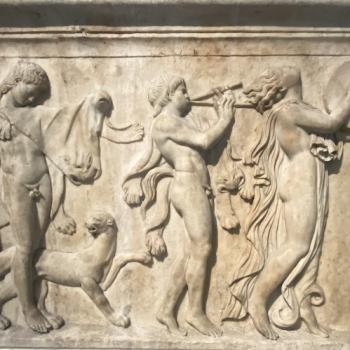
Hail To The Unconquered Sun!

Due to family obligations I won’t be blogging today, but I’ll be back tomorrow with my regular daily dose of modern Pagan-related news and commentary. In the meantime I wish a very happy holiday season to you all, and a very happy birthday to Jesus of Nazareth, Mithras, Carlos Castenada, Sol Invictus, Robert Ripley, and Annie Lennox among many others.


Sol Invictus

Happy Holidays! Back tomorrow.

2 responses so far

Older Entries »