A modern Pagan perspectivePosts RSS Comments RSS

Archive for August, 2009

Faith and the Facebook Jedi

Back in 2001 the British census was rocked by a massive Internet campaign/practical joke, where, for a variety of reasons, 400,000 people listed “Jedi” as their religious affiliation. The Pagan community, though ranking as the seventh-largest faith in Britain with a combined number of nearly 40,000, paled in comparison (Pagan groups, who feel they could actually number in the hundreds of thousands, are organizing to ensure a more accurate count in 2011). While I don’t doubt that there are sincere adherents to some sort of constructed Jedi-faith, it seems more likely that it became a haven for people who don’t like the idea of telling the government their religious affiliation, or even having to decide on a religious affiliation. I bring all this up because the Washington Post is doing a spotlight on faith within the popular social networking site Facebook, and it looks like the return of the Jedi.

“Since then, Facebook’s beliefs box has generated a staggering number of entries. So exactly how many users put down “beer” as their religion? How many “Catholic”? What correlations exist between religion and number of friends? Company spokeswoman Meredith Chin declined to answer such questions, citing user privacy. But Chin agreed to compile a list of the most popular religious identities and offered some tantalizing hints at what a full readout might show. Not surprisingly, the most popular faith professed is “Christian” and the various denominations associated with it. The category is so dominant that for this list, Facebook’s statisticians insisted on combining such other designations as “Protestant,” “Catholic” and “Mormon” under the “Christian” label. As a result, the second most popular entry on the list is “Islam,” followed by “Atheist.” “Jedi,” interestingly enough, makes an appearance at No. 10.”

There are so many questions about Facebook’s religion data that aren’t asked or answered in William Wan’s breezy little article. For instance, Facebook statisticians “insisted” on combining all the Christian variations, but did they do the same for other religious groupings? Were all the various Pagan faiths combined as well? If not, why not? Is “spiritual” a catch-all category, or is it just people who listed themselves solely as “spiritual”, and why include a Washington DC top-ten but not one for the USA as a whole?  Why only ten? If it isn’t a violation of user privacy to give us a top-ten list, why not a top twenty or fifty? Further, why did Wan classify “Seguidor del Wiccanismo” (follower of Wicca in Spanish, of which there are 2000 on Facebook) as “offbeat”, did he not bother to run it through a translator? Does the fact that this listing was given as an example of “offbeat” answers to the religion question (along with “Heavy Metal” and “Amish”) in fact prove that Facebook statisticians didn’t bother to gather the modern Pagans into an easy-to-count single grouping?

Instead of doing a real investigation of religion on Facebook, Wan focuses instead on how “hard” it is to fill in that text box, when all you want to do is hook up with some friends.

“It’s Facebook. The whole point is to keep it light and playful, you know?” said Heim, 27, a college student from Dumfries. “But a question like that kind of makes you think.”

Indeed, it does make you think, I just wish the Washington Post were similarly inspired. It’s “interesting” that Jedi came in tenth, but not interesting enough to probe a bit deeper into why it’s the tenth-most-popular faith category on Facebook. If only the The Force could spur some more in-depth journalism on these questions.

ADDENDUM: Get Religion and I seem to be on the same wavelength today.

5 responses so far

Quick Note: Exploring the Divine Feminine in Missouri

The Columbia Daily Tribune covers a just-opened University of Missouri’s Museum of Art and Archeology exhibit entitled “The Sacred Feminine: Prehistory to Post-Modernity”. The show not only looks at art that reflects women’s role in religion, but curator Benton Kidd has also organized a national symposium centered on themes from the exhibition.

“To fully explore both tensions and universalities, Kidd has collaborated with other parts of the university to move observers past a simply visceral, visual experience and stimulate community conversation. The most ambitious and prominent of these efforts will come at a national symposium on Oct. 16 and 17. Diane Apostolos-Cappadona, author and Georgetown University professor, will be the keynote speaker. Apostolos-Cappadona has been interviewed on television and in documentaries, discussing her take on the books of “The DaVinci Code” author Dan Brown. The event will incorporate both distinguished local scholars — MU Professors Robert Baum and Kristin Schwain — and experts from other major universities, speaking on topics almost as wide-ranging as the exhibit itself — everything from African female prophets to the cult of virgin martyrs, Cleopatra’s divinity to the role of females in Tantric sex rituals.”

Perhaps inspired by Kidd’s efforts to build such a far-reaching conversation concerning the sacred feminine, the Columbia Daily Tribune sent out questionnaires concerning gender and religion to area women. The first two respondents were artist Gennie Pfannenstiel, who is giving talks at the exhibit and holding a showing of her own work exploring the sacred feminine at a local gallery, and Taz Chance, a member of the local Wiccan church and nature preserve Ozark Avalon. The contrasting answers between an artist who feels the “sacred feminine is a divine source of knowing the feminine aspect of creation and existence”, and an explicitly Pagan goddess-worshipper are fascinating.

Pfannenstiel: Knowing that we are all children of our Earthmother makes me more compassionate and allows me to see more clearly the importance of my path for serving others, especially children — a Madonna role. My spirituality grounds me by revealing to me my true self so that I can stand tall and strong as a pillar, Isis-like. I am Grandmother Spider spinning my web of life.

Chance: Because I worship an Earth-centered religion I find that I am more connected to the ideals of the sacred feminine than those women who are in the more traditional spiritual roles. I am allowed to openly recognize my connection to the Goddess without and the Goddess within.

I assume that these respondents are merely the first to be profiled in the paper, and that more will be run as questionnaires trickle in during the exhibition’s run. Kudos to the Columbia Daily Tribune for going the extra mile in seeking out community voices for this piece, and including a Pagan perspective right off the bat. As for the exhibition and forthcoming symposium, they both sound fascinating, and will no doubt be a special treat for those living in or near Columbia, Missouri.

No responses yet

Inside the Mind of Linda Harvey

The Catholic-run news agency SperoNews features an interview with Linda Harvey, founder of Mission:America, and author of “Not My Child: Contemporary Paganism & the New Spirituality”, which claims to uncover the “casual occultisms” that lead teens towards “radical” Pagan spirituality. While I’m usually loathe to give people like Harvey any publicity, this piece does provide a harrowing look into her demon-haunted mind, and by extension, the minds of conservative evangelical Christians like her.

“A narrow definition of witchcraft would be a series of rituals, spells and actions that attempt, whether they realize it or not, to contact the demonic realm to try to get the evil spirits to cooperate with them with whatever they want to do … [witchcraft and the occult] has penetrated virtually all areas of entertainment and the media … Unfortunately, all these children have to do to get information is get on the Internet. Several Web sites have a youth section where kids can go and find covens in their cities and suburbs. Yes, these youth are going right from these books and media to these fora. All it takes is for them to have a little more interest and then going a little further with their interest and looking it up.”

Like all accomplished conspiracy theorists, there is no room for any competing theories or explanations, the secular world is an evil Satan-ruled place, and it is funnelling children towards Witchcraft covens. Anything that is not constantly sanctifying the Christian God is not only suspect, but actively anti-Christian.

“My family doesn’t celebrate Halloween since I became a Christian … October 31 is the pagans’ highest holiday and we are helping them celebrate it. What a slap in the face to our wonderful God! … keep [your children] in a good Christian school or home school them. Do not send them to public school … read and watch everything your children read and watch. Don’t assume anything your children read or watch is harmless. There are all kinds of accommodations to pagan beliefs and other practices throughout children’s media.”

Obviously Linda Harvey doesn’t speak for all Christians, or even most Christians, but she does represent a sizable demographic. It is with these sorts of believers that no real dialog can be accomplished, to the Linda Harvey’s of the world we are Satanic zombies overrunning all that is good, and the only solution is to wall themselves off and await God’s wrath/love to set the world to rights. No amount of logic or rational explanations of how Harry Potter isn’t some sort of Wiccan recruitment tool, or how we don’t invite children (without parental consent) into our covens is going to change her made-up mind. So instead, consider this an instruction into a certain worldview, hopefully one that is shrinking away in our post-Christian world.

2 responses so far

Feminists Love Religion (and the Goddess)

Mandy Van Deven at Religion Dispatches interviews academic Chris Klassen about her new anthology “Feminist Spirituality: The Next Generation”, an exploration of  spiritual/religious expressions among feminism’s “third wave”. In the interview Klassen expresses some surprise at how the majority of submissions came not from within the traditional monotheisms, but from the spheres of Goddess spirituality, Wicca, and modern Paganism.

“Actually I did not intend this. It is simply how it turned out based on the response to my call for papers. In hindsight though I think it makes sense. The term ‘feminist spirituality’ does, for some, mean ‘alternatives’ to mainstream religion. Thus people working on third wave feminism within Christianity or Islam or Buddhism may not have initially thought the call relevant. (Well, assuming there are folks out there working on third wave feminism within traditional religions, and I really hope there are.) But, as I said before, much feminist spirituality in the new millennium tends toward blurry borders between religions, so it could be that those most interested in third wave feminist spirituality are not focusing on traditional religions.”

I find it hard to believe that feminist scholars working within a Jewish, Christian, or Muslim context wouldn’t jump at the chance of being published in an even faintly relevant academic anthology. Unless the old “publish or perish” truism has degraded greatly in recent times. Assuming that this anthology is a somewhat accurate mirror of religious expression among modern-day feminists, are we witnessing a triumph of the Goddess? Maybe, though Klassen is quick to point out that feminist spirituality in our current age is an increasingly syncretic and pluralistic phenomena.

“…there is also a lot more religious pluralism within the individual. You have Christian feminists participating in Wiccan rituals and Goddess worshipers honoring Jesus. Like much spirituality in general, in the new millennium, feminist spirituality is a bit of a smorgasbord, and it is important for the individual to create a spirituality which fits her own experience and needs.”

Perhaps these new-millenium feminists are the polar opposites of ultra-patriarchal Christian groups like The Family. Instead of “Jesus plus nothing”, it’s “The Goddess plus everything”. After all, doesn’t the old chant go “we all come from the Goddess and to Her we shall return”? In other words, maybe the Vatican is cracking down on American nuns for a particular reason. As for “Feminist Spirituality: The Next Generation”, you can find a list of chapters and contributors, here.

4 responses so far

Building a Better Pagan Media

Anyone who has read my blog knows that I’m concerned with the health of Pagan-run/owned media and the state of journalism within our communities. For some time I’ve wanted to take what I’ve been doing with The Wild Hunt, observing and reporting on the news affecting our communities, to the “next level,” whatever that might mean. With the recent merger of newWitch and PanGaia into Witches & Pagans, the decision of Thorn Magazine to go online-only after their next issue, and the folding of Modern Witch Magazine, I decided I couldn’t wait any longer. While blogs and podcasts seem ever more popular in our communities, perhaps unsurprising considering our penchant for individualism, print periodicals seem to be in drastic contraction. Meanwhile, Internet-only Pagan publications don’t seem to be doing much better, often suffering from a lack of regular high-quality content, virtually nonexistent revenue streams, and an all-volunteer staff juggling their jobs and lives with the demands of editing content and putting out quality products on a regular schedule.

This isn’t to say that Pagan-run media is uniquely in trouble. Our microcosm mirrors the painful changes the mainstream media is going through as they try to navigate a severe recession and a shift towards making new media journalism pay. However, our (relatively) small size does allow us some opportunities to collaborate and evolve into this changing market. I’d like to introduce a new venture that I hope will not only spark a renaissance in Pagan journalism, but also create the needed synergy to allow existing and forthcoming Pagan media outlets to thrive in an emerging world of hyperlocal news and “hyperdistribution”.

The Pagan Newswire Collective is an open collective of Pagan journalists, newsmakers, media liaisons, and writers who are interested in sharing and promoting primary-source reporting from within our interconnected communities. The idea is simple: a pool of journalists and writers within the collective share sources and collaborate on dynamic and timely stories of interest to the Pagan community; media liaisons from various Pagan organizations pass along news and current events for possible coverage; editors, bloggers, podcasters, and other media outlets can call for submissions, collaborate with the collective, and negotiate with individual writer(s) to distribute finished product. All work created from within the collective remains the property of those who produced it, and it can be distributed in any number of ways, from Creative Commons to more traditional arrangements with various periodicals.

The variety of possible coverage models are endless, from syndicated multimedia packages for large events, to local beat-reporting when “hot” stories emerge in local Pagan communities, to “evergreen” human interest stories suitable for periodicals that publish infrequently. In short, we hope to become the “Pagan Reuters”, as Yvonne Aburrow put it.

Since we are brand new, we are looking for Pagans and like-minded allies, especially those with writing or journalism experience, to join our collective. If you use Facebook, you can join our official Facebook group, or join our mailing list at Google Groups. Here’s to building a better Pagan media.

10 responses so far

(Pagan) News of Note

My semi-regular round-up of articles, essays, and opinions of note for discerning Pagans and Heathens.

Charles Arthur Roberts, who is serving five years in prison for aggravated assault, is suing the Texas prison system for preventing him from practicing Wicca while incarcerated.

“Roberts alleges in a pro se lawsuit that he made repeated requests practice Wicca to the chaplain and administrators at TDCJ’s Lopez Unit off El Cibolo Road in Edinburg … The 28-year-old Brownsville native claims that prison administrators allow Catholic, Protestant and Moslem services but will not allow him to practice his Wiccan faith. Roberts wrote in his lawsuit that administrators told him they needed a Wiccan volunteer to hold a service for him but that they never attempted to obtain a volunteer. The jailed Wiccan claims he even tried to contact administrators at a state level but never received a reply. “I have been dealing with the defendants for a year to get things for my religion but they have not tried to get anything started, which is a violation of my Constitutional rights,” Roberts wrote in his lawsuit.”

The Texas Department of Criminal Justice won’t comment on the case, but did reveal that three inmates and an outside volunteer are required before they will allow scheduled sessions. If Roberts could not meet the three-inmate threshold, the case could be dismissed if he can’t also prove prison officials blocked attempts to find an outside volunteer or acquire Wiccan religious materials. While many jail-house lawsuits can be frivolous, we shouldn’t forget that according to Pagan chaplain Patrick McCollum there is “endemic” discrimination against incarcerated religious minorities.

The Maine Family Policy Council, formerly known as the Christian Civic League of Maine, are back to spreading lies about Rita Moran, Chair of the Kennebec County Democratic Committee, who was one of two openly Pagan delegates at the Democratic National Convention. Not content with first outing her as a Pagan and then stalking her, they are now trying to play the victim by misquoting an interview she did with a Pagan podcast back in 2007.

“In a recently discovered podcast, Rita Moran, Chairwoman of the Kennebec County Democrats, claims she cast a spell on the Administrator of the Christian Civic League, Mike Hein, in response to her outing by the League as a practitioner of the occult … In the podcast, Moran presents herself as a practitioner of an “earth-based” religion, but states she does not wear a pentacle, for the sake of ‘plausible deniability.’ If asked, she tells people she is a practitioner of an ‘earth-based’ religion. During the interview, Moran also expresses a desire to form a national “Pagan Caucus” within the Democratic Party, so that the Democrat Party and paganism can come together in a “positive way.” When asked if Mike Hein suffered any backlash from her outing, she replied that she is certain that there was an occult backlash, based on her casting of an “earth spell” on Hein.”

I happened to have listened to the podcast in question (mp3 link), from the now-defunct Lance and Graal show, and it clearly says that she cast a “mirror” spell (not an “earth” spell, whatever that means). In other words, the only malefic thing Mike Hein may have received spiritually is what he was already dishing out against Moran. It is truly sad that some supposedly moral Christians feel the need to lie, break laws, and harass innocent people to feel superior. One has to wonder if Focus on the Family knows what sort of things this “affiliated” group gets up to in the name of Christ.

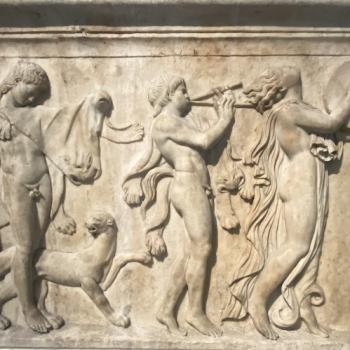
Warning! Some minor True Blood second-season spoilers follow! Do you watch the HBO vampire series True Blood? If not, you’re apparently missing out on some hot-and-heavy pagan themes in addition to all the vampire-lovin’ that’s already going on. A character introduced in the current (second) season, Maryann, was revealed to be a maenad, and some Pagans are seriously unhappy with the way things are being portrayed.

“…they could have called her a Maenad and been done with it – I wouldn’t have been thrilled with that, but I expected it. They went WAY too far with this, IMO. They have to bring in Lilith, Isis, Gaia, the Horned God AND Dionysus? To abuse the name of Isis, the favorite name of the Goddess, in that way was particularly offensive to me. The Christian devil imagery is so predictable and cliche – you may be right, the writers need to do some research.”

I’ve heard similar rumblings from other Pagans as well, but I’ll reserve personal judgement for after the season closes, and I’ve seen the episodes. However, if you aren’t spoiler-averse and want a taste of the way things are going, check out this recap of episode ten for some of the Dionysian mayhem currently on display.

Reuters covers the festival of Lurol in Tibet, a time that displays the syncretic mix between Tibetan Buddhism and the animist/shamanic Bon faith.

Dressed in special clothes, his long hair carefully cut and braided, Damtsengbon waits for his spirit, Amyesrmachen, the most sacred mountain god in the region. Other villagers call the spirit’s name while Damtsengbon, who like many Tibetans only goes by one name, enters a trance, twitching and jerking. “I am the third generation to channel this god, so it is not just about me. For three generations the god has manifested himself through us, and even living Buddhas recognize this … I think it’s a way for me to serve my people. It keeps us together and protects us, so it’s an honor to serve them.”

I recommend reading the entirety of this fascinating look into Tibetan religion and culture.

In a final note, be sure and check out presentations from friends-of-this-blog John W. Morehead and Chas Clifton at the recently-held 2009 CENSUR conference in Salt Lake City, Utah. Chas Clifton’s presentation, “In the Mists of Avalon: How Contemporary Paganism Dodges the ‘Crisis of History’”, is particularly interesting for those wondering why Wicca and modern Paganism didn’t collapse with the advent of better scholarship.

“Contemplating the crisis—or crises—of history as they affect contemporary Paganism, the Wiccan journalist Margot Alder comments,  “Traditionally, religions with indefensible histories and dogmas cling to them tenaciously. The Craft avoided this through the realization, often unconscious, that its real sources lie in the mind, in art, in creative work.”[31] By relying on the fictive power of books and other creative products to provide a sort of sacred story, the contemporary Pagans described thus step out of history while retaining a modern respect for the historian’s scholarship and thus postponing a collision between historical narrative and mythic past.”

For those interested in the study of new religious movements, you should check out all the “cyberproceedings” available online.

That’s all I have for now, have a great day!

6 responses so far

Just Be Glad They Didn't Find a Witches' Bottle

Sometimes you can understand why something strange makes the news and provokes wild speculation. For instance, when people find dead animals in parks, that is bound to freak people out and lead to speculation of “dark” magic practiced by a mysterious “other”. But other times, you have to wonder how something actually made the headlines, such as in the case of a “cursed cow tongue” found in a rural cornfield.

“…farmers called police to County Road 28 and County Road 5 around 7:30 p.m. Saturday, and police said they found a package wrapped securely in black plastic and tied with yellow nylon ropes. Police said someone dug a small hole and left the package inside. Since officers couldn’t tell what was inside the package, they called out the bomb squad. X-rays showed no mechanical devices inside, so police opened the package and found some kind of flesh that had sutures in it. An anthropologist, who is part of the investigative staff identified it as a cow’s tongue.When officers opened the sutures, they found a photograph inside, writing in Spanish and what looked like different types of pepper, said Longmont Police Cmdr. Tim Lewis.Officers said they did some research and found a cow’s tongue is used in different types of rituals, including one that would make someone stop gossiping or talking about a person, which is what this appears to be, Lewis said.”

First of all, a bomb squad? I understand the need for caution, but who would bomb a rural cornfield? Also, since they uncovered that it wasn’t a bomb, and in fact no danger to the community, why was the press told? Further, they said they are trying to warn the person in the photo and bring in the spell-maker for questioning (though they admit they probably won’t press charges), escalating a simple bit of folk-magic into an ongoing drama.


An x-ray of a cursed cow-tongue.

If there is a lesson here, it is two-fold. First, magical practitioners need to be really, really careful about where they leave spells. Even if you’re doing a bit of non-malefic magic to stop someone bad-mouthing you, you better make sure that en-spelled cow tongue (that you bought at the butchers) or bottle full of pee and rusty nails is buried somewhere safe. Second, if no harm was done, and no charges are going to be pressed, then this should never have been a matter that made its way to the press. You don’t think the local papers aren’t going to want to follow up and see who did this? There is the very real possibility that a fragile  (or simply personal) domestic situation could boil over now that it’s splashed all over “news of the weird” sections across the country. As for the local papers, frankly, you’d think that with newspapers collapsing across the country, they’d want to save their payroll for issues that actually concern the public at large.

14 responses so far

Older Entries »