A modern Pagan perspectivePosts RSS Comments RSS

Archive for August, 2010

Return of the “I Believe” Plates

Religion Clause reports that South Carolina Attorney General Henry McMaster has issued a ruling that clears the way for a non-profit group to have the infamous “I Believe” Christian licence plates produced.


The new “I Believe” design.

“Nine months after a federal judge barred the state from making legislatively approved plates with the religious message, Attorney General Henry McMaster says a similar plate designed by a nonprofit group is legal. The plate under review at the Department of Motor Vehicles reads http://www.IBELIEVEsc.net along the top. It features a golden sunrise and on the left, three crosses symbolizing the site where Jesus was crucified .  The nonprofit group applied for the plates in February under state law that allows private groups to create specialty plates, if they pay a $4,000 deposit or collect at least 400 prepaid orders before production. It officially changed its name to the website address, in hopes of meeting new DMV rules that require tags bear the sponsoring group’s name.”

The original “I Believe” plates were ruled unconstitutional due to the fact that they were sponsored by the South Carolina legislature, creating the impression of a state-sponsored religion. The DMV has yet to decide if these new plates are indeed legal.

This entire license plate case has been haunted by modern Paganism. McMaster released a campaign video referencing the famous Great Falls Darla Wynne case, in which a Wiccan won a court battle against sectarian government prayer. In the video McMaster vows to fight for prayers to Jesus, and he further proved his commitment to Christian sectarianism by attending pro-plate Christian rallies. Meanwhile, U.S. District Judge Cameron McGowan Currie, who ruled that the plates were unconstitutional, was also one of the judges to find in Darla Wynne’s favor during her many court battles. In addition, State Sen. Yancey McGill made plain that “any” religion could get a license plate, so long as they weren’t Wiccans.

“In South Carolina, Baptists wanted the tag on cars here and pitched the idea to Republican South Carolina Lt. Gov. Andre Bauer’s chief of staff. State Sen. Yancey McGill, a Kingstree Democrat, got the bill passed in a couple of days without even having a public hearing or debate. “It’s a great idea,” McGill said Tuesday, calling it an opportunity to express beliefs. “People don’t have to buy them. But it affords them that opportunity. I welcome any religion tags.” What about Wicca, commonly referred to as witchcraft? “Well, that’s not what I consider to be a religion,” McGill said.”

Leaving aside the biases of Christian politicians, the question now is if the DMV approves these new “I Believe” plates under the state’s non-profits program, will they then in turn approve other sectarian plates? Hindu plates? Wiccan plates? Any faith so long as they meet the requirements? Are religious plates secular if the sectarian iconography is in the logo?

“The specialty license program has a secular purpose – allowing all nonprofit organizations to identify themselves by a logo or symbol,” McMaster wrote in his Aug. 16 opinion. “It is our opinion that the Establishment Clause would not be violated by approval of the plate. Indeed, it is our opinion that denial would infringe upon the Free Speech Clause of the First Amendment.”

We should be paying close attention to what the DMV rules in the instance, and we should be quick in testing the parameters of an approval to see if the law will be applied similarly to all religious non-profits. If Christ’s cross is OK as a logo, then a Wiccan, Druid, Asatru, Hindu, or Buddhist symbol should be as well. If they aren’t, then we may have another court battle on our hands.

24 responses so far

Invoking TheurgiCon Coverage

This past Saturday in Berkeley, California was the one-day conference TheurgiCon, an intensive that focuses on the practice of theurgy, the use of magic and ritual to invoke (or evoke) the gods. This year’s line-up included Tony Mierzwicki, Brandy Williams, Don Frew, Diana Young, and Sam Webster. COG (now on Facebook) members Rachael Watcher and Greg Harder were there on behalf of the Pagan Newswire Collective to cover the event. First, here’s an interview with TheurgiCon founder and organizer Glenn Turner (who also founded PantheaCon).

Here’s their report on TheurgiCon.

It was a room full of mostly older folks dressed in varying ideas of LL Bean casual, coffee in hand, milling about prior to settling down to work for the day; your usual run of the mill business meeting with the usual number of computers, reference books and notated materials. However, with the opening statements of the first speaker, it became obvious that this was not your parent’s kind of business.

Welcome to Theurgicon 2010, held on August 28, in Berkeley California. The brain child of Glenn Turner, long time Witch and veteran Convention organizer, it was a one day symposium, the goal of which was to cover all you ever wanted to know about Theurgy but were afraid to ask; and believe me, you had better be paying attention because the information that proceeded from the day’s speakers was dense, deep, and fast paced. It was, in this attendee’s opinion a masterpiece in organization. Five speakers were arranged in such order as to present basic historical information first, with each speaker building upon the work of his or her predecessor. Each succeeding speaker moving forward in time, followed the thread of theurgy as it developed from its most ancient roots to its present day practice in such organizations as the Open Source Order of The Golden Dawn and British Traditional Wica.

Tony Mierzwicki started the morning followed by Brandy Williams, and Don Frew. They took us from the root and branch of Hermeticism through the development of theugy and the Chaldean Oracles, Platonic cosmology and theurgic practice, to Neo-Platonic cosmology, praxis and its part in Western Occult magical traditions today. They shared elements of ritual practice simple tools and technique. Whew! It reminded me of nothing less than those college lectures where you were afraid to take notes in fear that you would miss something vital. Mr. Mierzwicki and Ms. Williams are accomplished writers and Mr. Frew felt obliged to joke that being a Gardnerian had put a real crimp in his ability to publish though it should be said that he is a historian of note in British Traditional Wica.

By the time time lunch happened our brains were full. I needed the break to digest what had already transpired and I am no new comer to any of the material presented. Lunch was followed by a presentation from Diana Young on The Nexus of Mystic and Magus, and Sam Webster finished up with a discussion of the future of theurgy. He called for altars in public places, the establishment of temples, and clergy to serve the developing laity. He encouraged us to sample deeply, collecting “whole sets” creating synergy, to develop our own interpretations, to think of ways to make our presence more known. I suggested that perhaps we should take a page from the x-geners and practice flash rituals [a reference to "flash mobs" - ed]. Apparently that struck a nerve because many came up to me after the conference to ask if I were serious and when would we start. Let me encourage you who have the knowledge and industry to go forth and flash and may the Gods be with you.

The day of academic pursuit was followed by equally deep and thoughtful conversations in the Hospitality suite accompanied by wine and food. I wandered about seeking impressions of the day from participants. Gus diZerega, author and teacher commented, “I think it was a great presentation. It far exceeded my hopes. The quality of the presentations was wonderful, the variety of perspectives fascinating …” Barbara Cormack, head of the Open Source Golden Dawn, “I came because I feel that my tradition is one of the modern flowerings and an inheritor of theugric practice. I was curious to see what the speakers would do with that topic and I wasn’t disappointed…” Nathan Bjorge, presenter at PantheaCon on Neo Platonic practice “I think that this was a wonderful opportunity for different traditions to come together and explore this history, this context for our modern pagan traditions…” Everyone agreed that it was a great success, worth the money and stated that they looked forward to next year’s presentations with interest as well as curiosity as to how, as a concept, this symposium would develop.

Glenn Turner promises a published presentation of the papers presented, and I look forward to that. I’m also delighted that this is only an annual event. It will take me that long to digest what transpired here today.

I’d like to thank Rachael and Greg for covering the event, and allowing me to share it with you here at The Wild Hunt. I’m hoping this kind of local coverage inspires the formation of a PNC news bureau for the Bay Area of California. As one of the most populous Pagan hot-spots in the country I’m sure there’s no end to the news and events to be covered.

Speaking of California-based Pagan coverage, I’d like to quickly point you to Joanne Elliott, the LA Pagan Examiner, who’s been doing a lot of great local-based coverage. Notably, the plight of Pagan elder Ed Fitch, who’s been fighting to keep his home. That is exactly the kind of stuff that a robust Pagan journalism should be looking into (that, and thousands of other things).

ADDENDUM: Here’s presenter Tony Mierzwicki’s experiences of TheurgiCon.

3 responses so far

Suppressing A Pagan Revival in Russia?

Global Voices points to an Open Democracy report from last month on how Mari Traditional Faith (the indigenous belief system of the Mari people in the Republic of Mari El) is facing a renewed form of “anti-religion” in Russia.

In response to an appeal by the local state prosecutor, Yoshkar-Ola Municipal Court found Vitaly Tanakov guilty of religious and ethnic hatred in 2006, sentencing him to 120 hours’ forced labour. In 2009, Mari El Supreme Court ruled that his leaflet – “A Priest Speaks” – contained religious and other extremism. It is now banned throughout Russia.

Peoples influenced by the Bible and Koran “have lost harmony between the individual and the people,” argues Tanakov, in what is actually one of only a few references to other faiths in his leaflet. “Morality has gone to seed, there is no pity, charity, mutual aid; everyone and everything are infected by falsehood.” By contrast, he boasts, the Mari traditional faith will be “in demand by the whole world for many millennia.”

There are growing claims that Russia’s controversial anti-extremism law is being used to persecute and suppress religious minorities in the formerly communist nation (with even more restrictive anti-religious passages being proposed). Some fear that a Russian government and Russian Orthodox alliance is partially to blame for growing tensions and hostilities towards resurgent forms of Paganism in Russia. A Mari text mildly critical of Christianity and Islam being labeled as “extremist”, along with several other incidents, paints a grim picture. Some have even considered seeking asylum in the West.

Vitaly Tanakov, the controversial author of “A Priest Speaks” labeled “extremist” for writing lines like: “you have felled a tree, you have destroyed a living being”, is now looking outside of Russia for help to fight these persecutions, and wants to reach out to other Pagan and indigenous faith traditions.

A first step, proposes Tanakov, would be an international symposium of peoples true to the Old Religion. He would certainly invite the Native Americans, and is somewhat impressed by the Druids’ ceremonies at Stonehenge, “although they don’t yet know what they’re doing, it’s just improvisation.” Mari El’s most notorious kart squints knowingly: “With our unbroken traditions, we have something to tell them.”

One wonders if there’s a Mari representative at the ongoing World Congress of Ethnic Religions in Italy? Can indigenous traditions and revived Paganisms truly gather in a global symposium outside the purview and sponsorship of large events like the Parliament of the World’s Religions? Can cultural and theological differences be overcome in order to work on a shared political agenda? These remain open questions, but I’ve seen a new and fragile openness from all sides towards dialog on areas of mutual interest, hopefully it can bear fruit for all sides.

For more on the Mari people and their traditional religion, check out the MariUver blog (particularly this post).

8 responses so far

Interview with Mike Nichols

The writings of Mike Nichols are almost ubiquitous on the Internet. His essays on the Witches’ Sabbats have been endlessly re-posted and republished (sometimes without proper attribution), becoming an essential resource for many to understanding modern Witchcraft’s “wheel of the year”. Some time ago I had the privilege of interviewing him to help promote the book version of his essays on the Sabbats published by Acorn Guild Press. However, due to a computer melt-down the interview was lost. But as luck would have it, the interview was recently rescued from digital oblivion, and I’m now happy to present this “lost” Wild Hunt interview with Mike Nichols.


Mike Nichols

The Wild Hunt: I know you cover this in your book, but briefly, for the benefit of my readers, how did you come to be so interested in the origins of the holidays, and how did that intersect with your newfound Paganism?

Mike Nichols: As a kid, I adored holidays. It was like taking a break from normal, mundane time. And since I was raised Catholic, I was subject to a rich liturgical calendar from the start, one that borrowed many elements of custom and lore from pre-Christian sources. It wasn’t until I was in high school that I started actively researching the origins of holidays, but as I did, I realized that those studies dovetailed beautifully with my growing interest in Witchcraft. In dealing with the eight Witches’ Sabbats, I realized I was coming at the same holidays from two different angles, and it was pretty easy to fit the pieces together.

WH: Your works on the Witches’ Sabbats are well known, with the publication of the book do you feel you are “done” with the topic now, or are you still researching, refining, and updating your essays? Can we expect a “The Witches’ Sabbats Part 2″ at some point in the future?

MN: When I first set out to write about the Sabbats, I was trying to cram as much information as I could into articles that were originally intended for small magazine publications. So I wrote them in a highly concise fashion. It’s true that I occasionally run across new bits of information on one of the holidays, but probably not enough to justify a companion volume. Everything that I really wanted to say about the holidays, I already managed to say in those essays. Other authors have dealt with other aspects of the holidays, such as rituals or decorations or crafts, but my focus was on the history, folklore, and symbolism of the holidays. And I’ve said pretty much everything I wanted to say about that. That’s not to say that I don’t have other books up my sleeve, and other stories waiting to be told.

WH: Your writing on the Witches’ Sabbats were, thanks to the Internet, already famous within Craft circles by the time the book was published. How has the book done sales-wise since its release in 2005? Do you feel that making a good portion of the book available for free helped or hindered sales?

MN: Book sales tend to increase around the Sabbats or when I do a live interview. Since the recession, however, sales have dipped, but my publishers tell me this book has “long legs”; they’re already planning a second edition. My website (witchessabbats.com) also sees a greater increase in traffic around the Sabbats. Readers write to me, however, that they are happy to have the physical book, which was lovingly edited and designed, so they can toss the pages they’ve printed from the web and have been carrying in their BOS for many years.

WH: In your years studying the Sabbats have you seen different trends regarding the Witches’ Sabbats come and go? Were there any common elements in the early days of the Craft that are rare now? Any elements popular today that surprise you?

MN: Yes, there have been significant changes in how the holidays are celebrated, but those changes reflect the larger changes that I’ve seen happening in the Craft in general. The biggest is that when I first began to celebrate the Sabbats as a Witch, back in the late ’60s and early ’70s, I had to celebrate them alone, or with a group of friends who were not necessarily Pagan themselves. That’s because Witchcraft was so incredibly underground at the time. There were covens, but most would certainly not host open rituals. You’d probably have to train with them for at least the traditional “year and a day” before you would even be allowed to attend one of their Sabbats. Back then, this was a secret, initiatory, mystery religion. No one would come up to you and say, “Hey, we’re having a circle on Saturday night. Wanna come?” In fact, the tradition was (similar to the Masons) that you would have to seek them out, not the other way around. That was part of what proved your worthiness to be accepted into the fold.

WH: One essay collected in the book is one concerning your reflections on the Pagan community in 1999 (after being away for ten years). That essay is itself now ten years old. Have your views changed much since then? What are your impressions of modern Paganism in 2010?

MN: That’s an interesting question. When I wrote the article you refer to, I tended to focus on the growth of the Pagan community, and how quickly that happened. But I think if I were writing that article today, I would focus more on how the Pagan community has matured. Back in the day, if someone said they were a ‘hereditary Witch’, they were inviting snickers and guffaws. Today, you can’t go to a Pagan festival without seeing second and third generation Witches: kids who have been raised in Pagan households and have never known any other way of looking at things. That’s a huge difference. There is also greater diversity of viewpoint and tradition, and the first stirrings of questions of “authority”. By that I mean, up until now, this has been a grassroots movement wherein every practitioner is seen as a member of the clergy. But now, people are starting to ask whether there should be a separate, paid clergy, for those who want to devote the whole of their lives to ministering to Pagans. And should there be some kind of certification program for teachers? I mean, lots of people are kind enough to regard me as some kind of authority in this field, but I have no actual credentials. Should I have? Do we need them? Or would we simply be caving to the structures that many of us rebelled against when we left our birth religions in the first place?

WH: Do you feel that our communities place enough importance on seasonal rites? It often seems as though Halloween (Samhain) and May Day (Beltane) get some attention, but that often the others seem to fade into the background and only get lip-service (if that). How successful do you feel we have we been in reviving pagan holidays?

MN: Well, first, I have to accept that I may personally have a very skewed perception of this. Practically every bit of e-mail I get is in regard to one of the eight Sabbats and, although Halloween may still be the most popular, all eight holidays are well represented. But maybe that’s just because they are writing to me, and they know that the eight quarter-days and cross-quarter days are my own particular specialty. And there may be a further distinction between how the holidays are seen by practitioners of the Craft, as opposed to the general populace. Witches themselves may celebrate all eight holidays equally; whereas, they only get calls for media interviews just before Halloween or Beltane. That is why I jump at the chance to do interviews on any of the other holidays.

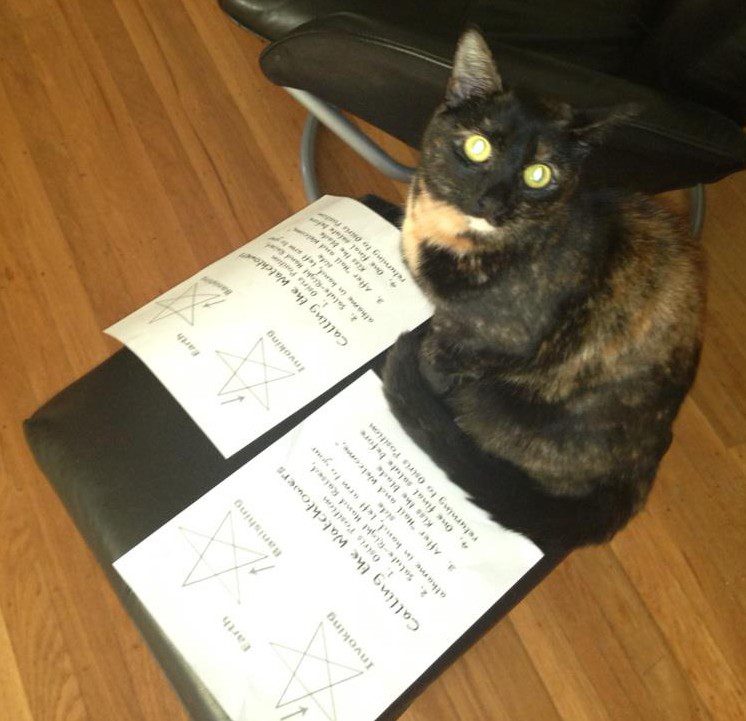
WH: Also included in your book on the Sabbats is an entertaining and insightful essay called “Rethinking the Watchtowers” where you put forth 13 reasons why the element of “air” should be in the North instead of the element of “earth”. Have you made many converts to with your arguments? Do you think that some Witches get so worried about tradition that they forget to be informed by their natural surroundings?

MN: Yes, I think I have made some converts because of my arguments, but by far the biggest surprise is how many people have contacted me to let me know they already do it that way. They usually fall into one of two categories: either they claim membership in a tradition that places air in the north (many Welsh traditions hold this in common, for example), or they are given the air-in-the-north model as an advanced degree secret, often conveyed to them as the “corrected” information. The funniest example of this was from a High Priestess who is a good friend of mine who spent many an hour in friendly argument with me about which element belonged in the north. After years of supporting the traditional attribution of earth, she went to California to take her third degree from her tradition’s elders, and just guess what the big Third Degree Secret she received was? LOL!

WH: Thank you for taking the time to answer my questions, if there is anything you would like to add, please feel free to do so.

MN: Only my thanks, Jason, for inviting me and my thoughts as guests on your Wild Hunt Blog! We are all much obliged! Bright Blessings!

One response so far

Quick Note: Gus diZerega in The New Yorker

Pagan author and Beliefnet blogger Gus diZerega is quoted in The New Yorker regarding a feature on the billionare libertarian conservatives David and Charles Koch, who fund “a huge network of foundations, think tanks, and political front groups”.

DiZerega, who has lost touch with Charles, eventually abandoned right-wing views, and became a political-science professor. He credits Charles with opening his mind to political philosophy, which set him on the path to academia; Charles is one of three people to whom he dedicated his first book. But diZerega believes that the Koch brothers have followed a wayward intellectual trajectory, transferring their father’s paranoia about Soviet Communism to a distrust of the U.S. government, and seeing its expansion, beginning with the New Deal, as a tyrannical threat to freedom. In an essay, posted on Beliefnet, diZerega writes, “As state socialism failed . . . the target for many within these organizations shifted to any kind of regulation at all. ‘Socialism’ kept being defined downwards.”

At his own blog, diZerega expands on the article and targets specific themes relating to the Koch family and their political worldview.

Americans have almost completely lost from sight a crucial distinction underlying the political thinking behind our founding.  All our Founders were as one in arguing that the Constitution created a limited government.  That is why the first ten amendments, our Bill of Rights,  declares limits on what government may do: it may not establish a state religion, it may not abolish freedom of the press, it may not make unreasonable searches and seizures, may not ban firearms, and so on.

Left far more vague is what government can do if people want it to act.  In fact James Madison explicitly said that if at some future date citizens trusted the federal government more than they did the state governments, it should expand its power – as it did during the Great Depression. (I would link to the appropriate passage in The Federalist, but I am moving and almost every book I have is in a box.)

Both the New Yorker article and diZerega’s follow-up make for thought-provoking reading, and I encourage you to check them out.

No responses yet

Pagan Community Notes: ADF’s Memorial For Isaac Bonewits, An ADF Ordination, Strowlerfest, and More!

Pagan Community Notes is a companion to my usual Pagan News of Note, a new series more focused on news originating from within the Pagan community. I want to reinforce the idea that what happens to and within our organizations, groups, and events is news, and news-worthy. My hope is that more individuals, especially those working within Pagan organizations, get into the habit of sharing their news with the world. So lets get started!

Celebration of Life: Ár nDraíocht Féin (ADF) recently held a special memorial service at the Summerland Gathering in Ohio for their founding Archdruid Isaac Bonewits who passed away on August 12th. Now the ADF has released video excerpts from the ceremony for the public to view.

“The following are a list of videos taken during the ADF Memorial Service for Isaac Bonewits. A full-length version of the entire rite will be available from the ADF Store soon. The videos below are roughly in order to fit the ADF Order of Ritual, except that the one entitled ‘Ritual’ is a compilation of a variety of ritual scenes.”

Here’s a clip featuring a eulogy by Rev. Ian Corrigan.

Here’s a clip featuring the closing song, “We Won’t Wait Any Longer” by Gwydion Pendderwen, a song that Isaac Bonewits loved.

I’d like to thank Ár nDraíocht Féin for sharing these moving videos in tribute to such an important figure within our movement. You can find links to all the videos released so far, here.

An Ordination at Summerland: Also at the completed Summerland Gathering in Ohio, at the Unity Rite for the Druid organization Ár nDraíocht Féin (ADF), Michael J Dangler was ordained within that tradition. The rite was captured on video, and uploaded to Youtube.

“The ordination rite of Rev. Michael J Dangler at Summerland in 2010. The rite was done during the ADF Unity Rite, and just as he is called forward, the heavens opened up into a downpour. Just as he was proclaimed by Rev. Kirk Thomas (Archdruid of ADF) as a Priest, the rains stopped.”

Despite the ubiquity of video today, it’s still rather rare to see modern Pagans capture their rites and rituals on video, so it’s a real treat to see an ADF ordination shared with the public. Congratulations to Rev. Dangler on his ordination.

Strowling Towards StrowlerFest: A new music and culture festival in St. Louis, Missouri, StrowlerFest, named after a bit of old thieving slang for traveling vagabonds and entertainers, is featuring a veritable who’s who of established Pagan and Pagan-friendly bands.

Tricky Pixie – (Saturday night) - Gypsy Celtic Folk Rock for Naughty Punk Faeries, Traveling Fates – (Sunday night) - A genre hopping musical ride skirting the edges of Alt-Rock, Americana, Jazz, Folk-Hop, and Mythpunk, DreamTrybe – (Saturday night) - The original headlining inspiration for the Festival of Pagan Music that Doesn’t Suck – re-united specifically for StrowlerFest 2010, Wendy Rule – (Friday and Saturday) - Dark, sensual, sonic theater – our very special guest from Australia, Sharon Knight – (Friday and Saturday) – Music, Myth, and Magick, Big Bad Gina – (Friday and Sunday) – Funky Goddess Folk Fusion, Heather Dale – (Friday, Saturday, and Sunday) – Celtic music for the 21st century, GB Mojo – (Friday) a duo of solo artists, they combine rootsy soul-folk and piano rock moxie, urban wit and ancient wisdom, Alexander James Adams – (Friday and Sunday) – the Faerie Tale Minstrel Himself; heir to the legacy of Heather Alexander, Louise Cloutier – (Friday, Saturday, and Sunday) – virtuoso vocal instigator, also offering holistic voice lessons throughout the weekend…”

The event happens the weekend of September 10th, and is brought to us by singer-songwriter SJ Tucker and author Laurell K Hamilton. Other Strowler events are planned  in Boston and Seattle in October, check out the Strowlers web site for more details.

Movie Featuring Pagans Set to Start Shooting: A low-budget Pagan-themed indie comedy entitled “Dark of Moon” has announced that it will start shooting on September 2nd. Directed by Taliesin Govannon, the film focuses on five friends, and the chain of events that unfolds when one of them leaves their eclectic group to join a Gardnerian coven.

“True Alternatives media is pleased to announce that the first shooting day of it’s new Pagan-themed comedy “Dark of Moon” has been set. It’s september 2nd, 2010. On that day, the lights will glow, and tape will roll, setting into motion 22 days of shooting spread over 5 weeks.

“Dark of Moon” is a dialogue driven comedy in the tradition of Woody Allen and Kevin Smith, and the first film to feature 100% realistic Pagan characters. It’s being directed by Taliesin Govannon (who also wrote the script), a Wiccan with 23 years experience in the Craft and modern Paganism. The film is set to feature the music of legendary Pagan musician Gwydion Pendderwen, amongst others.”

Is this the beginning of a new era in Pagan film-making? Will we soon see a crop of indie Pagan-themed films? If so, I can only hope they are more like Hindu-themed films in India than contemporary Christian films in America.

Green Egg Goes Free: Legendary Pagan magazine Green Egg,once a print journal and now online-only, as decided to go completely free instead of offering subscriptions to access their content.

“ALL OF THE CONTENT ON GREEN EGG IS NOW COMPLETELY FREE!!!! You will need to register only if you would like to comment on the Forum. We have been hard at work revamping our website, with Forum registration having just been made active again. Please check back often to see the new content and pages we’re adding!”

You can access all of their recent (now free) back-issues, here. For a taste of Green Egg at the height of their influence check out  “Green Egg Omelette: An Anthology of Art and Articles from the Legendary Pagan Journal”. I wish them luck as they move forward with this new change!

That’s all I have for now, have a great day!

3 responses so far

World Congress of Ethnic Religions Begins in Italy

August 26th in Italy sees the beginning of the 13th annual World Congress of Ethnic Religions. Formed in 1998 at the first gathering in Lithuania, the congress works to promote tolerance of ethnic indigenous religions and create networks of support among adherents of ethnic traditions across the world. There are member organizations from across Europe, and the Congress also welcomes delegations from India, Russia, and the United States. The theme this year is “Ethics in the Contemporary World”, and is being organized by the Italian organization Gentilitas.

“The Congress theme will be to compare the different ethical views of individual members of the religious associations within WCER to find a lowest common denominator or, more simply, to discuss ethical and religious views during the development of rings.”Federazione Pagana, Italy

WCER President Jonas Trinkunas (Romuva), who recently attended the Parliament of the World’s Religions in Australia, was inspired by his experiences there to propose a change of name and focus for the organization.

“In 2009 Romuva (Association of Lithuanian traditional religion) was invited to the Parliament of World Religions held in Melbourne, Australia. Romuva was invited to participate and was an active participant in the section of the Associations of indigenous religions. During the conference I presented not only the religious activities of Romuva, but the activities of the WCER as well. The invaluable experience of having taken part in the Parliament of World Religions after ten years of WCER encouraged me to see again and define the vision and the area of our activities. That’s why I want to reassess and redefine the term which we refer to ourselves. I refer to WCER – World Congress of Ethnic Religions (World Congress of Ethnic Religions). There is a word that I propose to discuss: the change of the term ‘world’ with ‘European’. Hence the change of name to ECER – European Congress of Ethnic Religions (European Congress of Ethnic Religions).”

In addition to the various European delegations, at least two Pagans of note from the United States will be in attendance. Andras Corban Arthen of EarthSpirit (also one of the Parliament’s Board of Trustees), and Prudence Priest, a COG Elder and co-founder of the American Vinland Association. At the AVA blog, Priest has a post running down the schedule of events at the WCER, and  talks about her role “promoting Heathenism” on her travels.

“Here’s why I’m always behind. Too busy out proselytizing and promoting Heathenism to stay home and deal with paperwork. And here’s what Marina sent me. I edited the most glaring mis-translations, but wanted all of you to know where I’ll be for my next adventure. I have never been to Italy, and when I asked all my friends, not one had been to Bologna. The only two things I know about it is when I watch the “Coliandro” mysteries on PBS (the mHz International Mysteries) and they show its environs as they do on “Streets of San Francisco”; and that some church there has the largest extant zodiac sundial.”

Priest also has a personal blog set up, so hopefully she’ll be sharing her experiences at the WCER as things progress. You should also keep an eye on the EarthSpirit Voices blog for any updates that may happen there. There is also supposed to be streaming video of the WCER proceedings, check out the WCER 2010 site for more details.

My hope is that, moving forward, the Pagan community can foster better lines of communication and resource sharing between communities in the Americas, Australia, the UK, and the rest of Europe (and ultimately the whole world). The World Congress of Ethnic Religions, soon to be the European Congress of Ethnic Religions, is laying the groundwork for a better awareness of Pagan religions (whether revived, reconstructed, or indigenous) across the globe. Creating networks that will be vital for future activism and collaboration. Modern Paganism is an increasingly global phenomenon, and it’s important that we pay attention to its growth and struggles.

7 responses so far

Older Entries »