A modern Pagan perspectivePosts RSS Comments RSS

Archive for October, 2010

A Blessed Samhain

Tonight and tomorrow is when most modern Pagans celebrate Samhain. Samhain is the start of winter and of the new year in the old Celtic calendar. This is a time when the ancestors are honored, divinations for the new year are performed, and festivals are held in honor of the gods. It is a time of final harvest before the long winter ahead. It is perhaps the best-known and most widely celebrated of the modern Pagan holidays.


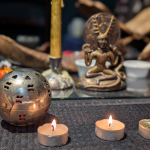
An ancestor altar.

This time of year also sees the celebration of Velu Laiks (“the time of spirits”) by Baltic Pagans, Winter Nights by Asatru in mid-October, Foundation Night in Ekklesía Antínoou on October 30th, Fete Gede by Vodou practitioners, Día de los Muertos for followers of Santeria and several indigenous religions in Mexico and Latin America, Diwali for Hindus (November 5th this year), and astrological “true” Samhain on November 8th for some Witches and Druids. In addition, Pagans in the Southern Hemisphere are currently celebrating Beltane.

It is a time when some communities acknowledge the Mighty Dead.

“The Mighty Dead are said to be those practitioners of our religion who are on the Other Side now, but who still take great interest in the activities of Witches on this side of the Veil. They have pledged to watch, to help and to teach. It is those Mighty Dead who stand behind us, or with us, in circle so frequently.”

Many who have been dear to our communities have crossed the veil this past year, joining the ranks of the Mighty Dead, including Len Rosenberg (Black Lotus), Lady Sintana, Isaac Bonewits, Alexei Kondratiev, Lady Svetlana, and Barbara Stacy.

“I love that story about Susan Anthony that Zsuzsanna Budapest tells in her book. Some journalist asked Susan Anthony, because she didn’t believe in orthodox religion, I suppose, “Where do you think you’re to go when you die?” She said, “I’m not going anywhere. I’m going to stay around and help the women’s movement.” So even if I don’t live long enough to see these things, I’ll be around to make a nuisance of myself.”Doreen Valiente, the Mother of Modern Witchcraft.

You can also find a list of departed pioneers, founders, and elders at the Green Egg Zine.

Below you’ll find an assortment of quotes from the media and fellow Pagans on the holiday.

“Death isn’t merely about human mortality. Samhain means “summer’s end” and the death of the fruitful season is also contemplated. We’ve each had dreams that died, feelings of love that died, prejudices that have died, and habits that have died. Let’s not forget that the passing of a pet or death of a beloved car is also cause to mourn. One of the four great fire festivals, Samhain is also about purification. The festival lies at the turning point of the Celtic year and you do not carry dead things into the new year. You prune your life, you pay respect to things past, and you move forward into the incubatory introspection of winter clean and new.” - Star Foster, Patheos.com

“While local celebrants of Samhain may draw inspiration from a variety of spiritual traditions — including Celtic, neo-pagan, shamanic, witchcraft, Wicca, Druid and Native American — their observances share common themes: honoring the dead, crossing from summer to winter, beginning the Wheel of the Year anew, acknowledging death as a part of the cycle of life, expressing thankfulness for the Earth’s harvest and lifting the “veil” between our world and the spirit world.” - Cathie Laurent Schau, Kalamazoo Gazette

“For the witches of Weymouth it is one of their most important religious festivals, a time when they believe the barriers between the physical and spiritual worlds are at their thinnest. They invite the spirits of north, south, east and west into the circle, and cut apples to share with the spirits of people who have died. The leader of the coven, Diane Narraway, bids farewell to the goddess of light, and kneels before the head of a horned ram, holding her hands out as if to a flame. ”I kneel before… the horned god, Lord of Witchdom, as we welcome him back to reign over the dark months,” she says.” - Robert Pigott, BBC

“Here in Sonoma County both our main altar and our ancestor altar will be decorated with marigolds, and the central candles will be atop a wonderful Mexican ceramic skull, for we are blessed with the near coincidence of Samhain and Day of the Dead.  These two celebrations are particularly harmonious for both honor those who have passed on. Both connect with that part of existence we usually most avoid.  And Day of the Dead is celebratory towards those who have passed, helping us connect with our ancestors, something far less prevalent in NeoPaganism than in indigenous traditions.” - Gus diZerega, Beliefnet

May you all have a blessed Samhain, blessings to you, and your beloved dead on this season. Let this new cycle be one of great blessings for all of you. Also, in recognition of the holiday,I’ve created a special edition of my podcast chock-full of Halloween and Samhain-themed music! Enjoy!

5 responses so far

Honoring My Ancestors

I’ll be away from the computer today in this Samhain season to participate in a small Month’s Mind for a beloved family member who recently crossed the veil. My wife’s mother, Nadine St. Louis, was a professor, a poet, and great woman of deep intelligence, compassion, and wit. She had been battling neuroendocrine cancer for nearly eight years, and I was honored to be one of the few to accompany and comfort her during the many visits to the Mayo Clinic in Rochester, Minnesota.

In her last published book of poetry, “Zebra”, she movingly expresses the feelings and uncertainties of her cancer diagnosis.

Nadine St. Louis

Nadine St. Louis

Heavy Metal and the Reciprocal Universe

Platinum and its analogues slip silent
precious poison through your veins,
and the taste of sour metal blooms.

Who can resist asking what gift
calls up this bane, resist thinking
the smiles of one god

will raise the wrath of another?
Take lone, emaciated Phineas:
Apollo endowed him with prophecy,

made him observer of worlds,
model builder, truth teller
who learned to hold life

at a new angle, disclose its secret
lights and shadows.

But Zeus, ever lord
of secrets, demanded tighter security,

sent harpies to foul the very bread
in the old man’s hands, stinking polluters
to remind him of a god’s might.

Is theirs the same vile breath swirling
at the back of your throat, cold echo
of the body’s rage smoldering deeper down?

It took the sons of Boreas, North Wind,
to drive away the harpies.
Phineas kept his voice. His rescue

bodes well; his endurance heartens.
Still, you can’t help wondering how long
it takes the wind to turn.

My wife and I, along with her youngest daughter, my step-daughter, will travel to her family’s ancestral farm in Oregon, sold years ago to loving caretakers, to drink, eat, observe, walk, and speak in her honor.

I hope that we will each take the time, in our own ways, to honor and acknowledge the loved ones who have passed over, to observe this liminal time and reach out, remember, and know that our ancestors celebrate this time with us.

6 responses so far

Checking Back In With the Samhain Flood (of News Coverage)

As I pointed out last week, the irresistible combination of Halloween (aka Samhain to many Pagans) and real-live Witches causes a great flood of articles involving modern Pagans every October. I thought I’d do a quick check back in with the coverage so far, a sort of snapshot of “silly season” as it happens. So buckle in! Here we go!

At the Chico News & Review you learn a “new view” of Witches: “instead of flying on broomsticks, they’re honoring Mother Nature,” while in India the Hindustan Times exclaims that “Witches or Wiccans do exist.”

“Though most of the wiccans who come to Prakash to learn the craft are still at the beginner’s stage, they make up for their lack of wisdom, with enthusiasm. “I’m enjoying the class thoroughly and have advanced to learning spell crafting now,” says Savleen Lamba, an 18-year-old BMM student, one of Prakash’s 20-odd students, who made a documentary on wicca for college.  But then there are others like 24-year-old Rutu Sharma, for whom, learning wicca was a natural extension of her interest in tarot and reiki. Today she is a wiccan priestess. “It’s all about worshipping nature. Witchcraft is only a part of wicca,” says Sharma, a Sion resident who also spearheads the wicca Go Green earth healing campaign.”

In Britain the BBC interviews Anglesey Druids in Northwest Wales and Druid priestess Cat Treadwell in Derbyshire.

“What does she think of the ghosts, the ghouls, the spooky costumes, the “trick or treat” approach: is it an exercise in hi-jacking? All fine and fun, she says - as long as it all avoids a false connection with evil. She is happy to be knee-deep in pumpkin pie as long as the memory persists of ancestral days when, with the harvest in and winter ahead, people lit the darkness, celebrated the dead and trusted that they would survive to see the spring.”

The Santee City Council City Council had Alan and Valera Childers, who run local shop The Village Witch, give an opening invocation (displeasing some), Alabama Wiccans are “finding faith in nature”, a Vermont Public Radio commentator finder her “pagan heart” in a local mummers play, and ”positive energy” in Australia is being sent in hopes that the Adelaide-based Community Church of Inclusive Wicca will receive tax breaks.

Ms Treleven says the decision early this month by Britain’s Charity Commission to recognise Druid worship of natural spirits as a religion had helped the Wiccan cause. But while Ms Treleven has applied on behalf of the church for tax concessions on any income the incorporated body might receive, the church’s income, as she explained in a later post, ”is squat”.

You’ve got Pagans in Leeds, a list of musicians who practice Witchcraft, a scuttled seance in Moose Jaw, and you can even learn a little something about a much-beloved (by Pagans) Dar Williams song.

After explaining that she’d written crowd favorite “The Christians and the Pagans” in an effort to attract Wiccan fans: “It didn’t work. All I got was Unitarians.”

So as you can see, I’ve got my work cut out for me. Before I end this post, it would seem unusual if I didn’t link to at least one article talking about Salem, the witch-trials, and the real-live Witches who live there today.

Real witches? Yes, outside witchcraft’s recent publicity in the political realm, such people exist in modern-day supernatural Salem, and they aren’t afraid to admit it. They live without fear of persecution and look, frankly, ordinary compared with the costumed characters in black lipstick and pointy hats at the masquerade balls.

So have fun this Samhain/Halloween weekend, and beware of journalists roaming the streets! Scary!

7 responses so far

Quick Note: Dan Halloran Interview Now Up at Pagan+Politics

Cara Schulz’s interview series “Pagans in Politics” at the PNC blog Pagan+Politics has just posted its second installment; this time talking with New York City Councilman Dan Halloran.  This is the first interview Halloran has done with a Pagan media outlet since his election in 2009.


Dan Halloran

Here’s a brief excerpt:

What do your co-religionists (Theodish) think about your new position? Are you able to fulfill your religious obligations to them? Do they feel your new status brings them increased good fortune?

The problem with change, is that it always disturbs the status quo. Many in the Theodish community (and in the Asatru community) still harbor issues about how my campaign handled issues related to my faith and the idea that one could serve openly in public without compromising elements of our traditions and beliefs. But they weren’t the ones running for office, and certainly, without great risk, there is no great reward.

So some do, some don’t approve of my position… the simple reality is, that we now have an elected official who represents our faith, a milestone to be sure. And that is no small feat- more so because New York City is the largest City in the country, the position I hold is nearly comparable to some state senate and congressional seats in size and scope.

In fact, one of the fundamental theological truths that our faith is centered on is that we make our own Luck and that outward manifestations of success in life and accomplishment are the only true measure of it.

Be sure to head over to Pagan+Politics and read the whole thing. The next installment will feature an interview with Jessica Orsini, Alderwoman, 3rd Ward, City of Centralia, Missouri.

14 responses so far

Wiccan Abortion Mills and other Pagan News of Note

Top Story: Some crazy things get said and done during an election season, and Pagans certainly haven’t been immune from that phenomenon this year, but this may take the cake. Washington, D.C., Republican congressional delegate candidate Missy Reilly Smith, in an interview with The Daily Caller, talks about using her candidacy as a way to air her anti-abortion views and lets slip some rather interesting opinions about Wicca.

“The more that you’re involved in this organization [Planned Parenthood] the more demonic you realize it is,” Smith said. “Many of the employees of Planned Parenthood and abortion mills, the actual killing centers, the employees are actual witches. They belong to Wiccan and there’s nothing more valuable to Satan than the blood of innocent babies.”

She also proclaims on her website that the Tea Party’s “number one mission” is to “end legalized child killing” which might come as a shock to the pro-choice Tea Partiers in the movement who are more concerned with taxes. While it’s shocking to hear any (supposedly) mainstream candidate say this about Wiccans, it’s actually a fairly common belief within the hardcore anti-abortion groups. Do a search for “the sacrament of abortion” on Google and you’ll see a near-obsession with an obscure book written by Ginette Paris in 1992 that discusses abortion as a sacred act, and uses the metaphor of the procedure being seen as a sacrifice to Artemis. This, along with other isolated comments by a former abortion practitionerwas pounced on as “proof” that Satanic Witches were behind the abortion industry. Various “insider” accounts still push the Wiccan abortionist meme today, putting Smith’s seemingly random outburst into context.

“Since then the Toledo, Ohio, abortion clinic where Abigail’s mother worked has moved to a new location, although it is still owned by the same woman, a Wiccan when Abigail knew her. Abigail’s mother has also moved on, so I don’t know if the nefarious practices and conditions Abigail observed are ongoing.”

Star Foster at Patheos.com has already expressed her disgust and anger at Smith’s slandering of Paganism in the interview, and I imagine more responses are being written as news of this slur spreads. It should be noted that Smith does not have the support of the Republican Party, despite having won the primary. It is also very unlikely that she’ll win (Democrats vastly outnumber Republicans in the District of Columbia). So, if anything, her candidacy should be a reminder of what the activist base of the anti-abortion movement believes about modern Paganism.

The Future of Pagan Lands: Pagan journalist Kathy Nance talks with acclaimed Pagan author and activist Starhawk during her visit to Diana’s Grove in Missouri;  the key topic of discussion is the fact that Diana’s Grove is currently on the market, and how land prices and the current economy are calling into question the future of Pagan-owned retreats and sanctuaries.

First, she said, the changing of the generational guard is being affected by a change in land values. Many of the groups—Pagan and otherwise—that bought land and set up intentional communities in the 1970s and 1980s were able to live off the land with little or no outside income. Now that land prices have increased so greatly in some areas, buyers need outside income to make the mortgage payments. Or, they need to be retired people with sufficient assets to invest and use for living expenses.

“I see now on my land in Northern California that the community is aging. The people who are moving in who can afford to buy tend to be retired,” she said. “You can’t ask Cynthea and Patricia to just give it (the Diana’s Grove acreage) away. That’s their retirement money. But the people who might be interested in taking it on, may not have the resources.”

It all comes back to the need for infrastructure, and how hard that can be to manage for a movement as decentralized and diverse as modern Paganism. While our growing (and aging) community often wants some of the amenities that other faith communities have (land, buildings, retirement communities, service organizations, charities), the individual faiths within Paganism are still too small to build/buy such resources, and the movement as a whole is often too diverse to effectively pool resources for such things. I have no doubt that eventually we’ll see more infrastructure within modern Paganism, but it may not come as soon as some would wish.

Baltic Paganism Around the World: After doing an article on the rise of new religious movements in the Baltic States (EstoniaLatvia, and Lithuania), the Baltic Times takes a closer look at Baltic forms of Paganism at home and in the diaspora.

“Evangelical movements along with neo-pagan movements locally and abroad are possibly the beginnings of something much larger. Next, we take a look at the rebirth of ancient religions. To call it an actual rebirth is somewhat of a misnomer since the neo-pagan movements are not a true revival of a religion once practiced in the region. Instead, as with the example of the Latvian Dievturiba (literally ‘keeping God’) movement, we see religion constructed from ancient practices.”

The article looks at Dievturiba, Romuva, Maausk, and Taaralased, many of which are seeing thriving communities growing in the Baltic diaspora. Also mentioned is the upcoming observance of Velu Laiks (“the time of spirits”), which share many commonalities with the holidays like Samhain.

Hiding Bones Because of Pagans? The Daily Mail reports on the trend of museums increasingly hiding or deemphasizing ancient human remains due to protests from various groups, including Pagans. Centered on the new book by sociologist Dr Tiffany Jenkins entitled “Contesting Human Remains in Museum Collections: The Crisis of Cultural Authority”, the article claims museums are over-reacting to protests by groups like Honouring the Ancient Dead (HAD).

Since the late 1970s, human remains in museum collections have been subject to claims and controversies, such as demands for repatriation by indigenous groups who suffered under colonisation, particularly in Australia, North America and Canada. But Dr Jenkins says that such appeals are not confined to once-colonised groups. British pagans formed Honouring the Ancient Dead in 2004 to campaign for reburial and respect for pre-Christian skeletons from the British Isles. Dr Jenkins said: “The profession is over-reacting to the claims of small minority groups – such as the Pagan organisation, Honouring the Ancient Dead. Most remarkable of all is that human remains of all ages, and which are not the subject of claims-making by any community group, have become subject to concerns about their handling, display and storage, expressed by influential members of the museum profession.”

As I’ve noted before on this site, there is no consensus among British Pagans on this issue, with many, most notably Pagans for Archeology, opposed to the reburial of ancient human remains. In fact HAD occupies something of a middle ground on this issue, only calling for the reburial of remains that “have no scientific or research potential,” as opposed to other groups who take a far harder line. Whether museum curators are “over-reacting” to demands by various Pagan groups is an open question. Who sets the metric for what’s an over-reaction? The Daily Mail? They don’t have a great track record for being fair and balanced when it comes to Pagan religion in the UK.

No Deal on Witch’s Wit? While I’m hesitant to bring this topic up again, it seem the New York Times was a bit too hasty in saying there was a deal between protesting Pagans and California brewery Lost Abbey over their witch-burning beer label. Peter Rowe with the San Diego Union Tribune interviews Tomme Arthur, Lost Abbey’s brewmaster and part owner, who says that he isn’t budging on this issue.

“I’m sorry we offended the pagan community. But our labels are original pieces of artwork. I’m standing behind the art and the artist’s imagination.” … At least one of Lost Abbey’s four co-owners would bow to these concerns. “I would change the label,” Vince Marsaglia said. “That’s one of a million labels you could put on that beer.” But Marsaglia said he’ll defer to the person who runs Lost Abbey day-to-day. And what would that person change about the label? “Nothing,” Tomme Arthur insisted.”

Observant readers will also note that Rowe interviewed me for the article. I’m afraid our nuanced conversation about Pagan opinions over this controversy were somewhat cherry-picked in the rather glib final version, but I tried to emphasize to him that there is no clear consensus within our communities over this issue. Whether this controversy dies down, or continues to gain stream, remains to be seen.

That’s all I have for now, have a great day!

36 responses so far

Patrick McCollum at the World Forum of Spiritual Culture

Last week Pagan chaplain and activist Patrick McCollum attended the first World Forum of Spiritual Culture in Astana, Kazakhstan. The event, which drew spiritual luminaries from across the world, got quite a bit of coverage from the foreign press and newswires in Russia, Central Asia, and the Middle East, but was barely noticed by Western news outlets. However, despite this lack of attention, the event marks a historic first in interfaith advances for modern Pagans. McCollum, who has been working tirelessly for the rights of modern Pagans, addressed the Kazakhstan Parliament, made many important connections, and got to meet and converse with world spiritual leaders that few Pagans will ever have the opportunity to encounter.


Patrick McCollum addressing the Kazakhstan Parliament

“During the meeting at the Kazakhstan Parliament, I had the special honor of being one of the speakers chosen to speak at the podium, where we specifically addressed the importance of nature, the interconnectedness of all life on earth, and the importance of diverse spiritual points of view working together to stop the destruction of the earth and her resources.

Following that, the day was packed with lively discussions of the highest caliber both at lunch and later during dinner. One of the first of my many significant conversations was with world renowned physicist, Hans-Peter Dürr, who was previously the Director of the Max Planx Institute. We became friends and will continue our relationship going forward. I also had conversations with the Patriarch of the Russian Orthodox Church, a representative from the Pope, and the world renowned Sir Dr. Reinhart Ruge from Mexico.”

In addition, McCollum also gave input into the development of the Noosphere Ethical Ecological Constitution for Mankind, which he addresses in the speech he gave before the Kazakhstan Parliament [pdf].

“It is also imperative that all religious and spiritual voices be heard and supported by the Noo-Constitution, and not just those that are currently popular or in power. It should be noted with distinction, that in recent years, more and more indigenous voices are finding their way into the conversations regarding our dilemma, precisely because some of their long standing religious or spiritual values which have long been minimized by the mainstream, are proving to be more in line with our survival than some of those we’ve been following.”


Patrick McCollum with Hans-Peter Dürr

Patrick was kind enough to share with me a write-up of his experiences in Kazakhstan [pdf], which I hope you’ll take the time to download and read. Here’s another short excerpt.

“It is clear that a major shift is in play worldwide regarding the importance and value of recognizing our connection to one another and with our Mother and all of her inhabitants. And I am very honored to have been able to participate in this historical event. As always, I remain in service to our community and to its values, and hope that by being on the front lines and sharing some of our insights, I might in some small way shift the consciousness of our brothers and sisters to work together with us toward preserving what you and I consider Sacred.”

Patrick’s impressive work as a chaplain and activist is lifting him up to the world stage, and we are lucky to have a Pagan with his integrity and commitment representing our communities. I congratulate him on this latest honor, and hope that this will only be a harbinger of success in his current court battles over the rights of Pagan prisoners in California. For more on Patrick McCollum, or to directly support his work, please see the Patrick McCollum Foundation web site.

4 responses so far

On Faith: Do We Need More Faith?

My latest response at the Washington Post’s On Faith site is now up. The question this week? Are “reason” and “sanity” the opposite of religious belief? Is taking religion out of the political debate the answer for restoring reason? Or do we need more faith?

“The arguments now raging over whether faith and reason can coexist are really debates between the politically dominant monotheisms and the reactionary forms of atheism their excesses have spawned. When you’ve spent much of your history winnowing the gods down to a singular creator, the next logical step is to cut out that last one, too. Left out in the cold is any faith or philosophy that doesn’t fit into either side’s attack narratives. These include humanism, Hindism, Buddhism, Taoism, countless indigenous religions, Paganism, and the witness of many individual Christians, Jews, and Muslims of conscience, who want no part in this struggle between two increasingly reactionary camps.”

I hope you’ll head over to the site and read my response, and the other panelist responses, and share your thoughts.

2 responses so far

Older Entries »