A modern Pagan perspectivePosts RSS Comments RSS

Archive for January, 2011

Interview with Alex Mar, Director of “American Mystic”

The new documentary “American Mystic”, which had its premiere at the 2010 Tribeca Film Festival, is a stunning directorial debut from filmmaker Alex Mar.  Languid and dreamlike in tone, it immerses you into the lives of three modern American mystics, a Spiritualist, a Lakota Sundancer, and Pagan priestess Morpheus Ravenna. It may be the best documentary involving modern Pagans that this generation has seen. The subjects are approached on their own terms, and they speak in their own voice. There is no omniscient narrator, or outside experts, all context is provided by the lush cinematography and candid glimpses into the lives of these individuals. Because of this, there is a engaging intimacy, a sense that you are truly getting to know these modern mystics, instead of merely studying them.

I’ve recently had the distinct pleasure to conduct a short interview with Alex Mar about the journey towards making this documentary, how she selected her subjects, and her feelings about modern Pagans.

“American Mystic” is your first feature film. What was the journey the brought you towards tackling this subject matter? Why a film about modern-day mystics?

I’m a bit of a diehard New Yorker — liberal, feminist, wary of any club that would have me — but at the same time I was raised by a Cuban mother whose beliefs are a dizzying mix I would call “liberated Catholic.” So from a young age I was taught to immerse myself in the mystery and ritual that you find in Catholic ceremonies while simultaneously questioning everything. As I got older, I began to see the mysteries and stories of Catholicism as very exotic, and wonder how it is that people come to subscribe to their belief systems. What makes one religion or spiritual practice more relatable than another? Clearly the culture you’re personally raised within has a lot to do with that.

As far as “mystics” — I was working within the media for a long time, and still do occasionally. And I was really tired of the way in which faith in America has been portrayed. It really seems as if there are two angles you can come from: we’re either talking about the evangelical Christian movement, in which case the story is all about politics; or we’re investigating some kind of cult, in which case it’s a freak show. I wanted to make a documentary that would say something else about spiritual practice in America, separate from the mainstream. Because there is obviously so much going on in this country, so many belief systems, that go beyond the Big Three religions. To write America off as a wall-to-wall Christian stronghold is simply wrong.


Alex Mar

In the film you follow the lives of a Pagan Witch priestess, a Spiritualist medium in training, and a Lakota Sioux Sundancer, why these three lives? Was it an organic process, or did you have some preconceived notions about who you’d like to profile?

I think all filmmakers who’ve worked in the doc genre will tell you that casting is critical, and very tricky. You want to find the right balance of subjects for a film, while at the same time having very little idea of how their lives will play out once you start filming. For me, the biggest challenge was inherent to the topic I’d chosen: I had to find people who were really dedicated to a non-mainstream spiritual practice, brave enough to talk about it publicly, articulate about experiences that are sometimes beyond words, and (on top of that!) great on camera. That’s not an easy combination to pull off. That’s why the casting process took about six months, all told, and took me all over the country, to some very hard-to-reach places.

As far as which traditions I wanted to include, I left that pretty loose. I knew I was very curious about Spiritualism, had been for a long time, so this was a good opportunity to explore that. And I also had a hunch that I wanted to develop a better understanding of what it means to be a “witch” today — the word is still so loaded. I remember the first few times I met Pagans, I really tiptoed around saying the word “witch” for fear that I might be committing some kind of faux pas! Of course, I learned very quickly that there are so many stripes of Pagan practice that there isn’t just one correct interpretation. That’s another thing — it was essential to me to stick with the stories from each individual’s perspective, and not get too much grander than that. So Morpheus, the priestess featured in the film, was sharing her own experiences — but neither she nor I would have claimed that we were speaking for all of Pagan-dom. That would have been impossible.

As a follow-up to the previous question, you’ve said in other interviews that you come from a Catholic-Cuban background. Did you consider including a Santeria practitioner, or a Catholic mystic in the documentary?

My mother’s family is originally from the north of Spain, so there wasn’t any Santeria practice in our background — that wouldn’t have been a personal angle, if that had been what I was searching for. And more importantly, as I said, I knew I wanted to steer clear of giving even more coverage to the mainstream. So, for me, that precluded any form of Christianity. In addition, I was trying to include traditions that were “made in America” to some degree. Most Native American practices have been around longer than everything else that’s practiced in this country; Spiritualism was founded in upstate New York in the 1840s; and perhaps you could say that Pagan practice in America involves a great deal of re-invention and room to shift your allegiances among specific traditions. In that sense, Paganism seems pretty all-American to me.

Was it easy getting your subjects to open their lives to you? The portraits are surprisingly intimiate, particularly of Chuck, the Lakota Sundancer. I suspect that building trust was a large part of your work on this project.

Building relationships is a big part of making a documentary, as any doc filmmaker can tell you. And it’s especially challenging when you’re asking people you barely know to open up to you, on-camera, about something as personal as their spiritual beliefs. It’s a topic that I think we’re trained to find embarrassing to talk about in this country — unless you’re an evangelical, on the one hand, or a resident of the states of California or New Mexico! (I’m exaggerating, but there’s some truth to that.) In the end, it was a combination of time spent with the subjects and a willingness on my part to open up in return — I did my best to open up to any questions about my own background.

Turning to Morpheus, and your work with Pagans, how did you two come into contact? Was she the first Pagan you approached for this documentary? What was the process there?

I actually spent time with Pagans in Montana, Tennessee, and other areas of California (as opposed to where Morpheus lives) before I even connected with Morpheus. I also had plenty of phone and email chats with Pagans in other states along the way, and a lot of people were lovely, really forthcoming with tips and thoughts on how to be faithfully represent Pagan practice. You’ve talked about this yourself, Jason — the ways in which the Internet has made it easier for Pagans to interact and find each other. The Internet definitely made some aspects of my search easier. But at the end of the day, when someone is still in the “broom closet” in an area of the country that’s hostile to what locals think being a “witch” involves, you need to build a relationship in person. I met a wonderful witch who lived in the hills of Tennessee who initially had me meet her at a truck stop diner to make sure that I was who I claimed to be. Eventually, I spent time at her home, and she really wanted to tell her story — but the fear of being outted in such a hostile environment was too much for her. She was afraid of threats to her or her family, or of losing her job. And she had good reason to be cautious.

When I finally met with Morpheus, in her khakis (nothing like her ritual gear!) after her day job, we clicked pretty quickly. And when once my producer and I stayed with her and her husband Shannon at Stone City, we all had a hunch that this would be a great fit. There was also the plus of being able to tell the story of this Pagan sanctuary they were in the earlier stages of building up on their land.

Could you tell us a little bit about your time working with Morpheus, Shannon, and their community? How would you describe the working relationship? Any interesting stories to share?

Morpheus and Shannon were great — real collaborators. I think that Morpheus performs, as a dancer, helped her to see this as a sort of art project she was taking on, and that gave our relationship an interesting angle. And once the two of them were on board, they helped me to make the other members of their community feel more comfortable when they visited and the cameras were rolling. We also never showed anyone’s face on-camera unless they had actively given their permission, so once people understood that, it was easier to decide to take part. And I think it also helped that I really did want to take part in ritual whenever it was possible, when I wouldn’t be ruining the shot! Samhain was a particularly moving experience at Stone City, and one I won’t forget. There was definitely some kind of powerful energy in the room, with maybe 60 people present calling on their loved ones who had passed.

Having spent some time working and socializing with modern Pagans, what is your perspective of our communities? Advantages? Drawbacks?

Maybe a downside would be something you find in all religious communities: the people who are more invested in their community for the lifestyle than anything much deeper. The Pagan equivalent of going to your megachurch for the X-Box and the Krispy Kreme donuts. But, of course, the Pagan version is racier than that!

Much more importantly, though, I loved the open attitude I found so many Pagans had. There was a lot of tolerance and genuine curiosity about people who practice differently. I really appreciated that. Also, the idea that you’re allowed to evolve and change aspects of your practice as you grow — that was something new for me.

___

There will be a special screening of “American Mystic” at the 2011 PantheaCon in San Jose, California, followed by a panel discussion moderated by me, and featuring Alex Mar, Morpheus, and members of Stone City Pagan Sanctuary. There will also be an opportunity to purchase DVD copies of the film. A wider DVD release of the documentary will follow shortly after this event.

15 responses so far

Going For the “Occult” Angle in Tucson Shooting

Saturday’s horrific attempted assassination of Arizona U.S. Representative Gabrielle Giffords, along with the deaths of Federal judge John McCarthy Roll and five others, has many grasping for answers.  Why did 22-year-old Jared Lee Loughner do this? Despite attempts from across the political spectrum to blame this on one ideology or another, his tortured, conspiratorial thinking seems to escape easy classification.

“I doubt people who say this is about politics have a good understanding of mental illness,” said Dr. Bob Dolgoff, medical director of Alta Bates Summit Medical Center‘s mental health division. “It could be conspiracy theories or men from outer space. The important thing here is, why wasn’t he in treatment?”

In the words of media consultant Andrew Sprung, who has analyzed Loughner’s Youtube ramblings, “this unfortunate insane individual is of no party or clique.” So it is dismaying that the NY Daily News, holding exclusive pictures of Loughner’s home, seems to be trying on an “occult” angle to see if it fits.

Loughner shrine.

NY Daily News photo.

A sinister shrine reveals a chilling occult dimension in the mind of the deranged gunman accused of shooting a member of Congress and 19 others. Hidden within a camouflage tent behind Jared Lee Loughner’s home sits an alarming altar with a skull sitting atop a pot filled with shriveled oranges. A row of ceremonial candles and a bag of potting soil lay nearby, photos reveal. Experts on Sunday said the elements are featured in the ceremonies of a number of occult groups.

Of course neither the Daily News journalists, nor the unnamed “experts” consider the possibility that the altar has no formal occult meaning. That it could be a product of his imagination, a manifestation of his distress, or playful seasonal potpourri left to rot as his mind deteriorated. Considering the fact that millions of people build altars every year with skulls and fruit, to ascribe a “chilling occult dimension” to this scene is jumping the gun to say the least. No doubt sensing an opportunity, I predict that it won’t be long before various “occult experts” start slithering out of the woodwork to give their “expert opinion” on the “occult” nature of Loughner’s short-lived reign of terror.

ADDENDUM: More on this from Star Foster at Patheos and USA Today.

95 responses so far

Reactions to an Arizona Assassination

Yesterday in Tucson, Arizona 22-year-old Jared Lee Loughner went to a supermarket where U.S. Representative Gabrielle Giffords, a Democrat representing Arizona’s 8th congressional district, was holding a routine constituents meeting and opened fire. Six people were killed, including Federal judge John McCarthy Roll. Giffords, who many believe was the prime target, was shot in the head at point-blank range, though she has (so far) miraculously survived. Initial reactions from just about everywhere were fast and furious. Who was Loughner? Was he on the political left? Right? Off the map? Was there a religious angleWas he influenced by the “inflamed” political rhetoric that has overtaken Arizona in recent years? Did he act alone, or was there an accomplice? Some of these questions will be answered in the fullness of time, and some of them won’t. I’m not going to pretend to have the full truth of the matter, instead, I’m going to share some of the Pagan reactions that have so far emerged.

First, I’d like to echo Circle Sanctuary’s Selena Fox, who is calling for healing support for Giffords and the others wounded by the shooter.

“Joining others across the USA & around the world in sending healing support to US Congresswoman Giffords, others wounded, killed in the mass shooting in Arizona today, & support to their loved ones & all impacted by this tragedy.”

At her blog, T. Thorn Coyle urges us to, in the words of Alasdair Gray“work as though we lived in the early days of a better nation.”

“I may not agree with every stance Rep. Giffords supported – there are several points on which we would part company – but I do know that this assassination attempt is yet another sign that we live in troubling times.

And yet, to not work as though we lived in the early days of a better nation would be to fall into despair. I have felt this particularly keenly since the news of the atrocities at Abu Ghraib began to appear. The world of humans, of political machinations, of greed, and the torture and enslavement of others is one of sickness and disease. And yet, last night I walked with friends among the small galleries of Oakland California, in a city considered one of the most violent in the US. It is also a city of activists, artists, musicians, and growers of gardens. The crowd was lively, the art was inspired and inspiring, and people played music on the street. A better nation was being created last night, because a better nation is filled with citizens who create art.”

At Patheos, Pagan portal manager Star Foster attempts to give a Pagan perspective to political violence.

“As Americans we have inherited the democracy of Greece and Rome, and we value the political process. We value the idea that the people elect people to represent them, that we choose our avatars to work for us at every level of government. Political assassination is not only cowardly, but it is sacrilegious. It violates that which we hold sacred. It brings dishonor upon us all.

Part of democracy is the very Pagan tradition of talking smack and rooting for our “own team”. It is good to take pride in your party and be loyal to their ideals. Yet I hope that at this moment we recognize that even as we engage in speculation and political gossip that this is an act that goes against the core of what we all hold sacred. Our battles take place at the voting booth and we all respect the score and hold the scorekeeper to a high standard. To attempt to “change the score” by an act of violence because you disagree with a representative’s views on politics or religion is shameful.”

I’ve been personally troubled over the years at the rhetorical brinkmanship within our country, while realizing that attempts to legislate away such speech would be abhorrent to our very values. It’s part of why I continue to work on projects like Pagan+Politics, because I believe we have to able to reason and work together in our society, even if we don’t agree on the methods or goals. I hope we can all avoid falling into the trap of using this tragedy to validate our worldview or political goals. Right now, in the first few days following this tragedy, this crime, this political violence, the only thing we can do is support the victims, call for justice, and continue to “work as though we lived in the early days of a better nation.”

ADDENDUM: More Pagan reactions from Gus diZerega and Peter Dybing.

135 responses so far

Pagan Community Notes: Patrick McCollum, Wisteria, Marriage Survey, and more!

Pagan Community Notes is a companion to my usual Pagan News of Note, a series more focused on news originating from within the Pagan community. I want to reinforce the idea that what happens to and within our organizations, groups, and events is news, and news-worthy. My hope is that more individuals, especially those working within Pagan organizations, get into the habit of sharing their news with the world. So lets get started!

Patrick McCollum Travels to Thailand: Pagan chaplain and activist Patrick McCollum will be traveling to Thailand in February at the invitation of Dhammakaya temple in the Pathumtani Province, where he will be honored as a World Inner Peace Ambassador, and share Pagan rituals and practices with Buddhist Lamas. McCollum will then travel to the renowned temple at Borobudur on the Island of Java with Lama Gangchen Rinpoche, of the World Peace Foundation.

“I am humbled by the opportunity to represent my community in such a significant way.  Perhaps in working to create a better world, my efforts may help reduce the prejudice and discrimination many of our community and other minorities face in the mundane world.  In the end, I hope to show that all people, no matter what their beliefs, are both sacred and connected, and that all the people of the world should be honored as brothers and sisters of the Human race!”

Patrick will be sharing more information and insights about his trip with us when he returns. This is a major interfaith event for modern Pagan faiths, one that could have far-reaching effects on Buddhist-Pagan relations for years to come. Congratulations to Patrick on this great honor.

Wisteria Wants to Clear the Air: The Wisteria campground and nature retreat in Ohio, home to several Pagan festivals and events, is participating in the Pepsi Refresh Project in order to win $5000 dollars for the construction of composting toilets for the facility.

“This project will aid Wisteria in building composting toilets on site for the use of its patrons and guests.  It will also act as a demonstration, showing that the use of composting toilets is a legitimate alternative to the traditional Porta-Johns that are typically used in festival and event settings.  Finally, it will go to helping develop legislation that will be instrumental for state acceptance of the composting toilet scenario.”

As press release sent to my by Wisteria workshop coordinator Adam Hoyt says: “No more walk through camp with friends, timing your conversation with the pause required to avoid the early morning “crispness” of the “Od’air” of the blue box.” If this project gets into the top ten (currently at #91), they will receive the funding. Individuals can vote twice per day by a variety of different methods. So take some time out and support a less smelly Wisteria!

Pagan Perspectives on Marriage: Marriage and Family Therapist Charlton Hall, a member of the Universal Order of Druids, is researching Pagan perspectives on marriage, and is conducting a survey.

“I am a Marriage and Family Therapist, researching this topic. If you practice an Earth-centered spiritual path, would you take a few moments to participate in this ten-question survey? Thanks!”

Feel free to pass the survey link along. The more responses, the more accurate the results!

Penton Magazine Changes With the Times: South African Pagan magazine Penton has shifted gears and relaunched as Penton Independent Pagan Media.

“Penton has just launched our new site – a more user friendly option. I’ll be uploading archived articles and interviews published in Penton Magazine (dating back to 2004) over the next few weeks. Penton Magazine’s new release as Penton Independent Pagan Media offers a change in both visual format, functionality and publication frequency. Penton’s readers can now interact online with our contributing authors, regular columnists and new bloggers directly. Instead of quarterly publications, Penton will now publish new articles and blogs more frequently (weekly).”

This is an encouraging step, and I look forward to more perspectives and news from South African Pagans from this relaunched venture. You can contact Penton Independent Pagan Media, here.

Maetreum of Cybele Continues the Fight: The Daily Mail in Greene County, New York, checks in with the Maetreum of Cybele, Magna Mater’s ongoing tax battle with the Town of Catskill, and finds that the legal stalemate continues.

The Palenville pagan sect fighting for the town’s recognition as a religious entity says it will not stop, even if it needs to go federal. The Maetreum of Cybele, Magna Mater’s ongoing tax battle with the Town of Catskill has entered its fifth year, with the municipality continuing to deny a religious property tax exemption it once granted for 2006. [...] “This isn’t just for us, this is for all minority religions,” [Cathryn] Platine said. “They took on the wrong people this time and I don’t understand why they don’t just cut their losses.” Platine said the Maetreum has spent about $10,000 in legal fees fighting to preserve their property in Palenville with a “very, very reasonably priced attorney.” The town, Platine estimated, has spent over $50,000 on attorney fees to remove an exemption that would net the town less than $750 annually at the current town tax rate.

You can read more about this ongoing battle in the Wild Hunt’s archives.

That’s all I have for now, have a great day!

5 responses so far

There’s No Sacred Land in Arizona

It is becoming increasingly clear that government officials and politicians don’t believe any piece of land in Arizona is sacred. At least if that land is considered sacred by Native Americans. First, a coalition of Native tribes and environmental activists lost a long legal battle over the controversial expansion of the Snowbowl ski resort on the San Francisco Peaks (though some are pressing on), a move that involves creating snow from treated wastewater, what they see as a desecration that would be like putting death on the mountain.” Now, U.S. Department of the Interior office of hearings and appeals have rejected the latest appeal to a proposed shooting range in the Mohave Valley, despite challenges from the Fort Mojave Indian Tribe and the Hualapai Tribal Nation.

“After 13 years, the attempt to secure a shooting range in Mohave Valley is drawing closer to reality. The U.S. Department of the Interior office of hearings and appeals rejected the latest appeal from two Tri-state Indian tribes. The federal Bureau of Land Management will transfer a 787-acre parcel to the Arizona Game & Fish Department, which has set aside approximately $2 million for construction. Of the total acreage, 470 acres will be used as a buffer zone. Game & Fish would own and maintain the facility, located on Boundary Cone Road, eight miles east of Highway 95. Bills have been introduced in Congress that would end further appeals by the Fort Mojave Indian Tribe and the Hualapai Tribal Nation, which maintain the land is sacred to them.”

Which Arizona politicians are introducing bills in the House and Senate to cut off any further appeals? Rep. Trent Franks, a hardline social (Christian) conservative who made headlines in 2009 for jumping on the “birther” bandwagon, and Sen. John McCain, who also pushed hard for the Snowbowl expansion.  While these Arizona politicians seem to care a great deal about expanding how many days in the year they can ski, or creating a new shooting range, they don’t seem to care all that much for the welfare of Natives living in their state. Not that this is surprising, in Arizona unemployment among Natives in rampant, and their issues all but ignored. When American politicians do listen to the concerns coming from Indian Country, they are just as likely to be attacked as praised for their efforts.

Last week, the “Director of Issues Analysis” for the Christian conservative American Family Association, Brian Fischer, wrote a blog post claiming that “President Obama wants to give the entire land mass of the United States of America back to the Indians. He wants Indian tribes to be our new overlords. Perhaps he figures that, as an adopted Crow Indian, he will be the new chief over this revived Indian empire,” Fischer wrote. “But for the other 312 million of us, I think we’ll settle for our constitutional ‘We the people’ form of government, thank you very much.”

The reason for this hyperbole and outrage? Obama’s willingness to support the (not legally binding) United Nations Declaration on the Rights of Indigenous People. While Canada, Australia, New Zealand, and the United States initially rejected the declaration, all have changed course in recent years. The United States was the last hold-out country to do so.

“While not legally binding, the declaration “carries considerable moral and political force and complements the president’s ongoing efforts to address historical inequities faced by indigenous communities in the United States,” the department said in a statement.”

One can see why some groups and politicians would fear any move that would give Tribal Nations more “moral and political force” to their efforts to protect and preserve what little they have left. To politicians like McCain and Franks, American Indians are simply obstacles. Irritants to be legislated into complete irrelevance. In their minds, there’s no such thing as sacred land in Arizona. Especially if it is not sacred land they can control. As the next generation of Native leaders emerge, we can only hope that a new respect, a new paradigm for relations, can be established.

16 responses so far

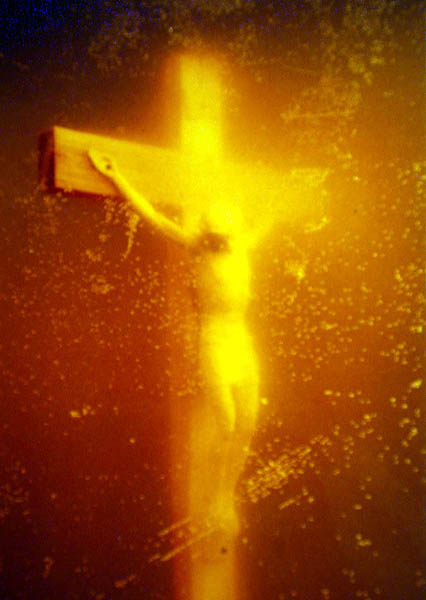
The Cross is (Still) Secular (Except When it Isn’t)

I continue to be amazed at the argument that the Christian cross, the primary symbol of Christianity across the globe, can also be a “secular” symbol that “honors” dead people who aren’t Christian. It seems so clear-cut an issue to anyone who isn’t Christian. Yet, seemingly learned Supreme Court judges have made hair-splitting arguments to this effect, discussing context and “message” of various monuments erected for the dead. Recently, another high-profile cross monument, the now-infamous Mt. Soledad cross, was unanimously ruled unconstitutional by the 9th Circuit Court of Appeals.

“In no way is this decision meant to undermine the importance of honoring our veterans,” the three judges said in their ruling. “Indeed, there are countless ways that we can and should honor them, but without the imprimatur of state-endorsed religion.”

Turns out the context, history, and message of this particular cross wasn’t so secular.

Michael Aguirre, a former San Diego city attorney who has followed the case closely, said cross supporters will have to counter the court’s analysis that the cross was used historically to promote Christianity. The ruling recounts that the cross was dedicated on Easter Sunday and used for religious gatherings for nearly three decades before it became a war memorial. It said La Jolla has a “well-documented history” of anti-Semitism from the 1920s to around 1970. “This cross marks La Jolla as a Christian community, that’s basically what (the judges are) saying,” said Aguirre, who is now in private practice. “It was a cross for decades in a community with a history of anti-Semitism.”

You’d think that this would be the end of the story, but it isn’t. The case will no doubt be appealed to the Supreme Court, and the court has left wriggle-room for the “modification” of the monument, meaning the cross stays up. Religion reporter Joshunda Sanders notes that it isn’t the only unconstitutional cross that is still standing. The Utah “secular symbols of death,” erected in memorial to fallen highway patrol officers, and ruled unconstitutional this past Summer, are still standing.

“A Denver appeals court has stayed an order that would remove 14 memorial crosses from Utah’s highways intended to honor fallen officers and encourage safe driving. The ruling gives the Utah attorneys general’s office 90 days to appeal to the U.S. Supreme Court 10th Circuit Court of Appeals ruling that the 12-foot-high memorials are unconstitutional.”

So now the fate of these unconstitutional crosses will most likely lay in the hands of the Supreme Court, and after the Mojave Desert cross ruling last year, which opened the door to the “secular cross” argument, many are worried the lines of separation concerning government-endorsed religion will be further blurred.

“…for Christians to celebrate this decision requires a will to allow the government to reject the distinct religious value the cross has traditionally held in Christianity.”

These events will not doubt embolden Christian groups to erect further “secular” crosses in hopes of sparking more legal decisions to establish a “secular cross” legal precedent. But the more Christian groups try to bend the law in their favor, in an attempt to return to a mythical pre-secular era of Christian dominance,  the more they make it possible for other faiths to eventually benefit from their labors. I somehow doubt these cross secularizers are going to stand in our corner when someone tries to erect a Wiccan or Asatru war dead memorial. Nor would anyone try to argue for a “secular” Jewish star of David, or “secular” Muslim crescent (particularly not the latter in our current climate). We’ll all have to wait and see what SCOTUS does, and how it will shape the religious landscape of this country.

40 responses so far

On Faith: Muslim-Christian Crisis

My latest response at the Washington Post’s On Faith site is now up.

Here’s this week’s panel question:

2011 began with some bleak news for Muslim-Christian relations around the world. Recent attacks against churches in IraqNigeria and Egypt have killed dozens of Christian worshippers. Meanwhile, the Pakistani government is standing by the country’s controversial blasphemy law which critics say threatens religious minorities. How should political and religious leaders deal with these challenges to interfaith relations?

Here’s an excerpt from my response:

These events are the sad fruits of mixing raw social and political power with religions that operate on a exclusionary, one-true-path, basis. What you see in Iraq or Egypt is just the extreme and violent form of a sickness that has haunted history since the now-dominant monotheisms rose to prominence and power. If you believe that only your faith can hold the truth, and that all others are either duped, ignorant, or evil, all you need to do is add the promise of power for the persecutions and violence to begin. This is not a controversial statement, or at least not a controversial statement to anyone who has studied history. The histories, chronicles, and even the holy books of the monotheisms, all attest to the fate of groups that their God doesn’t approve of.

I hope you’ll head over to the site and read my full response, and the other panelist responses, and share your thoughts.

76 responses so far

« Newer Entries - Older Entries »