A modern Pagan perspectivePosts RSS Comments RSS

Archive for January, 2011

What do the Babalawos See in 2011?

Each year there is a gathering of Santeria priests in Cuba where they perform Ifa readings for the coming year. While these readings usually try to avoid blatant political statements, that’s been starting to change in recent years. This year, the priests “predict coups d’etat and sudden political changes,” alongside a general theme of reorganization and “economic openness.”

“We are sure that there will be changes” in 2011, said the one of the group’s top priests, Lazaro Cuesta. “We’re certain that good moments are coming.” [...] The priests announced their latest forecast — known here as the “Letra del Ano,” or the “Letter of the Year” — following a secretive New Year’s Eve ritual that includes religious chants and animal sacrifices. Some 1,000 priests participated in the closed-doors ceremony, Cuesta said.

Naturally Cuba’s government-sanctioned Santeros, knowing where their bread is buttered, aren’t predicting the drastic changes seen in the independent group’s readings.

Predictions by a rival Santeria group agreed that 2011 is the year of Oggun. In a statement Sunday, the group, which enjoys official government sanction, added that “great difficulties” would be overcome this year.

You can find the full text of the 2011 Ifa readings, here.

So, having seen their predictions, let’s turn to the Pagan community. Did you do any readings about the coming year? Have any predictions you want to share with the world? Feel free to post them in the comments. But be warned! We’ll be looking back in 2012 to see how accurate you were!

25 responses so far

Quick Notes: Janine Pommy Vega, Evangelical Backlash, and Pope Benedict the Pilgrim

Here’s a few quick news notes to start off your Monday.

The Passing of a Poet: The New York Times has posted an obituary of poet Janine Pommy Vega, who passed away on December 23rd due to a heart attack. Vega was an intimate of several Beat Generation writers, most notably Peter Orlovsky, who was once her lover. Among the Goddess community, she may be most famous for her 1997 book “Tracking the Serpent,” a memoir and travelogue of “pilgrimages to sites of female spiritual and temporal power.”

Here’s an excerpt from a 1997 Boston Phoenix profile concerning the book:

Following on this touchingly understated tragedy is the book’s spiritual turning point: a near-fatal car crash. During her months of convalescence, she happens on a book about the female images of the ancient Celts: the owl-eyed goddess, the mother/protector, the huntress in her antler mask. She responds to their Jungian echo of millennia of creative female voices; they symbolize her fight to put her broken mind and body back together. They are also the seed of her travels. “As I read into the early-morning hours,” she recounts, “an owl began calling at my window. Slowly the idea coalesced of making a pilgrimage to the ancient sites . . . I needed to reaffirm something in me that felt ripped apart and empty.”

Thus begin years of introspective journeying. Vega visits the ancient sites where the goddess was worshipped: Glastonbury, Silbury, and Avebury in England, the high hills of Ireland, the shrine of the Virgin in Chartres Cathedral. She studies Vedic myth in desolate Himalayan temples, explores the earth cults of the Andes, participates in a yage ceremony in Peru, where believers coax visions from the potent, peyote-like hallucinogen ayahuasca. Fascinated by the survival of these ancient, poetic faiths in remote agricultural regions across the globe, she becomes both scholar and mystic — a Boddhisatva seeking an image of herself among the ruins.

For more tributes, check out here, here, and here.

New York Times Discovers the Green Dragon: The NYT’s Green blog looks in on the growing evangelical Christian backlash against environmentalism, referencing the fear-mongering “Resisting the Green Dragon” video series. According to “green dragon” promoter Calvin Beisner, Christians who support environmental causes, and admit the reality of global warming, “probably did not understand the science,” and that Christian “creation care” is “infected by the false worldview and theology of secular and pagan religious environmentalism.”

“Mr. Beisner, a former professor of theology and a ruling elder in the Orthodox Presbyterian Church, argued that the science is still unsettled on whether greenhouse gases are warming the climate and that projections of dangerous human-driven warming in the future are flawed and unreliable. But an “Evangelical Declaration on Global Warming” on the Cornwall Alliance’s Web site urges all evangelicals to accept that recent global warming is natural and that mankind is incapable of altering the climate.”

We’re incapable of altering the climate! God is in control! All who say differently are secularists or Pagans! Never mind the fact that humanity has been altering the climate for thousands of years, or that major climate change skeptics have been doing about faces recently. Even if you happen to believe that climate change has little or nothing to do with humanity, to audaciously endorse that we do nothing, that we continue as if everything will work out, is to turn a blind eye to the damage climate change is already doing to the world. Every inane joke about blizzards and global warming (refusing to distinguish weather from climate) simply reinforces how uniformed we truly are, and how insulated most of us are from the problems these changes in the climate are causing.

Who’s Invited to Benedict’s Interfaith Pilgrimage? In 1986 a massive interfaith gathering convened by Pope John Paul II was held in Assisi, Italy  in order to foster peace and dialog between different faiths. Since then the yearly event has become something of a political football within Catholicism, loved by the Catholic left, and often reviled by the Catholic right. The current Pope, since his days as Cardinal Ratzinger, has been a vocal critic of the gatherings. In 2005, most likely spurred by false rumors spread by an Italian journalist saying the Franciscans allowed African animists to slaughter chickens on the altar of the basilica of Santa Chiara, and American redskins to dance in the church,” (a rumor shamelessly repeated by Rod Dreher) Pope Benedict XVI removed autonomy from the Franciscans of Assisi. Now, with the 25th anniversary of the gathering approaching, Benedict says he’ll be attending “as a pilgrim” and is calling for “all men of good will” to attend.

Celebrating World Peace Day on Saturday, Benedict said that he would travel as a pilgrim to Assisi in October, inviting Christians of other confessions, leaders of other world faiths “and, ideally, all men of good will, to recall the historic gesture sought by my predecessor and to solemnly renew the commitment of the faithful of all religious to live their own religious faith as a service for the cause of peace.”

So now we get down to it. Who, exactly, will be attending? How many polytheists, animists, and non-monotheists will be in attendance? Will any indigenous religious leaders show up? What about any of the Pagans serving as trustees for  The Council for a Parliament of the World’s Religions (Andras Corban-ArthenPhyllis Curott, and Angie Buchanan)? Would they be allowed to come if they wanted? Could they rub shoulders with the pilgrim Pope? Will the man who predicted that Buddhism would replace Marxism as the Catholic Church’s main enemy this century, and that native populations were “silently longing” for conversion truly allow himself to be on equal ground with other non-Christian religions? I’ll be paying close attention to this issue, as we approach October.

That’s all I have for now, have a great day!

82 responses so far

Quick Notes: Selena Fox on 2011, Witchcraft in Romania, and Gaia

A few quick news notes on this Sunday morning.

Predictions for a New Year: CNN’s Belief Blog asks various religious leaders for their “faith-based” 2011 predictions. Circle Sanctuary’s Selena Fox sees a growth of interfaith involvement for Wiccans and Pagans.

“More Wiccan ministers and other pagan leaders will be actively involved in interfaith organizations, conferences and initiatives in the United States and internationally. Interfaith endeavors will grow in importance in addressing ongoing needs in the world today as well as in responding to natural disasters and other tragedies.”

Most of the predictions are aspirational, though Pagans have made great strides in interfaith recently. CNN’s senior Vatican analyst John Allen Jr. predicts that “Christianophobia” will become a buzzword in 2011, though I’d argue variations on that theme have been popular for generations.

(Don’t) Legalize It: Romania has changed its labor laws to make witchcraft a legal profession, but the local witches and fortune-tellers aren’t lining up to thank the government for it.

“The move, which went into effect Saturday, is part of the government’s drive to crack down on widespread tax evasion in a country that is in recession. In addition to witches, astrologists, embalmers, valets and driving instructors are now considered by labor law to be working real jobs, making it harder for them to avoid income tax.”

One Romanian Witch has already stepped forward to threaten spells against the government, nor is this the first time Witches have fought back against government intervention into their affairs. In a country where mystical attacks are still taken seriously by politicians, the economy must be truly bad for them to move forward on this initiative. As for the Witches, they opposes legal recognition for the same reasons marijuana growers in California do, because it would hurt their bottom line.

Gaia is (coming) Alive! At a recent symposium in Sydney, Australian professor, scientist, and environmental activist Tim Flannery apparently had some interesting things to say about our Earth and the Gaia hypothesis.

Robyn Williams: So there you’ve got an image of the earth, the planet as a god, but also a very sophisticated and credible scientific idea.

Tim Flannery: That’s right. I was tempted in the book to simply give in and call it Earth System Science, because Gaia is earth system science and in many university departments around the world, as you’ll know, Robyn, earth system science is a very respectable science. But as soon as you mention Gaia of course, the scepticism comes out. I didn’t do that though, because I think there’s a certain elegance to Gaia, to that word and the concept, and also because I think that within this century the concept of the strong Gaia will actually become physically manifest. I do think that the Gaia of the Ancient Greeks, where they believed the earth was effectively one whole and perfect living creature, that doesn’t exist yet, but it will exist in future. That’s why I wanted to keep that word.

Robyn Williams: How will it exist in the future? Because an organism is one thing; the earth is complicated, but it is after all a lump of rock with iron in the middle and a veneer of living things outside, and a very thin atmosphere. It’s not an organism, so how is the feedback system such that it stabilises things, temperature anyway, like an organism?

Tim Flannery: That’s the great question. I must admit that as I wrote the book I was unable to come to a clear landing on the extent of Gaian control over the system, because much of the data is equivocal. I think that there is clear evidence for something that I call in the book geo-pheromones, which are elements within the earth system, which when present in very small amounts have very large outcomes, a bit like ant pheromones. But they often do multiple jobs. Some ant pheromones do as well, but many of them are specific. One of those is course carbon dioxide, a trace amount in the atmosphere, four parts per ten thousand is enough to keep the earth habitable. Ozone is another one present in just a few parts per billion. Human-made CFCs are yet another one. Atmospheric dust may well be another one. So these elements in the earth system have a profound impact on the system, and there is some evidence that there’s some sort of homeostasis established, if you want.

This theory that Earth/Gaia is becoming a unified living organism has incensed conservative journalist Tim Blair, who blasts the idea of a “sentient Frankenplanet spirit” and rips into James Lovelock, largely credited with popularizing the Gaia hypothesis, for good measure. Behind the sneers of “general occult weirdness” and “summoning of a dirt god” is the same fear of an environmental “green dragon” seen among American Christians, the over-zealous backlash against the idea that Christianity isn’t the only or final truth in this world.

That’s all I have for now, have a great day!

41 responses so far

Pagan Community Notes: Witches & Pagans, Cherry Hill Seminary, Treadwells, and more!

Pagan Community Notes is a companion to my usual Pagan News of Note, a series more focused on news originating from within the Pagan community. I want to reinforce the idea that what happens to and within our organizations, groups, and events is news, and news-worthy. My hope is that more individuals, especially those working within Pagan organizations, get into the habit of sharing their news with the world. So lets get started!

Selena Fox & Southern Pagans: The latest issue of Witches & Pagans is now out, featuring a cover story on Circle Sanctuary’s Selena Fox and an in-depth look at modern Pagans living in the American South by Hank Eder.

But it’s not just the stars of the movement that deserve our recognition and support. Hundreds of thousands of Pagans live — quietly, passionately, devoted to their faith — in every part of the Western world. Some may believe that its impossible to be Pagan — especially out of the Broom Closet — in the so-called “Bible Belt” of America. But, in fact, there are many thousands of Pagans that live — and thrive — in the American South. Meet them, and learn more about what it’s like to be Pagan in a deeply Christian region in our 13-page story “Southern, Pagan & Proud” (complete with a directory of over 100 Pagan groups and stores in the Deep South.)

The piece on Southern Pagans is worth the price of admission alone, the kind of in-depth work that print publications should be pursuing in this era of instant and immediate news. You can browse a preview of the issue, here. You can also purchase a PDF download version of magazine, or become a subscriber.

Cherry Hill Seminary Names New Academic Dean: Preeminent online Pagan learning institution Cherry Hill Seminary has appointed academic and sociologist Wendy Griffin, Ph.D. as their new Academic Dean.

Perhaps the first American academic to be openly Pagan, Wendy has published numerous academic articles on Pagan women’s groups and is the editor of Daughters of the Goddess: Studies of Healing, Identity and Empowerment, a 13-essay survey of contemporary Feminist Witchcraft and Goddess Spirituality by British and American writers.  She is a founding co-chair of the Contemporary Pagan Studies Group in the American Academy of Religion, and serves on the editorial board of Pomegranate: The International Journal of Pagan Studies. Wendy recently completed work as co-editor of the first scholarly series in Pagan Studies published through an academic press, AltaMira.

Griffin said of her appointment, “I am excited about being part of Cherry Hill Seminary and making a contribution to the growing reputation and professionalization of the Seminary. When I entered the academic world as a brand new Ph.D. 26 years ago, I had no idea I would be able to end my career helping to build an institution that would serve such a diverse and committed international community.”

Fellow Pagan academic Chas Clifton says on his blog that CHS “made a good choice,” and praises Griffin’s ability and acumen. This is certainly a major recruiting coup for CHS, one that places them in an excellent position as they move forward towards accreditation and building a robust faculty. Congratulation to both Griffin and CHS (full disclosure: I have both taught and worked with CHS in a professional capacity).

Treadwell’s Big Move: First-rate esoteric London book shop Treadwell’s is moving into a bigger space in February.

“Treadwell’s will Moving in February 2011! It is good news, as we move to a slightly larger place in Bloomsbury, north of the British Museum - 33 Store Street, WC1. Do come and pay final visits to the much-loved (cosily cramped) shop in Tavistock Street in the next weeks. We’ve been filling the shop to the hilt with new books, rare books, featured books and gifts. We warmly invite you to visit in person. And friends overseas, we will gladly post mail orders to you of special books. We do vouchers, too, which are a favourite gift.”

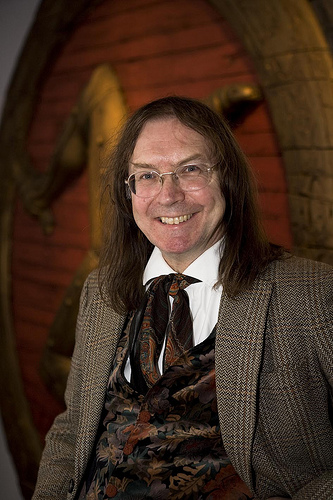
You can see a video of the old shop, along with owner Christina Oakley-Harrington, above. Congratulations to a worthy business on their success and expansion!

Patheos Begins Wiccan Series: The Pagan portal at Patheos.com will be focusing on Wicca in January, the beginning of new series that will focus on a different Pagan tradition every month in 2011. Many noted thinkers and practitioners within Wicca will be participating, and readers are invited to send in their responses as well. Portal manager Star Foster has already posted the first question for the start of the Wicca series on January 3rd.

We will be launching a similar series on January 3rd as part of our monthly focus on different Pagan traditions in 2011. We will be putting the spotlight on Wicca in January and here’s our first question: What makes someone Wiccan? Dedication? Initiation? Practice? Belief? If you’d like to weigh in just e-mail me your short response (250-500 words) before Jan 3rd. It’s sfoster at patheos.com.

I look forward to seeing the responses, as well as the future series on other Pagan religions.

That’s all I have for now, I hope all of you have a great 2011!

10 responses so far

« Newer Entries