A modern Pagan perspectivePosts RSS Comments RSS

Archive for May, 2011

Unleash the Hounds! (Link Roundup)

There are lots of articles and essays of interest to modern Pagans out there, sometimes more than I can write about in-depth in any given week. So The Wild Hunt must unleash the hounds in order to round them all up.

That’s it for now! Feel free to discuss any of these links in the comments, some of these I may expand into longer posts as needed.

15 responses so far

Crisis and the Rise of Exorcisms

I’ve spent quite a bit of time at The Wild Hunt looking at the revival of interest in exorcisms within the Catholic Church. The reason for this interest is the fact that many of these exorcists list modern Pagan religions, and interest in the occult, as symptoms of demonic possession.

“A lot of folks dabble in the occult, or they will be involved in practices that … classical Christianity at least would consider to be idolatrous.  People can get themselves involved in Wicca, or people will go see some sort of fortune-teller, or people will go to a séance, or they can go and they can learn how to channel spirits. …” Father Gary Thomas

“Father Euteneuer does not speak as a theorist. Since 2003 he’s had extensive experience ministering to those possessed by demons … Father Euteneuer told me possession is almost always a result of someone getting involved in some sort of occult practices, such as witchcraft, Wicca, tarot cards, and Ouiji boards. ”Harry Potter and these Twilight vampires glamorize the power of evil,” Father Eutenener explained, “and this has lead to many, many cases of possession among young people.” It may begin with a child or teenager simply “playing around” with the occult, but that seemingly harmless act is “opening a window” to possession.” Father Thomas Euteneuer

“No one knows why more people seem to be seeking the rite. Paprocki said one reason could be the growing interest among Americans in exploring general spirituality, as opposed to participating in organized religion, which has led more people to dabble in the occult. “They don’t know exactly what they’re getting into and when they have questions, they’re turning to the church, to priests,” said Paprocki, chairman of the bishops’ committee on canonical affairs and church governance. “They wonder if some untoward activity is taking place in their life and want some help discerning that.”Bishop Thomas Paprocki

Religion News Service correspondent Daniel Burke, writing for U.S. Catholic Magazine, explores the reasons for this spike in interest and practice of exorcisms within contemporary Catholicism. Burke quotes historian Nancy Caciola, who says that increases in exorcism usually happen during times of crisis and upheaval.

“Portable manuals detailing ever more elaborate and standardized rituals of exorcism proliferated during the papal schism of the 15th century, when two men claimed to be the rightful pope. The manuals surfaced again during the Protestant Reformation. “In general, exorcisms are associated with these turning-point moments when the church [feels] challenged in some way and tries to centralize power and clarify the delegation of authority from God down through the hierarchy,” Caciola says. The challenges now confronting the Catholic Church in the United States are legion: the sex abuse scandal, a secularizing society, and a restive flock that, studies show, loses one out of three adult Catholics, to name just a few.”

One of the ramifications of a “secularizing society” is increasing competition, no matter how small in stature. Paganism and “the occult” being ready made culprits and opponents for a reviving body of exorcists. Even still, this would only be a minor annoyance were it not for the fact that the “training” received by exorcists seems to point in ominous directions. Earlier this year media critic (and practicing Witch) Peg Aloi interviewed Father Gary Thomas, the brightest star among American Catholic exorcists, also interviewed in this U.S. Catholic Magazine piece, and found that he held some rather troubling ideas concerning who exactly he was battling.

Peg Aloi: Do you believe there are a lot of satanic cults out there?

Father Gary Thomas: There are probably more than we think. In fact, I pray over a woman right now who is a satanic cult survivor.

PA: I need to ask this. Speaking as someone who has done extensive research on the Satanic Ritual Abuse scare in the 1990s: Do you think it’s possible your parishioner’s experiences are false, or that she may be lying, or delusional? Because despite many, many horrific accusations of abuse and murder and various other atrocities by satanic cults over the years, most of them by alleged “survivors” who claim to be former cult members, the FBI, after years of investigation, never found a single shred of evidence to suggest there is or ever has been an underground network of satanic cults in the United States.

FGT: I don’t believe that she’s lying. She had been seeing a priest in our diocese for a while and her memories stated to surface, and that’s how we learned of her involvement in the cult. But if even half of what she’s saying is true, and I have not found any reason to doubt it, in her system, if anyone exposes the group, they’ll be killed. There is a whole culture in terms of what these people tell their members.

What you are reading there are the seeds for a new Satanic Panic, the same sort of moral panic that imprisoned, terrorized, and ruined the lives of hundreds of people. Some spent nearly twenty years in prison on false charges, as documented in the chilling 2008 film “Witch Hunt”. Others, like the West Memphis Three, are still fighting for justice. The deeper you dig into these exorcists, the more problematic material you find. That they are enjoying a certain level of mainstreaming now may point to tensions and problems faced by modern Catholicism, but it also has the potential to do considerable damage to any group unlucky enough to become spiritually scapegoated.

Religion journalists, both secular and denominational, seem to completely gloss over the problems in modern exorcism rhetoric. If “occult,” “Wicca,” or “Paganism” were replaced with signifiers for any other mainstream religion or spiritual practice there would be international outcry and mountains of bad publicity. That there isn’t seems to either be a failure of journalists to understand that these priests are saying that some religions are fair game for what is, in essence, spiritual warfare, or they simply can’t believe that anything serious could result from the rise of exorcism. That this is simply a interesting trend piece. But for those who are named in the fear-mongering and half-truths, who have lived through one “panic” already, this rise in spiritual warfare, whether Protestant or Catholic, carries with it the threat of future panic and hysteria.

54 responses so far

Huckabee Not Running for President

Last night former Arkansas governor and Fox talk-show host Mike Huckabee announced on his program that he would not seek the Republican nomination for the presidential election in 2012.

I’ve done quite a bit of writing about Huckabee recently, both at The Wild Hunt and at the Washington Post. I specifically found his deep admiration for pseudo-historian David Barton, who denies that religious minorities are protected by the Establishment Clause, especially troubling. He even jokingly said that he thinks Barton’s views should be taught at gunpoint in public schools.

Nor was Barton the only controversial friendship he nurtured. His ongoing silence concerning similar views voiced by  Bryan Fischer, the Director of Issue Analysis for the American Family Association, a man who, like Barton, claims the Establishment Clause only applies to Christians, that Native Americans are mired in alcoholism and poverty because they won’t all become Christians, and that the environmental movement is a stalking horse for Paganism, made him uniquely unsuited in my mind to lead a pluralistic and secular nation. So let us all breathe a collective sigh of relief that Huckabee isn’t running.

The question now is who will take up the Christian social conservative banner during the Republican presidential primary race? Jon Ward at The Huffington Post believes the baton will largely pass to Minnesota Representative Michele Bachmann (if she wants it).

“Perhaps no one will benefit more than Rep. Michele Bachmann (R-Minn.), if she decides to run. She has the capability, probably more than any other potential GOP candidate, to unite social conservatives in Iowa in a way similar to the way Huckabee did last election.”

Unfortunately, Bachmann is also a big David Barton fan, and is, if anything, more radical in her views than Huckabee. The only potential upside to all this for Republicans who aren’t married to Christianity and their culture war issues is that all the social conservative candidates flooding the field might just cancel each other out.

“But it is more likely now, even if Bachmann runs, that the social conservative vote in Iowa will be more splintered in 2012 than it was in 2008, with votes going to former Minnesota Gov. Tim Pawlenty, former House Speaker Newt Gingrich (R-Ga.), former Godfathers Pizza CEO Herman Cain, and former Pennsylvania Sen. Rick Santorum. In the end, this splintering could benefit other more moderate candidates like Pawlenty, former Utah Gov. Jon Huntsman, Indiana Gov. Mitch Daniels if he decides to run, or former Massachusetts Gov. Mitt Romney, if he decides to campaign in the Hawkeye State.”

That analysis might be overly optimistic, but it does show a potential way forward for more socially moderate candidates. In any case, religious minorities must remain vigilant that any politician who would deny us equal treatment not be allowed to move forward unquestioned and unscrutinized.

51 responses so far

Quick Notes: Playing Morgan, Paganism in Lancaster, and Dead Can Dance

Just a few quick notes for you on this Saturday.

The Ramifications of Playing Morgan: In a recent interview actress Eva Green, who currently plays the role of Morgan in Starz new series “Camelot”, admitted to “reading extensively” on the subject of magic.

“Real magic is everywhere,” says the 30-year-old actress. “It’s in the winds and the sun and the moon; the earth and the trees.” [...] she had no interest in magic before she began work on the series, but has now read extensively on the subject. She urges others to do the same. “People are not connected to nature any more. My character in the series is trying to restore the pagan ways.”

I’ve long been a fan of Morgan Le Fay in all her aspects, and I’ve developed a working theory that actresses playing her find themselves more interested in magic, mysteries, and pre-Christian religion than before. Most famously would be Dame Helen Mirren who played Morgana in Excalibur and recently took on the role of Prospera in a gender-bending version of Shakespeare’s “The Tempest.” In an interview during the run-up to that film Mirren noted that women with any interest in education are persecuted for being witches, herbalists, evil. I thought of all these women, now and throughout history, as I was playing Prospera. Perhaps Mirren and Green should meet up and chat.

Religion Journalist Looks at Modern Paganism: Former Get Religion contributor and religion journalist Elizabeth Eisenstadt Evans has started a series in her religion column for the Lancaster Intelligencer Journal concerning Pagan and New Age religions.

“American religious history has always included those who marched to the beat of different drummers, and those who tried to shoo them back into line (happily, they no longer cut off their heads or subject them to torture). American religious practices reflect the diversity of our history, our democracy and our culture, confounding those who believe in “pure” heritage passed on from one generation to another. In the weeks to come, we’ll step back and take a look at the wider context of American religious life, and where New Age and pagan denominations fit in.”

I’m quoted in the column, as is a local Lancaster-area Pagan. It should be worth checking out and keeping tabs on future columns. Evans also passed word to me that she tried to capitalize ”Pagan” for this piece but was overruled by her editor, so don’t be too hard on her for it. On the whole, this is a pretty balanced and fair initial look at our family of faiths and I look forward to seeing where she goes with it.

The Return of Dead Can Dance: A massive favorite among many Pagans, and an influence on several bands embraced by the Pagan community, the duo of Lisa Gerrard and Brendan Perry, more popularly known as Dead Can Dance, are planning to put out a new album in 2012.

I have been talking with Lisa Gerrard this past week with regard to recording a new DCD album this coming winter. We hope to complete the album by the summer of 2012 and then embark on an extensive two month world tour in late 2012. I will be posting updates from time to time with regard to our progress……. and remember….. you heard it here first and yes it is official!

The band’s last full-length album of new material, “Spiritchaser,” came out in 1996. In the interim, both Gerrard and Perry have put out solo material and collaborated with other musicians (Gerrard has become particularly well-known for her soundtrack work). At my music blog TheSkysGoneOut (a companion of sorts to my A Darker Shade of Pagan project) I recently discussed the massive influence DCD has had on a generation of musicians. I’ll keep you posted once I know more.

That’s all I have for now, have a great day!

6 responses so far

The “Wiccan-Proof” Invocation Model

As various government bodies in the United States navigate what is and isn’t a violation of restrictions against the endorsement of a particular religion (aka the separation of church and state) when giving an opening invocation, two models have emerged. The first model says you can have sectarian prayer (ie specific invocations to named deities or powers) so long as everyone is invited to participate, and the second model says that only nonsectarian (ie generic invocations to “god”) prayers are acceptable. Conservative Christians activists generally favor the first model, while secular civil liberties organizations broadly prefer the second. Between these two poles a variety of variations have been tested, often in the courts.

In many cases modern Pagans, specifically Wiccans, have been caught in the tumult of what is and isn’t permissible. For example, there’s the “include a Wiccan” gambit to protect yourself from accusations of “open” invocation models that seem to only invite Christians (though mere randomness sometimes isn’t enough), and then there’s the “we don’t want to include a Wiccan” model famously undertaken by Chesterfield County, Virgina. In that case a rotating sectarian model was challenged by a Wiccan when she wasn’t allowed a turn, the county board changed their policy to nonsectarian during litigation and that seemed to be enough to make exclusion of minority faiths permissible. This “nonsectarian monotheist invocations only” policy seems to have made an impression as it is now being emulated by Frederick County, Maryland.

“Board members voted 3-to-2 on Thursday to invite religious leaders to attend their meetings to invoke “divine guidance” for the commissioners and their deliberations. The religious leaders must be ordained and affiliated with a monotheistic religion with an established congregation in Frederick County. Their prayers must avoid referring to any particular religion, denomination or sect.”

The restriction to only “monotheistic” faiths is echoed in local coverage as well. An NBC Washington headline specifically called it the “Wiccan-Proof Prayer Policy.” Here’s what County Commissioners say about their new policy in a press release.

The Frederick Board of County Commissioners today approved an invocation policy to allow prayer at certain of its meetings, consistent with the Chesterfield County, Va., invocation policy upheld by the United States Court of Appeals for the 4th Circuit. [...] “We do not believe there would be any disagreement from the majority of Americans that we are still ‘one nation under God,’ as we say in our pledge of allegiance, and that it says on our dollar bill, ‘In God We Trust.’ Our policy does not mandate a one-county religion or endorse any religion over another, but we do acknowledge our Creator.”

While one commissioner was against the new policy because it didn’t allow sectarian prayers to Jesus, he is no doubt mollified by the reassurance that no polytheist will be allowed an invocation. Since the Chesterfield County policy went all the way to the Supreme Court (who refused to hear the appeal) no doubt many will see this path to exclusion as legally bulletproof. The only reason it hasn’t been more widely adopted by conservative Christian-dominated government bodies is that they hate nonsectarian prayer almost as much as they hate non-Christian religions. Indeed, at this moment the 4th Circuit Court of Appeals, who ruled in the Chesterfield case, is hearing case on the legality of sectarian prayer on a supposed open first-come-first-served model.

Judge J. Harvie Wilkinson, the senior judge among the three hearing Thursday’s arguments on appeal, at one point said that the county’s policy seemed geared to favor the “faith of a majority of residents in the county.” “The result of the policy is that the prayer is overtly sectarian,” Wilkinson later said. [...] Katherine Parker, the attorney for the residents who sued the county, said that despite the wording of the county policy, the real effect — as shown by the prayers that have been prayed — was to advance Christianity by the county government.

If the 4th Circuit paves the way for more sectarian prayer, will the Frederick County Government change policy? Is wink-and-a-nudge nonsectarianism enough? Either way, government officials seem to be ensuring that only monotheist lips utter prayers at meetings. Whether these models will ultimately remain “Wiccan-Proof” remains to be seen.

61 responses so far

Quick Notes: Hilmar Örn Hilmarsson, Don Frew, and Sascha Meinrath

A few quick news notes for you on this Thursday Thor’s Day.

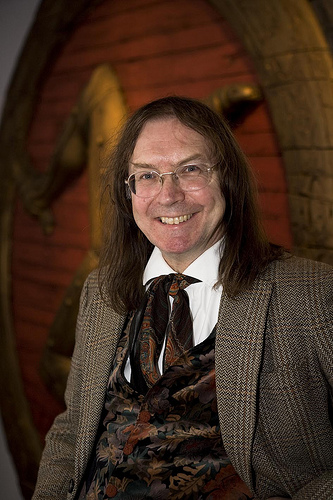
The Chief Godi in Translation: A couple days ago I featured a link to a story concerning the thoughts of Hilmar Örn Hilmarsson, Chief Godi of Ásatrúarfélagið in Iceland, on the new “Thor” movie. I could only get a rough gist of the piece since it was in Icelandic, and asked for a translation. Now, thanks to the Old Norse Network (ONN), Dr. Jane Sibley, Ravynne, and Merrill Kaplan, I’ve received a couple of accurate (and understandable) translations of Hilmarsson’s comments.

“I‘d see it mostly as a fan of bad movies,” says Hilmar Örn Hilmarsson, Allsherjargoði and leader of Iceland’s Ásatrúarfélag, when asked whether he had already or intended to see the newest Hollywood movie about the thunder god Thor. The movie is based on the Marvel comic book series and was premiered here in Iceland this week. He says that the Ásatrúarfélagið hadn’t taken any particular stance on literary and artistic works surrounding Ásatrú. “Then you’d have to begin in the eighteenth century. People have been drawing on this heritage for two, three hundred years. Sometimes it’s been successful and sometimes not. We can certainly be grateful that Edward Elgar composed beautiful music with these “motifs,” and Wagner did too. And naturally some heavy metal bands have appropriated it in much worse ways than will be the case in this film by Kenneth Branagh,” says Hilmar Örn. He said he didn’t regard the movie itself as any kind of misrepresentation of the faith. “If you take some kind of fundamentalist stance towards it, then some people are going to be offended. People have been drawing on this heritage for many hundreds of years, and we haven’t opted to organize any kind of protest about it the way it might happen in other religions. We’re a little more relaxed about it, I think,” says Hilmar Örn.

So there you are! Thanks to everyone who helped get me a translation. In addition, Kjell from the ONN list also points out reactions to Thor from Norway and Denmark (no translations, though). You might also be interested in this column from Religious New Service writer Cathleen Falsani.

COG and the Prayer Breakfast: The Covenant of the Goddess Interfaith Reports blog features a report from Don Frew on the Marin Interfaith Council Prayer Breakfast, at which Frew was a featured presenter. Here’s an excerpt from the talk Frew gave to an audience of over 180 local representatives of different faith communities.

“The easiest way to understand modern Neopaganism is to think of something like Nataive American spirituality or Japanese Shinto, but coming out of pre-Christian European and Mediterranean cultural settings.  There are Druids, reviving the religion of the ancient Celts.  There are Heathens, taking their inspiration from the religions of the Norse and Germanic peoples.  But by far the largest branch of Neopaganism is the Witches, coming out of the fusion of Celtic, Anglo-Saxon, and Graeco-Roman spiritualities that occurred in the British Isles.  This led many modern Witches to use Anglo-Saxon word – “Wicca” – instead “Witchcraft”.  Some found it easier to avoid one “w-word” by replacing it with another, especially when explaining things to their parents.  [chuckles]“

Apparently feedback for the presentation was very good, and most likely helped change some misconceptions that are held about our family of faiths. Congratulations to Don Frew on the successful interfaith experience. I encourage my readers to head over and give your feedback on the talk.

The Digital Divide on Native Reservations: MediaShift at PBS looks at the digital divide in Indian Country, and interviews Sascha Meinrath, director of New America Foundation’s Open Technology Initiative, about the struggle to bridge that divide and bring new media opportunities to tribal communities.

“You have a community that perhaps treasures media and cultural production more than almost any other constituency in the country, and you have an entire dearth of access to new media production and dissemination technology,” Meinrath said. Since 2009, New America Foundation has worked with Native Public Media, which supports and advocates for Native American media outlets, to help tribal communities take advantage of new media platforms. In January, the organizations formalized their partnership, and this fall, they plan to launch a media literacy pilot project that will train Native radio broadcasters in at least four communities to tell stories using digital tools.

This is a hugely important issue, and a chance to break “a pattern of historical exclusion from media and communication services” according to Loris Ann Taylor, president of Native Public Media. Amplifying and enriching indigenous voices is something that all of us should support and welcome, a road towards increasing self-determination and changing a dominant media narrative that often ignores the voices of Native Americans.

That’s all I have for now, have a great day!

28 responses so far

The Daily Show Draft

File this under things I never saw coming. Patheos.com Pagan Portal manager Star Foster has had enough of conservative Christian distortions concerning modern Paganism, their leaders saying one thing to supporters, and then moderating (or outright lying) about their views when the media spotlight turns to them. Star was so angry, that she decided the productive solution would be to lobby The Daily Show and have them bring me on as a guest.

“Instead I’m going to ask you to write The Daily Show and suggest they invite The Wild Hunt author and Washington Post columnist Jason Pitzl-Waters on the show to discuss David Barton and the real challenges religious minorities face in this country. As a journalist he is familiar with the legal battle facing Patrick McCollum, the discrimination against Santeria, the triumphs of and challenges before the Lady Liberty League, the AFA earth-centered spirituality space, the Witch-Children of Africa and India, and many more stories important to our communities. He’s the journalist at the nexus of all of these stories, and he’s an excellent public speaker.”

Within a few hours, a page entitled “100,000 to get Jason Pitzl-Waters on the Daily Show” appeared, and now has nearly 800 supporters. People are writing letters to The Daily Show, and posting supportive messages at their Facebook profiles and on Twitter.

I’m really quite taken aback, flattered, and surprised by all of this. Naturally, if some minor media miracle occurs and I actually get a call from The Daily Show people I’d be happy to appear and talk about minority religions and that question no one is asking David Barton. Even if I don’t, I think this outpouring shows just how invested we’ve become in building and maintaining our own Pagan-centered media. We are no longer voiceless or powerless, and we care about setting the record straight. So thank you to everyone who has put time and effort into this, and I guess we’ll see what happens!

26 responses so far

« Newer Entries - Older Entries »