A modern Pagan perspectivePosts RSS Comments RSS

Archive for October, 2011

A Blessed Samhain

Tonight and tomorrow is when most modern Pagans celebrate Samhain. Samhain is the start of winter and of the new year in the old Celtic calendar. This is a time when the ancestors are honored, divinations for the new year are performed, and festivals are held in honor of the gods. It is a time of final harvest before the long winter ahead. It is perhaps the best-known and most widely celebrated of the modern Pagan holidays.


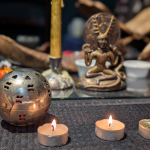
An ancestor altar.

This time of year also sees the celebration of Velu Laiks (“the time of spirits”) by Baltic Pagans,Winter Nights by Asatru in mid-October, Foundation Night in Ekklesía AntínoouFete Gede by Vodou practitioners, Día de los Muertos for followers of Santeria and several indigenous religions in Mexico and Latin America, Diwali for Hindus (October 26th this year), and astrological “true” Samhain on November 7th for some Witches and Druids. In addition, Pagans in the Southern Hemisphere are currently celebrating Beltane.

It is a time when some communities acknowledge the Mighty Dead.

“The Mighty Dead are said to be those practitioners of our religion who are on the Other Side now, but who still take great interest in the activities of Witches on this side of the Veil. They have pledged to watch, to help and to teach. It is those Mighty Dead who stand behind us, or with us, in circle so frequently.”

Many who have been dear to our communities have crossed the veil this past year, joining the ranks of the Mighty Dead, including Jehanah WedgwoodPeter ‘Sleazy’ ChristophersonShakmah WinddrumJanine Pommy VegaKenneth Grant, Bone Blossom, Merlin StoneLord SenthorBronwen ForbesSilva JosephBrian Fairbrother, Arthur Evans, and Lord Merlin.

“I love that story about Susan Anthony that Zsuzsanna Budapest tells in her book. Some journalist asked Susan Anthony, because she didn’t believe in orthodox religion, I suppose, “Where do you think you’re to go when you die?” She said, “I’m not going anywhere. I’m going to stay around and help the women’s movement.” So even if I don’t live long enough to see these things, I’ll be around to make a nuisance of myself.”Doreen Valiente, the Mother of Modern Witchcraft.

You can also find a list of departed pioneers, founders, and elders at the Green Egg Zine.

Below you’ll find an assortment of quotes from the media, and fellow Pagans, on the holiday.

“Folklore holds that liminal times and spaces (crossroads, thresholds, midnight, Samhain) bring us to a closer relationship with the Otherworlds, lands of enchantment and imagination. The Veil between our everyday world and the Otherworlds begins to thin. The inhabitants of the Otherworlds reach out to us and make themselves felt.. The nature of those inhabitants varies across stories and traditions – they may be the Good Folk, the puca and the bean-sidhe, the kelpie of the well and the hinkypunk of the marsh, and other kinds of creatures as well. Many of the secular traditions of Halloween are inspired by the tales of these creatures, playing on the possible relationships between humans and spirits.” - Literata and Morwen, The Slacktiverse

LGBT writers, such as poet Judy Grahn, have written of Halloween as a “great gay holiday.” Grahn wrote in her history of gay culture, Another Mother Tongue, that Halloween came to be observed by gay people as their special night because LGBT people had served as priests, witches, shamans, healers and intermediaries between living and spiritual worlds in many societies throughout history. [...] Jesse Monteagudo, a gay South Florida writer, wrote in Halloween: the Great Gay Holiday, that he believes LGBT people adopted Halloween as their special night because it had “a lot to do with our role as outsiders in society; our propensity for cross-dressing and gender-bending; our love for the unusual and the fantastic; our ability to find humor in the absurdities and misfortunes of life; our fascination with festive costumes and the world of make-believe; and our special capacity to have fun.” - David Webb, Dallas Voice

In his book The Pagan Mysteries of Halloween, Jean Markale describes Samhain (pronounced “sow-en”) as an important festival that served to unite the tribe. To commemorate the New Year, fires all over the Celtic world were extinguished the night of Samhain, then relit from ceremonial blazes kindled by Druids, the religious leaders of the pre-Christian Celts. Animals were slaughtered and sacrificed to Celtic deities. ”In marking the onset of winter, Samhain was closely associated with darkness and the supernatural,” adds Nicholas Rogers, a York University history professor, in Halloween: From Pagan Ritual to Party Night. “The festival was closely related with prophecy and story-telling.” It was a time out of time, “charged with a peculiar preternatural energy.” - Chris McGowan, The Huffington Post

Miguel de la Torre, Professor of Social Ethics at the Iliff School of Theology in Denver, Colorado, relayed a story told to him by a Protestant pastor. This man was in Mexico doing missionary work and had, for many years, refused to participate in annual Day of the Dead celebrations. He complained about the money that the people spent on candles and lamented their engagement with what he saw as “evil.” However, the year his father died, he reluctantly went to the cemetery. As the night went on, the pastor “lit candles, told stories of his father, and saw that as a healing moment and began to develop relationships with the people.” - Mary Valle, Religion Dispatches

“Halloween or the Festival of Samhain for Wiccans is by far Salem’s biggest holiday of the year. There are all kinds of parties, celebrations like the “Temple of Nine Wells Samhain Magick Circle,” eerie séances, magic shows, concerts, readings and other “haunted happenings” to experience throughout October leading up to the big night. Ask around and you might get invited to some of the spookier, more exclusive events. Salem gets crowded during late October, but the spirit of the city is most alive during the sliver between our world and the next. This otherworldly revolving door is said to be the thinnest on All Hallows Eve.” - Bob Ecker, Napa Valley Register

“The Day of the Dead, or Dia de los Muertos, honors departed souls of loved ones who are welcomed back for a few intimate hours. At burial sites or intricately built altars, photos of loved ones are centered on skeleton figurines, bright decorations, candles, candy and other offerings such as the favorite foods of the departed. Pre-Columbian in origin, many of the themes and rituals now are mixtures of indigenous practices and Roman Catholicism.”Russell Contreras, The Associated Press

May you all have a blessed Samhain, blessings to you, and your beloved dead on this season. Let this new cycle be one of great blessings for all of you. Also, in recognition of the holiday, I’ve created a special edition of my podcast chock-full of Halloween and Samhain-themed music! Enjoy!

17 responses so far

Guest Post: The Hail Columbia Movement

[The following is a guest post from Literata. Literata is a Wiccan who studies theaology and enjoys developing poetry and rituals. Her work has appeared in the anthologies "Queen of the Sacred Way", "Anointed" and "The Scribing Ibis" from Neos Alexandria, in CIRCLE Magazine, and in the ezine Eternal Haunted Summer. She also writes regularly for The Slacktiverse and blogs at Works of Literata. In between leading Rose Coven, reading Tarot, and communing with nature, she is writing her Ph.D. dissertation in history and enjoys travel and spending time with her husband and cats.]

The Hail Columbia movement is a way for Pagans to protect freedom of religion – and you can help.

At today’s Celebration of the Divine Feminine, I will lead a prayer to Columbia, honoring her as a patron goddess of the district that bears her name and as a protecter of our ideals of freedom, especially freedom of religion.

“Wiccans and Pagans are part of the American religious mosaic, and they’re here to stay. Founding Fathers like Thomas Jefferson and James Madison gave us religious liberty – and that means religious liberty for everyone. The followers of nature-based faiths are going to use it because they don’t want to lose it. What could be more in keeping with the great American tradition?”Reverend Barry Lynn, United Church of Christ minister and executive director of Americans United for Separation of Church and State

The Hail Columbia movement grew out of concern over the efforts exerted by a small but increasingly influential group of conservative Christians to restructure America so that all aspects of life conform to their vision of a Christian society. Several Republican candidates for president have significant connections to the New Apostolic Reformation and other groups that have explicitly stated they intend to influence politicians so that the government will enforce their religious edicts.

The catalyst for Hail Columbia was a NAR project called DC 40 which involved organizing “prayer warriors” nationwide to “change the spiritual atmosphere over DC forever” by conducting “spiritual warfare” and renaming DC the District of Christ. As DC-based bloggers, Hecate Demeter and I found this idea not just preposterous but offensive. We started spreading the word and encouraging Pagans to respond by honoring Columbia and, ultimately, by participating in politics to help protect freedom of religion.

“The methods used by the NAR and other Dominionists are founded upon hate, fear, and ignorance.  Their demonization of our Gods and Goddesses uses inflammatory language that can lead to violence and discrimination against followers of minority religions.  We have choices in how to respond to this threat to our freedom and our faiths.  Many are resorting to prayer, some to writing letters, and some to defensive strategies.  We decided to honor the Queen of Heaven, the Goddess Inanna, in a public space, and demonstrate the very freedoms the Dominionists seek to destroy.”Katrina Messenger, founder of Connect DC and the Reflections Mystery School in Petworth.

Star Foster and others created a Facebook page and Dash put together a website to spread information and coordinate Pagan responses. The results have been heartening; local coordinators are volunteering in states across the nation and we’ve raised awareness about the potential dangers posed by these would-be theocrats. But it’s not just about leaders – it’s about voters. NAR-related groups are working to register more evangelical Christians and to encourage them to vote for specific candidates who have expressed agreement with this radical agenda.

This is why it’s vital for Pagans to be politically aware and politically active. I want to work towards that goal by making the Hail Columbia project a nexus for information and action. It could include features such as information on candidates’ positions on religious liberty and action alerts for people to write to their elected officials about government infringement on freedom of religion. I’d like to hear more from the community about how useful something like that would be and any other ideas you have for how to move Hail Columbia forward. I’m also looking for additional contributors to the Hail Columbia blog.

Columbia represents the freedoms on which America is founded. She encourages us to protect what has been won and beckons us onward to expand freedoms, including religious liberty in a peaceful and pluralistic society. Will you help?

[You can read more about Literata's work with the Hail Columbia movement, and why she thinks it is important, here. You may also want to keep an eye on the PNC-Washington DC site (here's a pre-event post) for coverage of today's gathering. I'd like to thank Literata for taking the time to share her thoughts with us.]

79 responses so far

Starhawk on the Occupy Movement

Author, activist, and Reclaiming co-founder Starhawk has been attending several Occupy gatherings in California and writing about those experiences at her blog. In addition, she has also written about Occupy Wall Street for the Washington Post’s On Faith section.

Occupy Oakland

Occupy Oakland

“At its essence, the message of the Occupations is simply this: “Here in the face of power we will sit and create a new society, in which you do count. Your voice carries weight, your contributions have value, whoever you may be. We care for one another, and we say that love and care are the true foundations for the society we want to live in. We’ll stand with the poor and sleep with the homeless if that’s what it takes to get justice. We’ll build a new world.” The Occupy movement is not overtly religious, like the Tea Party. The 99 percent includes people of all religious faiths, and people who have none. But I believe its core message and ethic is profoundly spiritual, even prophetic.”

Starhawk goes on to say that the Occupy movement “renews my faith in the human spirit, in our creativity, our craving for justice, our determination to root our world in love.” As mentioned above, you can read her ongoing reports from the various Occupy gatherings in California at her personal blog.

For more on Pagan reactions to the Occupy movement, check out these reports from PNC-Bay Area and PNC-Minnesota. You may also enjoy these recent blog posts from Alison Leigh Lilly, T. Thorn Coyle, Jonathan Korman, and Gus diZerega.

9 responses so far

Assisi III: Too Much and Not Enough

Large interfaith gatherings can often be fraught with long-simmering tensions, just ask the folks who put on the Parliament for the World’s Religions, but it is generally thought that the benefits outweigh the drawbacks. That getting leaders and clergy of the major religions in the same room to find common ground and common understanding will bring dividends of lasting peace (or at least bring about greater tolerance). Yesterday, in Assisi, Italy the Catholic Church sponsored a massive interfaith gathering, the third such gathering to directly involve a sitting Pope (hence, “Assisi III” in Catholic circles), and the 25th anniversary of the first such meeting. In his address to the gathering, Pope Benedict XVI acknowledged that Christianity has used violence to achieve its ends, and that this is against the spirit of his faith.

“As a Christian I want to say at this point: yes, it is true, in the course of history, force has also been used in the name of the Christian faith. We acknowledge it with great shame. But it is utterly clear that this was an abuse of the Christian faith, one that evidently contradicts its true nature. The God in whom we Christians believe is the Creator and Father of all, and from him all people are brothers and sisters and form one single family. For us the Cross of Christ is the sign of the God who put “suffering-with” (compassion) and “loving-with” in place of force. His name is “God of love and peace” (2 Cor 13:11). It is the task of all who bear responsibility for the Christian faith to purify the religion of Christians again and again from its very heart, so that it truly serves as an instrument of God’s peace in the world, despite the fallibility of humans.”

Benedict has long been categorized as skeptical of interfaith efforts such as these, and famously criticized the first Assisi gathering, saying that it could lead to the impression that all faiths are valid. As a consequence, great pains were taken to avoid the impression of unified prayer at this event, and to assert that profound theological differences exist between the world’s faiths.

“In the 1960’s a theologian wrote (and I paraphrase as I can’t seem to find my copy of the work this morning), “Polytheism was half-right. It understood that God was immanent in the world. But, it missed the fact that God also transcends the world.” The theologian? Joseph Ratzinger of course. If one of the reasons to gather religious leaders of different faiths together was to focus on the first half, the part polytheists got right, that is well and good. But, for Benedict, we cannot neglect the other half, nor the fact that we Catholic Christians do not pray to the same God as our polytheist brothers.”

However, these measures weren’t enough for some Catholic traditionalists, who felt the very gathering together  of religious leaders with the Pope was a blasphemy too far.

“…the very nature of a pan-religious event with representatives of the world, most of them pagan, is to foster religious indifferentism and religious relativism.  Yet in the months leading up to the third major Assisi affair, we have been told repeatedly by Vatican officials that this latest manifestation of religious relativism will actually be an attack on religious relativism. That this manifestation of religious indifferentism will actually avoid religious indifferentism. Such a promise does not correspond to realty. The only way to avoid religious indifferentism in a pan-religious event is to not hold the event.”

Also unhappy with the event were agnostics and atheists, who, while invited to the event, were also singled out for criticism in the Pope’s address to the gathering.

The Vatican made a big publicity push out of Pope Benedict XVI’s personal initiative to invite atheists to this week’s interfaith dialogue at Assisi, Italy. It was supposed to be a day of reflection and dialogue, but Benedict XVI, with four atheists in attendance at his invitation, turned the meeting into yet another attack against atheists. ”God’s absence”, the Pope argued, would lead to violence and even concentration camps, because denial of the Divine “corrupts men, deprives them of restraint, making them lose their humanity”. By contrast, said the Pope, use of violence in the name of religion would only be “an abuse of the Christian faith.” ”Again and again the Pope reveals himself as an ‘atheophobe’” says Raffaele Carcano, head of the Italian Union of Rationalist Atheists and Agnostics (UAAR), an International Humanist and Ethical Union (IHEU) member organization. “His attacks against atheists, and his pretension to acquire agnostics, are a clear attempt to demonize the unbelief that’s increasingly spreading throughout the world, as acknowledged by the clearly worried Pope himself.”

It seems pretty clear from his statement that Benedict invited the four agnostics “so that God, the true God, becomes accessible” to them. Perhaps I am wrong about this, but it seems like one step forward, two steps back, in regards to outreach with agnostics and atheists.

From a personal perspective, I applaud the spirit of Assisi, interfaith gatherings that have been taking place every year since 1986 and made this anniversary celebration possible. I also think that the current Pope will always be caught between too much and not enough. Any move towards reconciliation and understanding with non-Christians will be seen as a betrayal by traditionalists and hardliners, while his outreach toward bringing extremist groups like the Society of St Pius X back into full communion, and his track record of hostility towards indigenous and non-monotheistic faiths will ensure outreach half-measures bring as much criticism as praise. He is fundamentally limited by his very role and purpose, unable as an individual to bring healing while existing as the living embodiment of his faith. Any step too far in one direction would rupture the Catholic world, destroying a balance that has allowed it to become one of the world’s largest faiths.

So, what, if one believes in the power of interfaith work, can be done? I honestly believe that interfaith can’t be a top-down affair, at least not in today’s world. The heads of the dominant monotheisms are all immobilized by the same problems that haunt Benedict, while the non-monotheistic world faiths, being largely decentralized, have no single leader that guides them all. I think the best leaders and clergy can do is to simply allow interfaith work to happen, through projects like the Parliament for the World’s Religions, or the United Religions Initiative,  so that the ground can shift under them. The absence of persecution for interfaith involvement may not seem like much, but is a core building block for future change. In 25 years a Cardinal hostile to interfaith became a Pope willing to meet and talk with the world’s faiths (albeit with restrictions), what will the next 25 years bring? If we allow the interfaith movement to grow, I’m hopeful we can see massive advances in my lifetime.

I also think that Pagan intrafaith (and intramovement) work needs to become a far more serious consideration. As a diverse movement of unique and individual faiths we have allowed too much to be taken for granted, and made far too many assumptions, threatening to create permanent divisions between natural allies. We need to stop building councils and start building Pagan gatherings that engage in the hard work of actually listening to one another. The days when any small handful of individuals could speak for our now-global movement are over. I think we are ready to emerge as a much-needed perspective in world events, but it can only happen if we respect our own nature and reality.

49 responses so far

A Day Off

I’m taking a “sick day” today. Here’s some things you might want to read instead.

Plus, all great content to be found at the Patheos Pagan Portal and the Pagan Newswire Collective!


11 responses so far

Happy Diwali!

I would like to extend my best wishes on this Diwali to Hindus (and Indo-Pagans) worldwide. May the triumph of light over darkness bring more understanding, cooperation, and opportunities to our respective faith communities in the year to come. May the blessings of Lakshmi reach us all in these trying times.

Lakshmi by Raja Ravi Varma

Lakshmi by Raja Ravi Varma

Diwali, the festival of lights, is a major Indian holiday representing a spiritual new year, and a triumph of good over evil. Depending on the region and tradition, this day commemorates the return of Lord Rama, the birth of Lakshmi, and the Austerities of Shakti (among other events). Celebrants usually light lamps, set off fireworks, and wear new clothing to commemorate the day. The Hindu American Foundation has a special page set up for this year’s Diwali featuring news of a congressional proclamation, an explanation of the holiday, and Diwali greetings from a variety of Hindus, politicians, and prominent figures from other faith traditions. This year several Pagan voices, including T. Thorn Coyle, Andras Corban-Arthen, Angie Buchanan, Phyllis Curott, Patrick McCollum, Barbara McGraw, and Rachael Watcher share their blessings.

“On this wonderful holiday I bring you Greetings on behalf of the Covenant of the Goddess. It is an amazing opportunity to see offerings of service as worship, alleviating suffering, inequality, and the darkness of ignorance. I cannot help but be deeply moved by the vibrant and active Hindu community that I have found in working with the Hindu American Foundation and its members. I will light candles seeking my own inner wisdom in companionship with you and look forward to a long and happy association on this most joyous of festivals.” – Rachael Watcher, Elder National Board, Covenant of the Goddess, Public Information Officer

For more information on Diwali, check out the Washington Post essay from Aseem Shukla, co-founder of the Hindu American Foundation.

“A contraction from the Sanskrit word Deepavali, that literally means rows of earthen lamps, the day has varied religious significance for Hindus, Jains and Sikhs.  But the metaphysical import is the same across all traditions: let the lighting of the Diwali lamp illuminate and vanquish the dark forces–the vices–that abound in the recesses of the intellect. The light symbolizes the victory of knowledge over ignorance, and goodness over evil and awakens an an awareness of God in every life.”

Again, a very happy Diwali to all!

4 responses so far

Blood Libel, Abortion, and Modern Paganism

One of the most pernicious types of religious slander is “blood libel,” the accusation that a religious group ritualistically murders (and often consumes) children. While most famously, and pervasively, used against Jews throughout history, many other groups have had similar accusations made against them. For example, in ancient Rome some accused Christians of partaking in cannibalistic orgies and incest.

“Now the story about the initiation of young novices is as much to be detested as it is well known. An infant covered over with meal, that it may deceive the unwary, is placed before him who is to be stained with their rites: this infant is slain by the young pupil, who has been urged on as if to harmless blows on the surface of the meal, with dark and secret wounds. Thirstily – O horror! they lick up its blood; eagerly they divide its limbs. By this victim they are pledged together; with this consciousness of wickedness they are covenanted to mutual silence.”Marcus Minucius Felix

Naturally, once Christians gained social and political power the shoe was on the other foot, and that power was used to all but eradicate classical paganism. Though there was plenty of slander from Christian writers towards ancient pagans, it was diffused somewhat due to their equal distaste for Christian sects deemed heretical and the Jews, who would become their favored target throughout history. Sadly, blood libel continues in the modern era, not just against Jews, but against modern Pagans as well. In a new Christian DVD, “The Abortion Matrix: Defeating Child Sacrifice and the Culture of Death,” director Jay Rogers does his best to imply that abortion isn’t simply the terminating of a pregnancy,  or even the moral equivalent to murder, but a “sacrament,” a blood sacrifice seen as holy by ancient and modern Pagans. They literally ignore modern Pagan voices to make their own preconceived links, and twist the words of prominent Pagans to imply that their reading of Pagan beliefs is correct.

“Do modern Wiccans view abortion as child sacrifice? To be fair, we must say that in our research we’ve received literally hundreds of letters and electronic communications from Wiccans around the world. The vast majority of Wiccans and Pagans deny that they have anything to do with human or animal sacrifice. They also deny that Wicca has anything to do with the abortion industry, nor do they view abortion as the sacrifice of the unborn in their rituals. But all modern day Wiccans freely admit that the modern religion is traced to ancient Celtic and Northern German people, the very people who practiced human sacrifice. Although the vast majority deny that they have anything to do with the practice of child sacrifice, Wiccans are hard pressed to explain a growing number of witches who argue that abortion is a witch’s prerogative.”

They take the support for legal access to abortion, and the support for the primacy of women’s bodies in matters of birth, as tacit acknowledgement for their sacrifice narrative. Then, when they can wring no further controversy from Starhawk or Z. Budapest, they turn to their old stand-by, an obscure 1992 book written by Ginette Paris that discusses abortion as a sacred act. Though Paris is far from famous within modern Paganism, she is a true BNP (Big-Name Pagan) among anti-abortion groups for giving them the “smoking gun” they needed to “prove” their link between modern Paganism, Wicca, and abortion as child-sacrificing sacrament. Also, if you’re Pagan and a pro-choice advocate? That just further proves that abortions are actually holy sacrifices to the Goddess.

“Today we have given the demons of human sacrifice new names: “Career” – “Convenience” – “Money” – “Lust” – “Self.” But beyond this, we have come full circle; today’s rationalism has given way to a new feminist spirituality that honors these same demons, actually calling them by their proper biblical and historical names. Surely it can be no coincidence that the hottest sub-movement within the feminist movement that began to emerge after the Roe v. Wade decision is goddess worship. Or that one of the primary deities that is being worshipped is Aphrodite – the goddess of child sacrifice.”

Whether you are pro-choice or anti-abortion, any clear-eyed observer would have to see this for what it is: blood libel. Religious slander that creates narratives that overrule our own voices and opinions on the subject to feed their beliefs. If you want to see the seeds for a new Satanic Panic, here they are.

177 responses so far

Older Entries »