

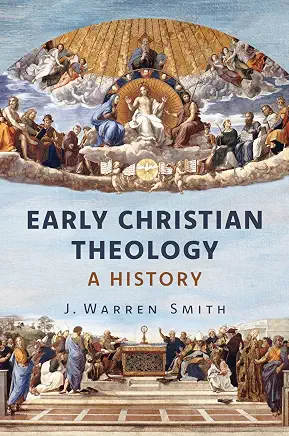
J. Warren Smith, Early Christian Theology. A History, (Eerdmans,2026) pp. 556ff.
In an age of over-specialization, there are very few scholars today who could have written an instant classic like this book. But Warren Smith has not only done it, but done it in great detail, with all the detailed references and footnotes one could want, many more than in J.N.D Kelly’s earlier classic on Early Christian Doctrines (latest edition 1978). This book reflects the culmination of a lifetime of study, writing, and detailed reflection on the theology of the emerging Christian church between the second and eight centuries. The writing is clear, and needed to be because of the complexities of early Christian theology, including its dealings with Marcion, Gnosticism, and various other offshoots from the mainstream of both western and eastern Christianity which in due course became the Roman Catholic and the Eastern Orthodox forms of the faith. Major figures like Irenaeus, Tertullian, Origen and Augustine received detailed treatments without neglecting some of the less well-known figures like for instance Ephrem the Syrian, who became so important in the much later reflections of John Wesley and others on the subject of holiness, and God’s wisdom.
The book in broad strokes is in chronological order, but it also takes the time to deal in great detail with the developments of Christology over numerous centuries, and similarly with the doctrine of the Trinity, and the doctrine of the Holy Spirit. As such, this book is a perfect textbook for the doctoral course Warren and I have taught together at Asbury “Early Christianity and the Formation of the Canon”.
One of the great lacunae in so many conservative Protestant seminaries is the teaching of what happened between the Apostolic era in the first century A.D. and the precursors to the Protestant Reformation beginning with Jan Hus just after 1400. That however leaves a huge gap of 1200 years of theological reflection and development of which so many Protestants, including some Evangelical scholars, are largely in the dark about. It leaves out not only the closing of the NT canon in about 367 A.D. but also the necessary development of the doctrine of the Trinity of which the NT only provides the raw materials.
As I have shown in my little monograph Sola Scriptura, many Protestants are ignorant that this phrase was used by Catholics such as William of Occam, or Marsilius of Padua or John Wycliffe to critique the notion that the Pope should be the final authority for the church. No said these writers, the Scriptures should have the final say about Christian doctrine, but not the only authority. Right reason, tradition, and later even Christian experience should be considered lesser authorities to be consulted, such that sola scriptura should not be taken to mean ‘the only authority to be consulted’, but rather the final authority on the church’s theology, ethics, spiritual formation, and the study of the Bible’s record of salvation history.
In reading through Smith’s detailed study, it becomes clear how important church councils like the council of Nicaea in 325 or the Council of Chalcedon in 450 were in drawing out the implications and applications of the Biblical thought on so many, many subjects. But those councils raised as many questions as they answered. For instance, what happened to the eschatology of the earliest Jewish Christian writers whose works formed the NT canon? What about the hermeneutics of interpreting the Bible and how it evolved over time? Why did the rise of anti-Semitism happen as the church became overwhelmingly Gentile in character? Why did the church increasingly revert to a very patriarchal model of ministry once the Edict of Milan was made public in the early 4th century A.D. and major church buildings came to be built modelled on Roman and Greek basilicas with male priests and sacrificial rites based on the Lord’s Supper? Why did the Greek notion of the immortal soul largely displace early Christian eschatology when it came to Christians thinking about their final destination and destiny? All these questions and so many more are treated carefully and with respect in Smith’s seminal study. Conservative Protestants desperately need this eye-opening study.
In fact, I would say the level of ignorance in that quarter of the church is so vast about this theological history, that when it comes to this material we should heed the voice that St. Augustine in great distress in 386 A.D. heard of a child saying “tolle et lege” ‘pick it up and read’ which led to his picking up a Bible and reading Romans 13.13-14, a move which changed his life. I am recommending we conservative Protestants do the same with Warren’s study. It could also be life changing.









 Ad-Free & Subscriber Log-In