

The British Library is the younger offspring of the British Museum. It first opened in 1973, but it finally got it’s own proper sized quality building in 1998, opened by Queen Elizabeth II in person. The purpose was to unify collections in various places. We had time to visit the Treasury room, which has a rotating exhibit (for instance when we were there the Lindisfarne Gospels were not currently on display. But what was there was fascinating and well worth the visit as you will see in this post. Here is the entrance way, and right away you know it is all about books, ancient books, and other sorts of manuscripts.
This first folio from 1623 was crucial because otherwise we might not have all the plays. It was the actors who brought these together in a form that could be turned over to London printers, thank goodness, because earlier partial printings left out, for example Macbeth. Speaking of first editions, here is Handel’s last oratorio. Jephtha in his own handwriting! On Handel going blind while composing this see below.
One of the earliest literary works of importance in olde English is Beowulf, featuring the sort of English spoken before the Norman conquest in 1066 and thereafter. It is an epic poem, of the ilk of Homer’s poems complete with monsters and drama and Beowulf the hero. Below is the only extant copy of the original work and it was partially damaged in a fire in 1731.
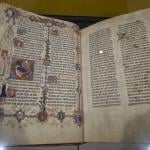
Much more important this is the portions of Codex Sinaiticus which the British Library has, as one of the very earliest whole Bible manuscripts extant, from the 4th century like Codex Vaticanus (which may in fact one of the originals Eusebius had copied in 325 A.D. after the council of Nicaea). Sinaiticus suffered from some corrections and additions in the 6th and 7th century.





 Ad-Free & Subscriber Log-In