

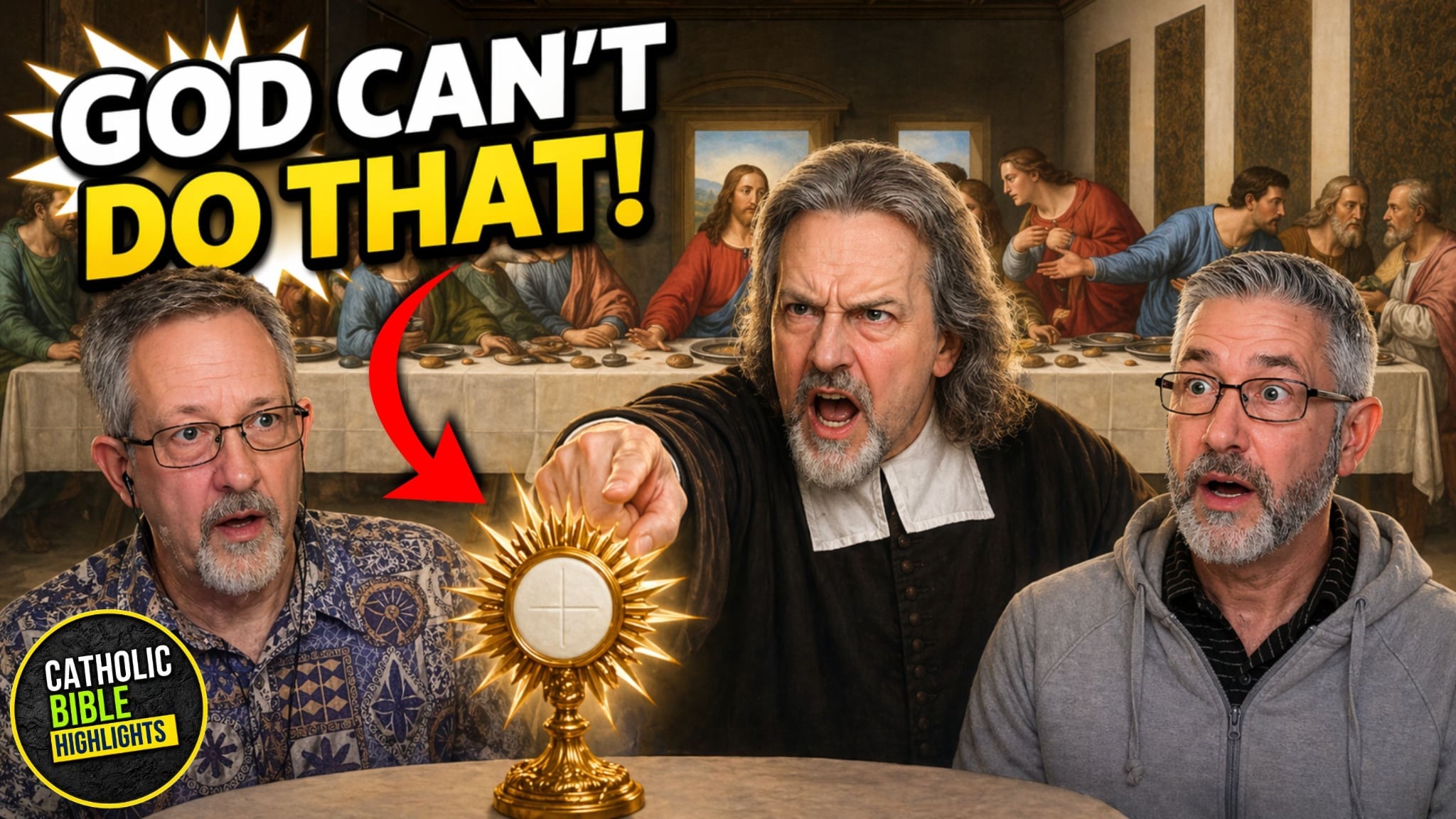
This is the transcript of the initial presentation of the video, “The Eucharist is a Miracle! [Biblical Proof]” (Catholic Bible Highlights with Kenny Burchard, 4-24-26)
*****
François Turretin (1623-1687) is regarded as the most important Calvinist theologian and apologist after John Calvin himself. I will cite his most important work, Institutes of Elenctic Theology, Vol. 3, and offer replies to it (his words in blue). Here’s the first quotation from that work:
A body cannot be granted which does not have quantity and extension, since quantity and extension do not differ really from the material substance, but are identified with it. (19th Topic: The Sacraments / 28th Question: The Corporeal Presence of Christ in the Supper . . ., from the translation of George Musgrave Giger, edited by James T. Dennison, Jr., Presbyterian and Reformed Publishing Company: 1997)
In the purely natural world, this is true. But in the supernatural world, where bodies and other material things have extraordinary capabilities, Jesus’ body and blood in the Eucharist have characteristics that normal bodies don’t have. Miracles always entail going beyond the natural. It’s almost as if Turretin can’t or won’t make exceptions to the laws of nature, for miracles. All of a sudden he has no belief in miracles, when it comes to the Eucharist. But why should it be different from any other miracle? Here’s another one from him:
All these and many other monstrosities of the same kind . . . are . . . most absurd . . . creations of the human imagination, bringing the Christian religion into disgrace with infidels.
To the contrary, all of the aspects of the Holy Eucharist are every bit as possible as all the other miracles that we see described in the Bible. Once the miraculous is possible in the first place, then any and all “odd” or “weird” or unexpected scenarios are possible. Turretin arbitrarily sets apart the one miracle and declares it “monstrous” and a “disgrace” but he does so only by thinking in a radically unbiblical, cynical, and skeptical way, as the Pauline “carnal man” does.
The possibility of miracles or their occurrence as facts of history aren’t determined on the basis of whether we personally like them or not. If we take that approach, we’re like the unbelieving Pharisees who opposed Jesus, saying, “It is only by Be-elzebul, the prince of demons, that this man casts out demons” (Mt 12:24). This was not merely a lack of ability to believe; but sinful unbelief.
Turretin’s arguments against the Real Presence are very weak, and scarcely even biblical or Christian. They do, however, fit right in with the approach of an atheist, who will deny every miracle in the Bible or any other purported one, because he has already arbitrarily and unreasonably decided beforehand that they are impossible. But at least the atheist is consistent. He doesn’t arbitrarily select one miracle to reject, while accepting others, on no consistent basis, other than simply because Catholics accept them; sort of a “guilt by association.” He says, further:
For if the form alone remains, how could Christ and Paul so often call it bread and the fruit of the vine? . . .
The Eucharistic symbols retain the same name after the consecration which they had before (namely, the name of bread and wine). This would not have been done if in virtue of the consecratory words they had ceased to be bread and wine and were changed into the body and blood of Christ.
In part, Catholics speak of outward appearances, as Bible writers often do, and/or refer to the accidents or outward characteristics in those instances. Everyone does the same thing when they say that “the sun is going down”. But Jesus simultaneously does both things. In John 6:51 He said, “if any one eats of this bread, he will live for ever; and the bread which I shall give for the life of the world is my flesh”, and in Matthew 26:26 at the Last Supper, the text says, “Jesus took bread, and . . . gave it to the disciples and said, “Take, eat; this is my body”.
Likewise, Paul states in 1 Corinthians 10:16: “The cup of blessing which we bless, is it not a participation in the blood of Christ? The bread which we break, is it not a participation in the body of Christ?” And in 11:23-24 he declared, “the Lord Jesus on the night when he was betrayed took bread, and when he had given thanks, he broke it, and said, “This is my body which is for you.” Then Paul says in 11:27: “Whoever, therefore, eats the bread or drinks the cup of the Lord in an unworthy manner will be guilty of profaning the body and blood of the Lord.” And in 11:29 he casually refers to “one who eats and drinks without discerning the body”.
Note also that Paul’s use of “drink the cup” (1 Cor 11:26-27). No one can literally “drink a cup” and must drink what it contains. But how do we know what is in this cup? We know by the context. In 1:25 Paul states, “In the same way also the cup, after supper, saying, ‘This cup is the new covenant in my blood . . .’”.
The words “bread” and “wine” in Holy Communion refer to the accidents of outward appearance, while the literal use refers to transubstantiation and the body and blood of the Lord. Otherwise, we are left with mere bread and wine being passed out, and no body and blood of Christ at all, and Jesus being equated with mere bread and wine, which is both absurd and blasphemous. But he’s not done yet. Mr. Turretin has more:
Omnipotence extends itself to all things possible, but not to those which are impossible; such as are those which imply a contradiction, which God can no more be said to be able to do than it be said that he is able to lie and sin. . . . these marks . . . God not only cannot do, but . . . cannot even will to do, because they are contrary to his wisdom, holiness and truth and repugnant to the laws established by him in nature. (19th Topic: The Sacraments / 28th Question: The Corporeal Presence of Christ in the Supper . . ., from the translation of George Musgrave Giger, edited by James T. Dennison, Jr., Presbyterian and Reformed Publishing Company: 1997)
There is no inherent contradiction in God changing bread and wine into His body and blood. It’s odd, strange, and not predictable, but not contradictory. God can certainly do this. He’s not limited by all of these laws of matter, simply Turretin doesn’t like eucharistic realism. Turretin almost seems to say that God is constrained by the very laws that He created, that we analyze through scientific study. He’s not at all, of course. Every miracle proves this. Turretin claims:
Although we confess that God can work above the order of nature, still we deny that his omnipotence extends to those things which are contrary to nature and the order established in it, because he cannot . . . overturn the order settled by himself.
This is ludicrous and almost blasphemous. As I suspected, Turretin – in effect — demotes the biblical transcendent God and sovereign Master of the universe to a sort of deist so-called “god” that is absurdly lesser than the mere laws that He made. Every miracle makes mincemeat of this self-contradictory and unbiblical nonsense.
The Real Presence in the Eucharist is not impossible at all! Turretin deludes himself. There are some things that really are impossible, even for God, because they are logical self-contradictions. He can’t make Himself exist and not exist at the same time or simultaneously eternal and not eternal. He can’t make a circle a square. He can’t simultaneously subsist in Four Divine Persons and Three, or create a world in which 2+2=4 and also equals 5. And (here’s the famous one), He can’t make a rock so big that He can’t lift it. All of those things are impossible for even an omnipotent being to do. But the Eucharist as Catholics believe it is not among these. Turretin, oddly enough, thinks like the biblical “carnal” or “unspiritual” man, that Paul describes:
1 Corinthians 2:11-12, 14, 16 . . . no one comprehends the thoughts of God except the Spirit of God. [12] Now we have received not the spirit of the world, but the Spirit which is from God, that we might understand the gifts bestowed on us by God. . . . [14] The unspiritual man does not receive the gifts of the Spirit of God, for they are folly to him, and he is not able to understand them because they are spiritually discerned. . . . [16] . . . But we have the mind of Christ.
*****
Related Videos
How Can Bread and Wine be the Presence of Jesus? The Bible has the answer! Calvinist Hyper-Rationalism vs. the Biblical Teaching of Twenty Kinds of God’s Presence [50 minutes, 5-23-25]
Can JESUS be in the Eucharist? Protestant Doubts vs. BIBLICAL Faith! [32 minutes, 5-29-25]
The Real Presence: Why Protestant Arguments Keep Failing [42 minutes, 2-5-26]
Related Web Page
Eucharist, Sacrifice of the Mass, & Liturgical Issues
Related Book
Biblical Catholic Eucharistic Theology (2011, 222 pages)
*****
Photo credit: Copyright 2026 by Catholic Bible Highlights.
Summary: Fourth critique of the eucharistic theology (or lack thereof) of Calvinist Francois Turretin (1623-1687): widely considered to be the best Reformed theologian after John Calvin.









 Ad-Free & Subscriber Log-In