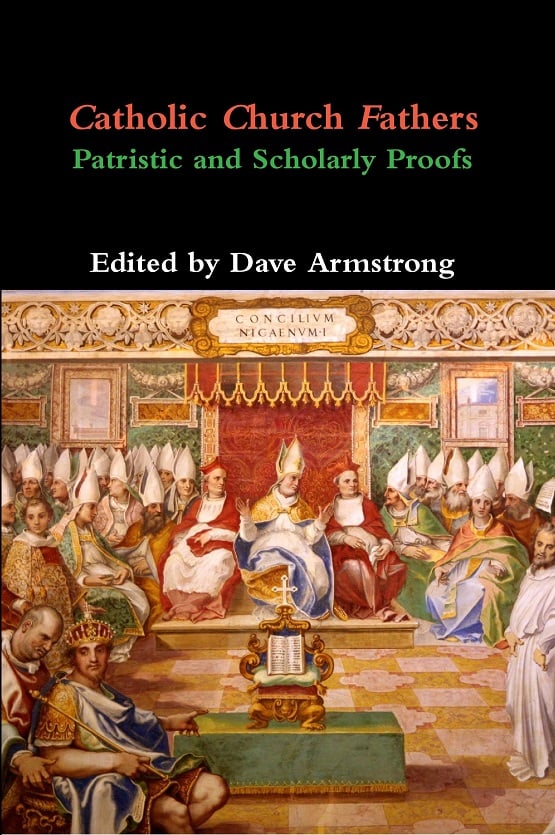
Photo credit: self-designed cover of my book (2nd edition, Lulu, 2013).
“Faith Alone” (sola fide in Latin) is, as Protestants say — one of the two “pillars” of the Protestant “Reformation” (along with sola Scriptura: Scripture Alone). Protestants use the term “reformation” to describe their origins in the 16th century because it’s their belief that they were bringing back the teachings of the early Church which the Catholic Church supposedly had greatly corrupted (hence, the description of “reform”). The serious problem with this outlook, however, is that these two “pillars” are virtually absent in the Church fathers. For massive documentation of the absence of sola Scriptura, see my Fathers of the Church web page, section VII.
The universality of the rejection of both is quite striking and remarkable. No one need take my word alone for that. Protestant scholars fully concur. For example, the famous Church historian and patristics expert Philip Schaff (1819-1893), referring to the time period of 100-325 AD, is honest — as he always is — about the facts, even though he himself disagrees with the patristic doctrines he is discussing:
If any one expects to find in this period, or in any of the church fathers, Augustin[e] himself not excepted, the Protestant doctrine of justification by faith alone, . . . he will be greatly disappointed. . . . Paul’s doctrine of justification, . . . is left very much out of view, and awaits the age of the Reformation to be more thoroughly established and understood. The fathers lay chief stress on sanctification and good works, and show the already existing germs of the Roman Catholic doctrine of the meritoriousness and even the supererogatory meritoriousness of Christian virtue. It was left to modern evangelical theology to develop more fully the doctrines of soteriology and subjective Christianity. (History of the Christian Church, Vol. 2, 3rd edition, 1890, § 154. Other Doctrines.)
Writing about Luther and the 16th century, Schaff observed similarly:
The Pauline doctrine of justification as set forth in the Epistles to the Romans and Galatians, had never before been clearly and fully understood, not even by Augustin and Bernard, who confound justification with sanctification. (History of the Christian Church, Vol. 7, § 23. “The Victory of Justifying Faith”)
The late prominent Protestant apologist Norman Geisler (1932-2019) strikingly extended this state of affairs all the way from the Apostle Paul to Luther:
Before Luther, the standard Augustinian position on justification stressed intrinsic justification. Intrinsic justification argues that the believer is made righteous by God’s grace, as compared to extrinsic justification, by which a sinner is forensically declared righteous (at best, a subterranean strain in pre-Reformation Christendom). With Luther the situation changed dramatically . . . (Roman Catholics and Evangelicals: Agreements and Differences, co-author Ralph E. MacKenzie, Grand Rapids, Michigan: Baker Book House, 1995, 222; italics in original)
One can be saved without believing that imputed righteousness (or forensic justification) is an essential part of the true gospel. Otherwise, few people were saved between the time of the apostle Paul and the Reformation, since scarcely anyone taught imputed righteousness (or forensic justification) during that period! (Ibid., 502)
Anglican Church historian Alister McGrath (b. 1953) commented on the soteriology of the Middle Ages:
Despite the astonishing theological diversity of the late medieval period, a consensus relating to the nature of justification was maintained throughout. The Protestant understanding of the nature of justification represents a theological novum . . . . It will be clear that the medieval period was astonishingly faithful to the teaching of Augustine on the question of the nature of justification, where the Reformers departed from it. (Iustitia Dei: A History of the Christian Doctrine of Justification, the Beginnings to the Reformation, two volumes, Cambridge: Cambridge University Press, 1993, 1:184-5; see the 4th edition from 2020)
In another work, referring to this change in the definition of justification that he described as a “theological novum” above, he elaborated:
The importance of this development lies in the fact that it marks a complete break with the teaching of the church up to that point. . . . The Council of Trent . . . reaffirmed the views of Augustine on the nature of justification . . . (Reformation Thought: An Introduction, 2nd ed., Grand Rapids, Michigan: Baker Book House, 1993, 108-109)
Trent maintained the medieval tradition, stretching back to Augustine, which saw justification as comprising both an event and a process . . . (Ibid., 115)
Protestant apologists routinely claim that the Church fathers were closer in their outlooks to them than to Catholicism. It’s simply not true, with regard to faith alone or sola Scriptura, and just about any other doctrine, either (as I’ve always found in the course of my apologetics and historical research). But despite the manifest facts and the historical evidence, there are still many Protestants who continue to promulgate the myth. One such example is the evangelical anti-Catholic apologist Jason Engwer, who runs the blog called Triablogue. He wrote in a comment there on 20 February 2020: “The claim that nobody believed in justification through faith alone . . . before the Reformation, or between the time of the apostles and the Reformation, is false.” Someone ought to send him a free copy of McGrath’s magisterial Iustitia Dei.
Martin Chemnitz (1522-1586) the eminent second-generation Lutheran theologian, in his Examination of the Council of Trent, Part I(St. Louis: Concordia Pub. House, 1971; translated by Fred Kramer), claimed that Protestantism had far more support from the Church fathers than Catholicism, which — so he contended — had to lie and distort the historical record in order to bolster its theological claims:
We have therefore the testimony of the ancient church . . . (p. 161)
And we confess that we are greatly confirmed by the testimonies of the ancient church . . . Nor do we approve of it if someone invents for himself a meaning which conflicts with all antiquity, and for which there are clearly no testimonies of the church. (pp. 208-209)
The papalists . . . search diligently in the writings of the fathers that they may scrape together from them a few statements which will in some way defend their purpose. (p. 212)
It is undeniably the truest of axioms that that alone is the true doctrine which the apostles transmitted and which the primitive church professed as received from the apostles. (p. 225)
How fraudulently the papalists quote and treat the testimonies of Scripture and of antiquity in order to establish and confirm their spurious traditions. (p. 226)
There is a very great difference between the primitive church, which was at the time of the apostles and of apostolic men testifying with regard to the books of Holy Scripture, and the papal church, which is foisting its fictions as apostolic traditions on us without proof. (p. 228)
These genuine, ancient, and true traditions of the apostles we embrace with deepest reverence. (p. 246)
We confess also that we disagree with those who invent opinions which have no testimony from any period in the church . . . We also hold that no dogma that is new in the churches and in conflict with all antiquity should be accepted. What could be more honorably said and thought concerning the consensus and the testimonies of antiquity? . . . we search out and quote the testimonies of the fathers . . . (p. 258)
You may establish from this with what sincerity the papalists treat the testimonies of the fathers. (p. 266)
0:35 On the previous program I discussed sola fide in the Church fathers, basically trying to interact with the common Roman Catholic argument that sola fide is a theological novum, so the notion of justification by faith alone . . . it’s a common Roman Catholic claim that . . . it shows up later in history, and you can’t find it in the Church fathers at all. [They say that] Luther basically invents this brand new idea. This especially shows up in a lot of popular Roman Catholic polemics online, and I’ve made the claim that that’s simply not the case and that we can find instances of sola fide or various Protestant aspects of justification in the Church fathers.
This claim about the profound absence of sola fide in the fathers is by no means confined to “Roman Catholic polemicists”: as shown in my documentation above from Protestant apologist Norm Geisler and Anglican expert on the history of justification, Alister McGrath. To reiterate, the latter stated that sola fide, as newly formulated — not by Luther but by his successor, Philip Melanchthon –, was “a complete break with the teaching of the church up to that point.” Note the word “complete.” That’s pretty sweeping. One can always find an exception here or there (Geisler used the language of “scarcely anyone”) — every rule has its exceptions –, but so what? The overwhelming consensus was the view regarding faith and works and justification that is preserved in the Catholic Church.
It was McGrath (not “Roman Catholic polemics”) who called sola fide a “theological novum” three times in the 2nd edition of his book, Iustitia Dei in 1998 (pp. 180, 184, 187). On page 184, McGrath referred to “a fundamental discontinuity” that had been “introduced into the western theological tradition where none had existed before” (his italics), and this had to do with “the nature of justification.” McGrath observed — almost astonishingly, for a non-Catholic scholar — on page 180:
The fundamental theological question which is thus raised is the following: can the teachings of the churches of the Reformation be regarded as truly catholic? In view of the centrality of the doctrine of justification to both the initium theologiae Lutheri and the initium Reformationis, this question becomes acutely pressing concerning the doctrine of justification itself. If it can be shown that the central teaching of the Lutheran Reformation, the fulcrum about which the early Reformation turned, . . . constituted a theological novum, unknown within the previous fifteen centuries of catholic thought [that takes it back to 30 AD], it will be clear that the Reformers’ claim to catholicity would be seriously prejudiced, if not totally discredited.
That’s measured but undeniably provocative scholarly language for what we would call in everyday language a “bombshell.” With all of this in mind, let’s take a closer look at the beliefs of thirty of the Church fathers on the issue of justification and salvation, faith and works (minus St. Augustine, who will be treated separately), in order to prove that the patristic consensus was overwhelmingly contrary to faith alone (per Schaff, McGrath, and Geisler).
*****
Pope Clement of Rome (d. c. 101) says that we attain to salvation by “faith” and also “if we earnestly seek the things which are pleasing and acceptable to Him; if we do the things which are in harmony with His blameless will” (Epistle to the Corinthians, 35); he refers to “being justified by our works, and not our words” (ch. 30); “For what reason was our father Abraham blessed? Was it not because he wrought righteousness and truth through faith?” (ch. 31). Clement does teach justification by faith in chapter 32. Catholics totally agree, as to initial justification. We simply believe that good works (which are meritorious) are necessary after initial justification. But it’s clear that he thinks that faith and works are both required for salvation (which is not faith alone): “he who in lowliness of mind, . . . has observed the ordinances and appointments given by God— the same shall obtain a place and name in the number of those who are being saved through Jesus Christ” (ch. 58). “On account of her faith and hospitality, Rahab the harlot was saved” (ch. 12); “Take heed, beloved, lest His many kindnesses lead to the condemnation of us all. [For thus it must be] unless we walk worthy of Him, . . .” (ch. 21); “Abraham . . . was found faithful, inasmuch as he rendered obedience to the words of God” (ch. 10); Enoch, . . . being found righteous in obedience, was translated, and death was never known to happen to him” (ch. 9); “Let us cleave, therefore, to the innocent and righteous, since these are the elect of God” (ch. 46).
Ignatius of Antioch (50-c. 110): “None of these things is hid from you, if you perfectly possess that faith and love towards Christ Jesus [1 Timothy 1:14] which are the beginning and the end of life. For the beginning is faith, and the end is love. [1 Timothy 1:5] Now these two, being inseparably connected together, are of God, while all other things which are requisite for a holy life follow after them. No man [truly] making a profession of faith sins; [1 John 3:7] nor does he that possesses love hate any one. The tree is made manifest by its fruit; [Matthew 12:33] so those that profess themselves to be Christians shall be recognised by their conduct. For there is not now a demand for mere profession, but that a man be found continuing in the power of faith to the end” (Epistle to the Ephesians, 14); “I also am the more encouraged, resting without anxiety in God, if indeed by means of suffering I may attain to God” (Epistle to Polycarp, ch. 7).
The Shepherd of Hermas (c. 150): “Have a care, then, you who serve the Lord, and have Him in your heart, that you work the works of God, remembering His commandments and promises which He promised, and believe that He will bring them to pass if His commandments be observed. . . . work your own work, and you will be saved” (Bk. III, Similitude 1); “. . . that He may bestow on them the blessing which He has promised them, . . . if only they shall keep the commandments of God which they have received in great faith” (Bk. I, Vision 1, ch. 3); “Stand steadfast, therefore, you who work righteousness, and doubt not, that your passage may be with the holy angels” (Bk. I, Vision 2, ch. 2); “They will save all who act in the same manner, and walk in guilelessness and simplicity. Those who possess such virtues will wax strong against every form of wickedness, and will abide unto eternal life. Blessed are all they who practice righteousness, for they shall never be destroyed” (Bk. I, Vision 2, ch. 3); “And he said, You will be saved, you and all who keep these commandments. ” (Bk. II, Commandment 4, ch. 3); “You will not be saved . . . since you have already determined for yourself that these commandments cannot be kept by man” (Bk. II, Commandment 12, ch. 3); “The commandments . . . are excellent, and powerful, and glorious, and able to save a man’s soul” (Bk. III, Similitude 6, ch. 1).
Polycarp (69-155): “He who raised Him up from the dead will raise us up also, if we do His will, and walk in His commandments, and love what He loved, keeping ourselves from all unrighteousness, covetousness, love of money, evil speaking, false witness; . . .” (Epistle to the Philippians, ch. 2); “We ought to walk worthy of His commandment and glory. . . . If we please Him in this present world, we shall receive also the future world” (ch. 5).
Justin Martyr (100-165): “Each man goes to everlasting punishment or salvation according to the value of his actions” (First Apology, ch. 12); “. . . impelled by the desire of the eternal and pure life, we . . . hasten to confess our faith, persuaded . . . that they who have proved to God by their works that they followed Him, . . . can obtain these things” (First Apology, ch. 8); “For not those who make profession, but those who do the works, shall be saved” (First Apology, ch. 16); “. . . by our works also to be found good citizens and keepers of the commandments, so that we may be saved with an everlasting salvation” (First Apology, ch. 65); “Since those who did that which is universally, naturally, and eternally good are pleasing to God, they shall be saved through this Christ . . .” (Dialogue with Trypho, ch. 45); “Jesus the Son of God has promised again to deliver us . . . if we do His commandments; and has undertaken to provide an eternal kingdom [for us]” (Dialogue with Trypho, ch. 116).
Epistle of Mathetes to Diognetus (possibly as early as 130, or as late as 180): This eloquent work approaches justification much as Paul does (and as Catholics do, rightly understood). He writes about initial monergistic justification — which we Catholics fully accept! But — again like Paul and Catholics — he doesn’t formally separate works from faith as Protestants do, and writes: “. . . to whom He sent His only-begotten Son, to whom He has promised a kingdom in heaven, and will give it to those who have loved Him” (ch. 10); “you shall know what God bestows on such as rightly love Him, . . . presenting in yourselves a tree bearing all kinds of produce and flourishing well, being adorned with various fruits” (ch. 12).
*
Theophilus (fl. 185-191): “To those who by patient continuance in well-doing [Romans 2:7] seek immortality, He will give life everlasting, joy, peace, rest, and abundance of good things, which neither has eye seen, nor ear heard, nor has it entered into the heart of man to conceive [1 Corinthians 2:9]” (To Autolycus, ch. 14); “keeping the commandment of God, he should receive as reward from Him immortality, . . . obeying the will of God, he who desires is able to procure for himself life everlasting. For God has given us a law and holy commandments; and every one who keeps these can be saved” (Bk. II, ch. 27); “He who acts righteously shall escape the eternal punishments, and be thought worthy of the eternal life from God” (Bk. II, ch. 34).
*
Irenaeus (130-202): “Those who believe God and follow His word receive that salvation which flows from Him” (Against Heresies, Bk. IV, 33, 15); “We are saved, indeed, by means of faith and love” (I, 25, 5); “The first and greatest commandment is, to love the Lord God with the whole heart, and then there follows a commandment like to it, to love one’s neighbour as one’s self; . . . the more prominent and the greatest [commandments], without which salvation cannot [be attained], He has exhorted [us to observe] the same in both” (IV, 12, 3); “He saved those that were obedient” (IV, 28, 3); “He who has gone forward to the better things, and has brought forth the fruit of the Spirit, is saved” (V, 11, 1).
*
Clement of Alexandria (c. 150-c. 215): “. . . the elect being saved by instruction, and purification, and the doing of good works. . . . For by grace we are saved: not, indeed, without good works; but we must, by being formed for what is good, acquire an inclination for it” (The Stromata, Bk. V, ch. 1); “Present yourself to God as an offering of first-fruits, that there may be not the work alone, but also the grace of God; and both are requisite, that the friend of Christ may be rendered worthy of the kingdom, and be counted worthy of the kingdom” (Exhortation to the Heathen, ch. 11); “Prophecy is given . . . for obedience, that we may be saved . . .” (The Instructor, Bk. I, ch. 2); “I . . . lay before you good commandments; by which you will reach salvation” (The Instructor, Bk. III, ch. 12); “To keep from wrong is the beginning of salvation” (The Stromata, Bk. IV, ch. 3); “. . . obedience, by which comes salvation” (The Stromata, Bk. VI, ch. 12); “. . . abstinence from what is evil, activity in doing good, by which salvation is acquired” (The Stromata, Bk. VII. ch. 12); “Whosoever . . . distinguishes himself in good works shall gain the prize of everlasting life” (Who is the Rich Man That Shall Be Saved?, 1); “. . . dispositions in accordance with the command of God; for which there shall accrue to you endless reward and honour, and salvation, and everlasting immortality” (Who is the Rich Man That Shall Be Saved?, 19).
*
Tertullian (c. 160-c. 220): “But even if the stimulus of her repentance proceeded from her faith, she heard her justification by faith through her repentance pronounced in the words, Your faith has saved you, by Him who had declared by Habakkuk, The just shall live by his faith. [Habakkuk 2:4]” (Against Marcion, Bk. IV, ch. 18); “For each individual lives by his own faith, nor is there exception of persons with God; since it is not hearers of the law who are justified by the Lord, but doers, according to what the apostle withal says” (On Exhortation to Chastity, ch. 7); “the children of believers were designed for holiness, and thereby for salvation” (A Treatise on the Soul, ch. 39).
*
Hippolytus (c. 165- c. 235): “To those who have done well shall be assigned righteously eternal bliss, . . . the righteous will remember only the righteous deeds by which they reached the heavenly kingdom” (Against Plato, On the Cause of the Universe, 3); “But who are they who have reconciliation made for their sins, but they who believe in His name, and propitiate His countenance by good works?” (On Daniel, second fragment); “The Gentiles by faith in Christ prepare for themselves eternal life through good works” (On Proverbs, first fragment); “. . . a recompense be rendered to each man according to his works” (Refutation of All Heresies, Bk. IX, ch. 25).
*
Origen (c. 185-c. 253): “So also in the race of our life we ourselves must expend labour, and bring diligence and zeal to bear; but it is from God that salvation is to be hoped for as the fruit of our labour. Otherwise, if God demand none of our labour, His commandments will appear to be superfluous” (De Principiis, Bk. III, ch. 1, 18); “Let no one think that someone who has faith enough to be justified and to have glory before God can at the same time have unrighteousness dwelling in him as well” (Commentary on Romans [4:2]; in Gerald Bray, editor, Ancient Christian Commentary on Scripture: New Testament VI: Romans [Downers Grove, Illinois: InterVarsity Press, 1998], 109-110); “The apostolic teaching is that the soul, having a substance and life of its own, shall, after its departure from the world, be rewarded according to its deserts, being destined to obtain either an inheritance of eternal life and blessedness, if its actions shall have procured this for it, or to be delivered up to eternal fire and punishments, if the guilt of its crimes shall have brought it down to this” (De Principiis, Preface, 5); “In the race of our life we ourselves must expend labour, and bring diligence and zeal to bear; but it is from God that salvation is to be hoped for as the fruit of our labour. Otherwise, if God demand none of our labour, His commandments will appear to be superfluous. . . . And in the matter of our salvation, what is done by God is infinitely greater than what is done by ourselves” (De Principiis, Bk. III, ch. 1, 18); “We will be judged at the divine judgment seat not on our faith alone, as if we had not to answer for our conduct; nor on our conduct alone, as if our faith were not to be scrutinized. What justifies is our uprightness on both scores, and if we are short on either we shall deserve punishment” (Dialogue with Heraclides, 8; from Navarre Bible Commentary; comment on Acts 20:21).
*
Cyprian (210-258): “We do not keep the way of the Lord, nor observe the heavenly commandments given to us for our salvation” (Epistle 7, 1); “For this it is which especially pleases God; . . . our works with greater deserts are successful in earning God’s good-will; this it is which alone the obedience of our faith and devotion can render to the Lord for His great and saving benefits” (Epistle 76:4); “Let our light shine in good works, and glow in such wise as to lead us from the night of this world to the daylight of eternal brightness. . . . If these commands be observed, if these warnings and precepts be kept . . . we shall reign with Christ in His kingdom . . .” (Treatise 1: On the Unity of the Church, 27); “The merits of martyrs and the works of the righteous are of great avail with the Judge” (Treatise 3: On the Lapsed, 17); “Unfruitful trees, that is, unproductive men, are cut off and cast into the fire, but . . . the merciful are called into the kingdom” (Treatise 8: On Works and Alms, 8); “You may be able to attain to see God, by deserving well of God, both by good works and character” (Treatise 8: On Works and Alms, 14); “Let us. . . take thought for our security and eternal salvation, according to the admonition of the Apostle Paul, [cites Gal 6:9-10, which exhorts us to do good works]” (Treatise 8: On Works and Alms, 24); “What, dearest brethren, will be that glory of those who labour charitably — how great and high the joy when the Lord begins to number His people, and, distributing to our merits and good works the promised rewards, . . . to present us to the Father, to whom He has restored us by His sanctification; to bestow upon us immortality and eternity” (Treatise 8: On Works and Alms, 26); “He Himself teaches and says that he shall come unto life who keeps His commandments, and that he is wise who hears and does His words; that he, moreover, is called the greatest doctor in the kingdom of heaven who thus does and teaches” (Treatise 10: On Jealousy and Envy, 12).
*
Lactantius (c. 240-c. 320): “For this reason He has given us this present life, that we may either lose that true and eternal life by our vices, or win it by virtue” (Divine Institutes, Bk. VII, ch. 5).
*
Alexander of Alexandria (d. c. 328): “Since therefore you know, brethren beloved, that the malignant and the unbelieving are the enemies of righteousness, beware of these, embrace faith and charity, by which all the holy men who have existed from the beginning of the world to this day have attained unto salvation. And show forth the fruit of charity, not in words only, but also in deeds, that is, in all godly patience for God’s sake” (Epistles on Arianism and the Deposition of Arius, ch. 5, 2).
*
Hilary of Poitiers (c. 315-368): “Election, therefore, is not a thing of haphazard judgment. It is a distinction made by selection based on merit. Blessed, then, is he whom God elects: blessed for the reason that he is worthy of election” (On Psalm 64 [65], section 5; in William A. Jurgens, editor and translator, The Faith of the Early Fathers, three volumes [Collegeville, Minnesota: Liturgical Press], Vol. 1 [1970], 386).
*
Athanasius (c. 297-373): “Meditation on the law is necessary, my beloved, and uninterrupted converse with virtue, ‘that the saint may lack nothing, but be perfect to every good work [2 Timothy 3:17].’ For by these things is the promise of eternal life, as Paul wrote to Timothy, calling constant meditation exercise, and saying, ‘Exercise yourself unto godliness; for bodily exercise profits little; but godliness is profitable for all things, since it has the promise of the present life, and of that which is eternal [1 Timothy 4:7-8].'” (Letter 11, 7); “For of these two things we speak of — faith and godliness — the hope is the same, even everlasting life; for he says, ‘Fight the good fight of faith; lay hold on eternal life’ [1 Timothy 6:12]” (Letter 11, 10); “None of us is judged for what he knows not, and no one is called blessed because he hath learning and knowledge. But each one will be called to judgment in these points–whether he have kept the faith and truly observed the commandments” (Life of Antony, 33); “He is to come . . . to judge all, by what each has done in the body, whether good or evil; where there is laid up for the good the kingdom of heaven, but for them that have done evil everlasting fire and outer darkness. For thus the Lord himself also says: “Henceforth ye shall see the Son of Man sitting at the right hand of power, and coming on the clouds of heaven in the glory of the Father. [Matt. 25:31]” (On the Incarnation of the Word, ch. 56, 3-4).
*
Basil the Great (c. 330-379): “Eternal rest awaits those who have struggled through the present life observant of the laws, not as payment owed for their works, but bestowed as a gift of the munificent God on those who have hoped in him.” (On Psalm 114, no. 5; in Jurgens, ibid. [see Hilary of Poitiers], Vol. 2 [1979], 22); “Mere renouncement of sin is not sufficient for the salvation of penitents, but fruits worthy of penance are also required of them” (The Morals, 1, 3); “He who would obey the gospel must first be purged of all defilement of the flesh and the spirit that so he may be acceptable to God in the good works of holiness” (The Morals, 2, 1); “They, then, that were sealed by the Spirit unto the day of redemption, and preserve pure and undiminished the first fruits which they received of the Spirit, are they that shall hear the words well done thou good and faithful servant; you have been faithful over a few things, I will make you ruler over many things. [Matthew 25:21]” (On the Spirit, ch. 16, 40); “It is yours according to your merit to be “ever with the Lord,” . . .” (On the Spirit, ch. 28, 69).
*
Cyril of Jerusalem (c. 315-387): “For the time to come ye must behave yourselves worthily of this grace both in words and deeds, that you may all be enabled to enjoy the life everlasting” (EighteenthCatechetical Lecture, 33); “Let us be content with Abraham only, as one of the examples from the Old Testament, seeing that we have been made his sons through faith. He was justified not only by works, but also by faith: for though he did many things well, yet he was never called the friend of God, except when he believed. Moreover, his every work was performed in faith” (FifthCatechetical Lecture, 5); “When you repent shall He not give you the remission of sins, and the kingdom of heaven, if you live a worthy life?” (SecondCatechetical Lecture, 19; old English modified)
Gregory of Nyssa (c. 335-c. 394): “Paul, joining righteousness to faith and weaving them together, constructs of them the breastplates for the infantryman, armoring the soldier properly and safely on both sides. A soldier cannot be considered safely armored when either shield is disjoined from the other. For faith without works of justice is not sufficient for salvation; neither, however, is righteous living secure in itself for salvation, if it is disjoined from faith. (Homilies on Ecclesiastes, 8; Jurgens, ibid. [see Hilary of Poitiers], Vol. 2 [1979], 45-46); “For faith without works of justice is not sufficient for salvation; neither, however, is righteous living secure in itself for salvation, if it is disjoined from faith” (Homilies on Ecclesiastes, 8; Jurgens, ibid. Vol. 2 [see Hilary of Poitiers], 45-46).
*
Ambrose (c. 336-397): The deserts of each one of us are suspended in the balance, which a little weight either of good works or of degenerate conduct sways this way or that; if the evil preponderate, woe is me! if the good, pardon is at hand. For no man is free from sin; but where good preponderates, the evil flies up, is overshadowed, and covered. Wherefore in the Day of judgement our works will either succour us, or will sink us into the deep, weighed down as with a millstone” (Letter II: To Constantius, a Bishop, 16; from The Letters of S. Ambrose, Oxford: 1881); “If thou clothe the naked, thou clothest thyself with righteousness; if thou bring the stranger under thy roof, if thou support the needy, he procures for thee the friendship of the saints and eternal habitations. . . . Nor again is any one more blessed than he who is sensible of the needs of the poor, and the hardships of the weak and helpless. In the day of judgment he will receive salvation from the Lord, Whom he will have as his debtor for the mercy he has shown” (On the Duties of the Clergy, Book I, 11, 39); “The sacred Scriptures say that eternal liferests on a knowledge of divine things and on the fruit of good works. . . . About works He gives this answer: Every one that has forsaken house, or brethren, or sisters, or father, or mother, or wife, or children, or lands, for My Name’s sake, shall receive an hundred-fold, and shall inherit everlasting life. [Matthew 19:29] (Ibid., Book II, 2, 5 and 6); “Faith, then, has [the promise of] eternal life, for it is a good foundation. Good works, too, have the same, for an upright man is tested by his words and acts” (Ibid., Book II, 2, 7); “The blessedness of eternal life is the reward for good works” (Book II, 3, 9); “You did not dedicate yourself to the Lord on purpose to make your family rich, but that you might win eternal life by the fruit of good works, . . .” (On the Duties of the Clergy, Book I, ch. 30, 150)
*
John Chrysostom (c. 345-407): “For not through believing only comes your salvation, but also through the suffering and enduring the same things with us. . . . the work of salvation consists not in doing evil, but in suffering evil” (Homily 2 on Second Corinthians; comment on 1:6-7); “Ver. 7. “To them who by patient continuance in well doing seek for glory and honor and immortality, eternal life.” Here also he awakens those who had drawn back during the trials, and shows that it is not right to trust in faith only. For it is deeds also into which that tribunal will enquire” (Homily V on Romans; v. 2:7); “For “each of us shall give account of himself to God.” In order therefore that we may render up this account with a good defence, let us well order our own lives and stretch out a liberal hand to the needy, knowing that this only is our defence, the showing ourselves to have rightly done the things commanded; there is no other whatever. And if we be able to produce this, we shall escape those intolerable pains of hell, . . .” (Homily XXI on 1 Corinthians 9:1, 11, v. 9:12); “How, tell me, doth faith save, without works?” (Homily IV on Ephesians, v. 2:8-10); “Let not us either expect that faith is sufficient to us for salvation” (Homily X on John, v. 1:13); “Though a man believe rightly on the Father, the Son, and the Holy Ghost, yet if he lead not a right life, his faith will avail nothing towards his salvation. Therefore when He saith, “This is life eternal, that they may know Thee the only true God” ( c. xvii. 3 ), let us not suppose that the (knowledge) spoken of is sufficient for our salvation; we need besides this a most exact life . . .” (Homily XXXI on John, v. 3:35-36); “Let us glorify Him, not by our faith alone, but also by our very works, that we may obtain the good things that are to come” (Homily XLVI on John, v. 6:52); “A right faith availeth nothing if the life be corrupt, both Christ and Paul declare” (Homily LXIII on John, v. 11:40); “Faith is indeed great and bringeth salvation, and without it, it is not possible ever to be saved. It suffices not however of itself to accomplish this, . . . on this account Paul also exhorts those who had already been counted worthy of the mysteries; saying, “Let us labor to enter into that rest.” “Let us labor” (he says), Faith not sufficing, the life also ought to be added thereto, and our earnestness to be great; for truly there is need of much earnestness too, in order to go up into Heaven” (Homily VII on Hebrews, v. 4:11-13); “For unless we add also a life suitable to our faith, we shall suffer the extremest punishment” (Homily LXIV on Matthew 19:27, 4).
*
My 303-page book, The Quotable Eastern Church Fathers: Distinctively Catholic Elements in Their Theology (July 2013) included almost seven pages of St. John Chrysostom’s citations opposing “faith alone” and another five pages of his statements on “faith and works.”
*
Jerome (c. 343-420): “For if the woman is saved in child-bearing, . . . why did he add if they continue in faith and love and sanctification . . . ?” [1 Tim 2:15] (Against Jovinianus, Bk. I, 27); “I am persuaded better things of you, and things that accompany salvation. For it is not accordant with the righteousness of God to forget good works” (Against Jovinianus, Bk. II, 3); “In Egypt the monasteries make it a rule to receive none who are not willing to work; for they regard labour as necessary not only for the support of the body but also for the salvation of the soul” (Letter 125: To Rusticus, 11); “The same may be said of sanctification and of that chastity without which no man shall see the Lord. Each of these is a step on the upward way, yet none of them by itself will avail to win the virgin’s crown. The gospel teaches us this in the parable of the wise and foolish virgins; the former of whom enter into the bridechamber of the bridegroom, while the latter are shut out from it because not having the oil of good works they allow their lamps to fail. [Matthew 25:1-12]” (Letter 130: To Demetrias, 11); “Amongst other passages, Paul the Apostle writes to the Romans: [Romans 6:21-22]What fruit then had ye at that time in the things whereof you are now ashamed? For the end of those things is death. But now being made free from sin, and become servants to God, you have your fruit unto sanctification, and the end eternal life. I suppose too that the end of marriage is death. But the compensating fruit of sanctification, fruit belonging either to virginity or to continence, is eternal life” (Against Jovinianus, Bk. I, 37).
*
Theodore of Mopsuestia (c. 350-428): Paul did not say we hold because he was himself uncertain. He said it in order to counter those who concluded from this that anyone who wished to could be justified simply by willing faith. Note carefully that Paul does not say simply without the law, as if we could just perform virtue by wanting to, nor do we do the works of the law by force. We do them because we have been led to do them by Christ. (Pauline Commentary From the Greek Church; commenting on Romans 3:28; in Gerald Bray, editor, Ancient Christian Commentary on Scripture: New Testament VI: Romans [Downers Grove, Illinois: InterVarsity Press, 1998], 104-105)
*
John Cassian (c. 360-c. 435) The beginning of our good will is given to us by the inspiration of the Lord, when he draws us towards the way of salvation either by his own act, or by the exhortations of some man, or by compulsion; and that the consummation of our good deeds is granted by him in the same way: but that it is in our own power to follow up the encouragement and assistance of God with more or less zeal, and that accordingly we are rightly visited either with reward or with punishment, because we have been either careless or careful to correspond to his design and providential arrangement made for us with such kindly regard. (Conference 3, ch. 19).
*
Cyril of Alexandria (c. 376-444): “What Christ says about the rich man and Lazarus is cast in the style of a clever parable. The tale goes (as the Hebrews tradition has it) that there existed a certain Lazarus at that time in Jerusalem who was at death’s door with poverty and weakness, and that the Lord mentioned him, using him as an illustration to make the point clearer still. Christ had not yet descended from heaven, the resurrection had not happened and no requital of action had followed anyone, but the parable picturesquely describes a rich man living in luxury without compassion and a poor man in weakness, with the aim that the owners of wealth on earth may learn that unless they intend to be good men, bountiful and sharing, and choose to help out the necessities of the poor, they will fall under a terrible and inexorable condemnation” (Doctrinal Questions and Answers, 8; from Cyril of Alexandria, The Early Church Fathers, Commentary on John, Routledge, London; New York: 2000, 209); “He gives endurance that even for those entangled in many and unavoidable sins, He will keep a remnant of kindness and clemency; and He says that even those He will not prevent from being saved if they will choose to return to better and more proper ways, in keeping with His laws” (Commentary on Isaiah [4, 2], in Jurgens, ibid. [see Hilary of Poitiers], Vol. 3, #2097, p. 218); “It is a true saying, that the fruit of good deeds is honorable. For those who wish to lead lives pure and undefiled as far as is possible for men, Christ will adorn with his gifts, and grant them an abundant recompense for all their saintly deeds, and make them partakers of his glory” (Commentary on Luke, v. 9:1-5; translated by R. Payne Smith, Oxford University Press, 1859).
*
Theodoret (c. 393-c. 458): You shall hear, I am well assured, from the lips of the righteous Lord, I was in prison, and you visited me. We are small and of no account, and burdened by a great load of sins, but the Lord is bountiful and generous. He remembers the small rather than the great, and says, Inasmuch as you have done it unto one of the least of thesewhich believe in meyou have done it unto me. I pray you in that you are conspicuous for right doctrine, and shine by worthiness of life, and therefore have great boldness before God, help me in your prayers, that I may be able to stand, to use the words of the Apostle, against the wiles of error, escape the sins of the destroyer, and stand, though with little boldness, in the day of the appearing before the righteous Judge. (Letter 131 to Longinus, Archimandrite of Doliche); “Well-doing is for a time, but the reward is eternal . . . Paul wanted to show that there are many rewards for those who are good” (Interpretation of the Letter to the Romans; commentary on Romans 2:7; in Bray, ibid. [see Origen], 60).
*
Pope Leo the Great (c. 400-461) You ought all to help one another in turn, that in the kingdom of God, which is reached by right faith and good works, you may shine as the sons of light . . . (Sermon 33, 5)
*
Pope Gregory the Great (c. 540-604): “Faith together with good life ought to be chosen in priests. If good life is wanting, faith has no merit, as the blessed James attests, who says, Faith without works is dead [James 2:18]” (Letters: Book IX, 110, To Theoderic and Theodebert, Kings of the Franks)
*
*****
Photo credit: self-designed cover of my book (2nd edition, Lulu, 2013).
*
Summary: I cite Protestant historians & apologists Schaff, Geisler, & McGrath with regard to patristic consensus against “faith alone”; then I provide documentation from 30 Church fathers.













 Ad-Free & Subscriber Log-In