

Isaac and the Broken Enemy
It’s an eternal question and a timely one: who is my neighbor? James Dalrymple’s The Good Samaritan (2025), now streaming on Angel, sets out to make this ancient concern legible to our modern moment. How do we relate to others? Whom should we be suspicious of? Should we be suspicious of anyone?
Writer-director Dalrymple takes the terse outline of Jesus’ parable and fills in the gaps in character and personal relationships.

Here, there is a Levite, a Samaritan, and a Jewish traveler, but they have names and prior identities. We see them going about their daily lives, loving their families, putting up with the vicissitudes of travel. As a result of this thrust toward characterization, The Good Samaritan possesses a lived-in quality. It helps the viewer recognize—across the millennia—common humanity across time.
To live in this world is to understand its differences, its biases. We learn early on that Jews and Samaritans do not like one another. This is striking not because it’s news (we already know this as people familiar with the story) but because it strikes such a contrast with what we have seen so far. The world seems to be at peace, and yet it is not. The characters seem loving and caring, but now we know there is hatred just beyond the frame. In this way, Dalrymple subtly blends the world of the film into our own. Prejudices of all kinds lurk even in places where they seem absent.
The Violence of Not Loving Your Neighbor
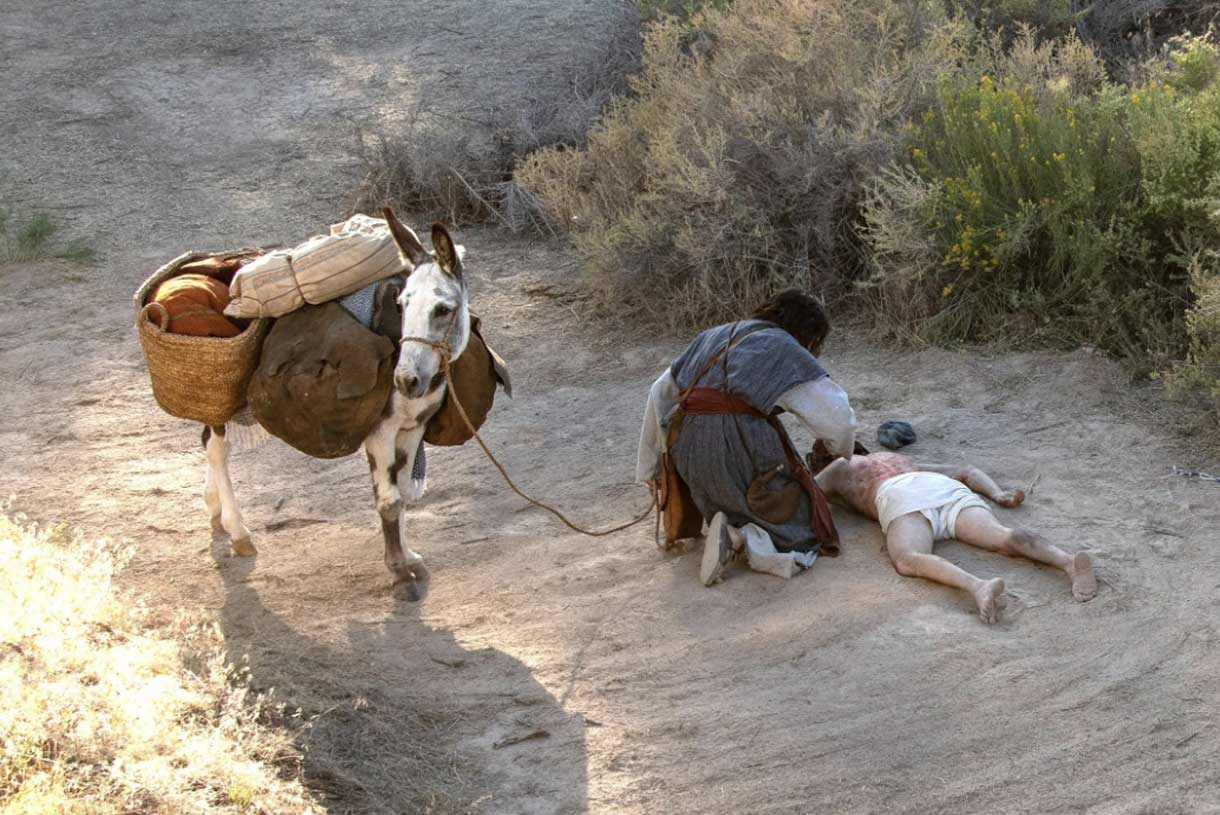
The film’s relative violence adds to this verisimilitude. When the Jewish traveler sets out alone, it is because his friend’s donkey is worn out. As he walks alone, three robbers lie in wait. His brief (and dramatic) attempt to defend himself ends in a flurry of club strikes. They want the beautiful cloak his wife made for him. Now dirty and tattered, they take it anyway. When the Samaritan arrives, he finds the man naked, bruised, and battered. The violence of not loving one’s neighbor is on full display.
Dalrymple counterposes this violence with the simplicity of the characters’ households. The film opens, for example, with a simple domestic scene: a daughter’s desired gift for Purim and a wife’s gift of a cloak (perhaps reminding us of Joseph’s technicolor version). The happiness of these domestic spaces underscores how neighbor-violence exists in and upsets the tranquility due to human beings. Further, it underlines how hatred and violence come even to those who do not seek them. Who could be more innocent than a man traveling with gifts? Who could want to harm such a person?
Why Did They Pass By?
That, I think, is what the movie does best: establish the lived reality of not standing by those whom it might prove inconvenient to love. The priest and the Levite stand in the shadow of the grand temple we’ve seen earlier in the film. They needn’t state that their concern in not helping is ritual purity—we know, because we’ve seen where they’ve come from. The robbers, though they want the cloak, ultimately get only a dirtied article of clothing. Their quotidian motivations matter less than the hatred that seems to drive them.
These are human concerns—big and small. Isaac, by contrast, puts aside his human concerns and brings aid to a broken enemy. And that is the essential message of the film, the same as that of the famous parable: we must be willing to put our own concerns aside. Purity, time, weakness—these must all be put aside. Such is Jesus’ message; such is Dalrymple’s.
To watch a 10-minute sneak preview of the movie, click here.
















 Ad-Free & Subscriber Log-In