

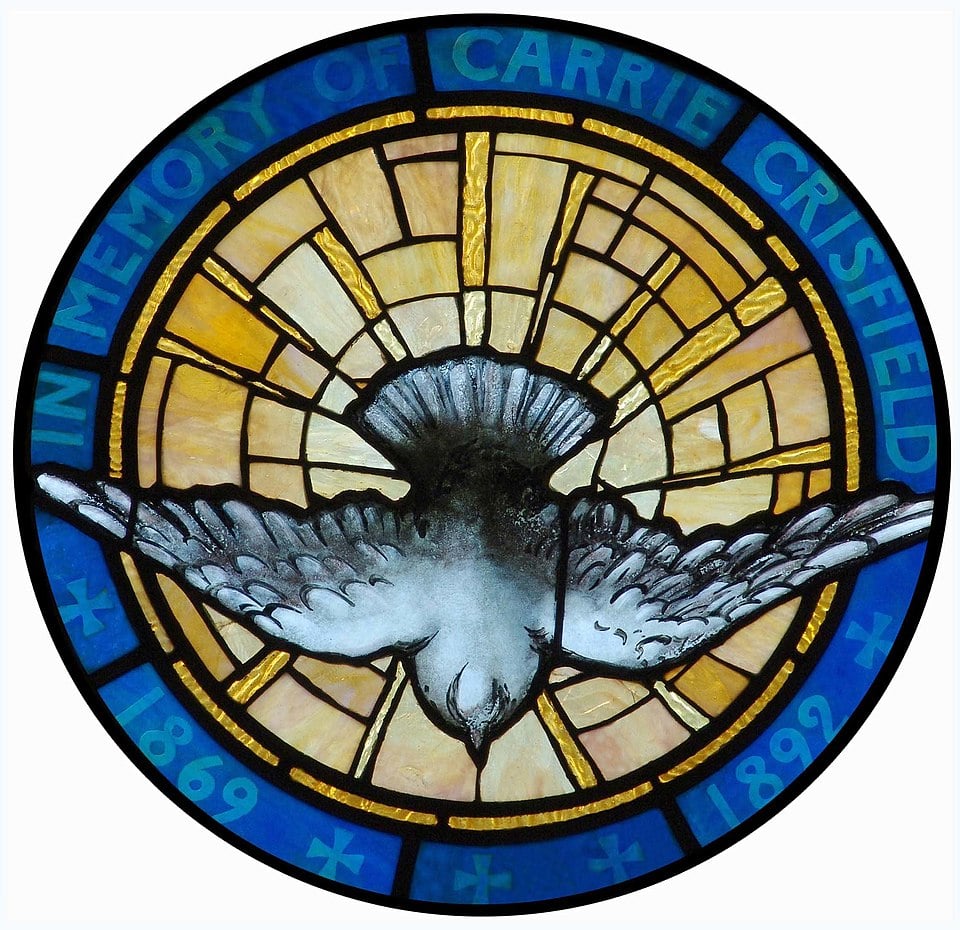
The Holy Spirit: Shy Member of the Trinity? (Part 1)
John 15:26-27; 16:4b-14
Today is Pentecost Sunday. That’s our Christian celebration of the birth of the church as recounted in Acts 2. Like Christmas and Easter, Pentecost is a Christian holy day. But, unlike Christmas and Easter, it’s not a holiday. Neither Christians nor secular people celebrate it although it often gets a nod in churches that follow the church calendar. Why isn’t it a holiday for Christians? Alongside Christmas and Easter? Perhaps it should be. But, then, again, if it were the secular world would probably create its own secular holiday of it alongside ours—as it has with Christmas and Easter. Perhaps it would sell “Pentecost doves” and hold “dove flying” contests. And forget that doves represent the Holy Spirit. I am becoming cynical and fanciful, I know.
But we Christians should pay more attention to Pentecost because of what happened on that day in Jerusalem two thousand years ago. You know the story. Jesus’s disciples and others were gathered in an “upper room” in Jerusalem after Jesus’s death, resurrection, and ascension. He had told them to go there and wait to be “endued with power from on high” that would then make them witnesses to him throughout the world. As they were gathered there, celebrating the Jewish feast of Pentecost, the Holy Spirit came upon them “like a rushing, mighty wind” and “tongues of flame” appeared over their heads. Then they spoke in tongues—foreign languages unknown to them. Apparently people from the area—gathered from all over the Roman Empire to celebrate Pentecost–flocked to see and hear this phenomenon and heard the gospel of Jesus Christ being preached in their own languages. They thought the disciples were drunk which indicates they were very excited.
So, that’s the story in a nutshell. On that day the Christian church was born; it didn’t exist before then. So what happened then, in that “upper room,” that birthed the Christian church? Christian tradition says what happened was the Holy Spirit was for the first time given to people—as an indwelling gift. The Holy Spirit, who before had been a somewhat elusive presence and power of God descending on prophets, suddenly came to dwell within Jesus’s followers.
We often talk about the church as “God’s people” and “followers of Jesus,” but we often neglect to mention that the church is also the dwelling place of God’s Spirit. Beginning on this day of Pentecost, in around 33 A.D., God’s own Spirit came to indwell, unite, energize and send forth the new people of God, the church.
Who is this “Holy Spirit?” One theologian published a book about the Holy Spirit entitled “The Shy Member of the Trinity.” His point was that the Holy Spirit does not want our attention; the Holy Spirit’s role is only to glorify Jesus Christ and to make him present to us and in us—if we believe in him and are his people. I’m not so sure about the Holy Spirit being “the Shy Member of the Trinity.” I agree that the Holy Spirit does seek to glorify Jesus, but I suspect that theologian’s tongue-in-cheek description of the Holy Spirit reflects many Christians’ hesitancy about the Holy Spirit.
I’ve taught mostly Baptist theology students for about thirty-five years now and most of them tell me they grew up in churches where the Holy Spirit was talked about, if at all, in hushed tones and with some anxiety. Whenever I have taught an elective course on the Holy Spirit it has filled up immediately; these students are hungry to know more about the Holy Spirit. When I ask them why they don’t already know much about the Holy Spirit they tell me their pastors and parents didn’t talk about the Holy Spirit much at all. When I ask why that is the case they say things like “We don’t want to be like those Pentecostals.”
I grew up Pentecostal—from birth to about age twenty-five when I “converted” to being Baptist. I won’t go into all the reasons why that happened; I will only say that to this day I consider myself a “Bapticostal”—a hybrid of Baptist and Pentecostal. I wish Pentecostals were a little more cautious about the Holy Spirit’s “manifestations” and Baptists were a little more open to them. I have often looked for the middle ground between the two groups but rarely found it.
But let’s go back to the question “Who is this Holy Spirit?”
In the Old Testament the Holy Spirit is hardly distinguished from Yahweh God, the Covenant Lord of Israel. Yet, there are hints here and there, especially in the prophets, that the Holy Spirit is a distinct person of God. The Holy Spirit came and went—occasionally descending on a prophet to reveal truth or to work miracles. But no prophet before John the Baptist was “filled with the Spirit.”
The New Testament has so much to say about the Holy Spirit it’s impossible to even touch on it all in one sermon. Sometimes I wonder why anyone would think the Holy Spirit is the “Shy Member of the Trinity”—given the prominent role of the Holy Spirit in the New Testament and really throughout church history after the first century.
Jesus promised the disciples that after he left them he would send “another Comforter” or “another “Advocate” to be with them and in them—to represent himself to them and to lead them into all truth. The Greek word in the New Testament translated “Comforter” or “Advocate” is “Paraclete.” This Paraclete, the promised Holy Spirit, is mentioned often in John’s gospel—especially in chapters 14 through 17. The Holy Spirit plays a prominent role in the Acts of the Apostles. The Apostle Paul mentions the Holy Spirit often and urges God’s people to “be not drunk with wine but be filled with the Holy Spirit.” He say that the Holy Spirit helps us pray—when we don’t know how to pray. He mentions several “gifts of the Holy Spirit” and “fruit of the Spirit.” There is no shortage of “talk” of the Holy Spirit in the New Testament.
And yet, for all that, somehow, for some reason, we Baptists especially have tended to shy away from talking about the Holy Spirit. And yet some of the greatest written treatises about the Holy Spirit in church history have been written by Baptists. I think we need to overcome our fear of being thought of as Pentecostals, who really are our spiritual and theological cousins, and rediscover the Holy Spirit. I’m sure that would be Jesus’s and Paul’s message to us. It’s my message to you on this Pentecost Sunday.
Bear with me as I do my “theologian’s thing” for a few minutes and teach about the Holy Spirit. Much of this many of you already know, but it doesn’t hurt to be reminded.
First, the Holy Spirit is God. Most of us know that, but even some good God-fearing, Bible-believing, Jesus-loving Christians are confused about who the Holy Spirit is. The Bible contains no “theology of the Holy Spirit” but when you put together all it says there’s only one reasonable conclusion to draw—the Holy Spirit is God. The Spirit does things only God can do.
Second, the Holy Spirit is a person, not an impersonal force or power like electricity. Again, when you put together all the Bible says about the Holy Spirit there’s only one reasonable conclusion to draw—the Holy Spirit is personal. I forbid my students from referring to the Holy Spirit as “it.” True, the Bible itself refers to the Holy Spirit as “it” but that’s only because in Greek the word for “spirit”—pneuma—is neuter. Our English translations should drop the neuter pronoun “it” and use “he” or even “she.” The Hebrew word for spirit is feminine. So there’s no reason, really, to only say “he” when referring to the Holy Spirit. And “it” tends to cause people to think of the Holy Spirit as an impersonal force or power like electricity. Instead, the New Testament tells us the Holy Spirit speaks, comforts, convicts, and can be grieved. An impersonal force or power cannot do any of that.
Third, the Holy Spirit is the third person of the Godhead—the Trinity. Again, putting all that the Bible says about the Holy Spirit together, the only reasonable conclusion is that the Holy Spirit is the third person of God—alongside Father and Son—and has been from all eternity.
Some of my Baptist students jokingly tell me they grew up thinking the Trinity is Father, Son and Holy Bible. Yes, we Baptists, especially conservative, evangelical Baptists, have tended to elevate the Bible to that status. I suspect that’s not only because we love the Bible but also because we are a bit afraid of the Holy Spirit. We know all too well what a “rushing, mighty wind” can do—especially in Texas. And we have seen on television Pentecostal evangelists like Benny Hinn and Rod Parsley doing very strange things. We don’t want to be like them.
Let me just stop right here—with a sidebar comment—and say from personal experience that not all Pentecostals are like the Pentecostal television evangelists. We Baptists don’t want to be lumped together with the Phelps family from Westboro Baptist Church in Kansas who picket funerals with hate speech, so let’s not lump all Pentecostals together with the strange televangelists, most of whom don’t belong to any organized Pentecostal group.
So the Holy Spirit is the third person of the Godhead—equal in every way with the Father and the Son but sent to us by the Father through the Son.
Like every other biblical subject the Holy Spirit has been the topic of much controversy throughout church history—possibly another reason many Christian shy away from giving the Spirit attention. The Eastern Orthodox churches and the Roman Catholic Church divided in 1054 A.D. over whether the Holy Spirit proceeds from the Father and the Son or only from the Father. I won’t go into all that; it seems speculative to us. Pentecostals broke away from Methodists and other Protestant groups over whether the Holy Spirit’s supernatural gifts are still available to Christians today or whether they ceased when the Bible was completed.
But I don’t want to dwell on controversies about the Holy Spirit; they interest me but aren’t the subject for Pentecost Sunday. Today we should focus together on the special function of the Holy Spirit among us and in us and not on debates and controversies.
So how does the New Testament speak to us about the Holy Spirit? What are the functions of the Holy Spirit that we should know about and seek to have working in us and among us?
First, the Holy Spirit is promise. Jesus promised that his leaving the disciples, a thought that deeply discouraged them, was actually a good thing. It was a good thing because he would send someone else to be his presence within and among them carrying on his mission. In other words, his no longer being bodily present among them was not, he said, something to be dreaded. The coming of the Spirit from him would more than take his place. He even said that they would do “greater things” than he did among them because of the Holy Spirit whom he would send to be in them and with them.
Backing up from Jesus’s promise of the Spirit taking his place, we see that the Hebrew prophet Joel promised that “in the last days” the Spirit would fill God’s people in a special way never experienced before. The disciple-apostle Peter interpreted the Day of Pentecost as the fulfillment of that promise.
*Note: If you choose to comment, make sure your comment is relatively brief (no more than 100 words), on topic, addressed to me, civil and respectful (not hostile or argumentative) and devoid of pictures or links*









 Ad-Free & Subscriber Log-In