

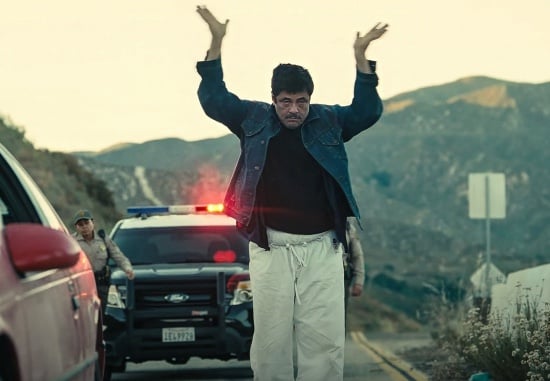
• The Academy Awards are on tonight and Benicio del Toro is nominated for best supporting actor for playing my favorite character in One Battle After Another.
He’s terrific in that part. Nailed it. That doesn’t necessarily mean he should get the Oscar — other nominees did tremendous work in larger supporting roles, including Sean Penn in that same movie. But del Toro’s Sensei Sergio is the character I’m still thinking about long after watching that film, and the category he’s nominated in explains why.
Leonardo DiCaprio is nominated for best actor in a leading role for One Battle. That’s appropriate — he’s very good in this, and the movie is his story, his character’s story. And the sensei plays a supporting role in the story of Leo’s character. But he’s not so much a supporting character in One Battle After Another as he is the protagonist of an entirely different movie that we only catch a glimpse of where it happens to overlap with Leo’s story.
And that’s a very different movie. One Battle After Another is about failed revolutionaries limping along just trying to survive, to run and hide and escape. The sensei helps them, but he does so while also apparently being very, very busy running an elaborate and seemingly effective Underground Railroad and who knows what else. He helps Leo out of pity, and solidarity, and because that’s what he does, with a kind of joyful competence that starkly contrasts with the flailing desperation of the flashier would-be revolutionaries in the movie’s main story. Leo comes to him for shelter and assistance and we see, in the background of the scene and the background of his story, dozens of others receiving that same help and assistance.
*** SPOILER FOLLOWS ***
When Leo winds up in del Toro’s car for yet another of the movie’s many fraught-but-also-funny car chases, the sensei cracks open a beer. It seems reckless and irresponsible and for a moment you think, oh no, how could he do this? How could he put his whole briefly-glimpsed network at risk — and put all the people he’s helping to evade the story’s fascist police at risk — just to get his buzz on? Then — having helped Leo escape — he gets caught, and it all seems to be over, with the supporting character sacrificing himself to save the hero.
But then Benicio/sensei smiles and does his glorious little dance and you realize that the cops have not just caught a dangerous revolutionary, exposing his entire underground network. They have, instead, arrested some nameless clown for a DUI. He has given the cops a story and — like the audience for One Battle After Another — that is as much of his story as those cops will ever get to see.
There are so many supporting actors in real life in places like the Twin Cities whose stories we will never see, and off-camera they’ve been effectively busy.
• Another way of saying all of that is that DiCaprio;’s character in One Battle After Another is based on Thomas Pynchon’s twisted version of ’70s radicals and “revolutionaries,” while del Toro’s character is based on the kinds of people Ananya Roy writes about here: “Fugitive Sanctuaries.”
• So far this year there have been measles outbreaks and large-scale exposures associated with the anti-abortion March for Life in Washington, D.C., and with the creationist Ark Encounter tourist attraction in Kentucky. Is that a pattern? It looks like it might be a pattern.
• One difference between the first Trump administration and the second is that back in 2018 I would read a headline that said “Middle-class Americans are selling their plasma to make ends meet” and shake my head sadly at such grim news.
But today, in 2026, I read about people getting $65 for their plasma and about how “there are now more places to sell plasma than there are Costco stores” and I open a separate tab to see if there’s one near me.
• Vanessa Williamson and Jeremy Bearer-Friend do the math to convert his proposals to 2026 dollars and find that Thomas Paine called for a tax on billionaires back in the 1790s:
The design of Paine’s tax is straightforward. He wanted to tax the annual financial return on wealth — what he referred to as its “yearly value.” He proposed a series of highly progressive tax brackets with rates rising from 1.25% to 100%. As his rates increased, only the money received beyond the previous bracket would be taxed at the higher rate. In 2020 dollars, the first roughly $100,000 in annual returns would be tax-free. At the other end of the spectrum, the 100% rate only applied to annual revenue over about $49 million. At a 5% rate of return, a revenue amount of $49 million comes from an estate of about $1 billion, so Paine’s top rate applies, roughly, to billionaires.
• Bo Gritz is dead. Erik Loomis puts this right-wing loon and his legacy in context.
I had a job in the early 2000s writing training materials for a private security company. One of the execs there was a retired special forces guy. He never talked about what he did or even where he did it. Ever. But he did tell me this: “There are two kinds of ex-special forces guys. Either they never, ever talk about it, or else they never stop talking about it. Those guys will tell you all kinds of amazing stories. And none of those stories is true.”
Bo Gritz told all kinds of amazing stories and, eventually, he came to believe them himself.
• The title of this post comes from “Bread and Roses,” the 114-year-old song that Lucy Dacus prayed at Zohran Mamdani’s inaugural in New York City back in January. I just went back and watched that again and it still gets me, so here it is:












 Ad-Free & Subscriber Log-In