

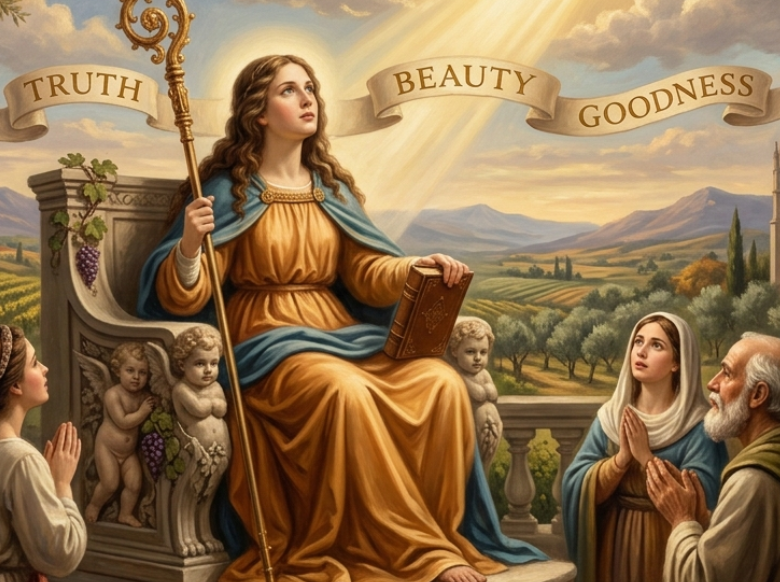
Are there qualities or ideals of reality that are universal? If so, what are they, and how should they be understood?
For most of the past two thousand years, philosophy and theology have almost with one voice answered yes to the first question and offered the transcendentals as the framework for answering the second.
In this paper, I will explore the concept of transcendentals within a Catholic framework. Specifically, I will show the significance of transcendentals for intellectual and religious life, and the danger posed by denying these properties of reality.
The Transcendentals
A transcendental is usually considered or defined as an ultimate property of being. Since being is not limited to the body or matter, transcendentals both include and transcend the material, physical world. As such, they are the ultimate, universal properties of being that apply to all things simply by virtue of existing.
How many transcendentals are there? The number varies depending on the source and interpretation; however, Catholic philosophy usually asserts that there are four. They are the one, the true, the good, and the beautiful.
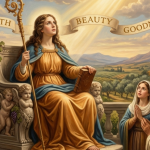
Everything that exists, everything that has being is one (distinct from others), true (conforms or is intelligible to its creator), is good (by virtue of existing), and beautiful (because whatever exists points to a divine or ultimate reality).
To some extent, Plato’s “Forms” laid the foundation for the development of the transcendentals in the Middle Ages. Platonic philosophy posited that concepts like absolute Truth, Beauty, and Goodness existed as ultimate, unchanging realities in a transcendent realm.
Plato viewed these qualities, which he called the Forms, not merely as properties or ideas but as possessing subsistent existence.
Unlike Plato’s Forms, however, transcendentals are not subsistent things but rather properties of being itself. Additionally, as we will see below, the transcendentals are interchangeable. That is not the case with Plato’s Forms.
Understanding the transcendentals as intrinsic properties of existence – rather than isolated, distant ideals – reveals why Catholic theology places such immense weight on them.
Significance Of Transcendentals
Beginning with Augustine and Aquinas, the transcendentals are understood as properties or attributes that exist perfectly in God and are reflected in creation. Said differently, the transcendentals are the ultimate, universal properties of being that transcend all boundaries of time, space, and culture.
The significance lies in the belief that the transcendentals are not inventions of the human mind but rather divine attributes. Because God is absolute Unity, Truth, Beauty, and Goodness, any encounter with these qualities in creation acts as a cosmic magnet, drawing the human soul back to its source.
God is one in His being, but moreover, God is being itself. Because God is an absolute Being, He is also an absolute Unity. The transcendental unity of God contains no multitude, parts, or composition, making divine unity radically pure and perfect.
As a philosophical concept, truth is defined as the correspondence of the mind to reality. In Catholicism, truth is not merely a concept, but the Person of Jesus Christ (John 14:6).
From the Catholic perspective, beauty is the majesty of truth. Since God is the embodiment of truth, He is also the pinnacle of beauty.
Finally, God is the summum bonum or highest good. We can understand this concept by recognizing that the world we inhabit possesses many goods. We experience love, and pleasure, and food, and a sundry other things we may deem “good.” However, all those things are temporal and fleeting, whereas everything good exists eternally and perpetually in God.
Whatever exists, whatever is true, whatever is beautiful, whatever is good finds its highest form or fulfillment in God.
If both Catholicism and most of Western philosophy emphasize the transcendentals, what do we lose if they are not emphasized in modern society?
Rejection And Result
Owing in part to William of Ockham’s Nominalism and Immanuel Kant’s rejection of metaphysics (the study of the fundamental nature of reality), the study of the transcendentals has fallen out of favor in modern philosophical thought.
From a Catholic vantage point, I think there are four detrimental effects associated with this repudiation of the transcendentals.
The first effect is to aid in the secularization of our culture. As the Catholic philosopher Peter Kreeft noted, the transcendentals act as a bridge between the physical and spiritual realms. Denying the transcendentals destroys that bridge.
Second, it does damage to the human person. The reason for this is that the transcendentals perfectly correspond to three core faculties of the human soul. The intellect seeks to know the truth, the will desires the good, and the emotions are drawn to and moved by beauty.
The third detrimental effect of the bracketing of the transcendentals has a moral component. Catholic philosophy has long held that the transcendentals are convertible, where one is present, the others are inherently present, as well.
A genuinely good act possesses moral beauty and aligns with objective truth. Because the transcendentals reflect God, they are universally true and beautiful regardless of culture or personal ideology.
When God is positioned as the highest good, it reshapes a person’s priorities. It implies that aligning one’s life, morals, and love with God gives everything else its proper and healthy order.
It is no wonder, therefore, that by denying the transcendentals, modernity struggles with matters of truth, goodness, and beauty.
Lastly, the Catholic Church relies on the transcendentals as primary avenues for evangelization and teaching. In an increasingly secular world, introducing non-believers to the beauty of Catholic art, music, and architecture, or to the intellectual truth of Catholic philosophy, can serve as “stepping stones” that lead people to the fullness of faith in God.
Schematically, the rejection of truth yields moral relativism. The rejection of goodness leads to a fractured sense of human dignity and egoism. The rejection of beauty explains the utilitarian, often bleak landscape of modern architecture and art. Lastly, the rejection of unity feeds the hyper-individualism and cultural polarization we see today.
Conclusion
Of the transcendentals, we may say that they are attributes of the divine nature that are reflected in God’s creation. Moreover, they are aspects of our consciousness that make us aware of, and have a desire for, the One, the True, the Beautiful, and the Good.
By adopting a Kantian position on metaphysics, which is to say the rejection of metaphysics, modern secularism has sought to deny the transcendentals. This rejection, in my opinion, has damaged our capacity for a critical and comprehensive understanding of reality.










 Ad-Free & Subscriber Log-In