
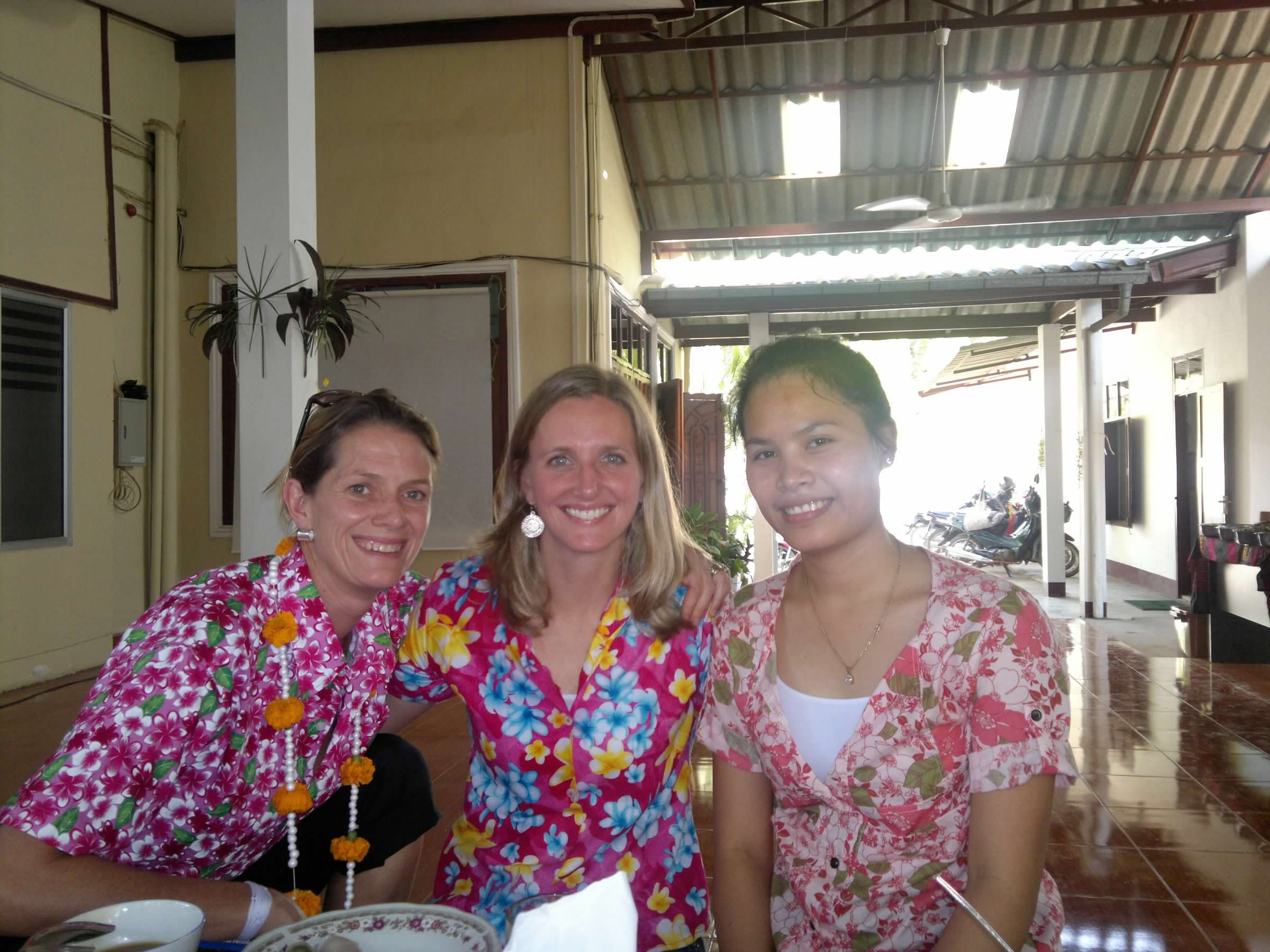
We were in the midst of a lively, outdoor daytime celebration with our group of twenty-five colleagues from various countries around the world. My statuesque friend Katrina looked down at me and said, barely able to form the words in her jolly British accent while tears twinkled in her eyes from laughing so hard, “Anyone at home wouldn’t believe this if we tried to explain it.”
For her, “home” meant Kenya, where she grew up; for me, America. Though neither of us had lived in our home countries for five years, her point was, anyone we knew from our respective countries might not understand what we were doing if they caught a momentary glimpse. In a gypsy’s crystal ball, we would have appeared rather silly to an objective viewer. Our open mouths spilled cackles of pure joy as we threw our heads back and laughed. We then resumed tossing water on each other and our colleagues. It was Pii Mai Lao (“bpee my lah-o”) after all, and this is what one does in Laos at that time of year.
Pii (meaning year) Mai (meaning new) is the Lao New Year and Laotians celebrate with a three-day water festival each year in mid-April. In fact, countries throughout Southeast Asia celebrate the Theravada Buddhist new year every April with their own forms of Pii Mai, all involving water festivals. Similar to the Gregorian calendar’s New Year holiday, Pii Mai is a time of reflection and renewal; a time to mark a positive outlook for the year ahead. The water element of the Southeast Asian festivals serves figuratively as a cleansing and literally as a relief. By April, temperatures hover around 100 degrees Fahrenheit daily. Region-wide, residents await the monsoons like anxious children looking up at the humongous bucket at a water park, anticipating the deluge. The water festivals offer a brief reprieve from the humidity saturated heavy air. In Laos, the water also offers relief from the giant pink sun, a jewel of nature that sinks beautifully on the Mekong River each evening after scorching the city by day.
“Please Don’t Rush”: Embracing The Slower Pace Of Vientiane
Katrina and I were celebrating Pii Mai with our colleagues in the back area of the law firm’s office building where we worked in the small, sleepy capital city of Vientiane, Laos, or officially Lao PDR; formally the PDR is for People’s Democratic Republic, though in jest (a joke among both foreigners and locals) for “Please Don’t Rush.” Enjoying life and community are foundational to the culture, and life there offers the gift of a slower pace in the most beautiful ways. The building was an old French colonial-era style house converted into office space. With yellow stucco and brown trim and a cozy front yard (or “garden” as more commonly called outside the U.S.) lush with tropical trees and flowers, it still looked like a house but for the law firm signage distinguishing its use.
Running alongside the house’s left side when looking at it from the sidewalk was a large driveway where we could park during the workday, and which was left vacant on days we needed the space, like Pii Mai. Behind the house was a sizeable enough space used for office gatherings—approximately ten square meters enclosed by eight-foot concrete walls typical of property borders throughout the city. Along the walls, plants and trees with giant palm leaves reminiscent of those used for fanning nobles adorned the walls. Reddish-brown tiled flooring covered the concrete to provide a patio-like appearance. Under the tin roof, utility prevailed over aesthetics to provide a gathering space. Adorned with our Lao colleagues’ decorative touches for Pii Mai, the space transformed into an invitation to leave our legal work inside and celebrate together.
A Communal Baptism: The Sacred Play Of The Lao Water Festival
While our office reserves a day to prepare for the celebration, the entire country immerses itself in preparation for several weeks leading up to the Pii Mai holiday. In Vientiane, roadside shops sell brightly colored shirts with flowery designs. The shirts predominantly feature the frangipani or “dok champa.” The national flower of Laos has five curved white petals and a gentle yellow center like a kiss of sunshine. The beauty resides in its subtlety. Additional holiday merchandise crowding the sidewalk shops includes brightly-colored flowery hair accessories, water guns from small handheld sizes to giant “super soakers,” all kinds of buckets, and waterproof phone cases.
Meanwhile, Laotians prepare their homes for the start of a new year by cleaning, sweeping, and readying their spaces to receive a new year’s blessings. When day one of the festival finally arrives, the streets of downtown Vientiane host multitudes of people ready to celebrate. The Pii Mai water festival is all about being soaked and dousing others with water in a playful, festive way. The water represents a cleansing of sins and sufferings of the old year and readying for the year to come.
Our law office celebration mimicked the larger festivities as a more intimate water festival in our gathering space; it took place annually prior to the official festival as the firm closed for the holiday. On the day Katrina mentioned those “at home”, the humidity felt like a comforting cloak of celebratory energy as all our colleagues gathered outside. Our faces dazzled with sweat and illuminated with smiles. We proudly wore our obligatory Pii Mai shirts—dok champas galore on canvases of pink, orange, blue, purple, and green. A long table took up the back portion of the space. A buffet of Lao food was available for our consumption—sticky rice and grilled pork skewers with sweet chili sauce, papaya salad, green curry with chicken, whole steamed Mekong River fish, jasmine rice, fresh and fried spring rolls, banana-leaf wrapped fish in coconut broth, Luang Prabang sausage, and more.
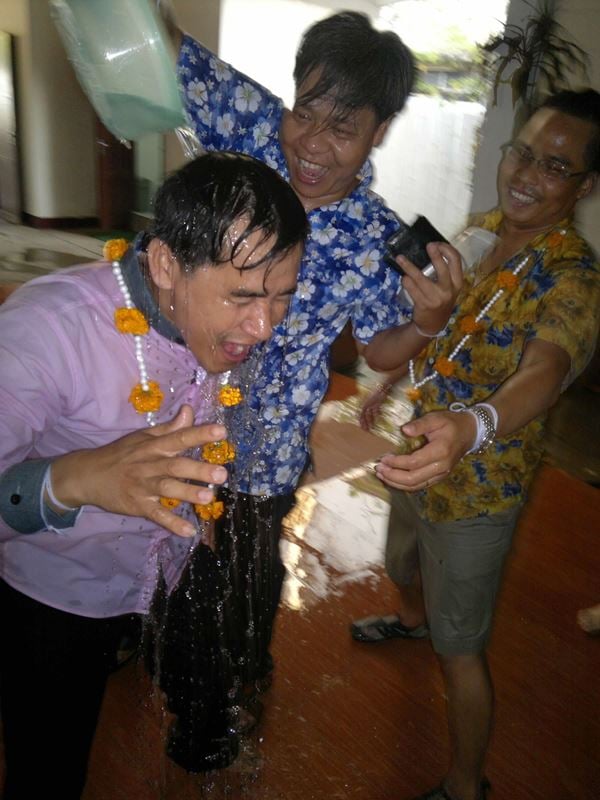
A fully stocked cooler offered giant bottles of Beer Lao which we poured into small glasses filled with ice cubes essential to keep a beer cold longer than the minute it might stay drinkable without them in the sweltering heat. We clinked our small glasses on one another’s and shouted “Nyohk nyohk” (“nee yolk”) meaning “drink.” With each tradition unfolding, we released the past year and welcomed a new one. A giant black plastic tub was filled with water from the hose connected to a spigot at the property’s back wall. A number of flat-bottomed plastic bowls were available for tossing water on each other. Someone started a toss of water onto someone else and that seemed to initiate the beginning of the communal baptism. Somehow being doused with water felt gentle and soothing in this space.
The intent of Pii Mai is not to soak anyone aggressively but offer a cleansing in preparation for the new year. Just a toss of water will do, or a sprinkle of water demonstrates respect for elders. The younger and more rambunctious of the group instigated each other with douses from the garden hose. Bottles of colored powder appeared, and we tossed that onto one another as another form of blessing. With powder stuck on our wet faces and arms, we looked like a tie-dyed species of pink and yellow and white. We sang karaoke and danced to the blaring Lao music, our laughter reaching a crescendo along with our spirits.
The Architecture Of The Soul: Finding Home In White Strings And Ritual
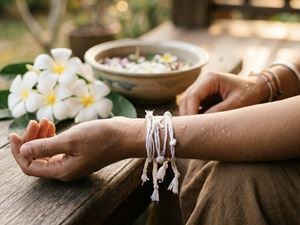
One of the best parts of that Pii Mai Lao in particular was the peaceful Baci (“bah-see”) ceremony we held prior to the exuberant water tossing component. A Baci ceremony is an ethnic Lao ritual conducted for many celebratory purposes. Among the rituals performed at a Pii Mai Baci, attendees tie pieces of white string around each other’s wrists as a symbolic gesture to offer blessings for the upcoming year. I think sometimes about Katrina’s mention of those “at home” as I wonder often where I consider home, if anywhere at all.
Maybe we carry all the traditions we learn, and they create a home within us rich with the treasures of our experiences. We can embrace a breadth of experiences regardless of their religious affiliations and invite an expansion of our spirituality. Sometimes I feel the gentle whisper of those strings on my wrists, remembering that old house in Laos, where part of my heart will always call home.
4/21/2026 10:45:54 PM




 Ad-Free & Subscriber Log-In