
Editor's Note: At Patheos, we're highlighting Faith & Media Initiative (FAMI) Fellows whose work brings thoughtful, lived faith perspectives into today's public conversations. These profiles showcase leaders helping broaden understanding of belief, dignity, and community in the world we share.
Rabbi Elan Babchuck is a teacher not because he calls himself a rabbi or is defined as one, but he is a rabbi because of those who see him as their teacher. In the Jewish tradition, “rabbi” is a possessive term, meaning “my teacher.” To everyone for whom Babchuck brings Jewish wisdom to light and life, the relationship between teacher and student relies entirely on relationship.
He knows he could very well have a title that says “rabbi” on his business card or in his email signature, but if he wakes up one day and realizes that no one sees him in that light, then he would no longer be rabbi.
A Calling Rooted in Grief and Community
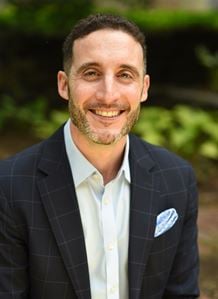
Babchuck remembers how his parents’ house was filled with stories, food, and kindness during the seven-day period of grief when he was in his early twenties. Although it took time to integrate and interrogate those experiences, once he looked back on the week of mourning, something clicked within him on a deeper, knowing level. As he shares in an address at the Chautauqua Institution, sitting shiva made him feel “more grounded, more rooted, and more loved than he had in a decade.” It also made him realize that being a rabbi was his calling.
“I thought to myself, I need to do that – not just perform Jewish rituals to help people go through times like these and other transitions,” Babchuck recently said. “But I need to be a part of a community that really shows up for one another, cares about each other, and tells one another stories.”
The Making of a Modern Rabbi
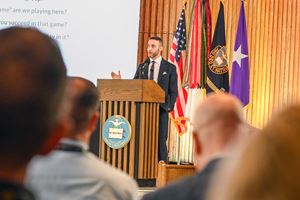
An ordained rabbi, Babchuck worked in a pulpit for four years before serving in various organizational capacities. He is the Founding Executive Director of Glean Network, an incubator with Columbia Business School that seeks to empower faith leaders to build innovative, values-driven ventures. He also currently serves as the Executive Vice President at Clal - the National Jewish Center for Learning and Leadership. Additionally, Babchuck earned an MBA in 2012 and is on track to complete a PhD in late 2026; he is the co-author of two books, has delivered keynotes at stages ranging from the Pentagon to TEDx, and has been published and featured in several national outlets. Not to be outdone, he is also a Faith & Media Initiative Fellow, a Founding Partner of Starts With Us, a movement to counteract toxic polarization in America, and a founding Board Member of Springtide Research Institute, which focuses on spirituality, mental health and Gen Z.
Despite his many accomplishments, he maintains a real commitment to a robust pluralism so that we can be reminded of one another’s humanity and dignity along the way. Babchuck believes that this is what we need more than anything else – and it’s a commitment that he seeks to embody day in and day out, on both professional and personal levels.
Living Out Human Dignity in Everyday Encounters
“Each of us were created in the divine image. It’s a pretty simple thing to say, but it’s difficult to fully comprehend and live out in your everyday life,” Babchuck noted, citing how “metaphorically, that’s wonderful,” but functionally, can prove a real challenge. In our conversation, he mused aloud whether the person he’d just bought cookies from earlier that morning had been reminded of her infinite value during their 30-second interaction. If he truly believes that every human interaction holds infinite value and greatness, then an inherent belief in human dignity is present in the way he lives and moves and has his being in the world.
As Babchuck further reflected on the concept, he seemed to lose himself in a litany of questions. But in that moment, he also became my teacher.
“How does such a belief shape the next person I meet, the next person you meet? Whether it’s your employee, your spouse, your kid, fill-in-the-blank whomever? Are they going to walk away from that interaction and feel like their dignity was elevated, that you reminded them of their own value?”
A Commitment to Pluralism in a Fractured World
Those questions certainly fuel his work at Clal – The National Jewish Center for Learning and Leadership, an organization that has believed in expanding moral horizons and stretching imaginations since its inception in 1974. Started by Rabbi Irving “Yitz” Greenberg, Dr. Elie Wiesel , and Rabbi Steven Shaw, their commitment to principled pluralism means not only advocating for pluralism, but embodying the concept wholeheartedly. As Babchuck sees it, in a world of heightened polarization and toxicity, a real commitment to a robust pluralism is necessary, precisely so we can be reminded of one another’s humanity and dignity along the way.
But the commitment also fuels his ordinary, everyday interactions. When pressed for specifics of how he advances human divinity in the world – for example, with the person he’d just bought cookies from earlier that morning – Elan Babchuck paused for a moment.
Then, like any good rabbi, he began to weave a tale of making eye contact, demonstrating genuine curiosity, and “being a human who cares about another human.” Hers was a story of Seasonal Affect Disorder, a mood disorder linked to seasonal changes that Babchuck understands and can tell you a thing or two about when cold and snowy winters yield longer, chillier nights in Providence, Rhode Island, where he now lives with his wife and three children.
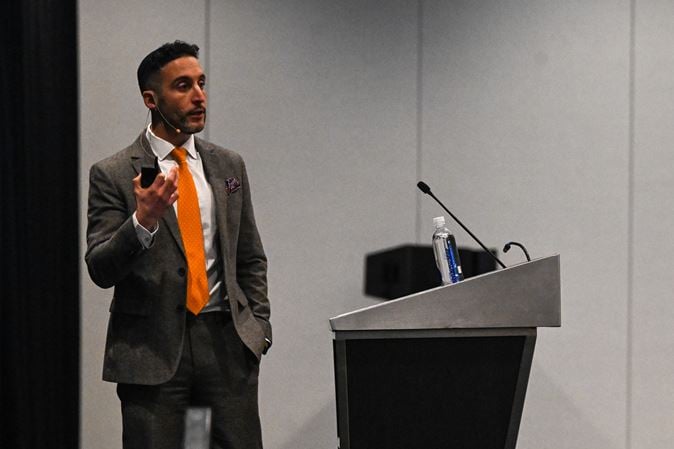
Because whether he’s interacting with a “bakery girl,” gardening in the backyard with his daughters, or delivering a keynote address to hundreds of attendees, Babchuck continues to lean into his calling.
Over the last several months, including during his time as a Faith & Media Initiative Fellow, Babchuck has deepened Clal’s work with senior U.S. military leaders, focusing primarily on pluralism, transformational leadership, addressing mental health issues among its ranks. As he continues work in this area, he’s also building a curriculum to train local and national leaders on facilitating dialogues across difference and creating cultures of curiosity over certainty.
Finally, Babchuck is also writing a new book about the Sabbath’s unique position to address many critical challenges of the moment, including loneliness and isolation, anxiety, technology addiction, and polarization.
After all, when it sometimes feels like our snow-globe of a world is being turned upside-down and shaken all around by these critical challenges, Babchuck’s suggestion is simple: “If history be our teacher, then I humbly suggest we have a little faith in what’s to come.”
Because for this rabbi, having a little faith in what’s to come means spending time asking people to tell him their story.
“No matter how difficult the story, if you’re asking somebody who’s still living to tell you about their life, the answer is always, ‘I made it. I’m living through. And I’m here to tell you the story about it,’” he mused.
To him, the solution is simple: What the world needs is a little more storytelling and a little less prognosticating, and then, a little more listening and a little less shouting while we’re at it.
2/5/2026 7:51:41 PM







 Ad-Free & Subscriber Log-In