
Well, I suppose I’d better talk about it.
Last month, GAFCON (the Global Fellowship of Confessing Anglicans) finally revealed something that had been a long time in coming: its intention to set up an organization called ‘the Global Anglican Communion’. GAFCON-affiliated provinces were advised to distance themselves from the Church of England, the spiritual hinterland of Anglicanism.
I didn’t feel much, personally, when I heard the news. But I did feel gutted for the men and women who have tried hard to hold the Anglican Communion together. I was disappointed, in particular, for those who worked on this issue with such intellect and rigor from the late 1980s to the mid 2000s. It has created a lot of awkwardness in the Church of Ireland, of which I’m a member, with a couple of our bishops openly sympathetic to GAFCON.
GAFCON leaders, in their October 16th press release, “The Future Has Arrived”, anointed themselves to lead Anglicanism into the future. (I can almost admire the sheer hubris needed to make such a move.) In this utopian future, the Bible would be the one focal point of communion between Anglicans. Okay, but if all that unites Anglicans is the Bible, what makes us different from the Baptists? …from the Methodists? …from the Presbyterians?
Traditionally, the most obvious answer to this question was ‘the Archbishop of Canterbury’. GAFCON, however, has already pronounced its verdict on Sarah Mullaly. (She won’t assume office until January 2026 and hasn’t had a single day to prove herself in the role.)
This latest news arrived within the fortnight of her nomination.
I have to wonder what will keep this new, GAFCON-led ‘Global Anglican Communion’ together in the long term. It’s easy to join forces in defiance of a shared bogeyman (or bogeywoman, in this case); and it might feel cathartic to stick one up to Canterbury, but after noses have been satisfactorily thumbed, what is the point of this new communion? There are still areas of disagreement within GAFCON; and splits only tend to breed further splits. Just ask a Presbyterian!
GAFCON’s press release attempts a redefinition of Anglicanism; but it’s a funny sort of Anglican who wants nothing to do with Canterbury. How, then, did we come to this point?
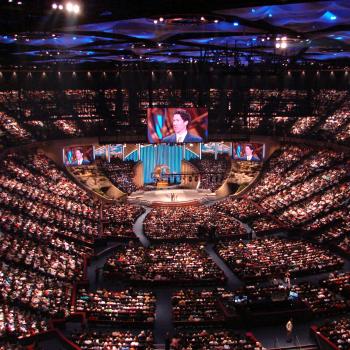
I blame the trend of religious entrepreneurialism on the fringes of evangelical Protestantism. (I’ve heard there are Anglo-Catholics involved in GAFCON, but I don’t see them on the front benches.) Instead of a more united Church, we see the proliferation of congregations and communions – like startups in the free market, a marketplace of religion.
Tradition, for the religious entrepreneur, is provisional. Everybody wants to be the founder of something, or at least a founding member; what honor is there for those who safeguard a legacy rather than build one? Christ, on the other hand, has called his followers to be the ‘slave of all’ (Mark 10.44); that includes even those who went before us, presumably. We should protect and build on their achievements for future generations.
Old forms of religious fellowship are seen as out-of-date for the religious entrepreneur, whereas new ones are ‘the future’. (Hence, “The Future Has Arrived”). I’m all for innovation when it respects our forebears. GAFCON, however, have decided to knock the house of cards down – the Communion that so many faithful hands had built – and start over.
Don’t underestimate what has been undone, here, in a single press release... “The Future Has Arrived”. It’s no description of GAFCON, but it would make a fine slogan for a new cryptocurrency: Gafcoin, if you will. Perhaps it could even fund their future conference bills – cover some overheads, at least.
Last month’s events, I would reassure other Anglicans, will have little to no material impact on us despite all the high drama. Consider the first Sunday post-schism: Holy Communion at 11am; Evening Prayer at 6pm; ‘and there was evening and there was morning’. In short, there was no discernible change.
If you had asked around that Sunday, the number of people in the pews who had heard the news about GAFCON would have been small. Even fewer would have been worried. It was likely the same with similar events in Christian history. Did the typical Roman farmer agonize over the Chalcedonian Schism?
The Church of Ireland will always be part of a worldwide fellowship – a smaller one, yes, but no less global. Anglicans in full communion with Canterbury can still be found on all six inhabited continents. Nobody can ever take that away from us. Individual provinces of GAFCON could still decide to pull back from the brink.
It’s not over until it’s over.
Most importantly, parish life will continue – the same as it always has. Whatever games are played in faraway conference halls, the local church will continue the real work: transforming communities on the ground in the name of Christ, and healing societies one soul at a time.
11/10/2025 6:11:50 AM





 Ad-Free & Subscriber Log-In