

The inhabitants of Jerusalem cried out, “Crucify Him!” Pilate, the governor of Judea, declared himself innocent of the man’s blood; soldiers struck Him on the head with a reed, and spat on Him. They pressed upon His head a crown of thorns. Oh, how the Gentiles raged against this man, and the peoples of Israel, they plotted with ill intent. Yet, the treacherous deeds of the rulers and commoners against the Lord and His Anointed were met with no success. For this man, although He was crucified, rose on the third day and now He sits at the right hand of His Father. He exercises dominion over His servants and His enemies alike. This man is Jesus of Nazareth, and He is the Christ.
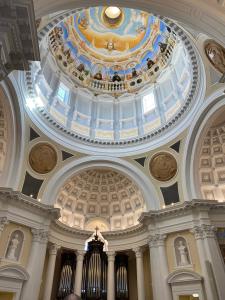
In the second of the 150 psalms that we have been gifted by God, we learn of a prophecy that concerns Israel’s Messiah—the Anointed One of verse two. The text describes what will happen to the Christ when He makes His appearance on earth, and it makes known His divine and human natures; Psalm 2 presents the Gospel to us, and tells us what our response should be when we are presented with it. Much of the Christian Faith is summarized in these twelve verses. So let’s briefly explore this psalm’s connection to the Good News by revisiting the story that I opened with.
A Plot Against the Lord’s Anointed
When asked by the High Priest if he was “the Christ, the Son of the Blessed?” The Lord Jesus responded in the affirmative. He said, “I am, and you will see the Son of Man seated at the right hand of Power, and coming with the clouds of heaven.” (Mark 14:62). Yet, those in authority, the chief priests and elders of Israel, acted in accordance with their spiritual blindness; they set Jesus on the path toward destruction. The entire council of Jewish religious leaders condemned the Messiah as deserving death, and Pontius Pilate acquiesced to their heinous request that Jesus should be crucified. Roman soldiers carried out this order; Jews and Gentiles alike took part in the sacrifice of the unblemished Lamb of God.
The psalmist foretold as much when, under the inspiration of the Holy Spirit, he asked, “Why do the nations rage and the peoples plot in vain?” It is a reasonable question, because we know that Almighty God was sovereign in the matters that concerned Jesus’ death. Therefore, it was futile for these men to conspire against God and His Anointed. In their attempt to cast away that which prevented them from being lords over their own lives, they instead succeeded in adding yet more precious stones to the eternal crown of Christ. Their actions declared Him as Lord of all lords, despite their attempts to do quite the contrary. Following his quotation of Psalm 2:1-2, Luke writes in Acts:
“for truly in this city there were gathered together against your holy servant Jesus, whom you anointed, both Herod and Pontius Pilate, along with the Gentiles and the people of Israel, to do whatever your hand and your plan had predestined to take place.” (Acts 4:27-28)
Jesus wasn’t taken by surprise; He wasn’t overpowered by the armored cronies of the empire. Truly, Jesus laid down His life willingly, and He took it up again. Sinful men did everything in their power to put away the Messiah for good, but they could not thwart the salvific plans of God. In fact, they simply played into the Almighty’s outstretched hand. Jesus defeated the death that He readily accepted; He welcomed the sins of those who had and would rebel against Him with open arms. “He who sits in the heavens laughs,” the psalmist records, because Jesus’ executioners had no more control over the fate of the Christ than did the wood of the cross.
Those Whom God Holds in Contempt
God holds those who crucified Jesus in derision; “He will speak to them in his wrath, and terrify them in His fury.” We read in the second Psalm that their inheritance is the judgment of the Holy One. However, it is not only Pilate, the Roman centuries, the chief priests, and scribes who will be called to account for their wrongdoings. In the last days, the living will be judged, and Death and Hades will give up the dead who are in them, and they will be judged, each one of them, according to what they have done (Rev. 20:13). None will be exempt from God’s judgment, and none are innocent. For “if we say we have no sin, we deceive ourselves, and the truth is not in us.” (1 John 1:8)
We are all guilty of transgressing the law of God. It’s not only the murderers of the Messiah who are deserving of condemnation—nor purely murderers in general. If we have ever dishonored a parent, coveted another’s husband or wife, stolen silly putty from the Dollar General, or placed anything above God, so as to make it an idol, we have contributed immensely to the Divine—human rupture that began in the Garden of Eden so many years ago. And we do not possess the powers necessary to pull ourselves out of the pit of sin that we regularly swim in.
Yet, because our Creator is most merciful and gracious, abounding in lovingkindness and truth, He has provided a balm that would heal our severed communion with Him. The Lord speaks of this remedy in Psalm 2, and we have already made mention of it earlier. In verse 3, the Lord declares through His psalmist, “As for me, I have set my king on Zion, my holy hill.” It is this King who will terrify the ungodly on the day that the Lord has set. But God’s Anointed also possesses the promise of hope for all who will repent of their sinful ways and place their trust in Him.
A Human and Divine Christ
This King is the Messiah, the same one who was scourged and nailed to a cross. He was set on Zion; that is, He was born of God’s chosen nation, the people of Israel. A Jewish woman, Mary, gave birth to Him on the soil that was promised to the offspring of Abraham. Jesus, assuming a human body and soul, entered this world much like us. However, His entrance had a miraculous component that set it apart from our entrances. He was conceived by the Holy Spirit; His mother carried Him in her womb although she was a virgin.
This Jewish King is given a voice in Psalm 2 as well, and we learn more about Him after He speaks. “The Lord said to me,” the King announces in verse 7, “‘You are my Son; today I have begotten You.’” What this passage suggests to us is that Jesus is not only a human Messiah, but also a Divine one. The Lord—that is, God the Father Almighty—declares that this man is His Son; He is begotten of God “today.”
Here, the word “today” does not mean that Jesus was begotten the moment the psalm was written, nor on the day He was conceived in the womb of His mother. It likewise doesn’t mean that Jesus was only adopted as the Son of God at His baptism—as some have suggested. Instead, “today” suggests an eternal present, an ongoing “today” without a beginning. Augustine writes about this in his Expositions on the Book of Psalms:
“in eternity there is nothing past as if it had ceased to be, nor future as if it were not yet, but present only, since whatever is eternal always is; yet as ‘today’ intimates presentiality, a divine interpretation is given to that expression, ‘today have I begotten thee.’”
Therefore, the Son of God is eternally-begotten of the Father. He has always existed and always will; there was never a time when He was not. Jesus proclaimed in the Gospel of John that before Abraham was, He existed. The “today” during which Psalm 2 was written, and the “today” of our reading it, both exist within the same everlasting present enjoyed by our Creator. The second person of the Trinity, the Son of God, wasn’t created, but He is continually generated by His Father with Whom He is one God along with the Holy Spirit.
The end of Psalm 2:7 also foretells a future moment in which Christ’s true relationship to the Father would be put on full display. During his speech in the synagogue at Antioch in Acts 13, the Apostle Paul correlates the second Psalm with the Resurrection. Luke records his words: “And we bring you the good news that what God promised to the fathers, this he has fulfilled to us their children by raising Jesus, as also it is written in the second Psalm, ‘You are my Son, today I have begotten you.’” (Acts 13:32-33) Psalm 2, the Apostle asserts, prefigures the Resurrection because Christ’s rising from the dead was an undeniable declaration of Jesus’ Divine sonship to the world.
Christ Shall Mend His Shattered Servants
Jesus, the Jewish King and everlastingly-begotten Son of God, has received the nations as His heritage, and the ends of the earth are as His possession. This is indicated in Psalm 2, and Jesus Himself makes it very clear in the Gospel of Matthew. He says succinctly in chapter 28, “All authority in heaven and on earth has been given to me.” (Matt. 28:18) So what does Christ intend to do with the people who are under His dominion? The psalmist relays this information as well; the Lord says to His Son in verse 9, “You shall break them with a rod of iron and dash them in pieces like a potter’s vessel.”
And this, of course, has come to pass, and it will continue to do so as time moves forward. We shall all be broken by Jesus’ rod of iron, either by Christ as He sits in His judgment seat at the end of time, or by God as He convicts us of the sins that we have committed against Him. When the Lord graciously reveals to you the severity of your transgressions, this will shatter you; you will be brought low before Him. Yet, our Creator has not left us simply with a promise of eternal judgment and a cloud of unquenchable guilt; He has provided for us a Savior as a remedy for both. The selfsame Jesus that will break the peoples of earth will mend and fashion into new creations those who believe in Him and serve Him.
Psalm 2 speaks of this reality in its final two verses: “Serve the Lord with fear, and rejoice with trembling. Kiss the Son, lest he be angry, and you perish in the way, for his wrath is quickly kindled.” If we put our faith in Jesus Christ, the Son of God, the King of the Jews, the Crucified and Risen Lord, the only perfect man to have ever walked the earth, we will be saved from the Lake of Fire that shall swallow up the unrepentant at the end of history. And faithful Christians, although by God’s grace they will be broken on account of their sin, will be made whole by the power of the Holy Spirit. Truly, if we embrace Christ, we will abound in hope and be filled with joy and peace. After all, there is much for Christians to rejoice over:
God forgives sinners. He has established a Church and left her with His Spirit. He will resurrect our lowly bodies, and those who persevere in the faith will be given everlasting life. The Lord Jesus Christ will return on the clouds of heaven with power and great glory. When one considers all these blessings, the concluding words of Psalm 2 appear undeniably true, “Blessed are all who take refuge in” the Son.










 Ad-Free & Subscriber Log-In