


Love Chapter
1 Cor. 13: 1-13
“If I speak in the tongues of human beings and of the angels, but do not have love, I have become resounding brass and a clanging cymbal. And if I have prophecy and know all the mysteries and have all the (experiential) knowledge, and if I have faith, of such a sort as to remove mountains, but do not have love, I am nothing. And if I distribute all my possessions, and if I hand over my body so that I may be burned, and do not have love, I have profited nothing. Love is magnanimous, love is kind, is not envious, love does not boast, does not bluster, does not act in an unseemly fashion, does not seek for things its own, is not irritable, does not take an account of the evil deed, does not rejoice in injustice, but rejoices with the truth. It tolerates all things, has faith in all things, hopes in all things, endures all things. Love never fails. But if there are prophecies, they will be made ineffectual; if tongues, they will cease. If knowledge, it will be made ineffectual. For we know partially and we prophesy partially, but when that which is complete comes, what is partial will be rendered futile. When I was an infant, I spoke like an infant, I thought like an infant, I reckoned like an infant, (but) having become an adult, I did away with infantile things. For as yet we see by way of a mirror, in an enigma, but then face to face. As yet, I know partially, but then I shall know fully, just as I am fully known. But now abide faith, hope, and love – these three – and the greatest of these is love.” (emphasis mine)
Most of us are familiar with this passage of scripture, if only because we’ve attended a wedding ceremony where the officiating minister quoted from it to remind us of the power and the beauty of love. But there are a few misconceptions I feel the need to address from this passage. We tend to make some assumptions about this chapter that tend to muddy the waters and prevent us from fully understanding what is being said.
First of all, we cannot even begin to comprehend the meaning of this chapter without first understanding what is being said in the previous chapter. If you remember, Paul begins chapter 12 by describing to us the mystery of our Oneness with Christ and our inseparable connection to one another. We cannot separate these concepts from what we read in chapter 13. The love being described in this chapter only makes sense in the context of our Oneness with Christ and our collaboration with one another as the Body of Christ. Perhaps our insistence upon quoting this love chapter at every wedding has only served to further distance us from the context it requires. This is not merely about romantic love. It is not limited to that. It is, in fact, more fully an expression of what naturally happens when people awaken to their Oneness with Christ and embrace their connection with one another. In other words, none of us can live up to this standard of love without first becoming immersed in the reality of our Oneness with the Divine, which leads us to realize that everyone, everywhere, is also one with everything and everyone. It is from this place of awareness that the love Paul describes here becomes possible.
When we separate these teachings about love from an awareness of our Oneness with Christ and one another, these verses can become used to exploit people and manipulate them.
For example, try reading these verses from the perspective of an abusive husband, and suddenly, what you’re reading becomes oppressive and toxic. This is exactly why we cannot allow ourselves (or anyone else) to take this chapter out of its context, which is outlined in the previous chapter.
Without Oneness and Connection, it’s too easy to weaponize these verses against other people. When that happens, the words Paul uses to describe the beautiful freedom of love become twisted into verses that dominate and subjugate others.
“Love keeps no record of wrongs” becomes an abuser’s permission to continue oppressing others. “Love does not seek for things of its own” becomes a weapon that narcissists use to silence anyone who complains about their selfishness. “Love tolerates all things…and endures all things,” becomes a tool to shame anyone who dares to complain about being mistreated. This is an abomination.
But, when we remove those chapter breaks, and we take in everything Paul says here about our Oneness with Christ, and our unbreakable connection to all humanity, and we carry that into what he says about how this realization inspires us to love everyone freely, without holding anything of ourselves back, then we have the complete picture.
Without an awareness of our Oneness, we cannot experience the Oneness of love. But, when we awaken to the reality of Quantum Theology – when the Universe becomes clearly experienced as an unbroken expression of Divine Unity – then, and only then, can we fully enter into this reality of self-giving love.
In other words, we will never fully experience the sort of pure love that Paul describes in chapter 13, until we have first become transformed by the reality of Christ as all and in all. From this place, and only from this place, can love as he describes here be experienced.
Those who have been transformed by love experience love. Divine love flows from the Divine source, and it flows between all of the members of the Body of Christ as they become aware and awakened to this Divine connection that permeates everything and everyone.
One final point I want to make is that, near the end, when Paul begins to speak about putting away childish things:
“For we know partially and we prophesy partially, but when that which is complete comes, what is partial will be rendered futile. When I was an infant, I spoke like an infant, I thought like an infant, I reckoned like an infant, (but) having become an adult, I did away with infantile things. For as yet we see by way of a mirror, in an enigma, but then face to face. As yet, I know partially, but then I shall know fully, just as I am fully known.”
Much has been said about Paul’s use of the phrase, “when that which is complete comes, what is partial will be rendered futile.” Some have erroneously attempted to convince us that this is a reference to the canonization of the Scriptures. This is completely off the mark.
What Paul is referring to here is the realization of our Oneness with Christ and with one another. He’s calling us back to what he said in the previous chapter. When “we know partially,” we are divided. We are separated from Christ in our minds, and therefore, we are separated from each other. But, “when that which is complete comes, what is partial will be rendered futile.”
This reference to “that which is complete” is pointing us to our Oneness in Christ. Once we realize that we are not separated from God, or from one another, “that which is complete” awakens.
So, later on when Paul asserts that he has now “become an adult”, he’s referring to the paradigm shift into spiritual maturity. Once we have awakened to Christ in all things, we become an adult, and we put away those childish ideas about separation. We, finally, have eyes to see God “face to face,” because the face of God is our face, and the face of our neighbor is God’s face; we see God in every face, and in our own face, and then, we “shall know fully, just as (we) are fully known.”
This isn’t something that happens only after you die. It’s a reality that everyone of us can (and should) experience right here and right now, as we awaken to the reality of the Oneness of all things in Christ.
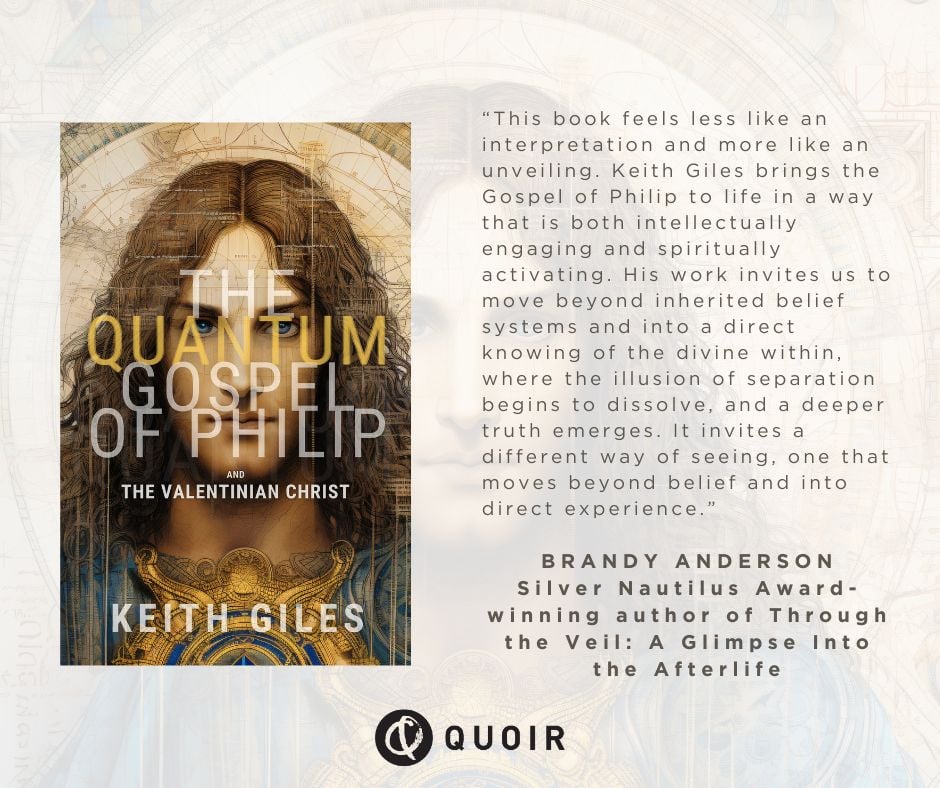
My book “The Quantum Gospel of Philip and the Valentinian Christ” is available now on Amazon.
Keith Giles is the author of the 7-part “Jesus Un” series on deconstruction and reconstruction of the Christian faith, and the “Sola” series about embracing the Divine Mystery, and the “Quantum Gospel” series which includes “The Quantum Sayings of Jesus: Decoding the Lost Gospel of Thomas” and “The Quantum Gospel of Mary and the Lost Gospel of Truth”.













 Ad-Free & Subscriber Log-In