

Feast Day – August 14
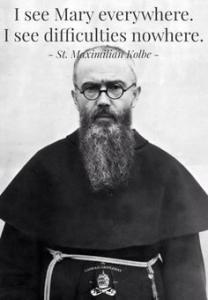
Today, I am reflecting on the life of St. Maximilian Kolbe through the lens of the Luminous Mysteries. Each mystery reveals how Christ’s light shone through him, and how his Marian devotion shaped a life of radical love, courage, and charity.
1. The Baptism of the Lord
We consecrate ourselves to Mary so that we might love Jesus with the heart that loved Him most. She is the mold in which we, too, become Christ-bearers.
St. Louis de Montfort taught that Marian consecration is the surest way to live out our baptismal vows: Those who have been baptized into Christ have put on Christ. Yet this is a reality we must choose to live daily.
St. Maximilian expressed it in his own way with a simple equation: V + V = S
Our will (V) united to God’s will (V) equals sanctity (S).
For St. Max, the surest path to sainthood was through Mary. He believed the whole world could be won for Jesus if every means were used to spread true devotion to her. For Mary never forms lukewarm Christians, but souls ablaze with love, utterly dependent on Christ, and always echoing her fiat, her “yes” to God. The All-Holy One models for us fidelity and complete abandonment to Divine Providence.
St. Max struggled with scrupulosity. He overcame this through obedience to his spiritual director and by trusting totally in Mary, the abbess of his heart and the monastery. Under her guidance, he learned the art of pure receptivity to God’s will.
2. The Wedding at Cana
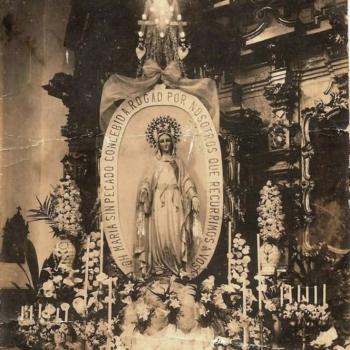
St. Maximilian’s life was a continual calling upon Our Lady. In the monastery, the brothers’ preferred greeting to one another was simply: “Maria.”
Max was a man of strong convictions and tireless work yet his heart mirrored the Blessed Mother’s posture of intercession. Despite the immense workload of the City of the Immaculate, he always made time for people. He gifted Miraculous Medals to strangers, and when evangelizing those of various faiths, he spoke with a compassion that flowed from his care for each soul, not the need to be right.
The monastery often faced financial difficulties, but Max trusted Mary entirely: if she desired the work to continue, she would provide the means. For the apostolate, the magazine, and even the monastery itself were not his but hers.
While in Japan, he instructed the brothers to pray to Mary as they folded each magazine issue: If we do not pray, how can we expect these pages to reach souls?
When a brother came to him with an interior crisis or a problem with the way things were being ran, Max would pace, thumb his rosary, and entrust the matter to Mary confident that she, as at Cana, would move her Son to act. His faith was utterly childlike, confiding in her about everything.
3. The Proclamation of the Kingdom
Repent, for the Kingdom of God is at hand.
All were welcome at the City of the Immaculata but Max warned: If you do not enjoy a life of service for others, you will not fit in here.
Some criticized the radical poverty of his monasteries, but Max saw this as essential to their mission. Mary, in apparitions, had called the world to penance, and Max believed the Militia Immaculata was a true militia engaged in spiritual battle whose goal was the conquest of hearts for Christ through His Mother.
For him, the work of converting individuals and even whole nations took precedence over personal comfort. He sacrificed food, clothing, and furniture so that every saved coin could go to printing, radio broadcasts, and outreach. One brother recalled how Max, despite poor health, would walk miles instead of taking public transport reasoning that the fare could instead be used for the salvation of a soul.
In Japan, historically a challenging mission field, he reminded the brothers: If we print thousands of copies and only one soul is converted, we have done our duty. His zeal was measured not by numbers, but by love.
4. The Transfiguration
On Mount Tabor, Christ’s divine light radiated before the eyes of His disciples. In Auschwitz that same light shone through St. Max.
From the moment he arrived, he risked his life. He was beaten for wearing his habit, and he defied camp rules by ministering to all regardless if they were Catholic or not. He prayed with prisoners, held spiritual discussions, administered the Eucharist when a smuggled Host arrived, and blessed and encouraged those losing hope, assuring them that God had not abandoned them.
The guards mocked and assaulted him, yet he prayed for them. Others tried to lighten his suffering, but he refused special treatment, choosing instead to be as the least among his brothers. His presence embodied the ancient prayer: “Under your compassion we take refuge, O Theotokos.”
In the barracks, he modeled the humility and hospitality of Mary, welcoming all who sought comfort. Auschwitz was built on hatred, yet he consecrated this death camp to Our Lady, transforming it into a hidden altar where suffering became liturgy, and good triumphed over evil.
5. The Institution of the Eucharist
St. Maximilian’s life was a living testament of self-offering. He became Eucharist for others.
When ten men were sentenced to death by starvation he chose to take the place of Franciszek Gajowniczek, who, when asked why, said: I am but a Catholic priest, and this man has a family. In the starvation bunker, St. Max led the prisoners in prayer, hymns, and the Rosary, searing the conscience of the guards. The dying men became a resounding choir, and like a good shepherd, he guided each soul through their passage from death to life.
Prior to this, he had been beaten severely, weakened by tuberculosis, and exhausted from relentless labor. Yet he blessed the dead bodies being carried out of the infirmary to be burned, heard confessions at his bedside, and refused extra rations or medicine, insisting they go to those who needed them. For Jesus Christ, he was prepared to suffer even more.
St. Max placed his life and death entirely into the hands of the Immaculata. His last words were said to be “Ave Maria” as he received the fatal injection of carbolic acid. Whenever we celebrate the Divine Liturgy and I hear the hymn, “mercy, peace, a sacrifice of praise” I cannot help but think of him and how he united himself completely to Christ’s suffering.
Max said the Cross is a school of love. For him, this was no mere head knowledge; it was a lived theology. Even before Aushwitz he was a radiant witness of charity.




 Ad-Free & Subscriber Log-In