


He searched for a safe house in Tyre with a door that would actually stay shut.
In that moment of his life, Jesus was a man hunted by his own fame. He sought the silence of a foreign shore because the miles behind him were paved with the relentless noise of the crowds. His body was heavy with the need for sleep, and his mind swarmed with pleading voices that refused to soften.
He crossed into the heat and dust of Gentile territory to disappear, listening for the sound of a latch clicking into place.
The gospel attributed to Mark is cold about his motives. Jesus was looking for a wall, a roof, and a space where the world could not touch him. He desired the simplest mercy of all, the mercy of being left alone.
So he entered the house and issued strict instructions: No one is to know. No one crosses this line.
The Greek is unambiguous about how this simple plan failed: Ouk edynasthē lathein.
He was unable to hide.
The door he had intended to shut became a target on his back. Human need arrived without invitation, and his presence proved too precious to remain hidden.
But why did Jesus need a door at all? Why was he trying to hide?
How To Disappear Completely
We cannot rely on the all-too-familiar vision you and I have already assimilated of a synthetic Christ harmonized by gospels that were assembled decades after the historical Jesus of Nazareth walked the earth. Unlike the shiny, polished icon that faith profiteers exploit at scheduled church events, the real Jesus was someone who could need a door, a person made of flesh: incarnation, as promised.

Our quest to discover the man rather than the myth begins by listening for the pulse beating deep in the heart of the story.
Here we meet a Messiah who withdraws, who seeks a room all to himself, who speaks with limitations, who needs rest. He also carried a mind that sought order and sequence when the world’s sensory blast became too loud to endure.
It’s impossible to ignore patterns in Jesus’s behavior that resemble what today is known as neurodivergence. The term is not a generic label to be used like a diagnosis, but it may be a valid key that helps unlock what many consider the mystery of Jesus’s actions: the hunger for quiet, the strain of noise, the need for controlled space.
Neurodivergent characteristics do not diminish Jesus’s divinity at all. Instead, by establishing that he behaved in ways consistent with a segment of humanity that is significant and growing, Jesus’s divinity becomes immanently biological.
Open and relational theology has a term for this: kenosis.
But what if God refuses to override the boundaries of our existence? What if the parts of ourselves we wish God would erase are the very spaces where we find God, and where we ourselves are found?
If Jesus was never subject to mental fatigue or cognitive burnout, his becoming like us becomes theater, a performative act instead of presence that intersects with us right where we are.
To meet us where we are is a self-emptying act. And that is what we see at work here: Jesus’s neurodivergent behavior is kenosis in action.
To be fully human is to have boundaries beyond our grasp. For Nobiscum Deus (God with us) to be more than a slogan, we must see in Jesus the full humanity we recognize in ourselves, including a nervous system that can be pushed to the brink.
Breaking the Silence
When the woman arrived, she was unknowingly violating something precious: Jesus’s last-ditch effort at regulation, silence, and a room that could hold him together a few moments longer.
But she wasn’t just anyone: she was a mother with a dying child.
She was also a Greek female from Syrophoenicia, details which carry with them every “wrong” label the era could produce. She brought with her the jagged static of a daughter seized by what the text calls a pneuma akatharton, an unclean spirit. In this story, “unclean” becomes moral language, a reflex that turns need into threat.
Typically, such vocabulary was reserved for individuals experiencing a malady marked by convulsions and other symptoms that remain vague, but clinically could point to mental illness, even schizophrenia.
Grief resounded through the miles she had traveled, invading the quiet of the room from the bottom of her dirty feet to the top of her head. Eyes bulging, she searched across the room for shadows in the darkness, listening closely for the sound of his breath so she could speak to him face to face.
Then her knees gave way, and she fell to the floor at his feet, undone by his presence.
Pushed To the Brink
The woman had placed herself directly between Jesus and the solitary refuge he sought.
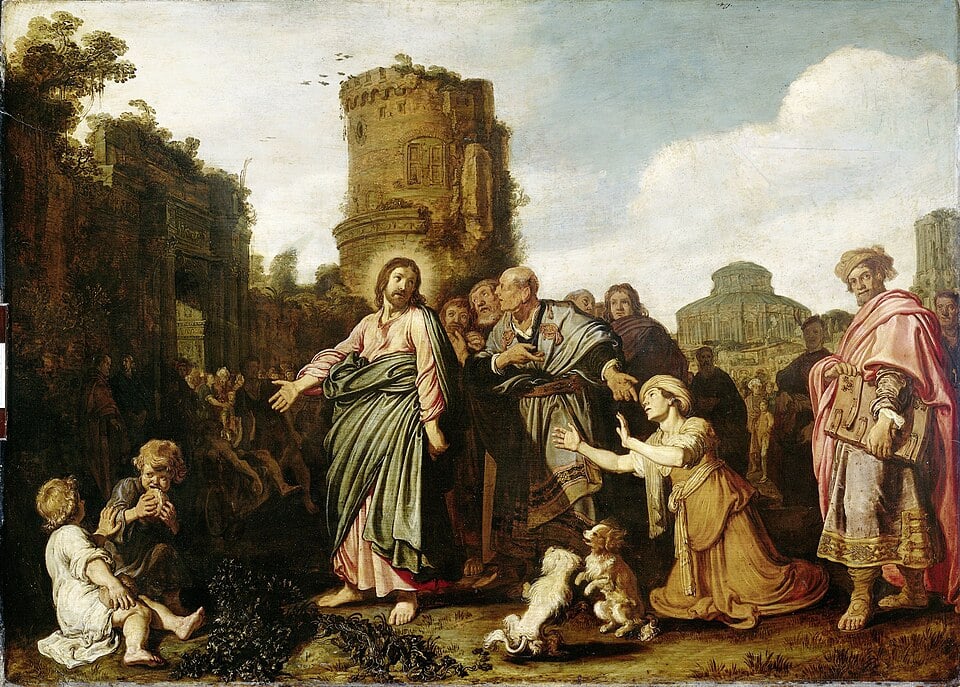
At that moment, he didn’t have the capacity for the social customs we identify as kindness. His inner defenses were in control, and he reacted to her as if she was an intruder.
“Let the children be fed first,” he said.
This was intended to be a dismissal, his words pointed, like spikes. He was sending her away.
But even deeper inside him was a very human need, a piece of himself that is just like many of us. And when he felt interrupted by yet another person desperate for healing, the next words that came from him landed like a blow to the mouth.
“It is not right to take the children’s bread and throw it to the kynaria.”
Little dogs.
He did more than insult her, his words were an outright slur.
This isn’t the beatific Jesus you and I have grown accustomed to hearing about in Sunday school. That day, the Savior known for tearing down boundaries for the least of these verbally flung this woman under the table, down into the darkness where yapping dogs scavenge. She deserved no place of honor, she was entitled to nothing, and he didn’t care to change any of it.
And still, she did not leave.
Grace In the Dark
“Nai, kyrie,” the woman replied. Yes, Lord.
Instead of arguing, she humbled herself by elevating him. Perhaps she realized that by asking for her daughter’s healing, she was seeking what she did not deserve: mercy.
“Yet even the dogs under the table eat the children’s crumbs,” she said.
It was brilliant and dangerous. She challenged neither his insult nor his logic, but used them to plead for mercy. By doing so, she dared to engage with a Savior who was overstimulated, defensive, and weary, one whose capacity to carry the expectations of “Messiah” were entirely spent.
So she encountered him beneath the table, in the dust where forgotten things fall. She understood that the miracle wasn’t a spectacle—it was that he remained with her in the room.
Jesus looked at her.
The room was thick with the scents of the street and the chaotic electricity of her desperation.
“Dia touton ton logon,” he said. Because of this word.
Without standing or rattling off a special blessing, he refused to decorate their moment with practiced choreography. Just a plain sentence stripped of ritual poetry. He had nothing to perform, yet he still gave her what mattered most: himself, present when she needed him.
Many of us would understand his sharp tone as a defect of character. The woman saw it as a triumph of proximity. She accepted the shadows and his insults, but she trusted his presence—even the crumbs.
A Human Presence
The woman from Syrophonecia had faith that the substance of Jesus’s presence remained intact even when his nervous system was frayed. To her, mercy was a single, random moment of his presence, an instant as valuable as a lifetime: grace inseparable.

Because love cannot be divided.
The gospel tells us that when she arrived home, her daughter was lying on the bed still and whole, the unclean spirit departed. The healing was simply recounted as facts, not a narrative. The miracle occurred without spectacle.
Jesus wasn’t required to “fix” his mood, or recover his social energy. There was no act of supernatural power that forced him to step out of human boundaries, nothing dramatically robbed Jesus of his humanity. Instead, as depicted, healing took place because his humanity was magnified. His presence remained holy, overflowing in the darkness even while experiencing cognitive burnout.
Grace is not defined by actions, but may be found through presence. Grace was accessible to the Syrophoenician woman for the same reason it’s accessible to us: the presence of love. And by sharing our time and presence, you and I have the ability to deliver grace and mercy to others.
And by the way, like Jesus exampled, loving others isn’t just divine, it’s extremely human.
Hide and Seek
Sometimes the door will not hold.
We run because we cannot take one more demand upon our attention, one more voice in our ears. We hide because the volume of the world becomes a roar. We shut the door because we need the darkness to help us discover the broken parts of ourselves and find new ways to function.
And then comes the shame. You and I have been conditioned to believe that our need for withdrawal is some kind of moral failure, as if to be Christlike is to be infinitely available, perpetually “on,” and socially seamless.
This story confronts that lie.
It tells the truth about the ones who hide, including Jesus. He tried to disappear and could not. But the exquisite beauty of this encounter is that his fatigue did not invalidate his divinity. It gave it context: his neurodivergence did not weaken his grace. Even when he snapped and used a slur we would normally consider to be out of character, he was fully present.
You and I keep reaching for grace as performance, as a visible, massive change we can point to. We want it staged like a rescue. But sometimes grace arrives as a closed door that fails to hold.
Grace is the prevenient realization that the parts of ourselves we think seem broken are the very places where grace is most authentically at work. They are down on the floor where the crumbs fall, and where the hungry are fed.
She saw the real Jesus. She saw that even when he was vulnerable and dysregulated, his loving presence overflowed with mercy. She staked everything on the conviction that if there are only crumbs left on the floor, they are more than the rest of the world has to offer.
Because love finds you not only in the places you seek, but in the places you hide.














 Ad-Free & Subscriber Log-In