
By Beth Davies-Stofka
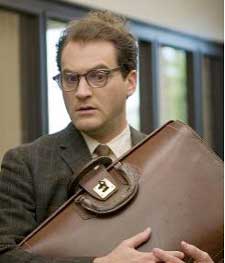
Starring: Michael Stuhlbarg, Fred Melamed, Sari Lennick, Richard Kind, Aaron Wolff
Directed By: Ethan and Joel Coen
Distributor: Focus Features
Rating: R for language, some sexuality/nudity and brief violence
Run time: 1 hour, 45 minutes
In American movie industry terms, the Coen brothers' latest masterpiece is career suicide. A Serious Man is intimate and personal, and cast with actors largely unknown to moviegoers. It explores some of life's most difficult questions: why do such terrible things happen to good people? How does God talk to us? What does God want from us? And actually, the questions aren't even about God. They're about Hashem, because this beautiful, funny, moving film is a magnificent work of Yiddishkeit.
Some might deem this its fatal flaw. Some have clucked that this movie is too Jewish, that it can't be profitable.
But after you make No Country for Old Men, you have some latitude, and the Coen brothers will be fine. One of the beautiful mysteries of Yiddishkeit is its universal appeal. A Serious Man is everyone's life story: perplexing, puzzling, and fraught with urgent and frustrating questions. And it is the Coen brother's funniest movie to date, funnier than Raising Arizona, funnier even than The Big Lebowski.
The film opens with a bit of advice from Rashi: Receive with simplicity everything that happens to you. We look up in the sky where we see snow falling, and we look down to see that it is falling gently on a shtetl on a cold and tranquil night. A happy, contented man is guiding his cart home, chuckling over what a marvel he's just seen.
The soft sounds of a harp provide the soundtrack, and the harp gives us a sense of... what? Longing? Serenity? Mystery? Does it describe the scene, or foreshadow what comes? Right away the movie begins to play with the art of the possible. In the sounds of the harp there are so many likely options. You might say art imitates life pretty accurately in A Serious Man. In the story, in the dialogue, in the search for ultimate meaning, there are so many possible interpretations
But we don't worry yet about the movie's message. We enter this incredible scene - a world now extinct, destroyed in the Shoah. Our protagonist enters his little two-roomed home to tell his wife the delightful news - he just met someone she knows on the road. The entire scene is played in Yiddish, the beautiful sounds washing over our ears. When the visitor arrives, played by the marvelous Fyvush Finkel, a fable unfolds. Is he an honored guest, or a dybbuk?
Rationality cannot admit to the idea of a dybbuk, but the wife does not care about that. She's sure of what she knows. "Good riddance to evil," is her code. Perhaps those were the days of simplicity. We really don't know. The movie switches to 1967, where physics professor Larry Gopnik lives a harmless life in a Minneapolis suburb. As his story opens, he is teaching the paradox of Schrodinger's cat.
Even though he can teach the paradox, Larry still believes that things make sense, and when his life begins to unravel, Larry starts to suffer. He's up for tenure and a student proposes to both bribe and blackmail him. His wife wants a divorce. He wrecks his car. His neighbor is encroaching on his property. The Columbia record company is calling to demand past-due payment on records Larry never ordered. "But I didn't do anything," he protests. "Yes," the Columbia record company rep tells him. "You do nothing and we send you the record, plus shipping and handling."
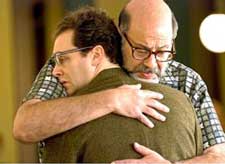 The more Larry searches for answers, the more perplexing his life comes. He needs help. He needs to understand what Hashem is trying to tell him. His visits to rabbis and attorneys produce partial answers, none of them particularly satisfying to poor Larry. "You can't understand the physics without understanding the math," he tells a student. Stories like the one of Schrödinger's cat are just fables, he says. It's the math that shows how things work. Larry needs the math, but there's a problem. He knows the mathematical proof to the uncertainty principle. "This proves you can never know what's really going on," he tells students in despair. "But you will still be responsible for it on the mid-term!"





 Ad-Free & Subscriber Log-In