
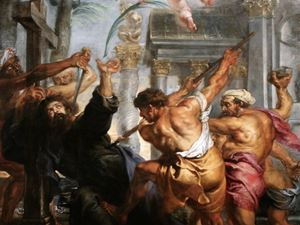
The apostle the West remembers for his doubt is the saint India celebrates for his faith
Back in the COVID era, Christians from South Asia lightened the darkness of lockdown with a celebration of our worldwide faith. On this occasion, there were no shindigs in Downing Street! Rather, Christians from around the world met online to mark the first Indian Christian Day, 3rd July 2021. Now the Pandemic is over; and Indian Christian Day has embedded itself as a cherished, annual celebration, both on- and offline.
It was no coincidence that, of all dates, Indian Christians landed on 3rd July for their celebration. It’s a crucial feast – a crucial date in the Church’s calendar, that is – for our brothers and sisters in the Subcontinent. On 3rd July, the Church honours a man who revealed God’s love to the first Indian Christians. That man’s name was Thomas – better known, to the Western Church, as Thomas the Doubter.
Thomas’s legacy, then, varies around the world. India holds him aloft as a titan of Christian witness, honored from the Himalayas to the Bay of Bengal. The Western Church, on the other hand, has tended to run him down because of his doubts. But we fail to consider the worldwide scale of Thomas’s achievements if we reduce him to his lowest moment.
It’s a dangerous business to be harsh on Thomas because we, like him, will have our doubts from time to time. Doubts can take hold – in our minds, and in our hearts – for all sorts of reasons. Discoveries of science can become sources of doubt, when there are tensions between science and the literal sense of the Bible. However, with an eye for symbolism, we can square what we learn in Genesis with what we learn in the science lab.
In Thomas’s case it was a lack of material evidence that Christ had risen from the dead: ‘Unless I see the wounds he received on the Cross, I will not believe’, he said. Before he died, Christ had foretold his Resurrection on more than one occasion; so, to be hard-nosed, we could accuse Thomas of a lack of trust in the Lord. In Thomas’s defence, however, Jesus had allowed others to see him; and, after the traumatic events of Easter Weekend, Thomas could have been in a state of shock.
It’s hard, when a faith crisis takes hold, to be surrounded with staunch believers. John describes a room saturated in faith, in which Thomas’s doubts would have made him feel alienated. Nevertheless, he did not abandon his friends. It could have been that he feared the Jewish leaders, who had turned on Jesus, and could not return to his former life; or Thomas could have had more noble reasons to stick around, like his faithfulness towards his brothers and sisters in Christ. I think it was a combination of both.
It reflects well on the followers of Jesus that, even when Thomas did not share their belief in the Resurrection, he remained welcome in their midst. In the Church, we have to make room for those who doubt; because where can we wrestle with our uncertainties if not in the household of God?
In an alternate world, where Thomas’s doubts meant he was ostracized and felt forced to leave, then he would not have been there when Jesus came back; and he would not have been able to name Christ as ‘his Lord and his God’, in those famous words.
In some circles, doubt is treated like an infectious disease, where the doubter must be held at arm’s length. In John’s New Testament account, we read of no such anxieties. Thomas the Doubter, for all his lack of conviction, was ‘one of the twelve’. Christ had woven his own future with Thomas’s – to hold him fast, whatever life has in store – which is what he does when he welcomes us into the Church. Our doubts cannot ‘unchristen’ us.
But where the sacraments are most obvious is in Thomas’s desire to hold the crucified flesh in his hands, flesh that had been stuck with nails and hammered to the Cross. This makes us think of Communion, when we, like Thomas, can touch and see for ourselves.
Communion wafers don’t have drill marks or stains of rust where nails once were – which is as well, because we have to swallow them! – but we hold in our hands the same risen Christ in whom Thomas came to believe. Communion is a lifeline for us in those times of doubt.
Even when his faith was battered and bruised – and how could it not have been? – Thomas and his brothers in Christ remained faithful to one another; and he was rewarded with a revelation of his own. It was the man who said, ‘I will not believe’, who first revealed Christ in a land which today numbers one and a half billion souls.
Thomas made a difficult choice: to run towards the Church, not from it, when his faith was in crisis. There, he was made welcome; and there, the Resurrection became real for him – as real as it is for us in the Sacrament, when we touch with our hands what we believe with our hearts. If our faith is on the rise, then Christ has a task for us, as well. It is to welcome seekers and searchers; to create an environment where honest conversation about our doubts is the norm.
However the scales of doubt and faith are balanced in our lives, Christ is there to walk beside us. It was an American Catholic novelist, Flannery O’Connor, who wrote: ‘Faith … rises and falls like the tides of an invisible ocean’, and right she was. How much, or how little, faith we have is out of our control; all we can do is love Christ and his Church as best we know how, then take a breath and let God be God.
That is the lesson of Thomas, who moved millions to follow Jesus.
4/9/2026 2:38:14 AM





 Ad-Free & Subscriber Log-In