

If I were a Young Earth Creationist (YEC), which most American fundamentalist Christians are, I would drop attempts to defend the view using “flood geology.”
In 1650 Irish Anglican Bishop James Ussher published a book in which he declared that the world was created in 4004 B.C. This became a standard date for creation among many conservative Christians.
In the 19th century especially doubt was cast on that date of creation by geologists. Most academics in Europe and later in America discarded the Ussher date on the basis of the discoveries of geology.
A great controversy ensued especially in Britain and America. Conservative Christians pit the Bible against modern geology, holding to a young earth creation view but not necessarily to Ussher’s date.
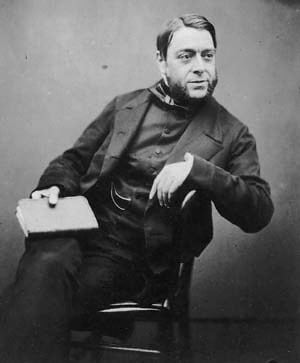
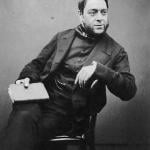
In 1857 British scientist Philip Henry Gosse (d. 1892) published a book entitled Omphalos in which he put forward a new hypothesis that came to be known as the Omphalos hypothesis and later “the ideal time theory.”
Gosse argued that IF you believe God created the world, the universe, only some thousands of years ago you could reconcile that with the geological and other evidence of the ancient earth, millions if not billions of years old.
Gosse pointed out that IF you believe, as he did, that God created Adam and Eve he must have created them as if they were some ages. Did Adam have a navel? Well, he did not have an umbilical cord. But did he have a navel? Yes, Gosse argued. Adam and Eve would have, at the moment of their creation, have had an “ideal age,” appearing in every way to be a certain age. Presumably they had scars from cuts and scrapes that never happened. Presumably they had hair on their bodies they did not have “before.” They were not created infants. Their age was “ideal time.”
Then Gosse pointed out that IF you believe God created the world, the universe, you must believe he created it with SOME ideal age and the evidence of that time that never passed (ideal time). Gosse denied that this made God a deceiver. God could not have created anything without it appearing to have some age.
Gosse did not know about the Big Bang, but if he had he would simply have said that even the universe that came from the Big Bang had to appear to be some age.
Gosse did not think his hypothesis should disturb any scientist. Scientists could go on doing what they do in geology, for example, but Christians would know that what they were discovering, such as dinosaur relics, were put there by God. Dinosaurs never existed except in ideal time, which is to say they never actually existed.
Now I have often thought about this. I will go on a tangent here and point out that Immanuel Kant’s argument that we have no knowledge of things in themselves but only of things as they appear to us never shook the scientific world. And Kant would have simply said they should go on studying appearances and not worry about things in themselves.
Well, the scientific community was not so sanguine about Gosse’s hypothesis. But it’s really a philosophical problem because it can’t be falsified and modern positivism says any belief that cannot be falsified is meaningless. Well, I doubt that would bother fundamentalists.
During the 20th century young earth creationists developed “flood geology” and argued that the flood of Noah’s day, recorded in Genesis, caused the geological evidence of an earth older than about ten thousand years. Henry Morris, John C. Whitcomb, Ken Hamm, and others published books and gave lectures about flood geology and young earth creationism.
The problem is that almost no credentialed geologist sided with flood geology. All non-fundamentalists reject it as not supported by evidence. It flourishes anyway among conservative Christians in America.
If I were a young earth creationist I would adopt Gosse’s ideal time theory, the Omphalos hypothesis, and let go of arguments with scientists. I would simply think to myself they are studying evidences of things that never really existed. And they should not really care. If they do care, I would think, they are confusing science with metaphysics and vice versa. Why does it matter? I would think it doesn’t. Just as if I were Kantian I would think that science can and should go on studying what they study as if they were studying things in themselves even though they aren’t.
Poof! There would go all the confusion and frustration fundamentalist public school students experience, all their cognitive dissonance, when they are told the Bible is wrong and the earth is billions of years old and etc. They would just smile to themselves as think “You’re right and you’re wrong.” There would be no point in arguing with their teachers of other students.
Of course, I and they would have to accept that we believe in something that cannot be verified or falsified, but so what? Everyone believes in some things that cannot be verified or falsified. My wife loves me, but I can’t prove it. My father secretly hated me, but I can’t prove it. I just know these things. A positivist may say these intuitions cannot be called “knowledge” but I just sneer at him or her like the made Frenchman on the battlements of the castle in Ponty Python and the Holy Grail.
Well, I’m not a young earth creationist, but IF I WERE ONE I would adopt Gosse’s hypothesis, theory, rather than flood geology. Students who are taught flood geology in church will run into falsifying proof in college if not in high school. It will throw their whole faith into question.
*If you choose to comment, make sure your comment is relatively brief (no more than 100 words), on topic, addressed to me, civil and respectful (not hostile or argumentative), and devoid of pictures or links.*







 Ad-Free & Subscriber Log-In