

In the modern “social imaginary,” science provides the only certainty, uncovering physical properties by rigorous experimentation and analyzing them with the rationality of mathematics. Science–not religion, not philosophy, not culture–gives us the only knowledge that can be considered objectively true.
But the American Physical Society conducted one of the largest surveys of scientists in history, questioning some 1,600 physicists in the whole range of specialties, from quantum physics to astrophysics, to see where they stood on issues of particle physics, general relativity, and cosmology.
The findings can be summed up in the title of the report by researchers Niayesh Afshordi, Phil Halper, Matteo Rini, and Michael Schirber: Far from Settled: Respondents at Odds over Greatest Physics Mysteries, with the deck, “One of the largest physics surveys ever conducted finds respondents divided on most topics. Surprisingly, some ‘textbook’ answers only racked up a minority of votes.” (The published paper is entitled Big Mysteries Survey: Physicists’ Views on Cosmology, Black Holes, Quantum Mechanics, and Quantum Gravity. The complete survey results are here.)
The biggest agreement that emerged was on a vague description of the Big Bang, with 68% saying that it involved a “hot dense state — which may or may not correspond to a beginning of time.” But only 20% of these scientists believing that the Big Bang was the beginning of time, even though that is the teaching of virtually all science textbooks!
A slim majority (51%) believed that the “unexpected uniformity of the universe” could be accounted for by cosmic inflation–the textbook answer–with 8% holding to a cyclic universe; 7% looking to quantum gravity; 5% thinking the laws of physics have changed; 10% saying it’s not inflation, but they don’t have an alternative; 6% having some “other” theory; and 13% having “no opinion.’
On all other questions, the answers were all over the place. I’ll let Frank Landymore , writing in Futurism, tell you some more of the results in his article with the great title, Someone Asked Physicists What They Really Believe About the Universe and… Yikes, with the deck, “Does anyone know anything?”
There was even more disagreement over dark matter, a hypothetical substance that we can see the gravitational fingerprints of everywhere and which appears to make up 80 percent of the mass in the universe, but which we are yet to prove exists because it’s invisible to all forms of direct detection. It’s an essential part of the standard model, but it doesn’t elucidate what dark matter is. Naturally, opinions differ, with only 10 percent holding the traditional view that it’s made of massive particles called WIMPs, and 21 percent answering that it’s a hybrid of some of the other popular ideas, like it being trapped in primordial black holes.
Dark energy’s responses reflect recent developments in the field. The traditional view of it as a cosmological “constant” was just 24 percent, which was less than the view that dark energy changes over time, at 26 percent, after observations from a recent DESI survey indicated that it may be weakening.
Just over a third (36%) of the respondents held to the mainline “Copenhagen” theory of quantum mechanics! Fewer than a third (30%) believe in Stephen Hawking’s contention that information is preserved in a black hole through the release of radiation. Less than a fifth (19%) believe in “string theory” to account for quantum gravity.
I was most interested in the question about the “Anthropic Principle,” how to account for the fact that the universe appears to be “fine tuned” for life, that if a wide range of constants in the universe, such as the mass of an electron, varied only minutely, the universe would not have formed complex structures and life would be impossible. One in five (20%) believe in the utterly unscientific dogma of the multiverse, that there is an infinite number of universes to account for all possibilities and we are in one that is hospitable to life. An explanation I hadn’t heard of, that some Darwinian process within the cosmos, such as baby universes within black holes, made life possible, is held by 6%. Nearly a tenth (9%) of the scientists believe in Intelligent Design! The answer with the largest response, 26%, is that this fine-tuning is just a “brute fact” that needs no further explanation.
In each of the questions, 13% or more of the scientists said that they had “no opinion.” That is probably the most “scientific”of the answers. If you don’t know the answer, don’t say that you do. If there is not enough evidence to come to a conclusion, keep it as an open question.
But the nearly complete lack of consensus may itself be evidence of what the great historian of science Thomas Kuhn observed in The Structure of Scientific Revolutions: Historically, scientists have always created paradigms to account for their observations (like the geocentric model of the universe). Eventually, anomalies appear–observations that do not fit the paradigm–whereupon scientists try to adjust the paradigm so that they will fit (as in the supposed epicycles of planetary movements around the earth). Eventually, a “paradigm shift” occurs, offering a model to better account for the data (the heliocentric model of the universe). This is at first resisted by mainline scientists (Galileo’s persecution), but eventually accepted. Whereupon the cycle continues.
Today we seem to be in a similar state. The existing scientific paradigms are not able to account for the evermore sophisticated observations. So scientists try to tweak the paradigms and oppose the scientists who are proposing new paradigms, but those aren’t currently working either.
If scientists can’t account for 80% of the mass over the universe, to the point of saying that it’s invisible and can’t be detected–that is, that the empirical evidence and thus the scientific method can no longer apply to it–where does that leave modern science?
Then again, what do you call something that cannot be seen or studied empirically but that comprises much of reality, exerts great power, and moves the stars? Wouldn’t that describe God? Could “dark matter” be some kind of spiritual realm that underlies the created order?
What do you call an energy that cannot be detected but that holds the universe together? Could “dark energy” be the power of God?
Maybe the next paradigm will be Intelligent Design. Though spoken against, ridiculed, and suppressed–just as Kuhn says happens with scientific revolutions that introduce new paradigms–maybe that will become the new reigning paradigm. I’m astonished that, according to this study, nearly one out of ten (9%) physicists–far more than I thought there would be–believe Intelligent Design is the answer.
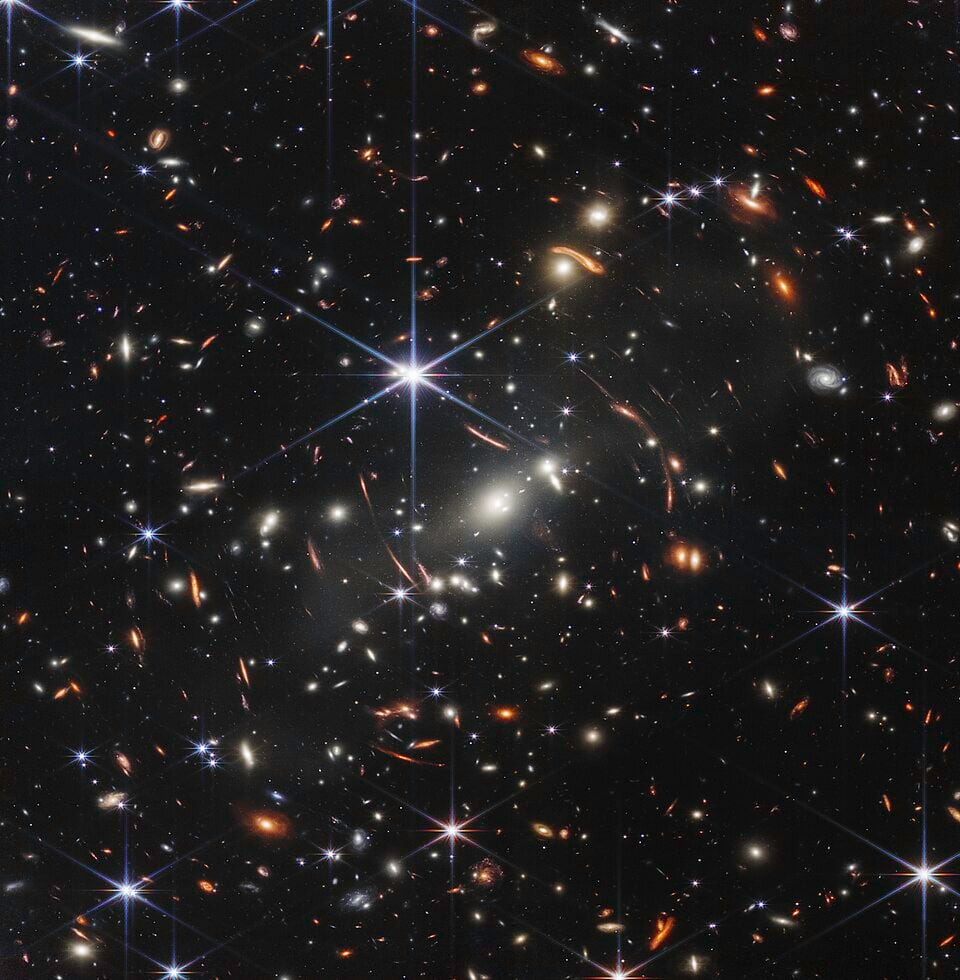
Photo: Webb’s First Deep Field by NASA, ESA, CSA, and STScI – https://webbtelescope.org/contents/media/images/2022/038/01G7JGTH21B5GN9VCYAHBXKSD1, Public Domain, https://commons.wikimedia.org/w/index.php?curid=120346043












 Ad-Free & Subscriber Log-In