

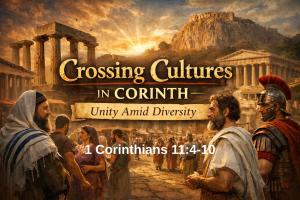
In my last post, which wrapped up my study on the biblical validity of male headship, I examined 1 Corinthians 11:2–3. Now we begin looking at the rest of the passage, verses 4–16, which I maintain deal with “unity, cultural diversity, and distinguishing God’s truth from human tradition.”
Here, we’ll focus on verses 4–10, and the next post will complete a deep dive into verses 10–16. Let’s begin with a bit of background information.
After addressing tensions created by differing levels of knowledge and personal convictions, Paul shifts his focus in this section to cultural differences. He urges the community to adopt a posture of being “non‑offensive” toward Jews, Greeks, and the entire church (which includes every other group within the community).
His deliberate mention of these distinct groups introduces the idea of cultural variation and the need to navigate those differences according to God’s truth.
Above all is God. He is the ultimate source of truth, and his word stands above every other teaching from every other source.
Let’s now move into our focus passage, starting with verse four.
Verses 4-6
At the start of verse 4, Paul addresses the gender distinctions and social customs of that period, recognizing existing conditions without claiming they were the intended norm, or God’s standard for living. He is simply stating the ”what is” according to their world and what is commonly understood of a practice in their current society. What we’ll soon see is that he is actually contrasting human perspectives with God’s perspective. Verse 4 reads as follows:
4 Every man who prays or prophesies with his head covered dishonors his head. 5 But every woman who prays or prophesies with her head uncovered dishonors her head—it is the same as having her head shaved. 6 For if a woman does not cover her head, she might as well have her hair cut off; but if it is a disgrace for a woman to have her hair cut off or her head shaved, then she should cover her head.
—1 Cor. 11:4-6 NIV
This passage could mean a number of different things. Thankfully, determining its exact meaning is not my primary focus. Still, it appears to involve some type of cultural practice that may—or may not—refer to physical head coverings. I, along with many others throughout history, have wrestled with this for quite some time.
Ultimately, unless an ancient source surfaces that sheds more light on the matter, we simply cannot know with certainty what Paul is referring to. Therefore, I will share my thoughts regarding heads, hair, and coverings—not as a claim to be correct, but as a possible way of understanding the text. We’ll now take a closer look at these verses.
Praying and Prophesying?
Let’s begin by breaking down the passage a bit further. First, the words praying and prophesying are religious terms that tend to evoke specific images in our minds. However, it is not necessarily the case that these men and women are in a synagogue or other religious setting, kneeling or bowing their heads with hands clasped, silently or publicly “praying” or “prophesying” to a congregation.
Essentially, to pray means to “earnestly ask,” and the word translated as prophesying means “expounding” or “explaining.” So several scenarios could be in view.
These men and women could be offering vows, teaching, testifying, petitioning a king or other authority figure, begging, giving a rhetorical speech, or engaging in any activity that fits these definitions.
It’s difficult to say with certainty, but restricting the meaning to our modern idea of praying and prophesying may not fit the context and could be hindering a clearer understanding of the passage.
Now let’s discuss these coverings.
Covered Men
Nevertheless, whatever it is they are doing, when the men perform this action “having down over” or “upon” the head—commonly interpreted as “having something down over” or “upon the head,” and further interpreted as having their head “covered”—it brings disgrace to their head or source. This would likely be Jesus the Christ.
Some in the church may have considered this practice idolatrous as it is believed that the Romans traditionally covered their heads as a sign of submission and to avoid distractions when sacrificing to their deities. New converts may have brought this pagan custom into the early church, and this tradition, rooted in idolatry, likely created conflicts similar to the controversy over food offered to idols.
In contrast, Greeks were said to have made sacrifices to their gods with their heads uncovered, and Jewish men did not yet have a standardized or widespread head‑covering practice; the “kippah” developed later. However, that’s not to say that certain Jewish men did not practice covering their heads in certain situations. And so, naturally, there would have been differences in beliefs and practices among the men, and so naturally, this would have caused strife. Next, we’ll look at the women.
Uncovered Women
Now, concerning the women, if a woman performs the same action with her head “uncovered”—a phrase that could refer to several possibilities, both physical and metaphorical—she disgraces her source or head, which is her male guardian.
For some, a head covering displayed modesty, submission, and humility before the gods or in honor of their men, and would therefore have been a necessity. Therefore, a woman with an uncovered head would carry the same shame as having had her hair shorn—a characteristic thought to have been associated with slaves, adulteresses, or even women who would cut their hair in honor of certain goddesses.
This practice, of cutting one’s hair in honor of goddesses or other deities, would have been viewed as idolatrous if brought into the church. Additionally, unbound and “disheveled” hair was associated with female followers of Dionysus (or Bacchus), whose ecstatic worship sometimes involved rejecting normal social restraints, and could have been viewed as an inappropriate “look” for the specific activity in question.
For others, covering the head may have meant an obstacle in the way of their connection with God. Or perhaps, they simply chose to exercise their freedom in Christ by not wearing it. Regardless of the motives,, we can see how these practices could have caused conflict among different groups. But how exactly might they have caused shame or dishonor to their “heads”?
Shaming or Disgracing the “Head”
In Paul’s day, certain vows involved letting one’s hair grow during the vow and then shaving and burning it when the vow was completed—a practice followed by both men and women, secular and non‑secular alike, in both the Old Testament (Num. 6 ) and the New. Paul himself seems to have taken such a vow (Acts 18:18).
Since people taking these vows were required to shave their heads at some point, I can’t imagine Paul himself would have considered that disgraceful. It’s important to note as well, that a slave who was required to have a shaved head or cut hair had no control over her hairstyle.
Paul then, would not be declaring that it is inherently disgraceful for a woman to cut her hair, to have short hair, or a shaved head. So this idea of shame must have come from some man‑made belief among the culture, not from God. This adds weight to the view that Paul is quoting cultural thinking rather than expressing what he himself believes or what God declares to be true.
Nevertheless, the honor‑shame culture of the time was real and couldn’t be ignored. Since a woman’s uncovered head was seen as the same as having her hair cut or her head shaved—both viewed as disgraceful—she was expected to cover it.
I imagine that in that world, just as a child’s conduct reflects the values of their parents, or a student’s actions reflect the teachings of their instructor, a man or woman’s behavior was seen as a reflection of their head or source–whether human or divine.
Their conduct, then, would have been thought to bring either honor or shame upon that originating authority. Any practice that contradicted the principles of that source reflected poorly on it, because the source was not being properly represented and was therefore disgraced.
So it seems that these practices—men having something on their heads and women leaving their heads uncovered during a specific activity—were viewed as actions that ran contrary to the teachings, values, or principles of each one’s “head” or source. As a result, they were seen as dishonoring that source. Yet these judgments were not necessarily grounded in God’s truth.
Let’s now look at verses 7-10.
Verses 7-10
Verses 7-10 read as follows:
7 A man ought not to cover his head,[b] since he is the image and glory of God; but woman is the glory of man. 8 For man did not come from woman, but woman from man; 9 neither was man created for woman, but woman for man. 10 It is for this reason that a woman ought to have authority over her own[c] head, because of the angels.
— 1 Corinthians 11:7-10 NIV
In verses 7–10, Paul continues describing the current beliefs and assumptions held among the people. Apparently, some believed that men, for some reason, were “not obligated” to cover their heads because they thought that men were the image and glory of God.
The Greek word doxa (δοξα), translated as glory in this passage, carries a range of possible meanings. In this context, the sense that best fits is “repute” or “reputation.” Thus, when Paul says that man is the “image and doxa of God,” the idea would be that men function as God’s representative and that their conduct reflects on God’s reputation.
And here we encounter another strong indication that Paul is presenting the views of others rather than stating divine truth. This is because the claim itself is not accurate.
Nowhere does Scripture teach that any regular human being is the image of God, nor does it teach that any human being constitutes an image of God. The fact that verse 7 calls man the direct image of God—seemingly contradicting the Genesis narrative that both male and female were made in his likeness, along with the rest of the Bible—is further proof that Paul is quoting a twisted, self-exalting Corinthian belief.
What the Bible consistently affirms is that humanity—both male and female—was created in or according to the image or “likeness” of God; not that any person is that image in themselves. The following verses support this.
Old Testament
- Genesis 1:26
- Genesis 1:27
- Genesis 5:1
- Genesis 9:6
New Testament
- James 3:9
- Colossians 3:10
- Ephesians 4:24
We are, in some meaningful way, patterned after the likeness of God. But we are not a direct image or an exact likeness of God Himself. Scripture reserves that description for one person alone: Jesus, who is identified as the exact image of God. These verses make this unmistakably clear.
- Colossians 1:15
- Colossians 2:9
- Hebrews 1:3
- 2 Corinthians 4:4
- John 1:18
- John 14:9
- Philippians 2:6
If kephale in this chapter really does mean “source,” specifically the source of an image, as I discussed in my last post, then the proper understanding is that men—within the context of their households—are to reflect the character of Christ, and Christ is their source. But they are not the image of God—Christ is. This may be why Paul had to state this point plainly at the beginning.
- 1 Corinthians 15:49
By contrast, because a woman was seen as the glory, or doxa, of a man, for some reason, her head should be covered during the specific activity mentioned. The reason behind this belief was the one-sided thinking that a man did not come from a woman, but a woman came from a man, and that a man was not created for the woman, but a woman was created for the man.
The ideas expressed here don’t even sound godly; they come across as yet another instance of human self‑glorifying interpretation. And that’s exactly what they are—people from an earlier time doing the same old self‑exalting things humans have always done.
It seems the Corinthians may have twisted or reshaped a teaching to make themselves (the men) appear more important before God. They must have believed—just as in our culture today—that being ‘first’ in succession made one more important.
But Jesus taught that the first would be last and the last would be first (Matt. 19:30). If you insist on being ‘first’ in authority simply because you came ‘first’ physically, you also take on the responsibility to serve others, making yourself of lesser importance. In God’s view, being “first” calls for humility and service rather than ruling and power.
Nevertheless, because this belief existed within that time and society, and because of the risk that her “source” might be viewed as disgraceful, it behooved a woman “to have exousia on or over the head.”
Many translations understand “the head” here—perhaps rightly—as referring to her own head. Thus, the woman was to have exousia, meaning “power, authority, freedom, or control” over her head. Others, however, take this to mean a symbol or sign of authority upon her head.
Whatever the correct meaning, the Corinthians deemed this practice necessary for the acts of “earnestly asking” or “expounding,” because of the angels; not because Paul or God required it. Next, we’ll explore possible meanings of the phrase “because of the angels.”
Because of the Angels
Next, regarding the statement about “angels,” I am fully convinced that we have no influence over God’s heavenly angels—certainly none to lead them into sin. Nor are we in any position to instruct them, as some teachers suggest. We can barely manage to educate ourselves, and teach other human beings let alone divine ones.
And no, a woman does not “disappoint” the angels in heaven if she chooses not to wear a head covering—that idea is simply ridiculous.
That said, I am 99% sure that “because of the angels” (διὰ τοὺς ἀγγέλους) refers to human angels—meaning “messengers” or “announcers”—not divine heavenly angels, as is often assumed. In fact, it could refer to messengers such as Paul, the other apostles, or those who delivered the epistles and publicly read them to the church.
Whatever the purpose of the coverings, they were “on account of the messengers”—meaning that, for some reason, this particular practice, whatever it involved, was carried out for the sake of these messengers—perhaps regarding some practical concern.
In any case, there is no compelling reason to think the word αγγελους refers to divine angels, apart from our tendency to see the word “angel” and immediately assume that meaning.
Another possibility—and the one I’ve come to lean toward—is that the word “messengers” here refers to spies or agents sent to observe and report back to the authorities over the land. Such observers were common in ancient kingdoms, where rulers often sent agents to monitor public behavior.
One could imagine a strong presence of these overseers—known in Greek as episkopoi—in a major commercial hub like Corinth.
What’s more, is that the word translated as “spies” in James 2:25 is the same word αγγελους used in 1 Corinthians 11:10.
In the same way, was not even Rahab the prostitute considered righteous for what she did when she gave lodging to the spies and sent them off in a different direction?
— James 2:25 NIV
Depending on the context, αγγελους can take on different meanings. However, the word itself simply means “messengers.”
It’s also possible that these “messengers” were individuals sent from Jerusalem to observe and support various ministries—similar to when Barnabas was sent to Antioch (Acts 11), or when certain men came from James, causing Peter to act hypocritically out of fear, likely, of what they might report back to headquarters (Gal. 2:11–21).
Another possibility is that these “messengers” resembled the ones mentioned in Galatians 2:4—people who slipped in secretly to spy on the believers’ freedom and attempt to bring them into bondage through man‑made doctrines. According to the text, their presence ultimately led to a significant dispute, requiring Paul to present his gospel before the leaders in Jerusalem.
It’s easy to see, then, why the Corinthians would have wanted to avoid this if they could. But the main point is that the women were simply following social norms to prevent any adverse actions that might result from these messengers noticing anything out of the ordinary. It wasn’t a command from Paul or God, but a practice of the people.
As we wrap up this section, let’s review a few key takeaways.
Key Takeaways
So, in a nutshell, what we see in Corinth is a situation where culture clashes with truth. In that society, it was believed that if a man performed a certain action in a particular way, he brought disgrace upon his head or “source,” which would be Christ. Likewise, if a woman performed the same action in a different manner, she was thought to disgrace her source, or male guardian.
Because a woman was believed to have come from a man—and not the other way around—she was expected to have something on her head indicating authority or control when “earnestly asking” or “expounding, whatever the precise nature of these activities may have been.
Without this, she was seen as bringing shame upon her source (which I now believe clearly points to the origin of an image).
The concern was that if certain messengers observed her engaging in these activities in a socially unacceptable manner—without this covering—they would report these social offenses, which would reflect negatively on her male guardian. For this reason—because of the messengers—a woman was to follow this custom.
Again, this is simply my interpretation of the text, not a definitive conclusion. There are several other ways to understand it, but I believe I’ve captured the general idea. However, what we can be confident about is that these statements are not Paul’s own views, because in the very next section he nearly overturns everything said in the previous verses, showing that he is correcting human‑made ideas.
In fact, as we will see, Paul explicitly states that he and the other churches of God have no such practice (1 Cor. 11:16).
In the next post, we’ll examine verses 11–16.











 Ad-Free & Subscriber Log-In