


How Confirmation Bias Affects Our Interpretation of the Bible
The “Proverbs 31 Woman” Comes in Many Forms
The final chapter of the book of Proverbs describes the “virtuous” woman, often cited as the ultimate role model for Christian women. The passage describes a woman who is an entrepreneur and community leader, in addition to being committed to her home and family. Despite this, the “homemaker” persona appears to be the predominant view when discussing the “Proverbs 31” woman.
For reference, here are some excerpts:
10 A wife of noble character who can find?
She is worth far more than rubies.
11 Her husband has full confidence in her
and lacks nothing of value.
12 She brings him good, not harm,
all the days of her life.
15 She gets up while it is still night;
she provides food for her family
and portions for her female servants.
16 She considers a field and buys it;
out of her earnings she plants a vineyard.
17 She sets about her work vigorously;
her arms are strong for her tasks.
18 She sees that her trading is profitable,
and her lamp does not go out at night.
19 In her hand she holds the distaff
and grasps the spindle with her fingers.
20 She opens her arms to the poor
and extends her hands to the needy.
21 When it snows, she has no fear for her household;
for all of them are clothed in scarlet.
22 She makes coverings for her bed;
she is clothed in fine linen and purple.
Much of what we have been presented with as “biblical” is really based on cultural interpretations of the text. Confirmation bias also plays a role in this. The person who believes women should stay home will find support for that in Proverbs 31 while completely ignoring the verses above that describe a shrewd businesswoman. Allowing our own preconceived notions to prevent us from properly interpreting the Bible can have devastating consequences, including limiting girls from fulfilling their potential based on misinterpretations of what the Bible actually says.
Women have been trailblazers in all spheres of life, including medicine and healthcare in general. As a physician and author, I have a special interest in early women physicians who paved the way for other women to become doctors.
Women Trailblazers in Medicine
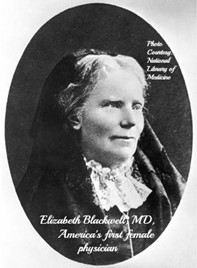
Elizabeth Blackwell (1821-1910)
Elizabeth Blackwell was the first woman in the U.S. to obtain a medical degree. Elizabeth had initially been repelled by the idea of studying medicine but changed her mind after a close friend who was dying suggested that she would have been spared her worst suffering had her physician been a woman. Elizabeth attended Geneva Medical College in New York, after being rejected at other schools. When she applied, the Dean, hesitant to accept a woman, had asked the 150 male medical students to vote on the issue. If one student had voted “No,” Elizabeth would have been barred from admission. Apparently thinking it was a joke, the students voted unanimously to accept her, only to be surprised when she arrived at the school, ready to begin her studies. Dr. Blackwell graduated in 1949 and went on to support medical education for women. She wrote several books addressing the issue of women in medicine, including Medicine as a Profession for Women and Pioneer Work in Opening the Medical Profession to Women.
“It is not easy to be a pioneer — but oh, it is fascinating! I would not trade one moment, even the worst moment, for all the riches in the world.”
-Elizabeth Blackwell, MD
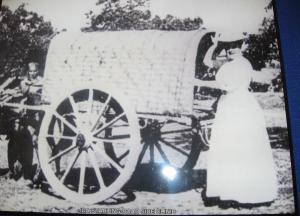
Ida Sophia Scudder (1870-1960)
Ida Scudder was born in India to American missionaries. Her father and grandfather were medical missionaries, and she was determined not to follow in their footsteps. She came to the U.S. to study and then, while visiting her parents in India after her graduation, she had a life-changing experience. In one night, three men had come separately to ask her to help their wives who were in labor. Ida could not help them due to her lack of medical training at the time and due to the local customs, they would not allow her physician father to treat their wives. All three women died that night, essentially for lack of a female physician. Ida took this as a call from God and decided that she would become a doctor and return to India to help the women of that country. She graduated from Cornell Medical College in 1899, part of the first class that accepted women. After graduation, she returned to India and started roadside dispensaries, a nursing school and eventually, a medical school to train female doctors. The school later became known as the Christian Medical College (CMC) and started accepting men in 1947. Today, CMC is ranked one of India’s top medical schools and offers numerous courses in medical, nursing and allied health professions.
Not Everyone is Called to Follow a Traditional Path
The Proverbs 31 woman and women like Elizabeth Blackwell and Ida Scudder are role models for all of us – men included. Elizabeth Blackwell and Ida Scudder did not get married or have biological children, yet we remember them for their contributions to society and for paving the way for others, especially other women. No one would argue that they somehow did not fulfill their life missions. I hope others will be inspired by these stories to follow their own unique path and not to allow society’s artificial limitations to get in their way.
Girls Become Doctors and Much More – Inspiring Stories of Women in Medicine
Drs. Blackwell and Scudder are some of the many women physicians featured in my forthcoming book,
Girls Become Doctors and Much More – Inspiring Stories of Women in Medicine, which will be available in September 2025.












 Ad-Free & Subscriber Log-In