

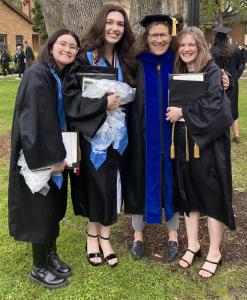
We are weeks away from the hardest part about being a college professor: the commencement. Mixed with the excitement of a year’s end—and a summer’s reprieve from grading—is the realization that the young people you’ve learned to know and love are now stepping away from campus and into the world, beginning a life for which you’ve spent up to four years preparing them. I’m always happy for my students and eager to celebrate this accomplishment, but I’m also really sad.
Every. Single. Year.
Saying goodbye to this crop of seniors feels especially fraught. So many amazing students graduating this year, so many talented and thoughtful and smart people who have changed me for the better. Yet they are entering a world that feels so dark, so unsettled and chaotic. And I wonder: how do I give these young people hope about the future when I so often feel despair? When I have so many questions about what tomorrow might bring? When I wonder whether justice and love and goodness will prevail?
The Hard World Graduates Have Known
These young people have experienced so much more turmoil than I ever did, coming of age in the 80s. Sure, there was bad stuff happening, but I never worried that my own government’s leaders would burn down the world for want of more wealth and power. Or that they would lie so freely, knowing the truth—about anything—would seem impossible. Sure, Ronald Reagan (the president back then) had his problems, but he wasn’t picking fights with the pope. At least not publicly.
The students graduating this year were pre-adolescents when President Donald Trump came down his golden escalator and began spewing hateful messages. For the past decade and more, the entire span of their teenaged lives, they’ve listened to his venom, watched the coarsening of civil discourse, witnessed Christian leaders praise a president who has been credibly accused of raping women.
These students have lived through several “unprecedented” world events—so many, they must be tired of the word unprecedented. They were in the early years of high school when Covid struck, sending them home for months, years in some cases, to learn through Zoom. That experience had to change them, as did their arrival at college just as Covid restrictions were easing. Even though George Fox stayed open during the pandemic, we were scarred in some ways by the necessary precautions that kept us safe, but cost us all a sense of normalcy and security. (Never mind that vaccines and masks have become remarkably political now, markers of where one stands regarding science.)
These students have never known a world without gun violence and the threat of active shooters entering their classrooms. They were in early elementary school when a gunman entered Sandy Hook Elementary and gunned down children their same age. They’ve only known active shooter drills. They’ve never attended a college classroom that didn’t have special locks on the doors, intended to keep out potential shooters.
They’ve also spent their entire young lives navigating social media. They grew up on Instagram and Snapchat and TikTok, and most don’t know what it’s like to travel through the world untethered to social media. Most walk across campus with their heads buried in their phones. Few know what it’s like to spend the moments before class starts talking to their classmates rather than scrolling through feeds. They’ve been victimized by social media companies who get them addicted, tell them how they should look and feel, shape the way they see others—and themselves.
Facing the Hard World with Hope
And now, they are headed out into a world beset by challenges, thanks in part to a president who has ignored economic wisdom about tariffs, and who started an unnecessary war that raised prices even further. Being able to earn a sustainable wage is more difficult than ever before; insurance and rent costs are sky-high. While corporations and billionaires continue to get wealthier, everyone else suffers, and the income gap is widening, with the top 1 percent of people in the United States hoarding 31 percent of the wealth.
When I consider this year’s graduating class, I want to hold them close and apologize for the world we are giving them—a world that feels so much more hostile and bleak than when I walked across the graduation stage in 1990, unsure about where I was headed. At the time, I longed for guarantees that the next phase of life would go well for me, but no one could assure me that life would turn out okay. It did, turn out okay that is, though Anne Lamott reminds me that we are guaranteed nothing in this world, save for the moment and the imperfect love of others. I’ve had that, in spades.
So I want to offer my imperfect love to the students who are graduating into a world without guarantees. What I will remember best about this graduating class is their resilience in the face of so many unprecedented events. And their creative spirits, a rebuke of the technology that has dehumanized us all in so many ways. And their rapier wit, which shows up in their social media accounts, in their writing, in their classroom interactions. And also, their deep, abiding faith, a model for how I want to believe, too.
I’m so grateful for the work I get to do, for the chance to meet and learn from remarkable young people. I hope the world they graduate into will cherish them in ways they deserve.











 Ad-Free & Subscriber Log-In