
Almost three years have passed since the May election in my hometown that began to reverse the destructive course of our local school board. Through a series of events, including an election in 2021 and the resignation of progressive school board members, the Newberg-Dundee School Board had an alt-right majority who made numerous disastrous decisions, forcing educators to flee and decimating the district budget; crafting racist policies that made national news; inviting multiple lawsuits with their illegal actions.
In the name of “keeping politics out of schools,” that board made countless political decisions, and as a result, our community’s children suffered, especially those already on the margins: Black and brown children, those who identify as LGBTQ, those who face emotional or mental challenges.
But in May 2023, five of the seven school board members were voted out, re-orienting the school board toward reasonable policies and bringing some much-needed stability to a school district rocked by controversy and chaos. Still, enough damage had been done in those two years of mismanagement that the schools will take years to recover.
Although I’m easily annoyed by sports fans who shout “We Won!” when they had nothing to do with a victory, save maybe yelling at the television, in the case of the Newberg School Board, the we was literal. We Won! So many people put aside their ideological differences to support school board candidates who themselves had ideological differences. So many people provided time, money, and emotional energy. So many people walking Newberg and Dundee streets every weekend for months, knocking on doors, talking to voters, building a coalition that could withstand the river of disinformation that had polluted our community and had eroded trust in our neighbors and our important institutions.
Over the last few months, I’ve been thinking a lot about those years between 2021-2023, what unfolded in my community, and how hope ultimately triumphed here. I’m writing a book about what I witnessed, tentatively titled Whatever is True: A Small Town, A School Board, and Hope for Our Country’s Future. The book will be published by Fernwood Press, due out next spring.
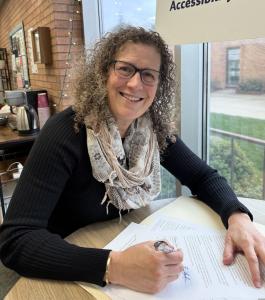
In my book, I narrate my town’s experience when Christian nationalists dominated our school board, and how what happened here mirrors what is unfolding in communities across America—and in America itself. Christian nationalists are using religious rhetoric as a cover for their white supremacy, consolidating power, trying to create a country that aligns with their narrow vision of America, one where whiteness and wealth reigns, and where diversity and pluralistic ideologies are suppressed.
We’ve seen the fruits of Christian nationalistic ideology play out nationwide. Recently, right-wing influencers have proclaimed Donald Trump the “most Christian president ever” because he read scripture from a teleprompter. They’ve claimed that he is “bringing God back to America.” Government social media posts about God blessing America often include pictures of white families at church, at picnics, at home—messages about a vision of America that excludes those who are not white, not Christian, not heterosexual. At the Pentagon, Secretary of Defense Pete Hegseth prays to a wrathful God who smites enemies and who endorses “maximum lethality,” advocating for a holy war against Iran. His is a Christian nationalist’s plea to a Savior who looks nothing like the Prince of Peace I love and serve.
In my hometown, school board directors read from their Bibles during meetings. They talked about their love for God and the American flag, sometimes conflating the two. They passed unlawful policies banning Black Lives Matter and Pride flags from any classroom. They canceled the district’s anti-racist policies, and hired a superintendent who’d already been fired from another district for racist Tweets. They caused significant suffering in the name of a Savior who looked nothing like the humble servant I know from the Gospels.
My book ends on a hopeful note, because again, we won. People who practice neighbor love and community are an antidote to the destructive, divisive, and hierarchical ideology of Christian nationalism. In Newberg, people with diverse beliefs found each other, developed systems of advocacy, and worked hard to change the school board. Those avenues for support, now more firmly in place, are working to keep neighbors safe during immigration enforcement raids in Newberg, and to assure those experiencing houselessness in our community also have resources to survive.
More broadly, in places like Minneapolis and Portland and Chicago, it’s people providing care for others that gives me hope that Christian nationalism will not survive in the United States. This kind of neighbor love reflects the truest nature of Christ and his ministry, and affirms that all people, bearing God’s beautiful image, are worthy of safety, love, joy: all the qualities that have the potential to make America, and all of our communities, great.









 Ad-Free & Subscriber Log-In