

A few days ago as I walked onto campus I was struck by a distinctive scent wafting on the breeze. Somewhere on the olfactory spectrum between a pristine pine forest and an overpowering air freshener hanging on the rear-view mirror of a car, this scent had rotting organic material tones, with the tangy hint of chemicals. “I love the smell of mulch in the morning! Spring has actually arrived!”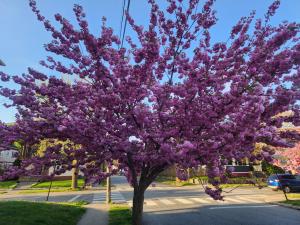
There are a number of interesting sights as well as smells that accompany the arrival of spring. Later that same day, I saw a squirrel hanging upside down by his back feet from the top of the metal shepherd’s-crook pole that holds several bird-suet cages on our side lawn, using his front paws to open the latch on one of the cages for a free lunch. Our blue spruce that the feeder is underneath makes it easy for an enterprising squirrel to leap to the feeder from the closest branch. Amazing what some people will do for a taste of bird seed embedded in blocks of greasy suet.
This means that it is time to start getting the yard in shape—one of my favorite projects of the year that I intend to attack with fervor as soon as the daily high temperature is a bit highter than 50 degrees. I use the word “yard” loosely, since we live in the city and our available land is postage-stamp size, comparatively speaking. That’s fine with me—we have lived here for thirty years and I am regularly grateful that it takes no longer than twenty minutes to mow the lawn, back, front, and side. I have little interest in a luxurious, weed-free lawn. Indeed I suspect that in the height of summer at least one-half of our lawn is covered with what those in the know would call weeds. But the lawn is green, and that’s all I care about.
What I do care about is flowers. I had no idea how much pleasure there is to be found in the annual cycle of cleaning flower beds in late March and April, watching lilies, tulips, columbines, and peonies poke their heads through the dirt despite having as much as six-foot snow banks on top of them during the winter (more than that this past winter). I keep a sharp eye out for the first leaf and flower buds on the flowering cherry tree, roses, and hydrangea bush in front, as well as the blackberry and lilac bushes in the back. I inspect each potential bud-producer every day and take it very personally when no progress is evident.
The process has been entirely trial-and-error over the years; assorted azaleas and hydrangea bushes have failed to make an appearance in given springs, tulips and daffodils have tended to be a disaster, leading to digging up last year’s remains and replacing them with something that might possibly do better. The perennials and flowering bushes we presently have are survivors of Morgan’s version of natural selection—if you don’t show up when I think you should, you’re out. The plants that have survived both my impatience and incompetence over the years are hardy enough to survive the toughest winter, even the now legendary Blizzard of 2026 a couple of months ago.
I’ve learned a few things over the years, of course—loosening the flower beds and working in bags of shit from Lowe’s (really—they contain manure), then covering with a layer of mulch is a stimulant for growth and a deterrent for weeds. The primary purpose of the mulch for me, of course, is to get high on the aroma. I never seem to buy enough bags, though, and always have to make another trip to purchase three or four more.
Luke’s gospel tells the story of a land owner who had as little patience with his plants as I have with ours.
Then he told this parable: “A man had a fig tree planted in his vineyard; and he came looking for fruit on it and found none. So he said to the gardener, ‘See here! For three years I have come looking for fruit on this fig tree, and still I find none. Cut it down! Why should it be wasting the soil?’ He replied, ‘Sir, let it alone for one more year, until I dig around it and put manure on it. If it bears fruit next year, well and good; but if not, you can cut it down.'”
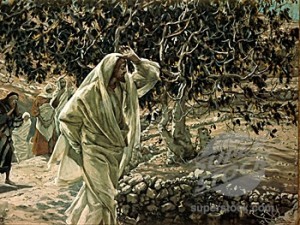 Jesus must have had a bad experience with fig trees as a child; Holy Week Monday a few weeks ago is the day that Jesus killed a fig tree for failing to bear fruit, even though it was not even the season for fig-bearing. He probably was in a bad mood because he knew what was coming in a few days.
I completely understand the impatience of the fig tree owner. There is no room for fruitless and flowerless plants in my yard—no slackers allowed. But the fascinating part of the parable is the remedy suggested by the gardener, the resident expert, for the figless tree. He says “Let me disturb it at its roots, throw some crap in there, and I’ll bet it will start producing!” That’s generally the suggested solution for any recalcitrant plant. Cut it back to the ground, lop its branches indiscriminately—in short, do things to the plant that any sensible person fears will kill it, then wait and see what happens.
It seems to be a truism in almost all everything I’ve ever read about spiritual growth that such growth is impossible without conflict, pain, suffering, and violence. The great and extraordinarily difficult philosopher Georg Friedrich Wilhelm Hegel observed that “periods of peace are blank pages in the book of history.” I want to know why. Of course, the classic expression of this problem is “Why do bad things happen to good people?” and, more problematically, “Why do good things happen to bad people?”
But I’m not that concerned about why human beings have to suffer and struggle—this is such an obvious feature of the human landscape that it hardly seems worth asking about. I’m more interested in what to make of a creating being who presumably had infinite options when choosing the guiding principles and template for the world to be created, and chose to do it in the most open-ended and messy fashion imaginable. This is not a world created with efficiency in mind.
In her fascinating and eclectic memoir Wild Harmonies, classical pianist and dedicated environmentalist Hélène Grimaud writes that “we can be essential only when we are suffering. It encourages us to remain honest.” I think most of us would appreciate being given a shot at living essentially and honestly without suffering, but we don’t get that chance. Instead we get to do it as plants do it, through productive seasons and dormant, through times when even we are astounded by our beauty as well as those times when even the most generous observer would swear that we are dead.
In a charismatic church I attended many years ago in a previous lifetime, we often would start the morning service with an annoying song based on Psalm 52:8.
Like a tree, like a tree, I’m like a green olive tree
In the house, in the house of the Lord.
I will trust in the mercies of God forever,
I will trust in the mercies of God.
I’ve never heard such a song about being a fig tree.













 Ad-Free & Subscriber Log-In