


Great events in history do not emerge from nowhere. They come out of the events which came before them, building upon them, expanding upon them, making something new out of them. Similarly, great people do not come out of nowhere. They come from all those who preceded them and all that happened before they lived. All history, all humanity, is interconnected. Great events come out of lesser events, building upon them, making those lesser events important even if we forget them. Likewise, the people involved in those lesser events are important as they they helped prepare the way for those who came after them. Indeed, some of them would have been deemed as great except someone greater, someone far more extraordinary emerged during their lifetime, eclipsing them. This, of course, is true with salvation history; in it, we find not only many lesser people and events preceding Christ, we find many great events and people as well. They all prepared the world for Christ, with one of those predecessors being alive during Christ’s life, that being John the Baptist:
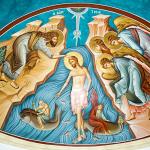
John the baptizer appeared in the wilderness, preaching a baptism of repentance for the forgiveness of sins. And there went out to him all the country of Judea, and all the people of Jerusalem; and they were baptized by him in the river Jordan, confessing their sins (Mk. 1:4-5 RSV).
John, and his greatness, received great amounts of attention by his contemporaries. His greatness was certainly Jewish in nature as he took upon himself and developed a Jewish ritual, making it something new as it became a hallmark of his own ministry. Yet, those who saw or heard him saw something amazing, something new, emerging with him. It is hard for us to understand how much of a shock to the system he must have been. He followed the path set up by the prophets who came before him, criticizing the authorities and their abuses even as he warned everyone else that they must also make straight their way so that they could be ready for the kingdom of God. He made it clear that everyone should attune themselves to God and God’s justice. But, however great he was, he knew he was just a messenger, and his greatness lay in the way he fulfilled that task:
As it is written in Isaiah the prophet, “Behold, I send my messenger before thy face, who shall prepare thy way; the voice of one crying in the wilderness: Prepare the way of the Lord, make his paths straight” (Mk. 1:2-3 RSV).
John was phenomenal, but he knew that he was a mere messenger, and people should not put their focus on him. He wanted people to be ready for Christ. Were he alive at any other time, he would have been the most remarkable man of his time, and certainly, many viewed him as such as we can see the way his contemporaries remembered him, and in the way some sought to follow him long after he died, forming their own religious tradition around him. He, and his prophetic calling, was a necessary precondition for the incarnation; though great, he, like everyone else, could only be seen as someone who was less than the one he knew was to emerge, the incarnate God-man, Jesus. He wanted people to be open to the Spirit, and the grace of the Spirit, which he believed was to come among them, given out by the one who he knew was about to be revealed to all:
Now John was clothed with camel’s hair, and had a leather girdle around his waist, and ate locusts and wild honey. And he preached, saying, “After me comes he who is mightier than I, the thong of whose sandals I am not worthy to stoop down and untie. I have baptized you with water; but he will baptize you with the Holy Spirit” (Mk. 1:6-8 RSV).
John’s message worked; many came to him, repented of what they had done. They were ready to change and become better. They were ready for God to work in and with them. He knew what God could do because he, while in his mother’s womb, had the Holy Spirit come upon him. He saw the way God directed him and hoped others could be inspired similarly. But he knew it was up to God; he could not give what he had been given to others. He could only help people repent and change, establishing the character they needed to welcome the Spirit in their own lives.
Now, we find ourselves waiting for the second coming of Christ, and with it, the eschatological judgment. That is, we await for the final event of history. As long as history continues, people have the chance to receive the Holy Spirit and let it sanctify them, helping them experience, in part, the eschatological glory. All they need to do is embrace it, following its prompting, and if they do so, they will find their lives are full of significant events which, even if they do not appear great in history, are great, as they will help inspire other, greater events, some which are greater than they could ever imagine. Only in the eschaton will the true nature of all the events of history be revealed to all. Thus, like Paul, we must recognize, if we follow the Spirit and engage it properly all our lives, we will see the fruit of our actions in the eschaton:
I have fought the good fight, I have finished the race, I have kept the faith. Henceforth there is laid up for me the crown of righteousness, which the Lord, the righteous judge, will award to me on that Day, and not only to me but also to all who have loved his appearing (2 Tim. 4:7-8 RSV).
Our lives, as they are a part of temporal history, might often seem pointless; but the reality is they matter; what we do matters, and what we do helps establish what comes next in history. While we might not know how or why, we should believe that our contribution to world history is important, helping to shape what comes next, not only in time, but in eternity itself.
Stay in touch! Like A Little Bit of Nothing on Facebook.
If you liked what you read, please consider sharing it with your friends and family!
N.B.: While I read comments to moderate them, I rarely respond to them. If I don’t respond to your comment directly, don’t assume I am unthankful for it. I appreciate it. But I want readers to feel free to ask questions, and hopefully, dialogue with each other. I have shared what I wanted to say, though some responses will get a brief reply by me, or, if I find it interesting and something I can engage fully, as the foundation for another post. I have had many posts inspired or improved upon thanks to my readers.








 Ad-Free & Subscriber Log-In