


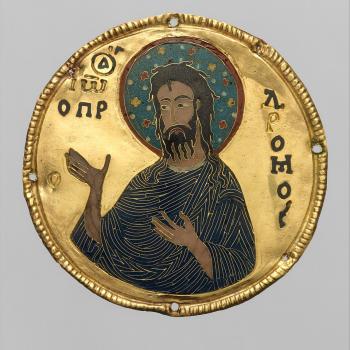
John the Baptist had fulfilled his primary role in the drama of salvation. He had prepared the way for Jesus. He had baptized Jesus. Was that the end for him? While he knew he must “decrease,” he also knew, so long as he lived, he would have more to do. No one’s work is done before they are dead. There is always something more to do or experience. John was a prophet and he had to continue to walk the path of the prophets to the very end. He had to continue to shine a light on the evil undercurrents of society. He continued to fight against the powers that be. And, because of what he said and did, his life would eventually be taken from him. However, during this time, he found himself dealing with another struggle, this time within himself. While he knew his role, and he thought he had fulfilled it, things were not going as he expected. Doubts started to cross his mind while he was in prison. What was Jesus doing? John sent some of his followers to ask Jesus what was going on.
Jesus knew all of this. When John was taken in by the authorities and imprisoned, he knew that John’s time was coming to an end. He knew John would continue to play his part, but he also knew it was a sign for him to act, to begin his own ministry:
Now when he heard that John had been arrested, he withdrew into Galilee; and leaving Nazareth he went and dwelt in Capernaum by the sea, in the territory of Zebulun and Naphtali, that what was spoken by the prophet Isaiah might be fulfilled:
“The land of Zebulun and the land of Naphtali, toward the sea, across the Jordan, Galilee of the Gentiles — the people who sat in darkness have seen a great light, and for those who sat in the region and shadow of death light has dawned.”
From that time Jesus began to preach, saying, “Repent, for the kingdom of heaven is at hand” (Mk. 4:12-17 RSV).
Seeing John have his light diminished and then snuffed out, Jesus knew it was time for him to take over and shine another, greater light, the light which came into the world to overcome all the darkness. While John’s light was one which he had received from God, for Jesus, it was his own very light. And yet, so long as John was alive, even in prison. he knew he had to continue his ministry, even if what he had to do was less than before. He still had followers. They still listened to him and did as he asked. Until the very end, John continued his ministry, even knowing that Jesus had begun his. He knew the two could co-exist. And in this way, John represents to Christians the way the Jewish faith can and continues to have its own mission. The Jews were chosen by God. They had a special mission. That mission continues, perhaps in a new way, but it is still the same mission. They still have and engage the grace given to them. They still have a role in world history. John, by continuing his mission and ministry all the way to the end shows us the error of replacement theology. That God inaugurated something new in Jesus does not mean all those who came before him lost what God had given to them.
If we question this, all we have to do is see how Jesus began his ministry and we will see he reaffirmed what John had prophetically announced: the kingdom of heaven is at hand. However, he meant something more, something different, than John because in himself the presence of the kingdom of God had come into the world. He was God incarnate; the kingdom of God as with and in him. All those in his presence would find themselves next to the kingdom of God. The kingdom is literally was at hand! It is not a kingdom established by any worldly authority; indeed, it has no beginning because the kingdom of God is eternal, found in and with God’s eternity. The kingdom of God is where we come from. It is where we reside. It is all around us. It is in us, even as it comes to us in the person of Jesus, allowing us to put a face to it. We have lost sight of it because of our sins; they block our vision of it. This is why we must repent. This is why we must change our ways. We must clear away all the barriers we have put up which keep us from experiencing the kingdom of God. Now that God has personally come to us, now that God has given us another way to engage the kingdom, if we repent, if we experience true metanoia, we will able to see and experience the kingdom of God for ourselves. We will see Christ, not only beside us, not only in others, but in ourselves. We will see the kingdom of God connects all things and makes them one (in Christ). Thus, if we open ourselves to Christ, we will receive all kinds of grace, grace which will help us to act but also to understand our place in the kingdom of God:
But grace was given to each of us according to the measure of Christ’s gift. Therefore it is said, “When he ascended on high he led a host of captives, and he gave gifts to men.” (In saying, “He ascended,” what does it mean but that he had also descended into the lower parts of the earth? He who descended is he who also ascended far above all the heavens, that he might fill all things.) And his gifts were that some should be apostles, some prophets, some evangelists, some pastors and teachers, to equip the saints for the work of ministry, for building up the body of Christ, until we all attain to the unity of the faith and of the knowledge of the Son of God, to mature manhood, to the measure of the stature of the fulness of Christ (Eph. 4:7-13 RSV).
We must engage Christ. We must engage the kingdom of God, not only as it is within us, but in the way it is found all around us. We must look and see how it has come to us in person . As we open ourselves up to more and more grace, when we cooperate with more and more grace, allowing its potential to be actualized, we will apprehend more and more of the kingdom of God, seeing how expansive it is. We will not try to imprison it by limiting it to the concepts and ideologies which we make for it. We will glorify in its expanse and in the way it transcends all human conventions that seek to limit or control it. We will rejoice when we see it active, not just in us, but in others, even in, especially in, those who we have often thought are outside it as they fulfill their roles in history.
Stay in touch! Like A Little Bit of Nothing on Facebook.
If you liked what you read, please consider sharing it with your friends and family!
N.B.: While I read comments to moderate them, I rarely respond to them. If I don’t respond to your comment directly, don’t assume I am unthankful for it. I appreciate it. But I want readers to feel free to ask questions, and hopefully, dialogue with each other. I have shared what I wanted to say, though some responses will get a brief reply by me, or, if I find it interesting and something I can engage fully, as the foundation for another post. I have had many posts inspired or improved upon thanks to my readers.








 Ad-Free & Subscriber Log-In