


The Thrill of the Trilliums
A Sign of Spring
‘Tis the season! Spring has finally … hopefully … arrived in the Ohio Valley. On Saturday, Marty and I took a ride through wooded areas around our home to look for trilliums, a special treat each spring. Although trilliums used to cover much of the hillsides on either side of our road, homes have been built and floods have come through, and, sadly, many of our trilliums have disappeared. We did, however, find several areas of woodland along our drive where the lovely white flowers are still abundant.
What is a Trillium?
You may have seen trilliums before and not realized what you were seeing. Also known as “Wake-robin” or “Birthroot,” they grow naturally in woodlands throughout much of the United States and Canada. These distinctive plants are easy to recognize if you are looking for them. They have a whorl of three leaves, topped by a single flower that has three petals and three sepals.
According to the Ohio Department of Natural Resources, “Ohio can claim eight native trilliums, each as stunning as the next. Some species are common and occur statewide, such as the large-flowered trillium (Trillium grandiflorum), our state wildflower. Others are imperiled rarities, like the endangered painted trillium (T. undulatum), only known from a few sites in Ashtabula County. One species, the nodding trillium (T. cernuum), is presumed extirpated and its presence in Ohio is based on a single specimen seen in 1879.
“Our native trilliums come in a variety of ‘flavors.’ All grow in forest and woodland habitats, but each can vary widely. Some prefer the well-drained calcareous soils of upland woods, while others enjoy moist acidic habitats. Depending on the species and location, trilliums begin blooming as early as late February and as late as May.
“Like many other spring ephemerals, their seeds are actively dispersed by ants. Known as myrmecochory, the ants are attracted to little fleshy structures on the seed called elaisomes. The ants gather the seeds and carry them back to their colonies where they eat the elaisomes because they contain lipids and amino acids. When done, ants discard the seeds to potentially germinate and become new trilliums.”
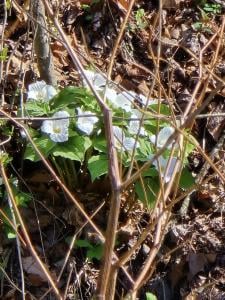
Symbolic, Endangered Trilliums
I like the use of the word ephemerals in that paragraph. Ephemeral means “lasting a very short time.” This is true when referring to the blossoms. However, the plants themselves may grow to great old age. They are very slow-growing and might take up to ten years to produce their fleeting blossoms. When one finds an entire hillside covered with them, it deserves taking some time to admire and appreciate.
With that in mind, one should know that picking trillium flowers can damage or even kill the plant. Picking trilliums is generally discouraged as they are listed as a threatened or endangered species. Environmental factors, deer and other animals that eat them, and people who help themselves to them are a yearly threat. In some places, it is even against the law to pick trilliums.
Trilliums are named for the Latin word for three. The plants have three leaves, three petals, three sepals, etc. In it one recognizes the Christian tradition of the Trinity-the Father, the Son, and the Holy Spirit. Trilliums have also been used to symbolize early spring, personal growth, and untamed nature, frequently evoked through themes of vulnerability, transformation, and environmental connection. Renowned poets like Mary Oliver and Louise Glück use trilliums to explore themes of childhood, memory, and the “earth-talk” of spring.
From “Variations on an Elizabethan Theme
By Edgar Bowers
Once I endured such gentle season.
Blood-root, trillium, sweet flag, and swamp aster—
In their mild urgency, the reason
Knew each and kept each chosen from disaster.
Luke 12:27
Consider how the wild flowers grow. They do not labour or spin. Yet I tell you, not even Solomon in all his splendor was dressed like one of these.
God bless you!











 Ad-Free & Subscriber Log-In