

The famous words, “What I hate, that I do,” along with “Oh wretched man that I am!” are expressions of exasperation. They come from the person who despises doing wrong but can’t stop doing it in Romans 7:7–25. Scholars identify this passage in Paul as “the divided I.”
It reflects the human dilemma of knowing what is right but unable to do it—the person is enslaved to sin. Vice and addiction control them.
Is Paul referring to his own plight here or another person? Is the person he represents a Christian or non-Christian? Interpreters go back and forth on the issue, and there remains no consensus over the identity of the miserable individual in this state.*
Here are 10 interpretations of the text.
The Divided “I”: 10 Views
View 1
Paul is referring to himself autobiographically, prior to his conversion in Christ. Such a view is sometimes explained that he does this retrospectively as a believer in Christ.
View 2
Paul is speaking of the struggles of any Christian.
View 3
Paul is speaking as a new covert, or a person on the verge of becoming a convert.
View 4
Paul is speaking as a weak or carnal Christian.
View 5
Paul is speaking as a Jewish Christian.
View 6
Paul is speaking as a Jew or on behalf of Israel under the Torah.
View 7
Paul is speaking as a gentile proselyte or god-fearer wanting to be placed under the Torah.
View 8
Paul is speaking of wicked gentiles or generally of non-Christians.
View 9
Paul is speaking in Adam or as an Adamic heir.
View 10
Paul is speaking of everyone, believer and unbeliever alike.
These positions perhaps can be grouped together with the “I” representing Paul’s pre-Christ existence (#1), the believer (#2–5), the Jew or gentile proselyte (#5–7), unbelievers or Adamic person (#8–9), or everyone (#10).
Problems with Some of the Viewpoints
Those who think this is simply Paul speaking about himself may overlook that Paul’s “I” can be rhetorical. Paul’s “I” in certain contexts may not necessarily include Paul (see Rom 3:7; 1 Cor 6:15; 10:29b–30). In Romans 7 Paul may be employing rhetorical prosopopeia or speech-in-character. He represents or takes on the persona of another individual.
That Paul represents someone else becomes lucid when we examine the passage closely. For example, when was there a time that Paul was first alive but then died due to the law? (Rom. 7:9–11). His Jewish upbringing and life as a Pharisee suggest there was never a time in Paul’s past that he was without the law.
Moreover, as a Pharisee, Paul didn’t seem to have much of a struggle with the law in relation to sin. He claimed to be “blameless” regarding righteousness in the law in Philippians 3:4–7.
In addition, if Paul is speaking as a Christian, how could he be “sold under sin” in Romans 7:14? How could sin “kill” him in Rom 7:11? Prior to this chapter, he just finished claiming that he, along with other believers, died to sin in baptism and are no longer enslaved to it (Rom 6:2, 6, 14, etc.).
If Paul is speaking as a non-believer, especially gentile, why would such a person even care about the Law of Moses and consider it holy and good? (Rom. 7:12)
The issue becomes even more complicated by speculations on whether the aorist-tense verbs in 7:7–13 and the present-tense verbs in 7:14-25 suggest two different identities for these sections.
My own Reflections on the Divided “I”
In Romans 7:7–25, Christ is never mentioned except for the closing praise in 7:25a, which seems to point ahead to ch. 8. The Holy Spirit is also never mentioned. Notice this contrast with Rom 8:1–13: Christ and the Spirit are now emphasized for those who are “in Christ”! This prompts me to suggest that the wretched person Paul represents in Rom 7 may not be a Christ-believer—the Holy Spirit does not appear to be evident in this person’s life.
This scenario perhaps best suggests that Paul is representing a person who is in Adam, whom he recently discussed in Rom 5. Sin spread to humanity through Adam. This is the converse of being “in Christ.” In Rom 7, to be in Adam is to be in the flesh and its sinful desires; even as in Rom 8, to be in Christ is to be in the Spirit.
Mosaic law, the old covenant, attempted to remedy the situation in Rom 7, but it was unable to do so—sin was too powerful. The Adamic person remained a slave to sin. In Rom 8 the Son and “the law of the Spirit of life” came, the new covenant, and this sets a person free from sin.
To be sure, sin still tempts Spirit-led believers in the present age. But this will no longer be the case when the full redemption of their mortal bodies takes place at the future resurrection of all believers (Rom 8:23).
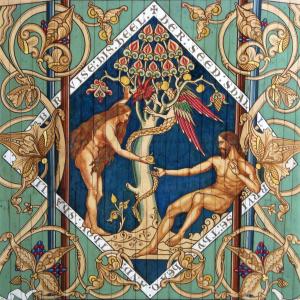
Adamic Struggle
Paul represents what is characteristic of the Adamic struggle. If the interpretation is Adamic, does this include Christians? The answer is no and yes. Yes, in the sense that Christians still struggle in the flesh with its sinful nature and temptation to sin (Gal 5:17). No, in the sense that those who are in Christ are not sold under sin anymore. Most importantly, no, if sin’s enslavement is to be the accepted norm for Christian living. Rather, the norm is to be what we read in Rom 8, not Rom 7.
If enslavement to sin in Rom 7 best characterizes Christians, then I would venture to say that we either have too low a view of our place in Christ, or we are not Spirit-filled believers. This is not to say that Christians will never fall into sinful struggles. It is to say that Rom 7 should not be the last word for Spirit-filled Christians; Rom 8 should be!
Granted, Christians still commit sin if 1 John 1:6–10 is correct; and yet we are not to let sin characterize who we are in Christ, if Gal 5:19–21 and 1 Cor 6:9–11 are correct. Temptations will come our way, but they can be successfully resisted. The battle remains (notice again the parallel text in Gal 5:17), but the “I” is no longer enslaved to sin so that Christians still must cry out, “what I hate, that I do.” If we are led by the Spirit, our words should be instead, “What I love, that I do, even though I might still get tempted to do what I hate.”
Notes
* Notice, for example, the book, Perspectives on Our Struggle with Sin: 3 Views of Romans 7, edited by Terry L. Wilder (Nashville: B&H Academic, 2011), in which different views are presented by Stephen Chester, Grant Osborne, Mark Seifrid, and Chad Brand.
Also, for Channing Crisler’s intertextual approach to the “Divided I” in Romans 7, see my interview with him by clicking here. For surveys of this issue in Romans 7, see Douglas Moo, The Letter to the Romans, 449-56, 467-75. Colin Kruse, Paul’s Letter to the Romans, 314-21. Arland Hultgren, Paul’s Letter to the Romans, 681–91; and Robert Jewett, Romans, 441–45.
Other books on the struggle in Romans 7 include the following:
A. Andrew Das, Solving the Romans Debate (Minneapolis: Fortress, 2007), esp. 204–35.
Brian Dodd, Paul’s Paradigmatic ‘I’ (Sheffield: Sheffield Academic Press, 1999).
Ronald Y. K. Fung, “The Impotence of the Law: Towards a Fresh Understanding of Romans 7:14–25,” in Scripture, Tradition and Interpretation: Essays Presented to Everett F. Harrison, ed. W. W. Gasque and William S. LaSor (Grand Rapids: Eerdmans, 1978), 34–48.
Craig S. Keener, The Mind of the Spirit: Paul’s Approach to Transformed Thinking (Grand Rapids: Baker Academic, 2016), esp. 72–74.
Brian Kidwell, “The Adamic Backdrop of Romans 7,” Criswell Theological Review 11 (2013) 103–120.
Jan Lambrecht, The Wretched “I” and its Liberation: Paul in Romans 7 and 8. LTPM 14 (Grand Rapids: Eerdmans/Leuven: Peeters, 1992), 59–72.
Franz J. Leenhardt, The Epistle to the Romans (London: Lutterworth, 1957), 195–198.
Herman Lichtenberger, Das Ich Adams und das Ich der Menschheit: Studien :um Menschenbild in Römer 7, WUNT 164 (Tubingen: Mohr Siebeck, 2004).
Michael Paul Middendorf, The “I” in the Storm: A Study of Romans 7 (St. Louis: Concordia, 1997).
Will N. Timmins, Romans 7 and Christian Identity. SNTSMS 170 (Cambridge: Cambridge University Press, 2019).
Emma Wasserman, The Death of the Soul in Romans 7: Sin, Death, and the Law in Light of Hellenistic Moral Psychology. WUNT 2.256 (Tübingen: Mohr Siebeck, 2008), 405–06.











 Ad-Free & Subscriber Log-In