

In Acts, Paul is first mentioned as Saul, a persecutor of the Jesus followers (Acts 7:58; 8:1, 3; 9:1, 4). Later on in Acts, his name changes to Paul. In Paul’s letters, he is never called Saul. So how did Saul’s name change to Paul?
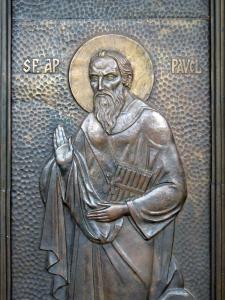
(“The Apostle Paul Icon” via pixabay.com)
Paul always introduces himself in his letters with the honorable Latin-Roman name Paul (in Greek Παῦλος, and in Latin Paul(l)us). It is not clear whether this was his given name at birth. In Acts, he is first known by his Hebrew name, Saul: “Σαῦλος = שָׁאוּל = ‘the requested one.’” (Strack and Billerbeck, ed. A Commentary on the New Testament from the Talmud & Midrash, 2nd ed. 2:790). He claims to be from the tribe of Benjamin (Rom 11:1; Phil 3:5). He seems to be named after King Saul, the famous Benjamite who ruled prior to David in 1 Samuel. Saul is also the name Jesus calls him when appearing before him on the road to Damascus (Acts 9:4; cf. 22:7; 26:14).
Why the Name Change?
In his Latin commentary on Romans, Thomas Aquinas considers that the name Paulus in Hebrew could mean “chosen” or “wonderful” (presumably, Aquinas meant פלא, but I fail to find how this means “chosen”). If kept in Greek, it could mean “at rest”—Aquinas uses quietus presumably for παῦλα. If retained in Latin, Paul means “little” (modicus). Aquinas claims these names suit Paul well, for he can be considered a chosen vessel in Acts 9:15 and his work is marvelous (Sirach 43:1). He is also quiet or restful in contemplation, as in Wisdom 8:16. And he is little in relation to his humility as the “least” of the apostles in 1 Cor 15:9 (Aquinas, Romans, Chap.1 Lect.1.16–17).*
When it comes to the name change, Aquinas, goes beyond a homiletic explanation to bring up three views on how the apostle’s name actually switched from Saul to Paul (Ch.1.Lect.1.18–19). He claims that Jerome holds to the first view, John Chrysostom the second, and Augustine the third, though Aquinas provides no references to their works.
View 1:
He was called Paul due to converting Sergius Paulus, the proconsul of Cyprus (Acts 13:7). The name of his convert was thus conferred to him, similar to the way general Publius Cornelius Scipio took on the name Africanus after conquering Africa (Carthage, north Africa during the Second Punic War). See Jerome De Viris Illustribus 5 (Concerning Illustrious Men).
View 2:
His name was given as an indication of his growth in virtue, similar to how Abram became Abraham (Gen 17) and Simon became Peter (Matt 16).
View 3:
A better explanation, according to Aquinas, is that Paul always had the two names. As was typical, Jews would go by their Hebrew name, but when they were with non-Jews, they would go by their Greek name, similar to Jason and Menelaus in 2 Maccabees 4.
In the apostle’s case, among Jews he was known by his Hebrew name, Saul. When with Romans, he would use Paul. The name switch took place when he started preaching to gentiles (Acts 13:9).
Aquinas may have confused Augustine with Origen. The latter is the one who preferred this view in his commentary on Romans (Preface 10). Even so, Origen also mentions the first view that Aquinas mentions. Paul’s conquest over the Cyprus convert, Sergius Paulus, might be similar to emperors (such as Marcus Aurelius) who take on the name Parthicus, after conquering the Parthians. And it would be similar also to other emperors being named Gothicus (such as Gordian III), after conquering the Goths (Origen, Romans, Preface 9).
More than One Name for Jews
It is clear that Jewish people could have more than one name, as we notice with the above examples from Scripture and Second Temple literature. There is also further ancient evidence for Jewish double names.** According to rabbinic literature, it is common that Jews especially in foreign lands might use a different name among gentiles (e.g., Tosefta Gittin 8.4 [332]; Strack and Billerbeck, 2:820). Likewise, Jews might even be called by three names: the name is parents gave to him, the name others give him, such as a nickname, and the name recorded in the heavenly registrar (Midrash Ecclesiastes 7.1 [31B]).
It is possible that Saul’s parents gave him more than one name at birth. In Acts, his family obtained Roman citizenship (Acts 22:25–29; cf. 16:37–38; 23:27).
Although this is not mentioned in Paul’s letters, Craig Keener suggests that, given the rarity of the name “Paul” among Jews, it is doubtful that this name would have been added to his “Jewish birth name if he were not a Roman citizen” (Keener, Acts 2:2019). Roman males typically had tria nomina, three names (e.g., Gaius Julius Caesar). Perhaps our apostle also had three names, though we only know two of them.
My Reflections
It seems to me that it’s more than a coincidence that Saul happens to be called Paul for the first time when encountering Sergius Paulus. This seems to suggest something about Paul’s name in association with Sergius. Is it possible that Sergius Paulus’s family is connected with Paul’s family’s because the Roman family was the slave owner of Paul’s Jewish family?
This would help explain how Paul’s Jewish parents or grandparents received Roman citizenship—they were freed slaves of Romans, and freed slaves became Roman citizens. But it is admittedly conjecture to suggest that Sergius Paulus’s family enslaved Paul’s.
More interestingly, it seems that Luke wants to portray Paul as essentially fighting a battle with the proconsul’s false prophet, Elymus (Acts 13:6–12). It is only after Paul prevails against the charlatan, when the latter is blinded temporarily, that Sergius Paulus believes (Acts 13:6–12). This would seem to be a worthy example, though spiritual in nature, of adopting a name due to conquest. This episode marks the first use of Paul’s name. Paul would then be Saul’s agnomen, a fourth name, frequently a nickname, given to a person due to a virtue, honorable accomplishment, or something that characterizes him.
Three Names of the Apostle?
If we assume the Roman tria nomina for Paul, we only know two of them. If the encounter in Acts 13 were to count as his agnomen, the apostle’s names might be as follows:
- Praenomen (first name): Saul (either here or as the cognomen)?
- Nomen (family, clan name): ?
- Cognomen (surname/hereditary/specific branch of a family): (see praenomen)
- Agnomen (extra name, nick name): Paul
Another possibility is that the agnomen originates from Paul’s size as “little” in stature. The early description of Paul as a small man in Acts of Paul and Thecla 3 (second c. CE) seems to support this sense:
“And he saw Paul coming, a man small in size, bald-headed, bandy-legged, well-built, with eyebrows meeting, rather long-nosed, full of grace.” (Translated by Alexander Walker. From Ante-Nicene Fathers, Vol. 8. 1886.) rev. ed. in New Advent by Kevin Knight.
However, I suspect that the Acts of Paul and Thecla may have derived its description of Paul based on “Paul” meaning “little” in Latin. Even if, historically speaking, Saul were a short man, this does not necessitate that his name was due to his size.
Another option is to recognize that the name Paul seems to be a somewhat common cognomen, and the cognomen is frequently used in ancient letters. This suggests that the apostle’s cognomen is Paul. Also, if Paul’s parents were indeed Roman citizens, it stands to reason that he would need to have a Roman name given to him at birth. In that case, “Saul” might be an acquired name that Paul as a Diaspora Jew earned when studying in Jerusalem.***
With this alternative intact, the encounter in Acts 13:6–12 does not actually claim that Saul received the name Paul via this encounter. He may have had this name already. As an apostle to gentiles, sometime during Saul’s early evangelism to the nations, the name Paul started to take precedence over Saul. What better way to transition from one name to the other than for Luke to begin using the name Paul when our apostle converted a proconsul with the same name? Along this line, the apostle’s names might be as follows:
- Praenomen: ?
- Nomen: ?
- Cognomen: Paul
- Agnomen: Saul
Whichever theory seems best, there is definite truth to the claim that the name Paul would be more acceptable for a gentile audience than the Hebrew name Saul. This is at least one good reason why Saul’s name changed to Paul.
Incidentally, the Greek word for Saul, σαῦλος, seems to be adjectival for waddling, straddling, or prancing about (such as with tortoises or horses). When used of humans, it seems to mean “of the loose, wanton gait of courtesans or Bacchantes” (Anacreon 32, 55, 168; 6th c. BCE; Liddell/Scott/Jones Greek-English Lexicon, 1586; also, Franco Montanari, Brill Dictionary of Ancient Greek, s.v.). If this was the sense understood in the first century, this might be another practical reason for Paul not wanting to go by “Saul” when among Greek speakers!
Notes
* Ambrosiaster likewise provides a homiletic explanation, this one on how the apostle’s name changed from Saul to Paul, presumably interpreting the Greek word σάλος for Saul: “Saul means restlessness, or trial, so when he came to faith in Christ he called himself Paul, in other words, rest, because our faith is peace.” (Ambrosiaster, Commentaries on Romans and 1-2 Corinthians, ed. Thomas C. Oden and Gerald L. Bray, trans. Downers Grove, IL: IVP Academic, 2009:2).
** See references in G.H.R. Horsley, “The Use of a Double Name,” NewDocs 1 (1981): 89–96; and to Maccabean literature and Josephus: Adolf Deissmann, Bible Studies (Edinburgh: T & T Clark, 1901), 313–314.
In Harry Leon’s study of Roman catacombs, Roman Jews would be more apt to have single or double names than three. If two names, these would be the gens (nomen) and cognomen (Harry J. Leon, The Jews of Ancient Rome; Philadelphia: The Jewish Publication Society of America, 1960:112–13). See recently, Adolphus Ekedimma Amaefule, “Paul and His Double Name: Relevance to the African Christian Pastor and Theologian Today,” Biblical Theological Bulletin 54 (2024): 38–49 (39–45).
*** For further data, viewpoints, and information, see Rainer Riesner, Paul’s Early Period (Grand Rapids: Eerdmans, 1998), 143–46; E. Randolph Richard, “Pauline Prescripts and Greco-Roman Epistolary Conventions,” in Andrew W. Pitts and Stanley E. Porter, eds., Christian Origins and Greco-Roman Culture (Leiden: Brill, 2013), 497–514 (506–507); Craig S. Keener, Acts: A Commentary (Grand Rapids: Baker Academic, 2013), 2:2017–2022; Colin J. Hemer, “The Name of Paul,” Tyndale Bulletin 36 (1985): 179–183; Julien M. Ogereau, 1 Thessalonians. Epigraphical Commentary on the New Testament, WUNT 545 (Tubingen: Mohr-Siebeck, 2025), 35-38; Cilliers Breytenbach, “What’s in the Name ‘Paul’? On Early Christian Inscriptions from Lycaonia,” in Paulus – Werk und Wirkung: Festschrift für Andreas Lindemann zum 70. Geburtstag, ed. P.-G. Klumbies and D. S. du Toit (Tübingen: Mohr Siebeck, 2013), 463-77; Martin Hengel, The Pre-Christian Paul (London: SCM, 1991), 105–106.
















 Ad-Free & Subscriber Log-In