

During my first full day in Tashkent, Uzbekistan, we visited the city market. After being duly impressed by the diversity of products, stunning tomatoes, and the ovens where bread was baked both sideways and upside-down, it was time for lunch. Though the food hall was large, it appeared as if every stall sold the same food: kebabs cooked over coals, a type of spaghetti with horse meat, and different types of sausage. Roaming vendors offered a few other options. I opted for two beef kebabs with a side of onions, and sat with hundreds of my newest Uzbeki friends.
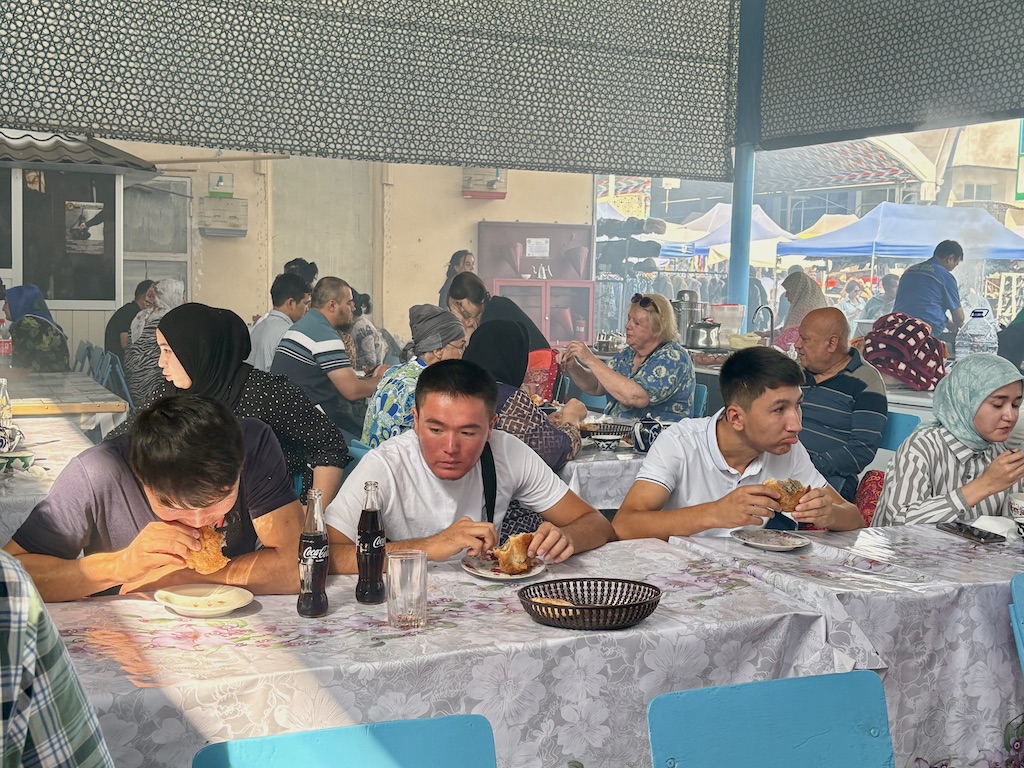
As I ate, I observed three men, sitting at the table beside me. When they finished eating, they cupped the palms of their hands and placed them in front of their faces. In unison, they made an outward circular motion with their hands as if washing their faces. Once their hands went down, they stood and walked away. I had never seen this particular gesture before, but it was clearly a gesture of gratitude. I asked our guide later that day, and he confirmed my suspicion, it was an action to express thanks to God. As a Catholic, this reminded me of the prayers offered at meal times, in particular the one after meals which is less common than the one before meals: “We give you thanks, O Lord, for these and all your benefits, who lives and reigns for ever and ever, amen. May the souls of the faithful departed, through the mercy of God, rest in peace, amen.”
A few days later while visiting the city of Khiva, an imam chanted from the Koran while we visited the tomb of the thirteenth-century Sufi saint Pahlavan Mahmud. When the chanting concluded, I saw the imam perform the same gesture of gratitude. As a Catholic, it reminded me of the response from the faithful at liturgy after the reading of Scripture, “thanks be to God.”
This experience pointed to the universal need imprinted in every heart to give thanks to God. Every human person recognizes that he or she has received unmerited goodness, starting with life itself. We recognize that all things are a gift from above.
Saint James writes in Scripture, “all good giving and every perfect gift is from above, coming down from the Father of lights, with whom there is no alteration or shadow caused by change.” Every day, every moment, is a moment to express gratitude.
Every time the Eucharist is celebrated, the priest and the faithful have an exchange of words during the preface. “The Lord be with you… life up your hearts… let us give thanks to the Lord our God.” The response to the final words from the priest is, “it is right and just.”
We give thanks to God always because it is the right thing to do. It is not the nice or polite thing to do, but we do it out of an awareness that we are unable to repay him. We owe him gratitude out of justice, in return for what He has given to us.
Gratitude expands our ability to love because it allows us to recognize the goodness we have received undeservedly.
Observing these gestures of gratitude in a country that is predominantly Muslim (estimates are between 93% and 97% of the population), was a remarkable reminder of the shared religious sense and need to give thanks that binds all of humanity together. We all bear the fingerprints of the one God who has created us who never tires of calling us to Himself.
Picture is mine, all rights reserved.








 Ad-Free & Subscriber Log-In